
A solid SEO strategy is all about connecting you with customers who are already out there, actively searching for what you sell. It’s a way to turn your website from a simple online brochure into a machine that consistently brings in new leads. Instead of just shouting into the void with expensive ads, SEO lets you show up as the perfect answer, right when someone types their problem into Google. It's an approach that builds real, long-term growth that keeps paying you back long after you’ve made the initial investment.
Picture your ideal customer standing on a busy high street. They need exactly what you offer. Paid advertising is a bit like hiring someone to stand on a box and shout your name over and over, hoping that one person hears you through all the noise. It can work, but it costs a fortune, and the second you stop paying, the shouting stops.
SEO is completely different. Think of it as securing the best shopfront on that high street—right on the corner, with big, bright windows and clear signage that draws people in. Customers find you naturally because you’re in the right place at precisely the right time. A smart SEO strategy works to improve your digital real estate, making you unmissable to a steady stream of people who are already keen on what you do.
This visibility drives organic traffic—the kind you don't have to pay for with every single click. For small businesses, this is huge. It’s all about creating a reliable pipeline of interest by generating organic views without paid ads, giving you a cost-effective way to grow your audience.
For Aussie small businesses, the opportunity here is massive. A recent survey of 700 Australian small and medium enterprises (SMEs) revealed that only 36% of small businesses are actually using SEO. That means a whopping 64% of SME owners are either not investing in SEO at all or simply don't realise how powerful it is for getting seen and winning new customers. Given that small businesses make up about 97% of all businesses in Australia, this gap is a golden opportunity.
You can get the full story in the full SEO for small businesses report.
This low adoption rate means that even a modest effort in SEO can put you leagues ahead of the competition. While others are ignoring this channel, you can be building a serious advantage.
SEO isn’t just another marketing line item; it's a core business strategy. It builds a digital asset—your website—that actually grows in value over time, constantly attracting new customers and cementing your brand as a credible authority in your field.
So, how do you build this digital asset? A proper SEO service is built on a few key pillars that all work together. Getting your head around these components demystifies the whole process and shows how each piece of the puzzle contributes to your online growth.
Here’s a quick rundown of the key pillars of SEO that work together to boost your online presence.
Table: Core Components of a Small Business SEO Service
| SEO Component | What It Does for Your Business |
|---|---|
| Technical SEO | Makes sure your website is fast, secure, and easy for search engines like Google to understand. It’s the solid foundation everything else is built on. |
| On-Page SEO | Optimises your website’s content and structure to clearly signal what you offer to both your customers and the search engines. |
| Content Creation | Involves creating genuinely helpful blog posts, guides, and pages that answer your customers’ questions and attract the right kind of search traffic. |
| Link Building | Earns 'votes of confidence' from other respected websites, which tells Google your site is authoritative and trustworthy. |
| Local SEO | Focuses on getting your business seen in local searches, like "plumber in Adelaide," driving foot traffic to your door and calls to your phone. |
By focusing on each of these areas, a complete SEO plan does more than just make a few tweaks here and there. It builds a durable, powerful online presence that fuels real, sustainable growth for your business. In today's world, it's no longer a 'nice-to-have'—it’s an absolute essential.
Search Engine Optimisation can feel like a bit of a dark art, but at its core, it’s really built on four solid pillars. When a professional SEO service for small business puts together a strategy, they're essentially balancing and building on these core areas. Understanding them helps to demystify the process and shows you exactly where your investment is going.
Think of your website as a house you're building. Each pillar is a crucial part of the construction, and if you neglect one, the whole structure can get pretty wobbly. For your business to stand tall in the search results, you need all four pillars working together.
This infographic breaks down how strengthening these pillars leads to the things that matter most: more customers, more traffic, and sustainable growth for your business.
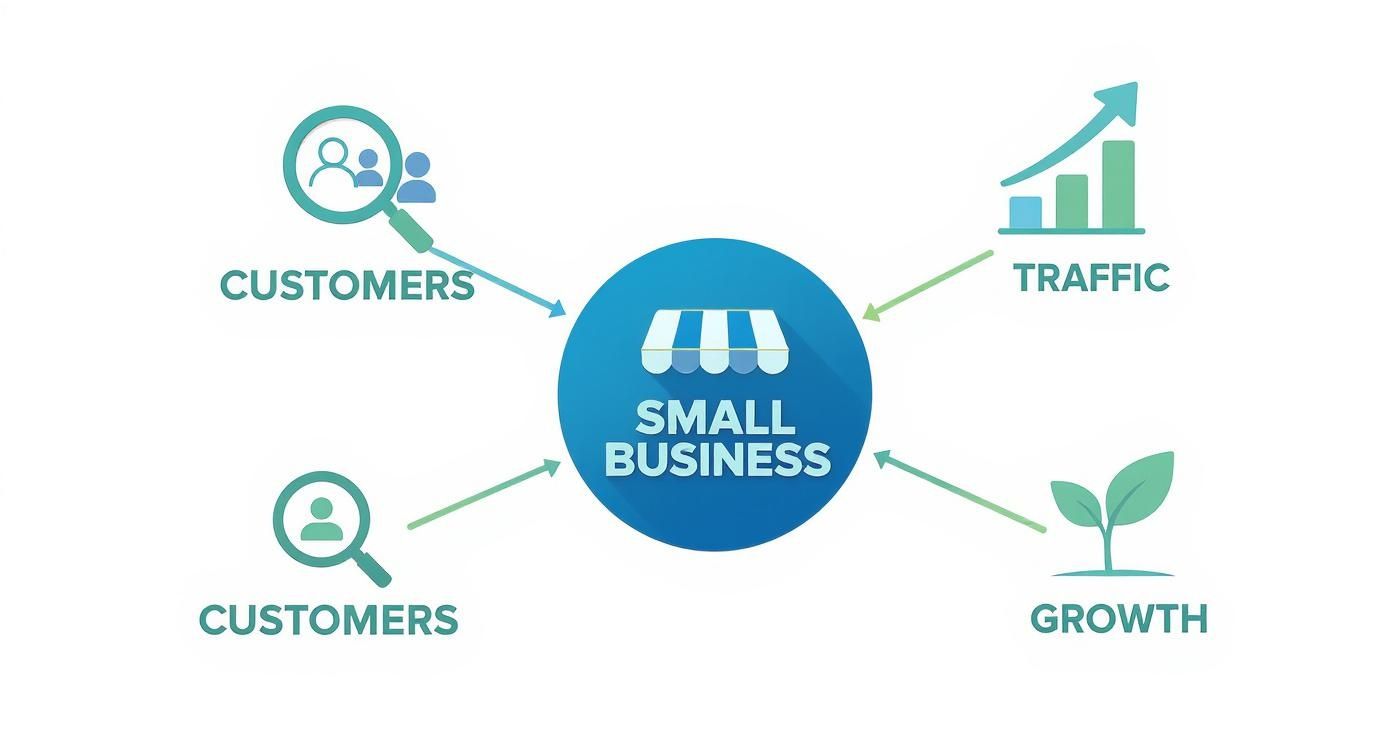
As you can see, the end game is always business growth, which is fuelled directly by getting more of the right people to your website.
This is the foundation of your house. Technical SEO is all about making sure your website is built in a way that search engines can easily crawl, understand, and index. If Google’s little robot crawlers can’t make sense of your site, even the most brilliant content in the world won’t get a look-in.
Imagine you’ve set up a beautiful shop, but the doors are locked and the windows are blacked out. That’s a website with poor technical SEO.
Key jobs for this pillar include:
Once the foundation is solid, it's time to furnish the rooms. On-Page SEO involves optimising the individual pages of your website to signal what they're all about for specific search terms. This is where you tell Google, "Hey, this page is about this specific thing."
For a local bakery in Perth, this means having a page that’s clearly focused on "sourdough bread Perth" or "custom birthday cakes Perth." It’s about using the right keywords in your titles, headings, and throughout your text, so when someone searches for those terms, Google knows your page is the perfect match. A great place to start is by following some core SEO optimization best practices to set your pages up for success right from the get-go.
Content is the valuable stuff you fill your house with, and link building is the reputation you build in the neighbourhood. High-quality content—like genuinely helpful blog posts, guides, or videos—answers your customers' questions and establishes you as an expert in your field.
For a sparkie in Brisbane, this could be a blog post titled "5 Signs You Need a Switchboard Upgrade." It attracts potential customers who are looking for answers and shows you know your stuff.
Link building, also known as off-page SEO, is the process of earning links from other reputable websites back to yours. Every link acts like a vote of confidence, telling Google that your site is a credible source of information. The more high-quality "votes" you have, the more authority your site builds, and the better your rankings become.
For most small Australian businesses, this pillar is an absolute game-changer. Local SEO focuses on making your business pop up in searches that are tied to a specific location. It’s the difference between ranking for "plumber" and ranking for "plumber in Ballarat."
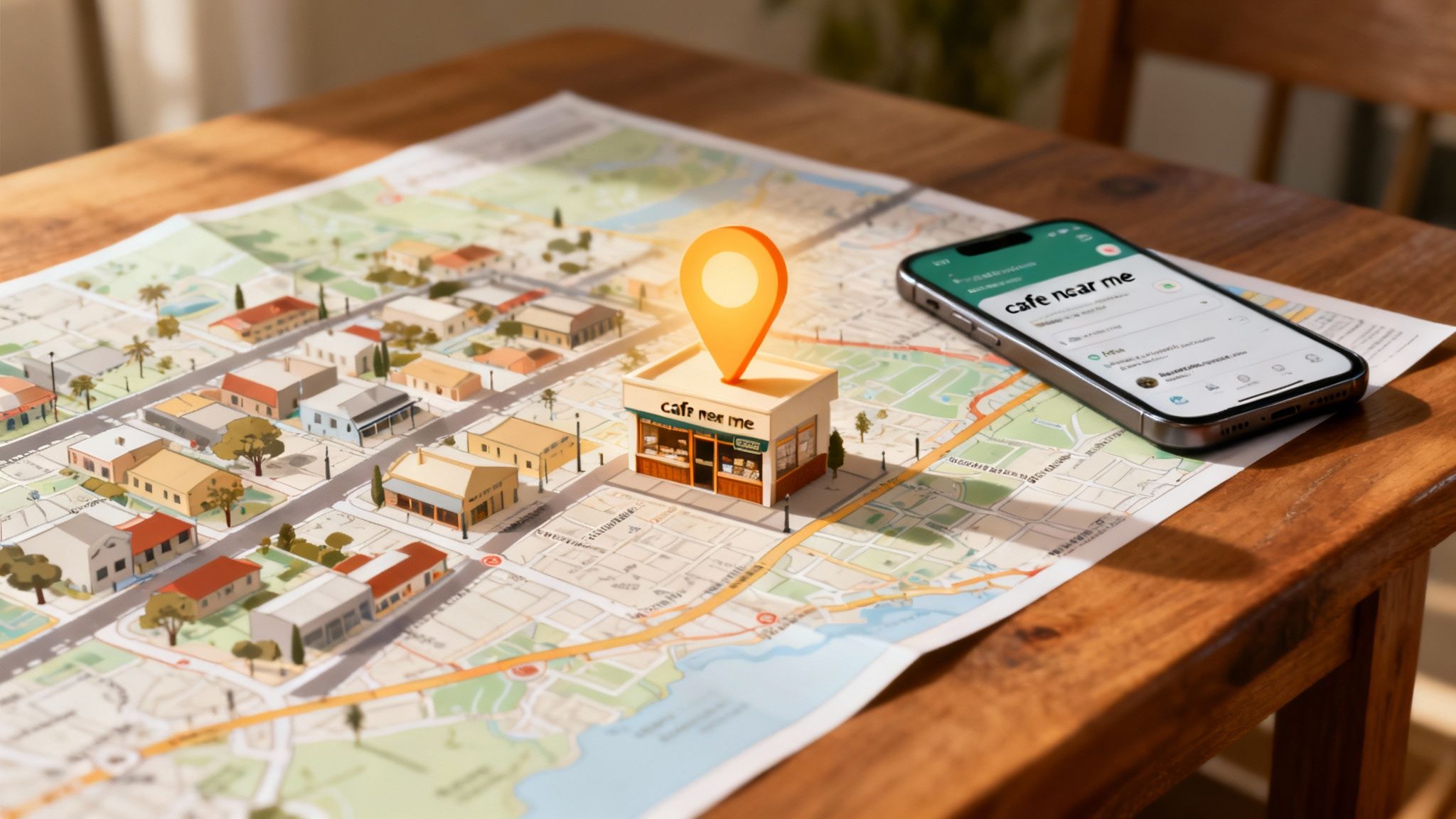
Local SEO is what turns online searches into real-world customers. When someone searches "cafe near me" on their phone, a strong local SEO presence ensures your business appears in the map pack, driving immediate foot traffic and phone calls.
This pillar involves optimising your Google Business Profile, actively gathering customer reviews, and making sure your business name, address, and phone number are consistent right across the web. It's the key to winning your local market.
For most small businesses, chasing a global audience is a waste of time and money. The real battle is won right here on your home turf—in your suburb, your city, your service area. This is where local SEO stops being just another part of your strategy and becomes the most powerful part of it. It’s the tool that connects you with customers who are physically nearby and actively looking to buy something right now.
Think about the last time you pulled out your phone and searched for "cafe near me" or "electrician in Parramatta." These aren't casual, window-shopping searches. They're what we call high-intent searches, and they signal an immediate need. When your business pops up at the top of those results, you’re not just getting a website click; you’re getting a potential customer who is ready to walk through your door or pick up the phone.
You really can't overstate the power of this immediate connection. In Australia, local SEO is a massive driver of real, tangible business. It's not just theory. One analysis found that local search drives about 28% of total traffic for small businesses, and this traffic converts at roughly three times the rate of general organic traffic. The numbers don't lie: 46% of all Google searches have local intent, and an incredible 76% of location-based mobile searches lead to a store visit within 24 hours. You can dive deeper into these local search trends in Australia on Netstripes.
The absolute cornerstone of any local seo service for a small business is the Google Business Profile (GBP). Honestly, you should think of your GBP listing as your digital shopfront. It's often the very first interaction a potential customer has with your brand, showing up in both Google Search and on Google Maps.
An unmanaged or incomplete profile is like having a shop with a broken sign and boarded-up windows—no one's going to stop. A fully optimised profile, on the other hand, is welcoming and packed with useful information, giving a customer everything they need to choose you over the competition down the street.
An optimised Google Business Profile isn't just a listing; it's your most valuable local marketing asset. It builds trust, provides social proof through reviews, and directly funnels high-intent customers to your phone, your website, and your physical location.
Optimising your GBP involves a lot more than just plugging in your address. To truly stand out in local search, your profile needs to be rich with information and actively managed. Any comprehensive approach to SEO for small business will always prioritise these critical elements:
Beyond your Google profile, local SEO relies heavily on trust signals. Two of the most important ones are customer reviews and consistent business information scattered across the web.
Customer reviews are the modern-day word-of-mouth, plain and simple. A steady stream of positive reviews provides powerful social proof that builds your credibility and directly influences whether someone decides to buy from you. Just as important is responding to all reviews—both good and bad. It shows you're engaged and that you actually care about customer feedback.
Finally, you need to ensure your business's NAP information is identical across dozens of online directories (think Yelp, TrueLocal, and industry-specific sites). This creates a consistent digital footprint. In the eyes of search engines, this consistency reinforces your location and legitimacy, strengthening your authority and making it that much easier for local customers to find you when it matters most.
For any small business owner, figuring out the budget is one of the biggest hurdles before jumping into a new marketing plan. When it comes to an seo service for small business, it nearly always boils down to two big questions: "How much is this going to set me back?" and "When will I actually see a result?"
Answering these means setting some clear expectations right from the start. Unlike paid ads that can switch on traffic almost instantly, SEO is an investment in building a long-term asset for your business. Think of it like planting a garden; you've got to prepare the soil, plant the seeds, and nurture them consistently before you get to enjoy the harvest.
It’s the same principle here. You’re building authority and trust with search engines, and that just doesn't happen overnight. Any agency promising you the #1 spot on Google in 30 days is selling you snake oil. A realistic, ethical approach is all about steady, sustainable growth.
In Australia, SEO services are usually sold through a few common pricing structures. Getting your head around these models will help you find a plan that fits your budget and what you’re trying to achieve. To get a feel for what’s out there, it’s worth looking at different pricing structures for web services, as they often share similar DNA with SEO packages.
The three models you'll bump into most often are:
Here's a simple comparison of what different investment levels typically get you.
| Monthly Budget (AUD) | Common Services Included | Typical Time to See Initial Results |
|---|---|---|
| $750 – $1,500 | Foundational on-page SEO, local SEO basics (GMB), basic keyword tracking, monthly reporting. | 6-9 months |
| $1,500 – $3,000 | All of the above, plus regular content creation (1-2 blogs/month), basic link building, more in-depth technical fixes. | 4-6 months |
| $3,000 – $5,000+ | Comprehensive SEO strategy, advanced technical SEO, high-quality content creation, proactive link building outreach, competitor analysis. | 3-5 months |
This table gives you a rough guide. Remember, more competitive industries often need a bigger push to get moving.
For most small businesses, a monthly retainer makes the most sense because it allows for the consistent, long-term effort that good SEO demands. A 'set it and forget it' approach simply doesn't work.
Patience is a virtue in the world of SEO. While you might spot some small improvements early on, you really need to be prepared for a longer-term strategy. The actual timeline depends on a few things, like how competitive your industry is, your website’s history, and how aggressively you're tackling your SEO.
Here’s a general timeline of what to expect:
Picking the right partner to handle your SEO is easily one of the most important marketing decisions you’ll make. This isn't just about hiring someone to tinker with your website; it's about finding a team that truly gets your business goals and can turn them into a clear, effective online strategy.
A great agency becomes an extension of your own team. A poor choice? Well, that can burn through your time and money with very little to show for it. You need to look past the flashy sales pitches and zero in on transparency, proven results, and straight-up communication. The right partner will demystify the process, not hide behind a wall of technical jargon.
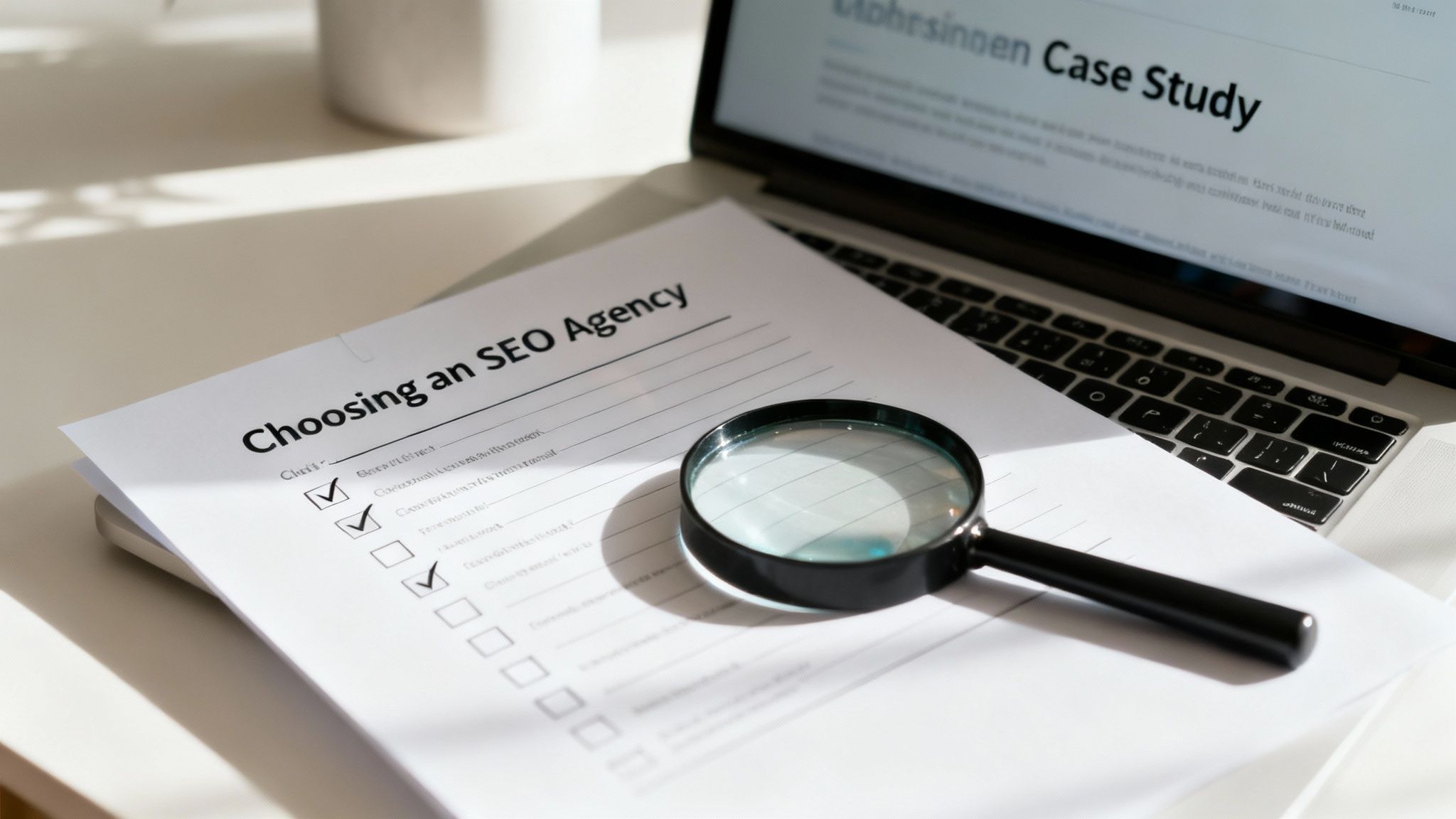
Before you even think about signing a contract, you need to ask the right questions. This isn’t an interrogation—it’s a fact-finding mission to make sure their approach actually lines up with what you need. A transparent, confident agency will welcome these questions with open arms.
Walk into that conversation prepared with this checklist:
Digging into these topics will help you sort through the noise and find the right fit among the many SEO companies for small business out there.
Just as important as knowing what to look for is knowing what to run away from. Some providers still use outdated or downright dodgy tactics that can get your website slapped with a penalty from Google.
Be extremely wary of any agency that offers guarantees. No one can guarantee a #1 ranking on Google. True SEO is about continuous improvement and adapting to algorithm changes, not making impossible promises.
Keep a sharp eye out for these warning signs:
Choosing the right SEO service for your small business comes down to finding a transparent partner who is genuinely committed to your growth. Take your time, do your homework, and trust your gut.
Jumping into the world of SEO can feel like learning a new language, especially when you're already flat out running your business. Let's tackle some of the most common questions we hear from Australian small business owners, with clear, straight-up answers to help you figure out the best path forward.
You absolutely can, and many business owners do. Getting your hands dirty with the basics is a fantastic start. You can make a surprising amount of headway by properly setting up your Google Business Profile, making sure your website works beautifully on mobile, and writing useful content that speaks directly to your customers' needs.
But there comes a point where DIY hits a ceiling. As your business grows, the time it takes and the technical details involved can become a real headache. A professional SEO service for a small business is the logical next step when you need to dig deeper with technical audits, build the kind of backlinks that actually move the needle, and stay ahead of Google's constant algorithm updates. It frees you up to do what you do best—run the business.
Look, SEO is a long game. It's a marathon, not a sprint. While you might see some early flickers of life in as little as four to six weeks, especially with local SEO tweaks, you should be prepared to wait four to six months to see significant, lasting improvements in your traffic and rankings.
Be wary of anyone promising you the top spot on Google overnight. Real, sustainable SEO is all about building genuine authority and trust with search engines over time. The results are powerful and they stick around, but they demand patience.
The exact timing always depends on a few things: how competitive your industry is, the current state of your website, and how consistently the strategy is applied.
That's a bit like asking if a hammer is better than a screwdriver. They're different tools for different jobs, and they work best together. Paid ads are brilliant for getting immediate traffic. Got a new offer or a big sale? PPC gets you in front of people right now. The catch? The moment you stop paying, you disappear.
SEO, on the other hand, is about building a long-term asset for your business. It creates a steady stream of organic traffic that keeps coming, often delivering a much higher return on your investment over the long haul. Think of it this way: paid ads are like renting your spot, while good SEO is like buying the property and building equity.
Choosing between an agency and a freelancer really comes down to what you need. A freelancer can be a great, cost-effective option for specific, one-off tasks. Need a few blog posts written or a quick website audit? A specialist freelancer could be perfect.
An SEO agency, however, brings a whole team to the table. You get specialists in all the key areas—technical SEO, content strategy, link building, local search, and analytics—all working together. For a comprehensive, long-term strategy where all the pieces need to fit together perfectly, an agency usually offers more depth, more resources, and a more unified approach.
Ready to turn your website into a reliable source of leads? The expert team at Virtual Ad Agency builds custom SEO strategies that deliver real, measurable growth for Australian businesses. Start your journey to the top of Google today.

 previous