
Local SEO is all about fine-tuning your online presence so you show up in front of people searching for businesses like yours, right in your own backyard. Think of it less as just another marketing job and more like a direct pipeline to customers who are actively looking to buy what you sell.
Forget casting a wide, expensive net with national marketing campaigns. For most brick-and-mortar shops and service-area businesses, the real action—the customers with their wallets out—is happening much closer to home.
Local search connects you with people at the exact moment they need you. This isn't about chasing abstract metrics; it's about turning online visibility into actual foot traffic and phone calls, making it one of the most efficient ways to get new customers.
The mindset of someone doing a local search is completely different from someone doing a general one. Let's break down the difference, because this is where the money is.
| Attribute | Local Search (e.g., 'plumber near Adelaide') | General Search (e.g., 'how to fix a leaky tap') |
|---|---|---|
| User Intent | Transactional & immediate. The user has a problem and needs a local professional now. | Informational & educational. The user is in research or DIY mode, not necessarily ready to buy. |
| Conversion | High. These searches often lead directly to a phone call, store visit, or service booking. | Low. The user is looking for information or instructions, not a service provider at this stage. |
| Business Value | Generates immediate, high-quality leads that are geographically relevant and ready to convert. | Builds top-of-funnel brand awareness but doesn't typically lead to an immediate sale. |
Someone searching for an "emergency plumber Adelaide" has a burst pipe and is ready to hire the first qualified person they find. The person searching "how to fix a leaky tap" is just in research mode. That immediacy is the secret weapon of local SEO.
This is a massive opportunity. The data shows just how many people are looking locally and, more importantly, how many of them are ready to make a purchase.
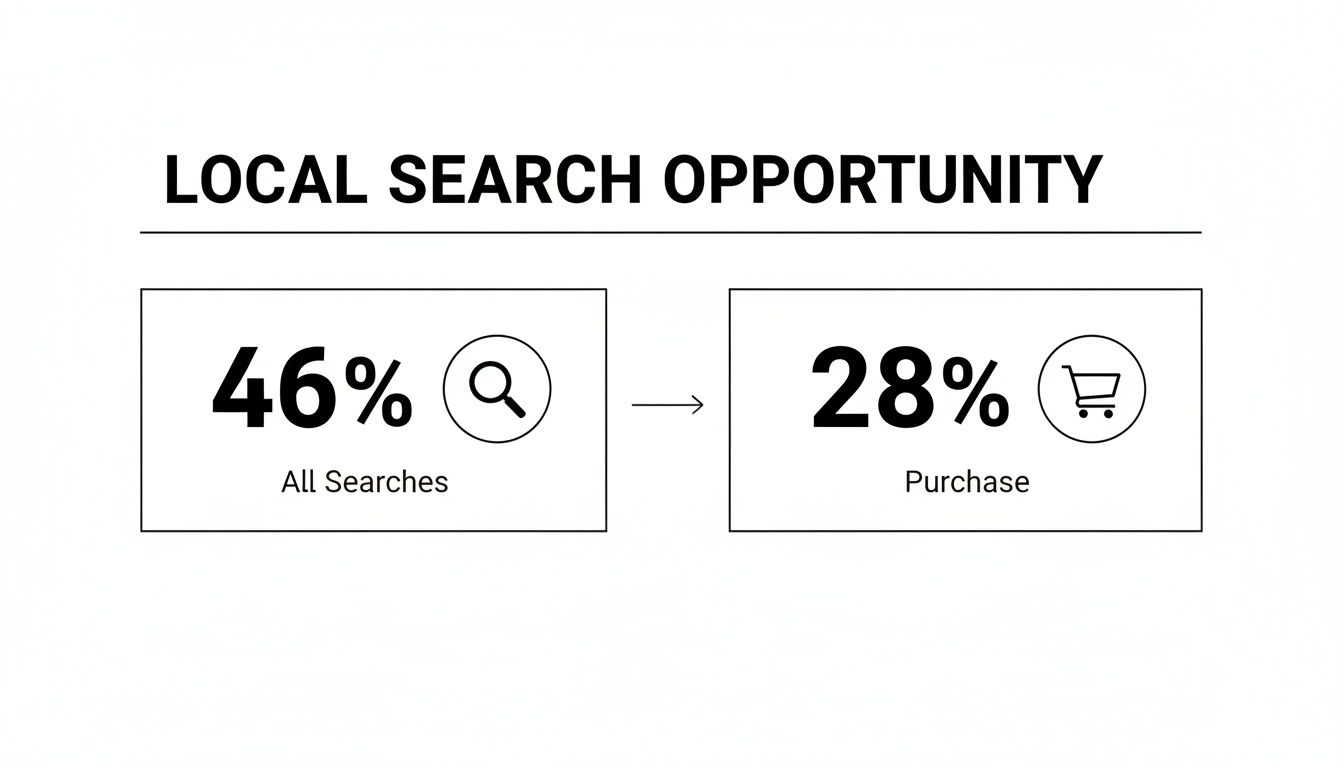
As you can see, local search isn't just about getting seen; it's about getting seen by people who are ready to become customers.
The numbers in Australia really drive this home. A staggering 46% of all Google searches have local intent. That's nearly half of all searches.
But here’s the kicker: an incredible 28% of those local searches result in an actual purchase. That conversion rate blows most other marketing channels out of the water, making it an incredibly efficient way to spend your marketing dollars. You can get a broader perspective on its impact by exploring our related guide on how SEO helps small businesses.
This guide is your playbook for turning those local searchers into your loyal customers. We’re getting straight to the point with actionable steps to make your business the obvious choice in your local area.
Local SEO is no longer optional. It's the most direct path to connecting with customers who have already decided to buy and are simply looking for the best local option.
We’ve broken this guide down into the essential pillars of a winning local SEO strategy. Each section builds on the last, giving you a clear roadmap from the foundational setup to more advanced tactics for growth.
Here’s a look at what we'll cover:
By focusing on these core areas, you'll build a resilient local presence that consistently brings in new business.
Let’s be honest, your Google Business Profile (GBP) is your new digital shopfront. For many local businesses, it’s the very first interaction a potential customer has with you—long before they even think about clicking through to your website. A neglected profile is like having a ‘Closed’ sign hanging on the door, but a fully optimised one? That’s a powerful magnet, pulling in high-intent local customers who are ready to buy.
This is your single most important asset in the world of local SEO for businesses. An analysis of two million Google Business Profiles found that businesses ranking in the top local spots have profiles that are, on average, 75% more complete than those languishing on lower pages. And completeness isn't just about ticking boxes; it's about being strategic with every single field.
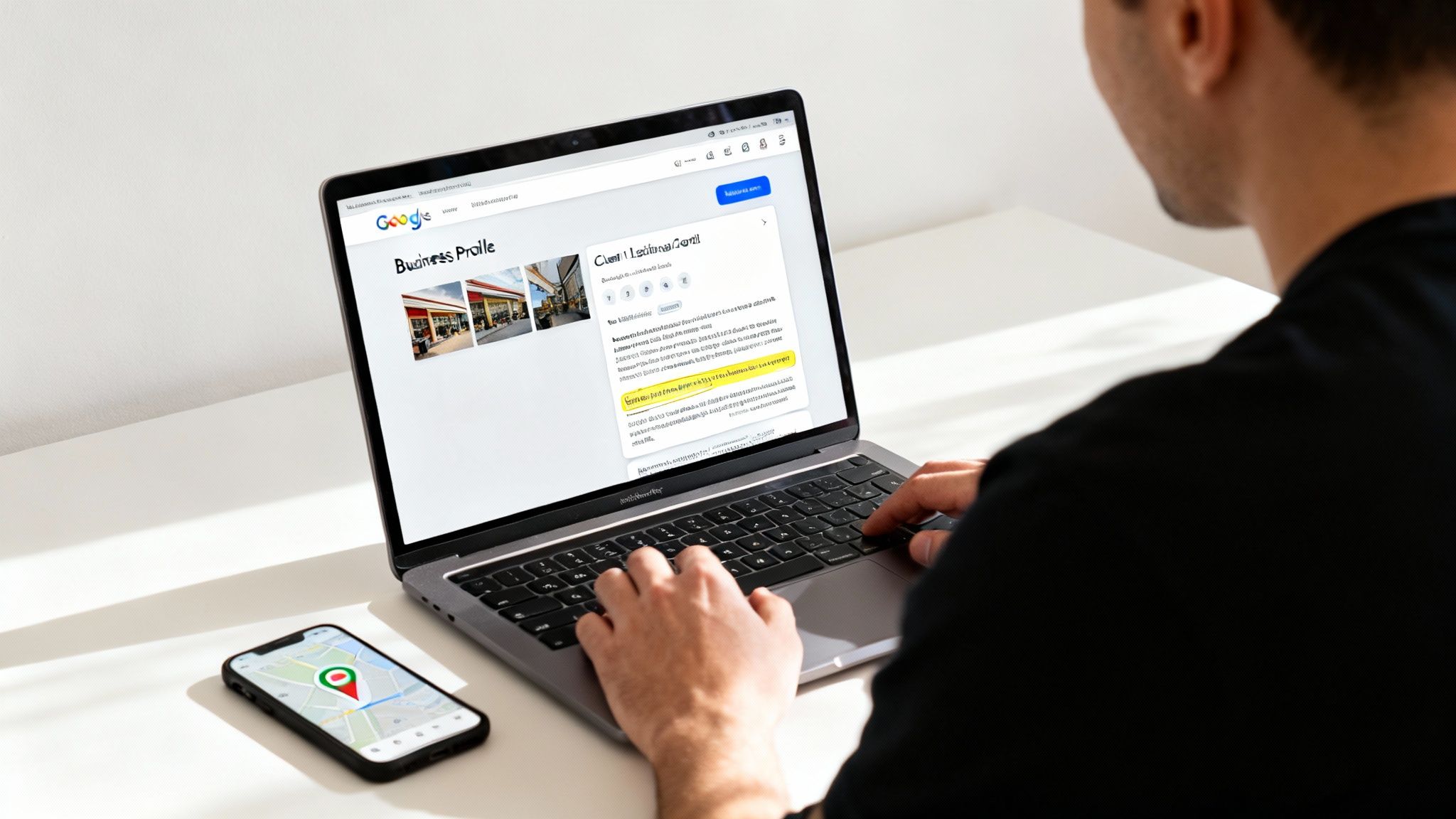
Choosing the right primary category is probably the most critical decision you'll make for your GBP. This one choice tells Google what you're all about and heavily influences the searches you show up for.
Take a law firm, for example. Just listing "Lawyer" is a huge missed opportunity. A much better primary category would be "Family Law Attorney" if that's their main game. This immediately qualifies them for more specific, high-intent searches from people who know exactly what they need.
From there, it's about adding relevant secondary categories. That same family law firm might also offer services that fall under "Estate Planning Attorney" or "Divorce Lawyer." You need to select every category that accurately reflects a part of your business. And don't stop there. Dive into the 'Services' feature to list out every single specific thing you do, adding short, keyword-rich descriptions for each one.
You get 750 characters for your business description. Think of it as your elevator pitch to every potential customer in your local area. This is your chance to tell them who you are, what you do, and why you’re the best choice around.
Don't just rattle off a list of services. Weave your primary local keywords in naturally. Instead of a bland "We offer plumbing, gas fitting, and drain cleaning," try something with a bit more personality: "For over 20 years, Adelaide homeowners have trusted us for reliable emergency plumbing and expert gas fitting. We're your local solution for everything from blocked drains to hot water system installations."
This approach does two things really well:
Attributes are those little details that can make a huge difference in a customer's final decision. These are pre-set tags you can add to your profile to highlight specific features of your business.
Think about what makes you unique. Are you a "Women-led" business? Do you offer "Online appointments"? Is your shop "Wheelchair-accessible"? These attributes can appear prominently in your profile and make you the obvious choice for someone with specific needs or values. Taking a few minutes to select every relevant attribute helps you stand out from competitors who've overlooked this simple but effective feature.
A fully fleshed-out GBP isn't just an SEO task; it's a customer service tool. You're answering questions and removing friction before a potential customer even has to ask, making their decision to choose you that much easier.
A static profile is a missed opportunity. Google rewards active profiles, and two of the best ways to show you’re engaged are through GBP Posts and the Questions & Answers (Q&A) feature. Mastering these requires a proactive approach, which is a key part of any effective local SEO optimisation services.
GBP Posts: Treat these like mini-ads or social media updates that sit directly on your search listing.
These posts usually expire after seven days (unless they're for an event), so try to get at least one new post up each week to keep your profile looking fresh and active.
Proactive Q&A: The Q&A section is so often underutilised. Don't wait for customers to start asking things; seed it yourself with your own FAQs. Think about the most common questions you get over the phone or by email, then post them with clear, helpful answers.
Here are a few easy ones to pre-load:
By managing the Q&A section yourself, you control the narrative, handle potential objections upfront, and provide immediate value to searchers. This transforms your profile from a simple listing into a dynamic, interactive tool that actually drives business.
Once your Google Business Profile is firing on all cylinders, it's time to turn your attention to your website. Think of your GBP as the digital shopfront – it gets people to the door. But your website is the main showroom, and it needs to reinforce all the same local signals you’ve just established.
This is where you tell Google, and your customers, exactly what you do and where you do it, using the specific language they use to search. A solid on-page and local keyword strategy is the absolute bedrock of a successful local SEO campaign.
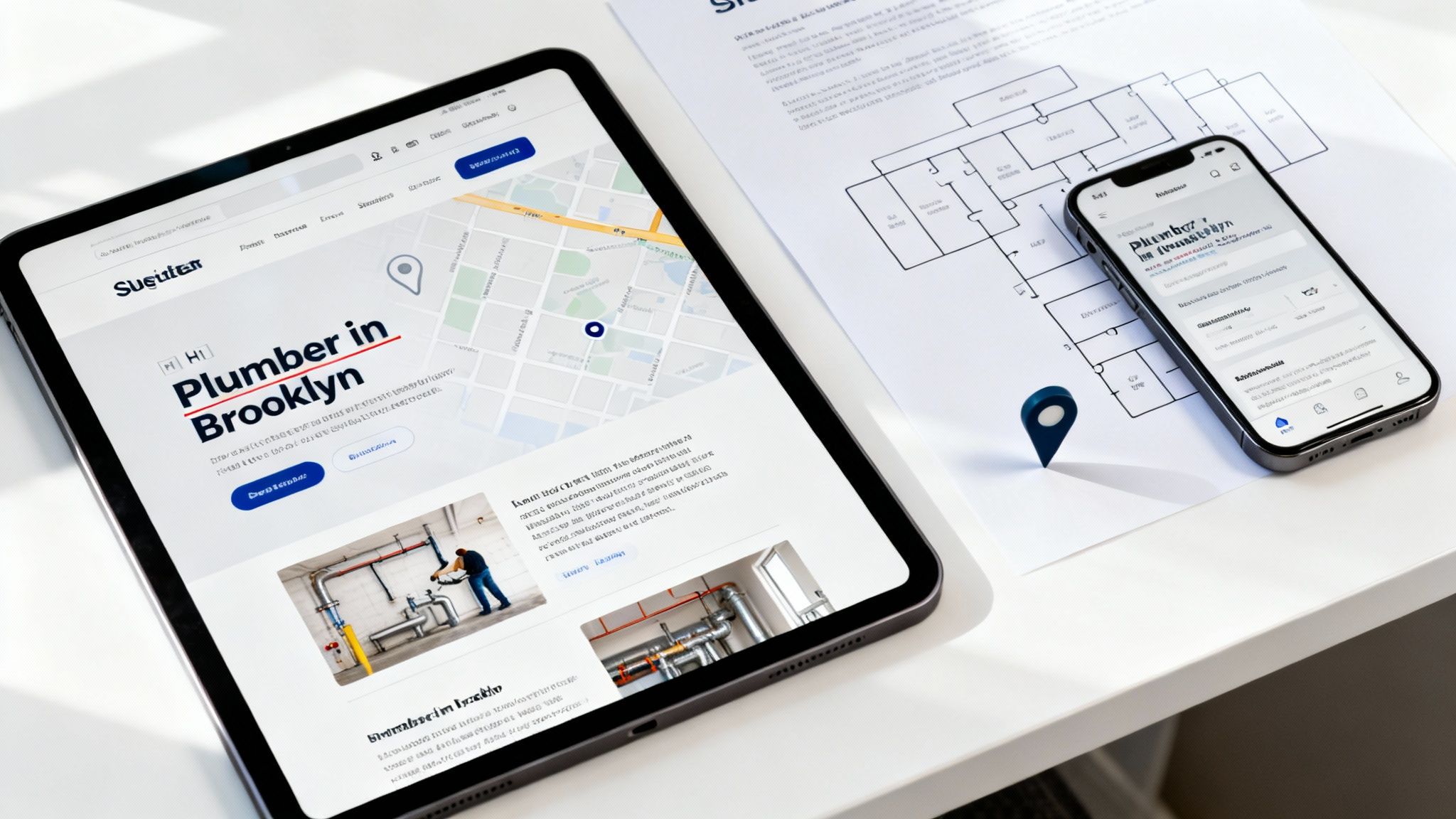
Good local keyword research isn't about finding obscure, clever terms. It's about getting inside your customer's head and understanding their intent. You’re trying to catch people who are past the research phase and are actively looking for a local solution right now. For a deeper dive, it's worth mastering local keyword research.
The most valuable local keywords almost always follow a simple, powerful formula: [Service] + [Location]. This format perfectly matches what someone types into Google when they need help.
Put yourself in their shoes. A homeowner in an Adelaide suburb with a burst pipe isn't searching for "hydronic engineering solutions." They're frantically typing "emergency plumber Norwood" or "24 hour plumber Unley" into their phone. Your job is to find and target these real-world, intent-heavy phrases.
Start by brainstorming your core services, then pair them with every single suburb, city, or region you cover.
Just like that, you have a foundational list of keywords to build your entire on-page strategy around.
With your keyword list in hand, the next job is to create dedicated pages on your site that laser-focus on them. Forget having a single, generic "Services" page. The most effective structure for any local service business is to build out specific service pages for each key location.
A landscaping business serving multiple areas, for instance, should have a structure that looks something like this:
yourwebsite.com.au/landscaping-adelaideyourwebsite.com.au/paving-glenelgyourwebsite.com.au/retaining-walls-prospectEach of these pages should be a standalone resource, packed with unique content about providing that specific service in that specific area. This approach sends incredibly clear and powerful signals to Google about your local relevance.
By building out location-specific service pages, you're not just optimising for a single keyword. You're creating a highly relevant landing page that directly answers a local searcher's query, which dramatically increases your chances of both ranking and converting.
Now that you have your page structure sorted, it's time to place your keywords where they'll have the most impact. This is what we call on-page SEO, and it’s all about helping search engines understand the context and relevance of your pages.
Here’s a simple blueprint for optimising each location page:
**Expert Paving Services in Glenelg | Your Business Name**.**The Most Trusted Paving Specialists in Glenelg**.In the Australian market, if you’re doing local SEO, you’re doing mobile SEO. It's not optional. A whopping 84% of local searches are now conducted on mobile devices.
This is all driven by the "near me" phenomenon. Searches including phrases like "near me" or "close by" have exploded by more than 900% in just a couple of years. This isn’t a trend; it's a fundamental shift in how people find local businesses.
If a potential customer lands on your site from a "plumber near me" search and has to pinch and zoom just to find your phone number, they're gone. They’ll just hit the back button and call your competitor.
Your website has to be responsive, load quickly, and be dead simple to navigate on a small screen. Test it yourself. Make sure buttons are easy to tap and your contact details are front and centre. A seamless mobile experience isn't a bonus feature anymore—it's an absolute requirement for winning local business.
Trust is the real currency of local business. Once you've dialled in your Google Business Profile and website, the next move in building a powerful local SEO for businesses strategy is to start building that trust across the web. This all comes down to two crucial signals: citations and reviews.
Think of citations as digital breadcrumbs. They’re simply mentions of your business's Name, Address, and Phone number (NAP) on other websites. Each one helps verify your existence and location for both search engines and potential customers. Reviews, on the other hand, are pure social proof, telling everyone you’re a real business that actually delivers on its promises.
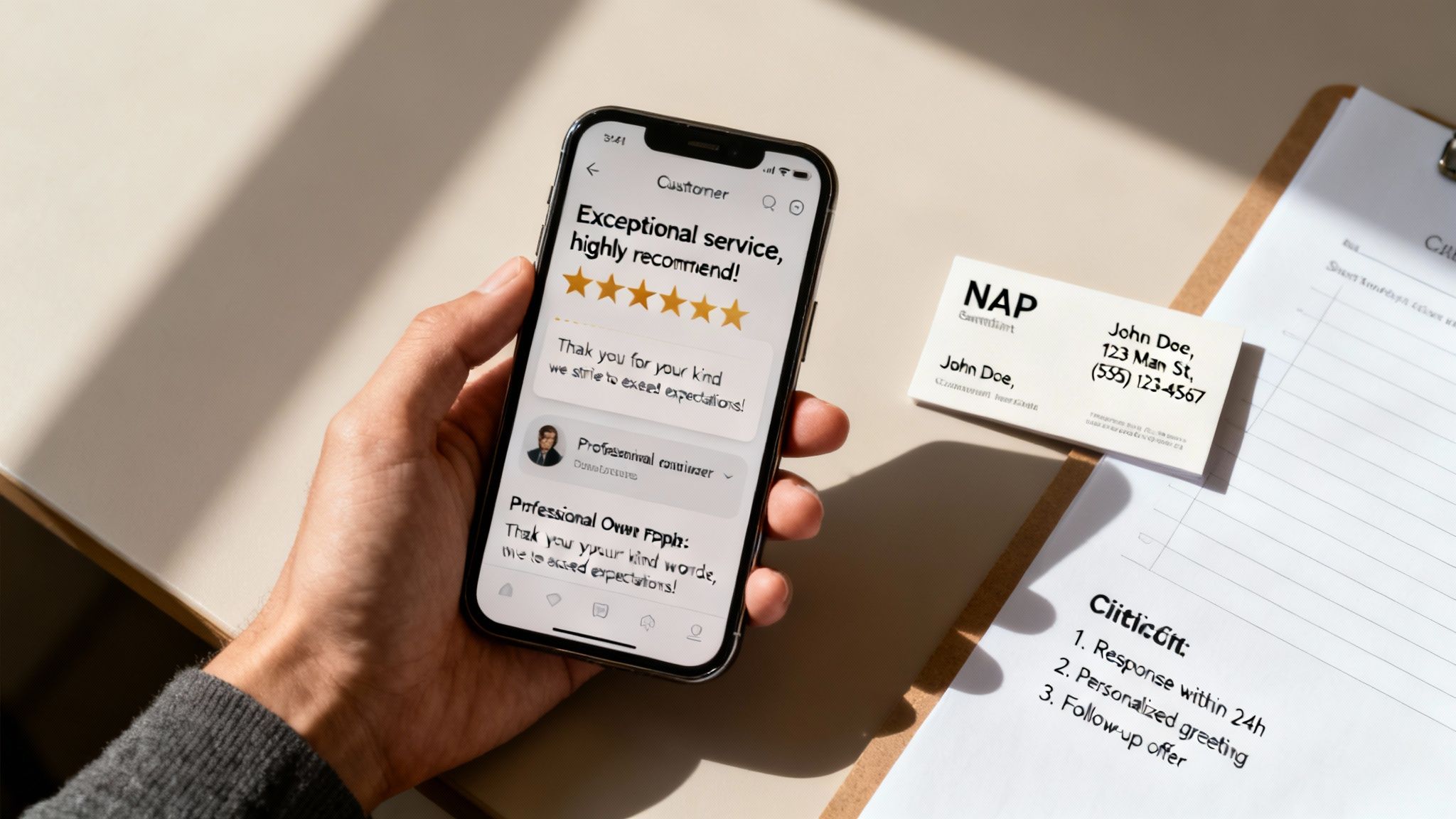
Inconsistent business information is a massive red flag for Google. If one directory lists you as "Smith Plumbing" on "Main St" and another has "Smith's Plumbing Pty Ltd" on "Main Street," it just creates confusion and waters down the authority of all your listings. The aim here is absolute consistency, right down to the last detail.
Your first job is to lock down a single, correct version of your NAP. This needs to match your Google Business Profile exactly. Then, it's time to audit your existing online footprint to hunt down and fix any rogue variations.
Start by checking these key places:
Tackling a citation cleanup can feel like a chore, but it's one of the most fundamental pieces of the local SEO puzzle. Every correction you make strengthens Google's confidence that your business is exactly where you say it is.
Reviews are a massive ranking factor. It's a fact that 97% of consumers now use online searches to find local businesses, and often, it's the reviews that tip the scales between you and a competitor. You can't just sit back and hope for the best; you need a simple, repeatable process for encouraging your happy customers to share their feedback.
The real secret is to ask at just the right moment. That golden opportunity is immediately after a successful job or sale, when the positive experience is still fresh in their mind. Don't overcomplicate it. A simple, personal follow-up email or SMS can do wonders.
For instance, a service-based business could use a simple template like this:
"Hi [Customer Name],
Thanks again for choosing us for your [Service] today. We hope everything was to your satisfaction.
If you have a moment, we'd be grateful if you could share your experience on Google. Your feedback helps us improve and lets others in our community know what to expect.
Here’s a direct link: [Your Google Review Link]
Thanks for your support!
The [Your Business Name] Team"
This approach is polite, direct, and makes it incredibly easy for the customer to leave a review with just a single click. To really manage your online reputation and visibility well, consider leveraging Maps Reviews for local SEO as a core part of your strategy.
Your work isn't finished when the review pops up. Responding to all feedback—the good and the bad—is non-negotiable. It shows you’re an engaged business owner who actually cares about customer input.
For positive reviews, a simple thank you goes a long way. Try to personalise it by mentioning something specific from their review. For example, "Thanks, Sarah! So glad you were happy with the new garden bed we installed. We look forward to working with you again!"
Negative reviews are an opportunity, not a disaster. Respond promptly, professionally, and with empathy. Acknowledge their issue, apologise that their experience didn't meet expectations, and offer to take the conversation offline to sort it out. This public response shows potential customers that even when things go wrong, you’re committed to making it right. This kind of transparency is a powerful trust signal all on its own.
Once you’ve nailed the basics of local SEO, it’s time to really open the throttle. Scaling your efforts is about more than just incremental gains; it’s how you expand your digital footprint, start dominating new service areas, and shift from being a local name to a regional powerhouse. This is where we get into the nitty-gritty of multi-location management and the fine art of local link building.
This is where the serious growth happens. Don’t just take my word for it; research on Australian businesses found that multi-location companies pull in a mind-boggling 557% more traffic on average than their single-location counterparts. The top players rank for around 448 keywords in the top 10, while smaller operations average just 94. The potential is massive if you get it right. You can dive deeper into the numbers in the original Australian local SEO research.
Expanding to new locations is exciting, but it brings a unique set of digital challenges. The single biggest mistake I see businesses make is trying to treat all their locations as a single online entity. It just doesn't work. To win, you have to treat each location as its own distinct business with its own unique digital presence.
This thinking needs to start with your website structure. Please, don't just dump all your addresses on one contact page. That’s a huge missed opportunity. Instead, you need to build out dedicated, fully optimised landing pages for each physical spot. Say you're a dental group with clinics in Norwood and Glenelg. Your site structure should look something like this:
yourclinic.com.au/dentist-norwoodyourclinic.com.au/dentist-glenelgAnd each page needs its own unique content. Talk about local landmarks nearby, introduce the staff who actually work at that clinic, and showcase reviews from patients who live in that suburb. This sends a crystal-clear signal to Google that you have a genuine, physical presence in each community, which is gold for your rankings.
The exact same logic applies to your Google Business Profile. Every single shopfront, office, or clinic needs its own verified GBP listing. No exceptions. This ensures each branch shows up properly in local map searches and lets you collect location-specific reviews and post updates relevant to that neighbourhood.
Treat each business location like its own small business online. A unique location page and a distinct Google Business Profile for every address are non-negotiable for multi-location success.
Citations build your foundation of trust online, but it's local link building that builds true authority. A backlink is simply a link from another website to yours, and in Google's eyes, it's a vote of confidence. When that vote comes from a respected local source? Its value for your local SEO shoots through the roof.
So many businesses skip this part, thinking it's too hard or complicated. The reality is that some of the most potent local links come from just getting involved in your own backyard. If you want to really get into the weeds on this, our professional link building services can give you a hand in building a rock-solid backlink profile.
Here are a few practical ideas to get the ball rolling and earn some brilliant local links:
Not all link building tactics are created equal. You've got to be smart about where you invest your time and effort. A balanced approach is usually best, mixing some of the quick wins with a few of the higher-effort, higher-impact plays that really move the needle.
To help plan your attack, here’s a simple way to think about your options.
| Tactic | Effort Level | Impact Potential | Example |
|---|---|---|---|
| Local Directory Listings | Low | Low-Medium | Ensuring your business is listed on the local Chamber of Commerce website. |
| Sponsorships | Medium | Medium | Sponsoring a local charity gala and getting a link on their event page. |
| Community Partnerships | Medium | Medium-High | A gym partnering with a local health food store for a cross-promotion. |
| Creating Local Content | High | High | A tourism operator creating an interactive map of local hiking trails. |
By strategically scaling with dedicated location pages and a smart, community-focused link building plan, you can blow past your competitors. This advanced approach to local SEO for businesses is what separates the market leaders from everyone else.
Even with the best playbook in hand, it's natural to have a few questions when you're getting stuck into local SEO. Let's tackle some of the most common ones that come up, clearing away the confusion so you can get on with it.
This is the million-dollar question, and the honest-to-goodness answer is: it really depends. While you might see some small wins from on-page tweaks or a properly optimised Google Business Profile in just a few weeks, a solid local SEO strategy is more of a long game.
Generally, you can expect to see real, measurable improvements in your rankings, traffic, and leads within 3 to 6 months. But what pushes your timeline to one end of that scale or the other?
Think of it like getting a heavy flywheel spinning. That initial push takes the most effort, but once you've got momentum, keeping it going becomes a whole lot easier.
They're cut from the same cloth, but they're chasing completely different things. Traditional SEO is all about casting a wide net, trying to get national or even global visibility for broad keywords. It’s the perfect approach for an online-only store or a software company that doesn’t have a physical address.
Local SEO, on the other hand, slams a geographical filter on top of everything. Its entire purpose is to make your business pop for customers right in your service area. The focus shifts entirely to signals that prove you're a legitimate, relevant local player.
The real difference comes down to intent. Traditional SEO often targets people looking for information. Local SEO targets people looking for a solution right here, right now.
This means local SEO for businesses leans heavily on specific signals that traditional SEO doesn't really care about, like:
Look, plenty of the foundational local SEO tasks are well within the reach of a motivated business owner. Getting your Google Business Profile claimed and filled out, encouraging customers to leave reviews, and making some basic updates to your website are fantastic starting points. If you've only got one location and you aren't in a hyper-competitive market, a DIY approach can get you surprisingly far.
But things can get complicated, and fast. An agency brings specialised tools, years of experience, and a deep understanding of what actually moves the needle. This is especially true for the more technical and time-sucking jobs, like a comprehensive citation cleanup, strategic local link building, or navigating the headaches of a multi-location business.
For any business that's serious about growth or is fighting for attention in a crowded marketplace, bringing in an agency is often the most direct path to getting the results you're after.
Ready to stop wondering and start ranking? The team at Virtual Ad Agency specialises in building powerful local SEO strategies that drive real growth for businesses just like yours. Let's build your local presence together.

 previous