
Local SEO optimisation services are essentially a bundle of strategies designed to make your business pop up when people are searching for products or services 'near me'. The whole point is to make sure your physical shop or service-area business gets seen in those crucial local search results, like Google Maps and the 'Local Pack' that appears at the top of the page.
Imagine you run a fantastic café, but it’s tucked away down a laneway in a busy city. Without a big, clear sign pointing people your way, potential customers are just walking straight past, completely oblivious. That’s exactly what it’s like operating without a local SEO strategy – you’re digitally invisible to people who are actively looking for what you offer.
And that invisibility is a massive missed opportunity. The way customers search has completely changed. They don't just look for products anymore; they look for them nearby. This shift makes local SEO optimisation services absolutely essential for connecting with high-intent customers right when they need you most.
Unlike general SEO which casts a wide, national net, local SEO is surgical and hyper-focused. Its success really boils down to three core pillars that Google uses to rank local businesses.
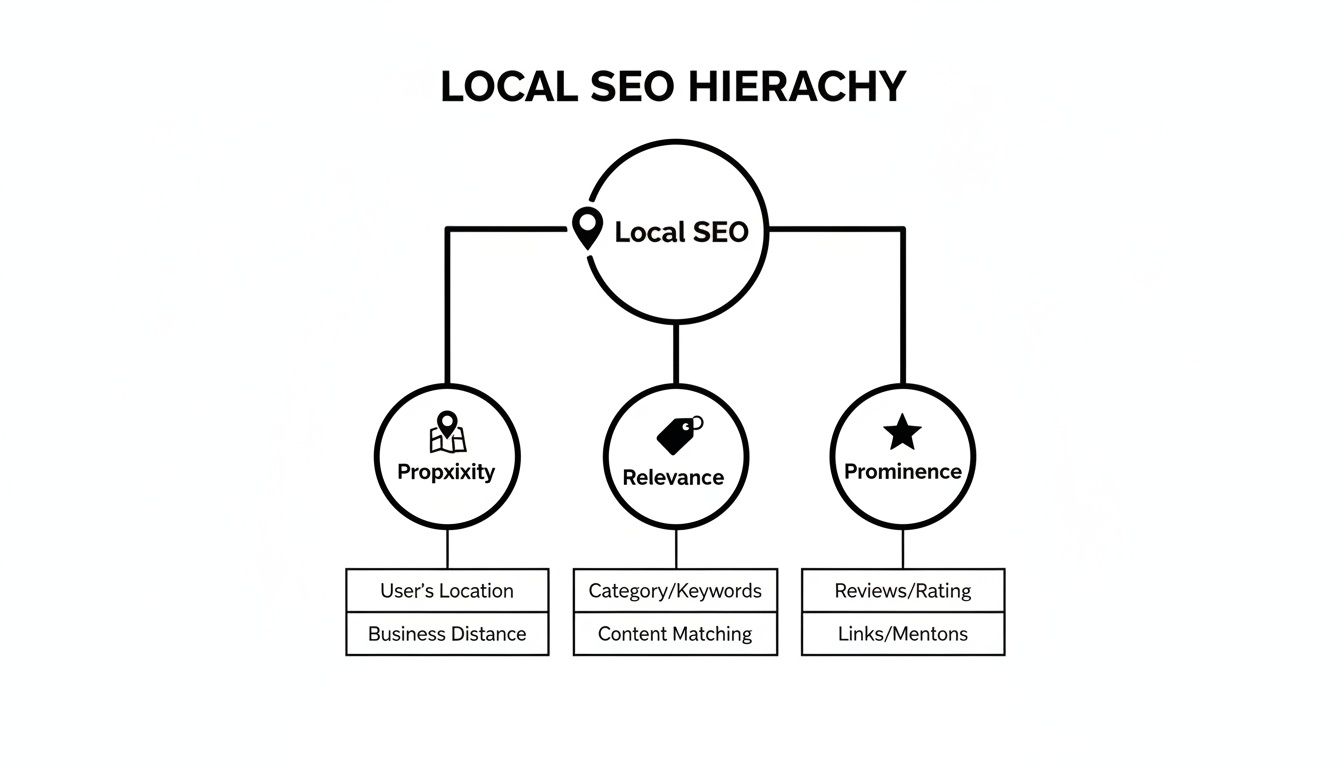
This diagram shows how a successful strategy needs to balance these three distinct but interconnected factors.
The real power of local search lies in its urgency. People searching locally usually need something now.
In Australia, a staggering 46% of all Google searches carry local intent. That means nearly half of all searches are for things like 'cafe near me' or 'solicitor in Adelaide'. What's even more impressive is that 78% of these local mobile searches lead to an in-store visit within just 24 hours. That’s digital visibility turning directly into foot traffic and revenue.
By focusing on these three pillars, local SEO optimisation services transform your online presence from a passive listing into an active magnet for customers who are ready to buy, call, or visit. It’s a direct line to your most valuable audience. You can explore how this directly impacts growth in our guide on SEO and small business success.
Think of your Google Business Profile (GBP) not just as another online listing, but as the digital front door to your business. It's often the very first thing a potential customer sees when they search for services "near me". A professional local SEO optimisation service treats this profile like a perfectly merchandised shop window, making sure every single detail is geared to attract, inform, and ultimately win over that customer.
Your GBP is hands-down the most powerful tool you have for influencing how you show up in local searches. Google pores over the information here to decide your relevance, proximity, and prominence for any given search. Get it right, and you'll see a direct increase in phone calls, website clicks, and most importantly, people walking through your door.
Leaving your GBP to gather dust is like locking the door to your shop and leaving the front window completely empty. It sends a signal to both Google and your customers that you might not be the most active or reliable choice in the area.
Look, simply claiming your profile and plugging in the basic details is just table stakes. To really get ahead, you need to dive deep and use every feature Google gives you to tell a compelling story about your business. That means going beyond a single primary business category and selecting multiple, relevant secondary categories that truly capture everything you offer.
A top-tier profile is much more than just a name and address. It's a living, breathing part of your business that needs constant attention and strategic updates.
Here are the key bits that need ongoing refinement:
A study found that businesses with complete and accurate Google Business Profiles are 2.7 times more likely to be considered reputable by consumers. That's a direct line between a well-managed profile and building local trust.
A static profile quickly becomes an invisible one. The secret to staying at the top is consistent activity. This tells Google that your business is open, active, and engaged with the local community. It's an area where so many businesses drop the ball, creating a massive opportunity for those willing to put in the work.
Regularly refreshing your profile with new content keeps it relevant and gives customers timely information, nudging them to choose you over a competitor with a dormant listing. For a much deeper dive into getting this right, our comprehensive Google Business Profile optimisation guide is a great place to start.
To really dominate the local search results, you have to use the full suite of tools inside your Google Business Profile. These features are specifically designed to boost engagement and give searchers valuable information without them even needing to click through to your website.
Essential Engagement Tactics:
While your Google Business Profile acts as your digital shopfront, your website is the engine room. To really dominate local search, the two have to be perfectly in sync. This foundation makes sure that when customers click through from the map listings, they land on a website that screams "local expert" and gives them a smooth, easy experience.
Think of it like this: your GBP gets people to the door, but it’s the on-page and technical stuff on your website that convinces them to come inside and buy something. Without it, you're just waving goodbye to valuable, high-intent traffic. This is a core part of any effective local SEO optimisation service.

First things first, you need to sprinkle your location-specific keywords naturally throughout your website. This isn’t about cramming "plumber Adelaide" into every single sentence. It’s about being smart and placing these terms where they make sense for both your customers and the search engines.
The goal is simple: signal to Google exactly where you operate and what you do, all without sounding like a robot.
Here’s where you should focus your attention:
If your business serves multiple suburbs or cities, dedicated location pages are an absolute must. A generic "Contact Us" page just won't cut it. Each location page needs to act like a mini-homepage for that specific community, loaded with unique, locally-focused info.
These pages are your chance to show you truly understand each area you serve. They should feature:
A classic blunder is to just copy and paste the same content across all location pages, only swapping out the suburb name. Google sees right through that. Each page has to offer unique value to stand out and signal that you're a true local authority.
Technical SEO can sound a bit scary, but one of its most powerful tools for local businesses is LocalBusiness schema. Think of it as handing Google a perfectly formatted business card. It's a snippet of code you add to your website that spells out your key business info in a language search engines understand instantly.
This "digital business card" includes details like:
By putting this in place, you take all the guesswork out of it for Google. This makes it far easier for them to show your details correctly in local search results and those handy knowledge panels. A thorough technical review is key, and our expert team can run a comprehensive SEO auditing service to uncover these kinds of opportunities.
Finally, never forget that the vast majority of local searches happen on a mobile phone. Someone standing on a street corner searching for "coffee near me" isn't going to hang around waiting for a slow, clunky website to load.
A mobile-friendly design and lightning-fast page speed aren't just nice-to-haves anymore—they're absolutely essential for grabbing those on-the-go local customers. Google knows this and gives a huge advantage to sites that deliver a fast, responsive mobile experience. If your site isn't up to scratch on mobile, you're practically handing customers over to your competitors.
Having a great website is just the start. To truly dominate your local market, you need to build authority and trust right where your customers are searching online. It’s about weaving your business into the very fabric of the local digital community, sending strong signals to both Google and potential customers that you’re a serious, legitimate player in the area.
This is where two crucial parts of any local SEO optimisation service come into play: managing your business citations and building local links. They might sound similar, but they do different jobs that work together perfectly. Getting both right is non-negotiable if you want to be seen as a local leader.

Think of citations as online mentions of your business's most vital details: its Name, Address, and Phone number (NAP). These pop up all over the web, from big directories like Yelp and TrueLocal to smaller, industry-specific listing sites.
They’re basically professional references for your business. When Google’s crawlers see your exact NAP details listed consistently across dozens of trustworthy websites, it backs up everything you’ve claimed on your Google Business Profile. This consistency is a massive vote of confidence, proving you are who you say you are and you’re located where you claim to be.
Messy NAP information is a huge red flag for search engines. Even a small mistake, like a wrong suite number or an old phone number, creates confusion. This erodes trust and torpedoes your chances of ranking in the Local Pack, where accuracy is king.
If citations are about confirming your identity, local link building is about showing your involvement and authority within the community. A backlink is simply a link from someone else’s website to yours. From an SEO perspective, links from high-quality, relevant local websites are like glowing endorsements.
It’s not about getting as many links as possible; it’s about getting the right ones. A single link from the local newspaper or the city’s Chamber of Commerce website is worth far more than a hundred links from generic, spammy directories.
Smart local link-building strategies often involve:
Building out this digital footprint is an absolute game-changer for businesses with more than one location. In fact, research shows that Australian businesses that properly target multiple locations with local SEO see 557% more traffic on average than their single-location counterparts. You can dig into the numbers in these Australian local SEO statistics.
This shows that expanding your SEO isn't just about adding more pins to the map; it's about systematically scaling your authority. By carefully building citations and earning local links for each and every location, you create a powerful network of trust signals that boosts your entire brand's visibility, community by community.
In the world of local SEO, trust isn't just a nice-to-have; it's your most valuable currency. While all the technical tweaks and keyword magic are crucial, it’s your online reputation that often clinches the deal with a potential customer.
Think of your online reviews like a public conversation happening in a digital town square. Every single comment, good or bad, and every response you make, shapes how the community sees your business. This perception doesn't just sway customers—it’s a massive signal to Google, too.
A steady flow of recent, positive reviews is powerful social proof. It tells both search engines and real people that you’re an active, trusted, and reliable local business. In fact, a high star rating and a healthy number of reviews are some of the biggest levers for ranking in Google’s coveted Local Pack.
You can't just cross your fingers and hope for good reviews to roll in. You need a proactive system to encourage them. The secret is to make it incredibly easy for happy customers to share their thoughts right when they're feeling most satisfied. This isn’t about being pushy; it's about making the ask a natural part of your customer service.
A simple but effective system looks like this:
Responding to reviews is absolutely non-negotiable. It’s a core part of any professional local SEO optimisation service for a good reason. Your replies are just as public as the original review, and they’re a golden opportunity to show you’re committed to customer service.
Every review response is a mini marketing campaign. It shows potential customers that you listen, you care, and you’re actively involved. These are the qualities that build immense trust and set you apart from competitors who leave their feedback page looking like a ghost town.
Your response plan needs to cover all the bases:
For those particularly nasty or fake reviews that violate Google's policies, it's vital to know the right steps. This is where consulting a definitive guide to removing Google reviews becomes essential. Handling these correctly protects the reputation you've worked so hard to build. At the end of the day, managing your online reputation is an ongoing effort that directly builds customer confidence and gives your search visibility a serious boost.
Picking a partner for your local SEO optimisation services is a massive business decision. This isn't just about hiring another supplier; it's about finding a strategic partner who can genuinely kickstart your local growth.
The right agency feels like a natural extension of your team. The wrong one? Well, they can burn through your budget and set you back months, with very little to show for it.
You have to look past the slick sales pitch and really dig into their process, their experience, and most importantly, how they actually define success. Without a clear plan for vetting them, it's all too easy to be wowed by a flashy presentation that’s all sizzle and no steak.
To cut through the noise, you need to ask sharp, insightful questions that get to the heart of an agency’s real capabilities. Wishy-washy answers are a huge red flag. A confident, experienced agency will have clear, transparent responses at the ready.
Here are a few essential questions to guide your conversations:
Agency pricing can seem all over the place, but most fall into a few common buckets. Getting your head around these helps you compare apples with apples and find a model that fits your budget and goals.
A massive red flag to watch for is any agency that "guarantees" a number one ranking on Google. No reputable agency can ever promise this. Google's algorithm is a complex, ever-changing beast. Claims like this usually signal inexperience or a willingness to use risky tactics that could get your site penalised.
To make this process a bit more structured, it helps to have a checklist. This way, you can compare each potential agency against the same criteria and make a decision based on facts, not just a gut feeling.
| Local SEO Agency Vetting Checklist | ||
|---|---|---|
| Evaluation Criteria | What to Look For | Red Flags to Avoid |
| Relevant Experience & Case Studies | Proven results with businesses of a similar size or in your industry. Clear, data-backed success stories. | Vague examples, no verifiable data, or only showing results from tiny, non-competitive markets. |
| Transparency & Communication | Clear explanations of their process. Proactive updates and a designated point of contact. | Secretive "proprietary methods." Poor communication during the sales process (it won't get better). |
| Strategy & Customisation | A tailored strategy based on a deep dive into your business, competitors, and market. | A generic, one-size-fits-all proposal that could apply to any business. |
| Reporting & KPIs | A focus on business-centric metrics (leads, calls, foot traffic). Clear, easy-to-understand reports. | "Vanity metrics" like keyword rankings for irrelevant terms or just raw traffic numbers without context. |
| Team & Expertise | An in-house team of specialists (or transparent partnerships). You should know who is working on your account. | Heavy reliance on outsourcing to unknown third parties. A "jack-of-all-trades" team with no deep specialists. |
Using a checklist like this ensures you're asking the right questions and keeps the focus on what truly matters for your business's growth.
Great reporting is the foundation of a successful agency partnership. It’s how you measure progress and hold your provider accountable for the investment you’re making.
A good report does more than just dump data on you; it tells a clear story about what’s working, what isn’t, and what the game plan is for the next month.
Your reports should clearly track the metrics that actually move the needle for your business. We're talking about improvements in Local Pack rankings for your money-making keywords, growth in clicks-to-call from your Google Business Profile, and a real increase in organic traffic from your target service areas. The selection process can be a minefield, but there are some excellent resources out there detailing top SEO companies for small business that can help you find a great fit.
Diving into the world of local SEO optimisation services can definitely bring up a few questions. It’s a specialised field, and it’s smart to get a handle on the essentials before you jump in. We’ve pulled together some of the most common queries we hear from business owners, complete with straightforward, no-fluff answers.
Think of this as your cheat sheet to demystifying the whole process, so you can feel confident you’re making the right move for your business's growth.
This is the million-dollar question, and the honest-to-goodness answer is: it depends. Local SEO is much more of a long game than a quick win. You should start seeing some positive movement in your rankings and a bit more traffic within the first three to six months.
That initial period is crucial. It’s when your agency rolls up its sleeves to do the groundwork—audits, fixing technical gremlins, building out those foundational citations, and kicking off content and link-building campaigns. The real, business-driving results, like a reliable flow of leads from local searches, tend to become much more consistent after that six-month mark.
Think of it like planting a garden. You don't get a full harvest the day after you put the seeds in the ground. It takes consistent watering, weeding, and a bit of patience before you can really enjoy the fruits of your labour.
A few things can speed this up or slow it down:
While they both stem from the same SEO family tree, they have very different jobs. General, or national, SEO is all about casting a wide net. The goal is to get a website seen by a massive audience, whether that’s across the country or around the globe. It focuses on broad keywords and building authority on a national scale.
Local SEO, on the other hand, is all about your backyard. Its entire purpose is to make you the obvious choice for customers in your specific service area. It zeroes in on location-specific keywords (like "electrician in Adelaide"), leans heavily on your Google Business Profile, and builds trust with local citations and links from within your community.
The price tag for professional local SEO services here in Australia can really vary. It all comes down to the scope of work, how fierce the competition is in your industry, and the agency’s level of expertise. Most will work on a monthly retainer model.
For a medium-sized business, you can generally expect retainers to fall somewhere in the $1,500 to $5,000+ per month range. That investment keeps the wheels turning on things like creating new content, managing citations, building links, and providing you with detailed reports on how everything is performing. Be cautious of anyone promising the world for a few hundred dollars a month—they're likely cutting corners, and that can end up doing more harm than good.
Ready to turn those local searches into loyal customers? The expert team at Virtual Ad Agency specialises in building data-driven local SEO strategies that deliver results you can actually see. Contact us today to discover how we can boost your local visibility.

 previous