
Think of an SEO audit as a specialist health check for your website. It’s a deep dive that uncovers all the technical glitches, content gaps, and sneaky issues holding you back from ranking higher in search engines. Without one, any SEO strategy you try is pretty much just guesswork.
Imagine trying to navigate a new city without a map. Sure, you might stumble upon your destination eventually, but you’ll probably take a few wrong turns, hit some dead ends, and waste a whole lot of time. An SEO audit is that map for your website. It gives you a clear, data-driven picture of where you are, where you need to go, and the most efficient way to get there.
Professional SEO auditing services go way beyond just tracking a few keywords. They deliver a complete analysis of your website's real ability to rank on Google. It's not just about finding what's broken; it's about spotting those golden opportunities for growth that basic tools almost always miss. Without this foundational analysis, businesses end up throwing time and money at the wrong problems.
A really solid audit organises its findings around four core pillars. Each one looks at a critical part of your site's performance, and if you neglect even one, it can create a weak link that brings down all your other marketing efforts.
Let's break them down.
| Audit Pillar | Primary Focus | Key Goal |
|---|---|---|
| Technical SEO Health | Crawling, indexing, site speed, and mobile-friendliness. | Make sure search engines can easily find, understand, and rank your site without hitting any technical snags. |
| On-Page & Content | Content quality, keyword optimisation, meta tags, and user intent. | Ensure your content is relevant, valuable, and perfectly aligned with what your target audience is searching for. |
| Backlink Profile Quality | The authority and relevance of websites linking to you. | Build a strong, trustworthy backlink profile that signals authority and credibility to Google. |
| User Experience (UX) | Site navigation, engagement metrics, and overall visitor satisfaction. | Create a seamless and enjoyable experience that keeps visitors on your site longer and encourages them to convert. |
Each of these areas is a piece of the puzzle. When they all fit together perfectly, you get a website that doesn't just rank well—it dominates.
An SEO audit turns confusion into a clear action plan. It replaces assumptions with hard data, making sure every marketing decision you make is strategic, targeted, and set up to deliver a real return.
This kind of diagnostic approach is becoming non-negotiable. It's projected that in 2025, Australian businesses will spend over $1.5 billion on SEO services—a pretty big jump from 2024. This tells us that more and more businesses are realising that a proper audit is the only smart place to start. It helps you fix critical issues like 404 errors and duplicate content before you pour more money into your marketing. You can check out more insights about local SEO investment trends right here.
To really get what you’re paying for with professional SEO auditing services, it helps to pull back the curtain and see what actually goes on. An audit isn't a single switch-flip; it’s more like a forensic investigation in several phases, where each step builds on the last to give a complete picture of your website's health.
The whole process generally breaks down into three key stages: discovery, analysis, and strategy.
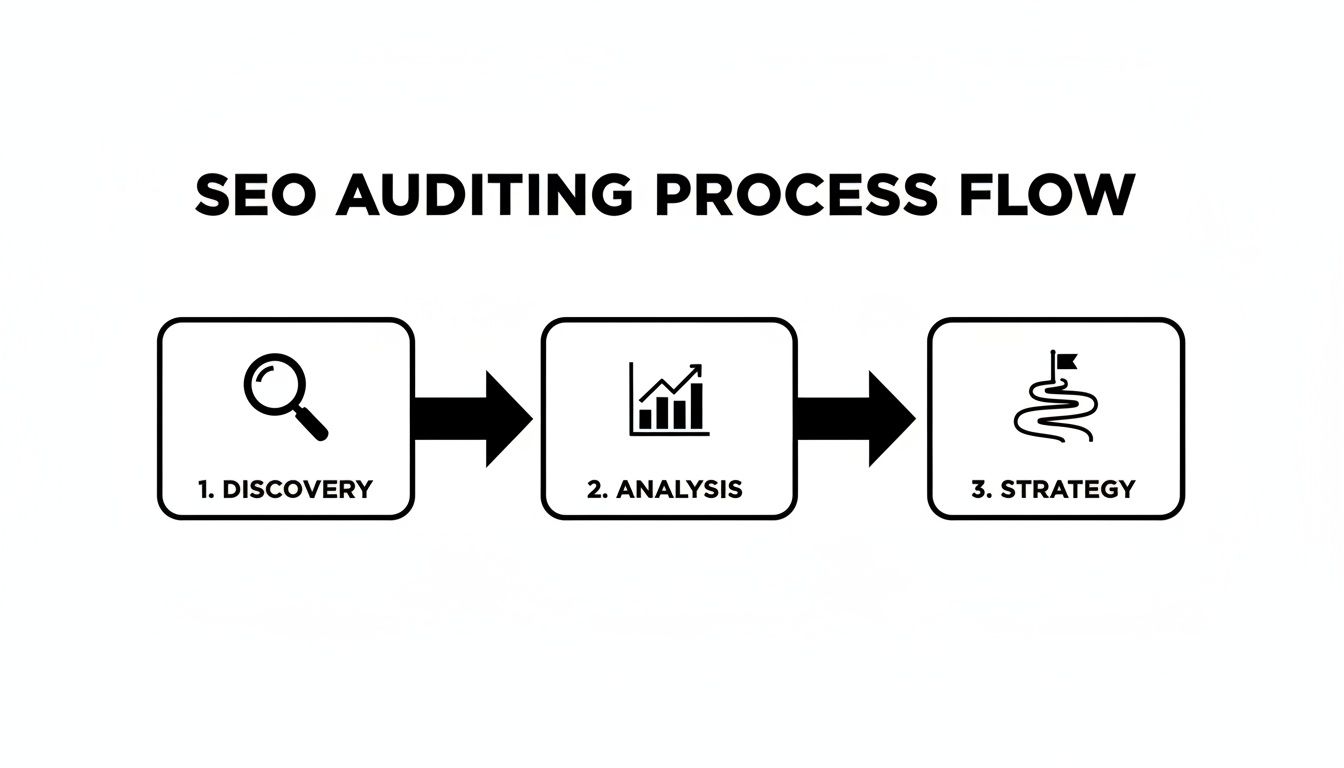
This workflow isn't just for show. It makes sure every recommendation is grounded in solid data, not just a hunch. It turns a mountain of complex analysis into a clear, prioritised roadmap for genuine growth.
Every good audit starts with the bedrock of your website—its technical foundation. Think of it like checking the plumbing and wiring of a house; if that’s faulty, nothing else is going to work properly. Auditors use specialised tools to crawl your site just like Google does, digging up issues that are completely invisible to the naked eye.
Key areas of focus usually include:
For instance, an auditor might find a long chain of redirects that’s watering down your authority, or discover that some clunky JavaScript is preventing Google from rendering critical content on the page.
Once we’re confident the site is technically sound, the focus shifts to the content itself. This phase is all about assessing whether your on-page elements are optimised to meet both search engine rules and, more importantly, what your customers are actually looking for. It’s about making sure your message is clear, compelling, and perfectly aligned with their search.
A crucial part of this is a comprehensive keyword audit to uncover new search opportunities and line up your content strategy with what people are really typing into Google. An analyst will review everything from meta titles and descriptions to heading structures and internal linking to ensure they follow SEO optimisation best practices.
A common finding is "thin content"—pages that offer very little value and drag down the site’s overall authority. Another classic is "keyword cannibalisation," where multiple pages are accidentally competing for the same search term, which just confuses search engines and splits your ranking potential.
Finally, the audit looks outward to your site’s authority signals. A backlink analysis is like a financial audit for your website’s reputation, identifying both valuable assets and toxic liabilities. High-quality links from relevant sites act as votes of confidence, while spammy links can do real damage and even trigger penalties.
For any business with a physical presence, a local SEO audit is a total game-changer. These have become critical for Australian businesses; a fully optimised Google Business Profile can get 7x more clicks, and simply managing your reviews can boost conversions by a whopping 32%. In a market where 88% of Aussies trust online reviews as much as personal recommendations, auditing your local presence is non-negotiable if you want more digital leads.
SEO professionals don't rely on guesswork; they use a suite of sophisticated tools to get a precise reading of a website's health. Think of it like a specialist doctor's office—you wouldn't want a diagnosis based on a hunch. You want one backed by advanced technology. These tools are what separate a quick, surface-level check-up from a deep, data-driven analysis.
They generally fall into a few main categories, each playing a distinct but vital role in uncovering hidden issues and opportunities. Understanding what they do demystifies the audit process and shows you the level of detail involved.

First up are the website crawlers, like Screaming Frog or Sitebulb. These are the digital detectives of an audit. They systematically travel through your entire website, following every single link just as a search engine spider would.
Their job is to create a complete architectural blueprint of your site. Along the way, they find technical flaws that are totally invisible to the human eye, such as broken links, server errors, confusing redirect chains that dilute authority, and duplicate content issues. This initial mapping is absolutely essential for any technical audit.
Next, we bring in the heavy hitters: powerful all-in-one platforms like Ahrefs, Semrush, or Moz. If crawlers are the detectives investigating the crime scene, these platforms are the central intelligence hub, giving us a 360-degree view of your website's position in the wider market.
These tools are crucial for digging into:
Without this competitive context, an audit is only telling half the story. It’s not enough to know your own site's weaknesses; you have to understand the landscape you're competing in. For a deeper look, we've outlined some of the best SEO tools for agencies and how they fit into a winning strategy.
An audit without robust data tools is like a ship navigating without a compass. It might be moving, but it has no idea if it’s heading toward its destination or straight into a storm.
Finally, no audit is complete without diving into analytics platforms, primarily Google Analytics and Google Search Console. These tools give us the ground truth, showing how real users and search engines actually interact with your website.
While other tools show what could be happening, analytics show what is happening. They reveal which pages pull in the most organic traffic, how long visitors stick around, and what actions they take. This data on user behaviour is critical for validating our findings and prioritising the fixes that will have the biggest impact on your audience and, ultimately, your bottom line.
To bring it all together, here’s a quick look at how these tool categories stack up, what they do, and what they help us find.
| Tool Category | Primary Function | Example Findings |
|---|---|---|
| Website Crawlers | Scans and maps every URL on a site to identify technical issues. | Broken links (404s), server errors (5xx), redirect chains, duplicate title tags or content. |
| All-in-One Platforms | Provides a competitive overview of keywords, backlinks, and market positioning. | Ranking drops for key terms, toxic backlinks pointing to your site, competitor content gaps. |
| Analytics Platforms | Reveals how real users and search engines interact with the website. | High-traffic pages with low engagement, poor mobile user experience, underperforming content. |
Each category provides a different piece of the puzzle. By combining the technical blueprint from crawlers, the competitive intel from all-in-one platforms, and the real-world user data from analytics, we get a complete and actionable picture of your site's SEO health.
The real magic of professional SEO auditing services isn’t in the mountains of data they collect; it’s turning all that information into a clear, prioritised plan for growth. A great audit doesn't just hand you a giant to-do list of everything that's wrong. It delivers a strategic roadmap that tells you exactly what to fix, when to fix it, and why it's so important.
This is where true expertise makes all the difference. An audit should take you from a confusing data dump to a clear path forward for your business. You get more than just numbers; you get a story about your website’s performance and a blueprint for its future.

At the heart of any good roadmap is a set of prioritised recommendations. Let's be honest, not all SEO issues are created equal. A skilled auditor weighs each finding based on two crucial factors: its potential impact on your bottom line and the effort required to implement the fix. This simple approach helps you tackle the quick wins first while mapping out the bigger, high-reward projects for later.
For example, fixing a critical indexing error that's hiding your main service pages from Google is a high-impact, low-effort job that should be right at the top of your list. On the other hand, a complete overhaul of your site’s architecture might be high-impact but also high-effort, needing a lot more time and resources.
An SEO audit roadmap is designed to prevent overwhelm. It organises dozens, sometimes hundreds, of findings into a logical sequence, making sure your team’s time and money go where they’ll make the biggest difference, fastest.
A proper audit report should be easy for anyone in your business to pick up and understand, from your marketing team right up to the CEO. It typically contains a few key sections, each designed for a different audience.
This structured approach turns abstract data into real, tangible tasks. A finding won't just say "missing meta descriptions." It'll say, "Identified 50 high-priority pages with missing meta descriptions, which is likely hurting click-through rates from search results." Or, "Discovered a 40% drop in mobile traffic because key service pages are too slow." This level of detail makes the problem real and the solution obvious.
For any business owner, the big question always comes down to one thing: is it worth the money? An SEO audit can feel like a line item on an expense sheet, but its real value is measured in tangible results. It’s about connecting the dots between technical fixes and better rankings, more organic traffic, and a real lift in quality leads.
Viewing an audit as just another cost is a common mistake. It's much better to think of it as a strategic investment—one that stops you from pouring your marketing budget into tactics that are going nowhere. It's the foundational step that makes sure every dollar you spend on content or link building actually delivers, uncovering growth opportunities you never knew were there.
When you start looking into SEO auditing services, you’ll generally find the cost is structured in one of two ways. Each model works for different business needs, so knowing the difference is key.
The right model really depends on your goals. For a more detailed look at what to expect, check out our guide to SEO packages and pricing to see how these services fit into a bigger picture.
Working out the return on your audit investment goes way beyond just looking at traffic numbers. To see the true ROI of SEO auditing services, using effective SEO dashboard examples for lead attribution is crucial for proving the value. It’s all about tying specific fixes to concrete business outcomes.
An SEO audit isn't about finding problems; it's about finding profitability. By identifying and fixing the technical roadblocks that suppress your visibility, you unlock revenue streams that were always there, just hidden from view.
For instance, an audit might show that your main service pages are loading sluggishly on mobile, causing people to leave almost immediately. Fixing that single issue could directly lead to more quote requests and sales from mobile users. The ROI is the value of that new business, measured against what you paid for the audit.
Recent data shows just how big the potential is. The average ROI from SEO—often kickstarted by a thorough audit—can climb as high as 500% or more for local Australian businesses. This return is built on sustained organic traffic, where 85-90% of clicks go to non-paid results. An audit shows you exactly why you’re missing out, and fixing things like crawl errors or content gaps can give your traffic and conversions a serious boost.
An audit should never just be a checklist of problems that lands on your desk with a thud. While some providers will hand you a static report and call it a day, we see an audit as the starting point of your success story. Our SEO audits are woven directly into your wider marketing strategy, connecting every technical detail back to your business goals.
We’re not just hunting for errors. We’re looking for opportunities. Every insight we uncover is designed to improve how customers find you and interact with your brand, from that very first search right through to the final click. It’s about turning complex data into a clear commercial advantage.
Take an Adelaide-based B2B client who came to us stuck in a rut with their organic traffic. Our deep-dive audit quickly pinpointed critical indexing issues and a heap of content that just wasn't speaking to the right people. It was missing the mark completely.
By following the roadmap our audit provided—fixing the technical snags and sharpening their key service pages—we delivered a 74% increase in qualified organic leads in just six months.
"The clarity we gained from VAA’s audit was a game-changer. They didn’t just give us a list of problems; they showed us a clear path to profitability. We saw top rankings for our most competitive terms faster than we thought possible."
Ready to find out what's really going on with your website? Let's chat. Schedule a complimentary discovery call with our team, and we’ll show you exactly how a proper SEO audit can give you the clarity you need to grow.
It's only natural. Diving into SEO auditing services for the first time can bring up a few queries. Getting straight answers helps you see the value clearly and figure out the best path forward for your business.
Think of it like getting your car serviced. You'll want a deep, comprehensive audit at least once a year to check every single component under the hood. It’s also an absolute must after a major website redesign to make sure you’re starting off on the right foot.
For everything in between, smaller quarterly health checks are a smart move. They help you keep pace with Google's constant algorithm tweaks and maintain your momentum. This way, you can catch small issues before they snowball into major headaches down the track.
A regular audit schedule isn't about finding fault; it's about proactively adapting. It ensures your SEO strategy remains sharp, relevant, and aligned with the ever-changing rules of search.
You can, but it’s a bit like using a simple symptom checker when you really need a specialist's diagnosis. While those basic online tools are great for a quick look, they really only scratch the surface. They’ll flag the most obvious errors but will almost certainly miss the complex, underlying issues that need an expert eye.
A professional audit uses powerful, enterprise-level tools to pull together exhaustive data. But more importantly, you get an expert who can translate all that complex information into a prioritised, actionable roadmap. That’s something an automated tool just can't do.
It's important to know that not all audits are created equal. A technical audit, for instance, is a vital but very focused piece of the puzzle. It looks purely at your site's backend health—things like crawlability, indexation, site speed, and how well it works on mobile devices.
A full SEO audit, on the other hand, is the whole shebang. It includes a complete technical review but then expands to cover everything else:
This complete approach gives you a truly comprehensive strategic roadmap, built for total digital growth.
Ready to stop guessing and start growing? The expert team at Virtual Ad Agency can provide the clarity your business needs with a comprehensive SEO audit. Get in touch with us today to build your roadmap to success.

 previous