
For a lot of companies, social media marketing is all about using platforms to get the brand name out there, chat with customers, and hopefully drive some real business results, like leads or sales. It’s a mix of putting out free, organic content and running paid ads to hit very specific groups of people right where they hang out online. But real success comes from a solid plan, not just posting whenever the mood strikes.

Before you even dream up your first post, you have to lay a strong strategic foundation. It’s non-negotiable. So many businesses jump straight into making content, but that approach almost always leads to wasted time, money, and results that are just… meh. The most effective social media marketing always starts with careful planning that links every single action back to a tangible business outcome.
This early stage is about ditching the guesswork and setting a clear, evidence-based direction for your entire social presence. It’s the difference between shouting into a void and having a genuinely good conversation with potential customers.
You can’t connect with an audience you don’t get. Basic demographic data like "females, 25-40" is a place to start, but it's nowhere near enough. To really hit home, you need to build out detailed audience personas that feel like real people.
Go much deeper than just their age and where they live. Ask the critical questions to get the full picture:
For instance, a financial services company in Sydney might be targeting "Startup Steve," a 32-year-old founder who scrolls LinkedIn for industry news and is always looking for efficiency and growth hacks. Getting this granular is what will directly shape your content and channel strategy.
Your competitors are already out there on social media, which is great news for you—they’re a goldmine of insights. A proper competitor analysis isn't about copying what they do; it's about spotting the opportunities they’ve completely missed.
Look for patterns in what they're doing. What topics do they constantly talk about? Which of their posts get tons of engagement, and which ones are just crickets? This analysis helps you find your own unique angle. Maybe your main rival only posts polished, corporate content, leaving a massive gap for a more authentic, behind-the-scenes approach that your brand can completely own.
A smart competitor analysis shows you where the conversation isn't happening. Your goal is to find that untapped space and become the go-to voice within it. This is how you carve out a real niche, even in a super crowded market.
Finally, every single thing you do on social media has to be tied to a clear business goal. Vague objectives like "increase brand awareness" are impossible to measure and, frankly, a bit useless. Instead, use the SMART framework to create goals you can actually be held accountable for:
This structured approach makes sure your social media marketing is a smart investment, not just another business expense.

Spreading your company thin across every social media platform is a fast track to burnout and wasted resources. Effective social media marketing isn’t about being everywhere; it's about being exactly where your customers are. The real skill lies in strategically picking the channels where your ideal Aussie audience genuinely spends their time and is actually open to hearing from you.
This whole decision hangs on the audience personas you've already built. If you're targeting tradies in regional Queensland, your platform choice will look worlds apart from a brand trying to reach corporate lawyers in Melbourne's CBD. Each platform has its own unique user base, its own culture, and its own content expectations. Get it wrong, and you're just shouting into the void.
Think of each social media channel as a different kind of party. LinkedIn is a professional networking event. Instagram is a visually curated art gallery. TikTok is a loud, chaotic, and brilliant street festival. You wouldn't wear a three-piece suit to the festival, and you wouldn't set up a formal trade show booth in an art gallery, right?
The secret sauce is matching your brand's voice and your customer's mindset to the platform's vibe.
Let's look at a couple of scenarios:
This goes way beyond simple demographics. You need to get inside their heads and understand their intent and behaviour on each channel.
While new platforms pop up all the time, a few key players really dominate the Australian scene. Knowing their specific strengths will help you put your marketing budget and effort where they'll make the biggest impact. Honestly, for most companies, a focused approach on two or three core platforms delivers far better results than a scattered presence on five or more.
To help you get started, here's a quick look at how the major platforms stack up for Australian businesses.
| Platform | Primary Audience (AU) | Ad Reach (AU) | Best For (Business Goal) |
|---|---|---|---|
| Broad; strong with Millennials (25-39) and Gen X (40-54). Still the largest user base. | ~13.7 Million | Community Building, Local Business, Lead Generation, E-commerce (Broad Audience) | |
| Gen Z (18-24) and Millennials (25-39). Skews slightly female. | ~10.6 Million | Visual Storytelling, Brand Awareness, Influencer Marketing, E-commerce (Lifestyle) | |
| Professionals (25-54). Educated, higher-income earners. | ~10.0 Million | B2B Lead Generation, Thought Leadership, Recruitment, Professional Networking | |
| TikTok | Primarily Gen Z (<25) but rapidly growing with Millennials. | ~6.5 Million | Brand Personality, Viral Marketing, Reaching Younger Demographics, User-Generated Content |
| Skews heavily female (~70%), primarily Millennials and Gen X. | ~3.9 Million | Driving Website Traffic, Visual Discovery, Product Inspiration (e.g., home, food, fashion) | |
| X (Twitter) | Males (25-49), strong in media, politics, and tech circles. | ~4.9 Million | Real-time Updates, Customer Service, Public Relations, Joining conversations |
This table gives you a solid starting point for matching your persona to the right playground.
Choosing the right platforms is an exercise in focus. It's better to create exceptional content for two relevant channels than to produce mediocre content for five irrelevant ones. Quality and relevance will always outperform quantity.
While the major platforms are a great foundation, don't overlook niche channels that might be a perfect, laser-focused fit for your brand. A gaming hardware company could find a passionate community on Twitch or Discord. A home renovation business could absolutely thrive on Pinterest, where users are actively looking for visual inspiration for their next project.
Here's a quick cheat sheet on platform strengths:
Ultimately, your perfect platform mix is unique to your business. By aligning your choices with your specific audience personas and business goals, you ensure every post, ad, and dollar spent is working towards a real, tangible return.
Let's be blunt: great content is the heart and soul of any social media that actually works. It's the engine that powers your engagement, builds a real community, and—ultimately—gets you the business results you're after. The goal isn't just to fill a feed; it's to create something that genuinely stops the scroll and makes your audience feel seen, understood, and even valued.
This means you’ve got to move away from a constant barrage of sales pitches. Instead, build a content strategy that serves your audience first. The focus has to be on providing value, whether that’s through a laugh, a helpful tip, or a bit of inspiration. When you consistently show up with content that helps or interests people, you earn their trust and attention. That makes them far more receptive when you do have something to sell.
To keep your content focused and prevent your message from getting muddled, you need to establish content pillars. Think of these as three to five core themes or topics your brand will own. These pillars should sit right at the intersection of what your brand is an expert in and what your audience actually wants to see. They become your strategic filter, making sure every single thing you create is relevant and has a purpose.
Let’s take an Australian activewear brand as an example. Their content pillars might look something like this:
Suddenly, their feed is about so much more than just "buy our leggings." It builds a lifestyle and a community around the brand, and that’s a far more powerful position to be in.
Relying on a single content format is one of the fastest ways to bore your audience into scrolling right past you. A dynamic strategy embraces a whole variety of formats to keep your feed fresh and cater to different tastes. People consume information differently, and your content mix needs to reflect that.
Video is absolutely non-negotiable. Short-form video, in particular, completely dominates platforms like Instagram Reels and TikTok. It's perfect for showing off product features, creating quick tutorials, or sharing those behind-the-scenes glimpses that build a real human connection. And don't overthink the production—often, an authentic, phone-shot video will outperform a slick, highly-produced ad.
Of course, high-quality imagery is still a cornerstone of social media. This includes everything from professional product shots and vibrant lifestyle photos that show your product in action, to eye-catching graphics that communicate key messages or promotions.
User-generated content (UGC) is one of the most powerful tools in your entire content arsenal. When a customer posts about your brand, it's an authentic endorsement that carries far more weight than your own marketing ever could. Actively encourage and repurpose UGC to build social proof and strengthen your community.
Beyond just images and video, think about interactive formats that can spark a proper conversation. Polls, quizzes, and "ask me anything" (AMA) sessions in Instagram Stories are fantastic for getting your audience to participate and for gathering incredibly valuable feedback.
How you say something is just as important as what you say. Your tone of voice is your brand's personality, brought to life with words. Is your brand witty and playful? Or is it more professional and authoritative? Are you encouraging and empathetic, or direct and no-nonsense?
Nailing this down is critical for staying consistent across all your channels. A strong tone of voice makes your brand instantly recognisable and much more relatable. Just think about the Australian home goods brand Koala—their voice is cheeky, humorous, and quintessentially Aussie. This personality is woven into every caption, ad, and customer service chat, making them completely unforgettable in a crowded market.
To pin down your voice, try thinking about your brand as a person. Ask yourself:
This simple exercise helps shift your social media from a one-way broadcast into a genuine, two-way conversation. And it's that personality that turns followers into a loyal community who feel a real connection to your brand.
Relying on your organic social media reach alone is a bit like trying to whisper in a crowded stadium. Your message just won't travel very far. For any business serious about growth, paid social advertising isn't just an option anymore—it's a critical part of the marketing mix. It’s how you cut through the noise and put your message directly in front of the Australian consumers most likely to buy from you.
The numbers tell the story. Aussie companies recently poured a massive $4.26 billion into social media ads, a solid 12.1% jump from the previous year. Social platforms now gobble up 29.3% of all digital ad spend, a huge slice of the pie that shows just how essential this channel has become for reaching the country's 20.9 million active social media users.
Great paid social isn't about blasting a single, hard-sell message at a cold audience. That rarely works. Instead, it’s about building a relationship through a full-funnel strategy that guides potential customers from their very first interaction with your brand right through to the final purchase.
This means creating distinct campaigns for each stage of their journey:
Your content strategy is the fuel for this entire funnel. It all starts with defining your brand pillars, then creating compelling content that pulls people in and drives them to act.
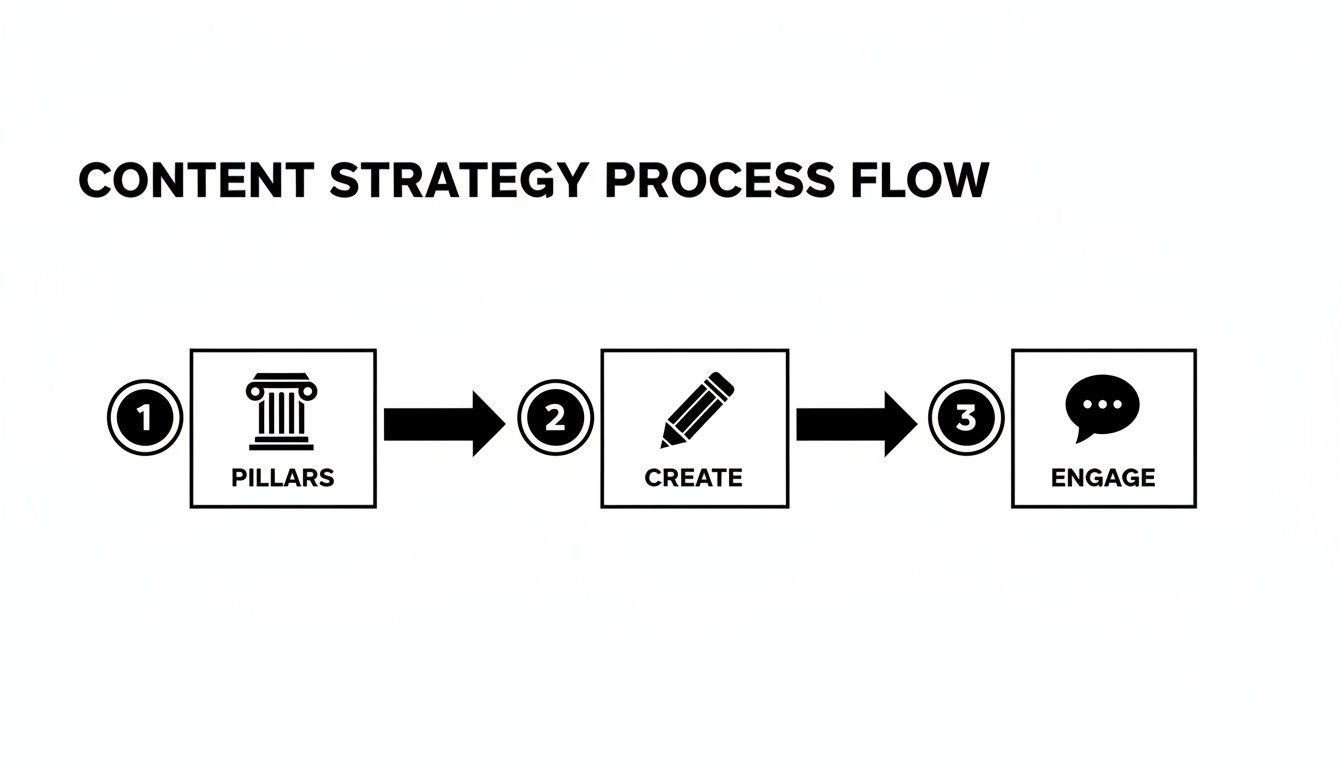
This simple flow shows how a strong content foundation is what makes genuine engagement possible—and that's essential for moving customers through your paid advertising funnel.
The real magic of paid social is in the incredibly sophisticated targeting. You can go way beyond basic demographics to find your ideal customers with pinpoint accuracy.
Get familiar with these powerful options:
Matching the right ad format to your objective is just as important. For a B2B company, a LinkedIn Carousel Ad showing off a case study can be a lead generation machine. You can find plenty of examples of effective B2B LinkedIn ads that have successfully brought in leads. An e-commerce brand, on the other hand, might use Instagram Collection Ads to create a slick, shoppable experience right in the feed.
Never assume you know what will work. The golden rule of paid social is "Always Be Testing." A small tweak to a headline, image, or call-to-action can sometimes have a massive impact on your results.
Launching a campaign is just the first step. The real work—and the real results—come from continuous optimisation. This is what separates a successful social media strategy from a wasted budget. You have to be almost religious about tracking your data and making informed decisions.
Start by running A/B tests on your ad creative and copy. Pit different images, videos, headlines, and audience segments against each other and see what resonates. Let the data, not your gut, pick the winner.
Focus on the metrics that actually matter to your business. While reach is great for awareness, it's metrics like Cost Per Acquisition (CPA) and Return on Ad Spend (ROAS) that truly show the financial impact of your campaigns. If your CPA is too high or your ROAS is tanking, it's a clear signal to adjust your targeting, creative, or landing page. For a deeper dive into strategy and execution, explore our expert social media advertising services.
By constantly testing and refining, you can transform your paid social efforts into a predictable and scalable engine for business growth.

If you can't measure your social media, you can't improve it. It's as simple as that. This is the point where social media marketing graduates from hopeful guesswork to a predictable, bankable driver of business growth.
Proper measurement is about more than just numbers on a page; it’s about proving the value of your work and justifying every dollar of your budget to the people who sign the cheques.
This means you need to look far beyond the superficial stuff. While a big follower count or a flood of 'likes' might feel great, they're often just vanity metrics. They don't actually tell you if your social media efforts are generating leads, driving sales, or contributing to the bottom line in any meaningful way.
To really prove your return on investment (ROI), you have to get serious about tracking the key performance indicators (KPIs) that connect directly to your business goals.
The very first step is a mental shift. You need to move away from the metrics that only stroke the ego and start focusing on the data that shows genuine audience interest and, more importantly, action.
Here’s how you can reframe your thinking from vanity to genuine value:
This sharp focus on actionable metrics is what allows you to start optimising your campaigns for real business impact, not just fleeting online popularity.
The specific KPIs you choose will ultimately depend on your unique business objectives, but a solid measurement framework should always cover the full customer journey. For most companies, a core set of metrics for both organic content and paid ads will do the trick.
If you really want to understand how all your channels work together to create a conversion, it's worth digging into strategies like unlocking true ROI with multi-touch attribution. This kind of approach helps you see the bigger picture of how different touchpoints contribute to the final sale.
To make this crystal clear, let's map some common business goals to the KPIs that matter most.
This table connects the dots between what you want to achieve and what you need to measure. Think of it as your cheat sheet for proving value.
| Business Objective | Primary KPIs to Track | Why It Matters |
|---|---|---|
| Increase Brand Awareness | Reach, Impressions, Engagement Rate, Share of Voice | These metrics show how many people are seeing your brand and how deeply your message is resonating within your target market. |
| Drive Website Traffic | Click-Through Rate (CTR), Cost Per Click (CPC), Clicks | This is all about getting people off the social platform and onto your own turf (your website), moving them further down the funnel. |
| Generate Leads | Conversion Rate, Cost Per Lead (CPL), Lead Quality Score | This directly measures your ability to turn social media engagement into tangible sales opportunities for your team. |
| Increase Sales (E-commerce) | Conversion Rate, Return on Ad Spend (ROAS), Average Order Value (AOV) | These are the ultimate bottom-line metrics, proving a direct financial return from your social media investment. |
By aligning your reporting with these KPIs, you move the conversation from "How many likes did we get?" to "How much revenue did we generate?".
Finally, you need a way to communicate these results to stakeholders who might not live and breathe social media. A simple, clear reporting framework is your best friend here.
Structure your report in a logical flow that tells a story:
This structured approach transforms your report from a boring data dump into a strategic document that clearly demonstrates ROI and guides smarter decisions for the future.
Even the most powerful social media strategy is just a document without the right combination of people and technology. You need a skilled team to bring the plan to life and the right tools to make the work efficient, scalable, and measurable.
One of the first major hurdles is deciding on your team structure. Do you build an in-house crew, outsource to an agency, or go for a hybrid model? There’s no single right answer here. The best fit depends entirely on your company's size, budget, and the expertise you already have on board.
An in-house team gives you deep brand knowledge and lightning-fast communication. But hiring, training, and retaining top talent across multiple specialisations can get expensive, fast. On the flip side, outsourcing to an agency gives you instant access to a team of experts, though it can sometimes feel less integrated with your company culture.
Whether you hire internally or work with partners, some roles are simply non-negotiable for doing social media marketing effectively. These roles are the engine room of your day-to-day operations, each playing a distinct but connected part in hitting your goals.
You'll need to cover these key roles:
For smaller companies, one person might wear all these hats. As you grow, these roles naturally become more specialised, allowing for deeper expertise and, ultimately, better results.
Your ideal team structure isn't static. It has to evolve as your business grows and your social media efforts become more complex. The smart move is to start lean and add specialised roles only when you can justify the investment with clear ROI.
The right technology doesn't just save time; it unlocks completely new capabilities. Your "tech stack" is simply the collection of tools you use to manage, run, and measure your social media marketing. Building a smart stack is all about finding a balance between functionality, budget, and scalability.
A solid, foundational tech stack typically includes these three pillars:
Choosing the right software can feel overwhelming, but many of the best social media management tools offer free trials. This is a brilliant way to test-drive their features and find the platform that best fits your team's workflow before you commit any money, ensuring your people and platforms work together seamlessly from day one.
Diving into social media marketing, especially here in Australia, always kicks up a few questions. It’s a complex space, so let's clear up some of the most common ones we get asked.
There’s no magic number here. Your budget is going to hinge on your industry, what you want to achieve, and the platforms you've decided to play on.
For a small or medium-sized Aussie business trying to get a feel for it, a good rule of thumb is to put 10-15% of your total marketing budget toward social media.
Think of this as covering a few key areas:
It's all about context. A B2B company chasing leads on LinkedIn will likely invest more in producing high-value, professional content. On the flip side, an e-commerce fashion brand will probably pump more of its budget into eye-catching Instagram and TikTok ads.
Patience is your friend here. While a really well-targeted ad campaign can bring in website clicks or even sales within a few days, building a solid organic presence that lasts is a marathon, not a sprint.
You should start seeing real, meaningful growth in things like engagement and brand awareness within 3-6 months of consistent, quality activity. For the harder metrics like lead generation and sales conversions, give it closer to 6-12 months as you build trust and really dial in your strategy.
Definitely not. That’s a classic mistake that just spreads your resources way too thin, and you end up with a half-baked presence everywhere.
The smarter move is to go all-in on the one or two platforms where your ideal customers actually spend their time. Go back to your audience personas—they hold the answer. It’s far more powerful to be a dominant force on Instagram and Facebook than to have a weak, forgettable presence across five different channels.
Ready to build a social media strategy that actually drives business outcomes? The team at Virtual Ad Agency specialises in full-funnel marketing solutions that spark real growth. Let's chat about your goals today at https://www.virtualadagency.com.au.

 previous