
Figuring out SEO pricing can feel a bit like you’re trying to crack a code. In Australia, you’ll see packages starting from around $500 a month for the basics, stretching all the way up to $5,000+ per month for really ambitious, growth-driven strategies. What you end up paying really boils down to your business size, how tough your industry is, and what you’re trying to achieve.

Let’s cut through the jargon. When you invest in an SEO package, you’re not just buying a to-do list of services; you’re bringing a strategic partner on board to help you build sustainable, long-term growth. It's a bit like building a house. You could go with a standard blueprint—that’s your basic package. Or, you could commission a custom architectural design for something truly special, which is your high-growth, tailored strategy. The price tag directly reflects the complexity and the long-term value you’re looking to build.
At the end of the day, any SEO package has one job: to deliver a solid return on your investment (ROI). It’s not just about climbing the rankings. It’s about getting in front of the right people and turning them into paying customers. To get a feel for what you might need to invest, it's worth exploring the different pricing structures that agencies offer.
A good SEO strategy should make your business more profitable by cutting down your reliance on paid ads and lowering what it costs to win a new customer. A well-put-together package delivers more than just website traffic; it brings in qualified leads and real sales.
An effective SEO package is an asset, not an expense. Its success should be measured by the tangible business growth it generates, such as increased revenue, qualified leads, and improved market share—not just keyword rankings.
Thinking this way helps you move past just comparing prices. Instead, you can start weighing up proposals based on how likely they are to actually deliver the results your business needs to grow.
So, what actually determines the price of an SEO package? A few key things come into play, which is why a one-size-fits-all approach just doesn't work.
Once you get your head around these variables, you can look at seo pricing packages with a lot more confidence and pick something that genuinely fits your business. A big part of this is understanding how your marketing spend impacts profitability; our guide on what is customer acquisition cost is a great place to start.
When you start shopping around for an SEO agency, you'll quickly realise their pricing packages aren't all built the same. Most agencies use one of four main models to bill for their work. Getting your head around these is the first step to figuring out which one actually fits your business goals, budget, and timeline.
Think of it like hiring different tradies. You might get a sparky on retainer for ongoing maintenance around the factory, but you'd hire a painter for a specific, one-off project. SEO is much the same. Let's break down how these common pricing structures work.
The monthly retainer is by far the most common model you'll come across. It’s pretty simple: you pay a fixed fee each month for a continuous suite of SEO services.
It's a bit like having a financial advisor looking after your investment portfolio. You're not paying them for individual trades here and there; you're investing in their ongoing expertise to watch the market, tweak your strategy, and steadily grow your wealth over the long haul. SEO is no different—it needs consistent, persistent effort to build and keep momentum.
This model is the perfect fit for any business committed to long-term, sustainable growth. It gives your agency partner the room to plan, execute, and refine a strategy that compounds over time, covering everything from content and link building to technical site health. Retainers typically start around $1,500 and can go well over $7,500 per month, depending on the scope of work.
Project-based pricing is exactly what it sounds like. You pay a flat fee for a specific, clearly defined project with a definite start and finish line. This is the go-to for one-off needs.
Imagine you're renovating your kitchen. You hire a builder for a fixed price to handle that specific job. Once the kitchen's done and the final invoice is paid, the job's complete.
This model is ideal for tasks like:
Project fees are all over the place, from $2,000 for a detailed audit to upwards of $30,000 for a complex site migration. It's a fantastic option for businesses with a solid in-house team that just need an expert to help tackle a specific challenge.
Sometimes you don't need a team to do the work, but you desperately need an expert to tell you what work needs doing. That's where hourly consulting slots in perfectly. You're paying an SEO specialist for their time, usually for strategic advice, team training, or high-level problem-solving.
This is like bringing in a top-tier business consultant to analyse your operations for a few hours. They give you the blueprint and the strategic direction, but it’s up to your team to actually build it. In Australia, hourly rates generally fall between $100 and $300 per hour, though elite technical consultants can command a fair bit more.
This model is perfect for businesses that have an internal marketing team but lack specialised SEO knowledge. It allows them to access expert guidance without committing to a full-service package, ensuring their efforts are pointed in the right direction.
Lastly, we have performance-based SEO. It's a less common and often much riskier model where an agency's pay is tied directly to specific results—things like hitting page one for certain keywords or generating a set number of leads.
On the surface, it sounds like a dream. You only pay for results! But the reality is, this model can push agencies towards risky, short-term tactics (often called "black-hat SEO") that can get your site slapped with a Google penalty. Reputable agencies tend to steer clear of it because so many ranking factors are completely out of their control. It’s a structure that often promises more than it can responsibly deliver.
To see how other services structure their costs, it can be useful to look at different service pricing models used across various industries. Understanding these core approaches is the foundation you'll need before diving into the specific SEO packages you'll encounter next.

As you start exploring SEO pricing packages, the first options you’ll almost certainly bump into are the entry-level or "starter" plans. These packages are really the ground floor for businesses just dipping their toes into SEO – think small, local operations in markets that aren’t too crowded.
It helps to think of a starter package like the concrete slab for a new house. It’s absolutely essential; it gives you a solid, level base to build everything else on. But that’s all it is. It’s not the finished house, and it won't have the walls, roof, or features needed to stand out on a competitive street.
These packages are designed to get the fundamentals in place. They’ll sort out the basic issues and establish an initial presence, but they aren't built to help you dominate competitive search rankings. For any medium-to-large business, understanding what these packages include—and more importantly, what they leave out—is the key to realising why a bigger investment is needed for real growth.
An entry-level package will typically focus on a handful of core activities designed to just get your website on the search engine map. The scope is kept tight to keep it affordable, usually landing somewhere under the $1,500 per month mark.
Here’s a realistic look at what you can expect to get for your money:
The primary goal of a foundational SEO package is to build a solid base, not to achieve market dominance. It corrects initial errors and establishes a starting point for future, more aggressive growth strategies.
While starter packages are great for getting off the ground, their limits become pretty obvious when you're aiming for serious growth. They almost never include the heavy-hitting components needed to compete in crowded markets.
For example, some interesting findings about AU SEO pricing showed that entry-level packages between $500 and $1,000 per month often struggle to build the necessary website authority. While they cover the basics, sites investing at this level typically only see about 25% traffic growth over a year. Compare that to the 150% growth for businesses in the mid-tier, and you can see the gap.
Crucially, these basic packages are missing:
A foundational package might not even include a proper technical review, which is where our comprehensive SEO audit services become so important for spotting those deeper issues. For any business with real growth ambitions, the right way to think about these entry-level packages is as a short-term starting block, not a long-term solution.
Once you move past the basics, you get into what we call growth-focused SEO. This is where most medium-to-large businesses need to be, playing for serious market share, not just a participation trophy. These more advanced SEO pricing packages are built for one thing: driving real, measurable business growth.
Think of it like this: an entry-level package is like giving your car a basic service and a wash. A growth-focused package is taking it to a performance workshop for a full engine tune-up, suspension upgrade, and custom bodywork. It’s a strategic investment designed to turn your website into a high-performance machine that can actually win races.
These packages go way beyond just ticking boxes. They’re built on a deep understanding of your market, your competitors, and your specific business goals, turning your website from an online brochure into a customer-generating powerhouse.
When you invest in a growth package, which usually sits anywhere from $1,500 to over $5,000 per month, you're paying for a much deeper, more proactive strategy. The work is more complex, the analysis is more sophisticated, and the goals are a whole lot bigger.
Here’s what really sets these packages apart from the entry-level stuff:
The real difference is in the results. While starter packages aim for a bit of visibility, growth packages are laser-focused on ROI. You should expect sophisticated performance tracking that ties SEO activities directly to business metrics that matter, like leads, sales, and customer lifetime value.
Research on the Australian market makes this crystal clear. Mid-range SEO pricing, from $1,500 to $5,000 per month, is the sweet spot for 40-50% of AU businesses that are serious about growth. These packages typically cover comprehensive on-page SEO, optimising for 10-20 keywords, monthly content creation, and link-building that secures 5-15 quality backlinks each month. Agencies report that retainers in this bracket often deliver a 2-3x ROI within 12 months, with traffic surges of 100-300%. For competitive niches, packages in the $3,000-$6,000 range can deliver 200% lead increases and a 150% organic traffic uplift. You can dig into the numbers more in this breakdown of how much Australian businesses invest in SEO on digitalnomadshq.com.au.
This level of investment produces outcomes you can take to the bank, making the value proposition pretty obvious.
A growth-focused SEO package isn't about ranking for a few keywords; it's about building a predictable and scalable channel for customer acquisition that delivers compounding returns over time.
To really get your head around the step-up in value, it helps to see the deliverables side-by-side. The difference in scope and strategic depth becomes immediately apparent.
This table breaks down the typical services included in different SEO pricing packages, highlighting the difference in scope and strategic depth between entry-level and growth-focused investments.
| Service Component | Entry-Level Package ($500 – $1,500/month) | Growth-Focused Package ($1,500 – $5,000+/month) |
|---|---|---|
| Keyword Targeting | 5-10 low-competition keywords | 20-50+ keywords, including competitive terms and topic clusters |
| Technical SEO | Basic on-page fixes (titles, metas) | Comprehensive technical audit, site speed optimisation, schema markup |
| Content Creation | Limited or no content included | Strategic monthly content plan (e.g., 2-4 pillar articles, blogs) |
| Link Building | Basic local citations and directory listings | Proactive outreach campaigns to earn high-authority backlinks |
| Competitor Analysis | Surface-level review of 1-2 main competitors | In-depth analysis of competitors' content, link profiles, and strategies |
| Reporting & ROI | Basic ranking and traffic reports | Advanced analytics, conversion tracking, and detailed ROI analysis |
At the end of the day, choosing a growth-focused package is a strategic business decision. It’s an admission that to get significant results in a competitive market, a basic effort just won’t cut it. You need a comprehensive, proactive, and data-driven strategy that consistently builds your digital assets and drives your business forward.
Choosing the right SEO package isn't like grabbing something off a shelf; it's more like getting a suit custom-made. A generic, off-the-rack solution is never going to fit perfectly because every business is different—you’ve got your own goals, your own market position, and your own unique strengths. So, let’s move past the standard proposals and figure out how to shape a package that’s actually built for your business.
The first step is getting crystal clear on the variables that dictate the scope and, ultimately, the cost of any good SEO strategy. These are the core factors any decent agency will use to build their proposal, making sure you’re investing in a plan designed for your specific needs, not some cookie-cutter template that misses the point entirely.
Before you even glance at a proposal, you need to define what success actually looks like. An SEO strategy for a national e-commerce brand is a completely different beast to one for a B2B firm trying to get in front of C-suite executives.
Think about your main goal:
Your business goals are the compass. They should guide every single decision, ensuring every activity in the proposal is directly tied to an outcome that actually matters to you.
The diagram below gives you a simple visual of how a foundational package differs from one geared for growth, helping you see where your needs might fall.
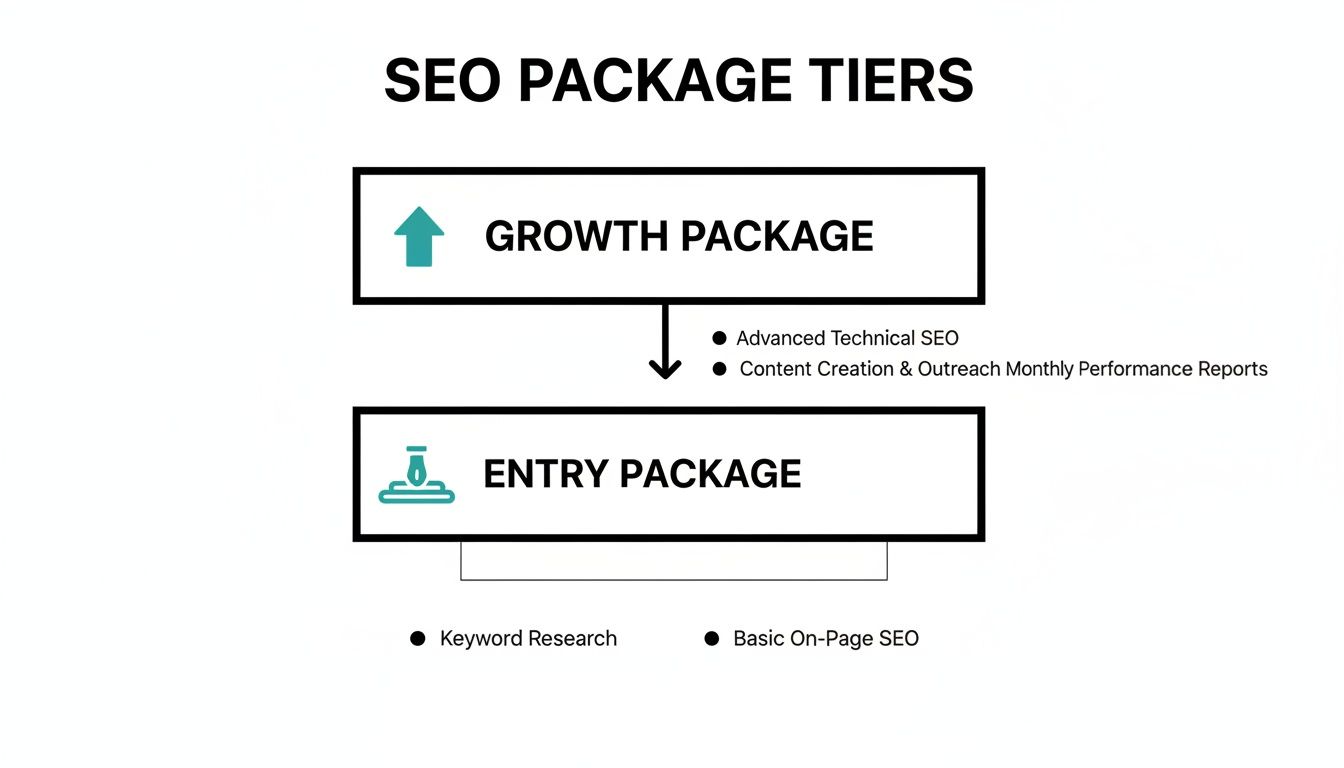
This shows that while an entry-level package builds the must-have foundation, a growth package is what adds the strategic layers needed to make a real dent in the market.
Next up: your website's current state and the competitive jungle you're operating in. A brand-new site needs the basics built from the ground up. On the other hand, a ten-year-old site might need a deep technical clean-up to get rid of legacy issues before you can even think about growth.
Likewise, how tough your market is will dictate the resources required. A local plumber might see fantastic results with a solid local SEO plan. But a company in a cut-throat national market like finance or healthcare? You'll need a much more aggressive and resource-heavy strategy just to get noticed.
A truly customised SEO package is a strategic blend of your business goals, your website's current state, and the competitive reality of your industry. It should feel like a direct response to your specific challenges and opportunities.
When you start having these conversations with potential agencies, you’re no longer just a passive buyer. You become an active collaborator, helping to shape the strategy from the inside. For smaller operations just getting started, understanding the specific tactics involved is key. You can find more details in our guide on SEO services for small businesses to see how these principles apply at a foundational level.
Armed with this clarity, you can confidently evaluate any seo pricing packages that come your way. You'll be able to ask the right questions, push back on generic fluff, and make sure your investment goes towards the activities that will actually drive meaningful results for your business.

When you start digging into SEO pricing packages, you’ll find yourself sifting through a lot of proposals. But here’s the thing: not all providers are on the level, and a slick document can easily mask a flimsy strategy. Knowing what to look for is your best defence against a bad investment.
Think of it like getting a pre-purchase inspection on a car. The shiny paint might look fantastic, but you need someone to pop the bonnet and check for the real problems. These red flags are the SEO equivalent of a dodgy engine—major issues that will cost you big time down the track.
The biggest, most glaring red flag of them all is an ironclad guarantee of a #1 ranking on Google. No one—and I mean no one—can honestly promise this. Search algorithms are incredibly complex, constantly shifting beasts influenced by countless factors that are way outside any single agency's control.
A genuine partner will talk about realistic goals grounded in data. The conversation will be about driving traffic growth, improving lead quality, and generating a tangible ROI—not unbreakable promises.
Another warning sign is an obsession with "vanity metrics." If a proposal fixates on things like keyword rankings for obscure terms or a jump in website traffic without any context, be wary. More traffic is completely useless if it's the wrong audience and none of it converts.
A strong SEO proposal is all about business outcomes. It connects every single activity to the goals that actually matter—like more qualified leads, better conversion rates, and measurable revenue growth—not just metrics that look good on paper.
Transparency is everything. If an agency gets cagey about their methods or calls their strategy a "secret sauce," it's time to get sceptical. Great SEO isn't magic; it’s a disciplined mix of technical skill, smart content strategy, and genuine authority building.
By the same token, vague reporting is a huge problem. A good agency will give you clear, detailed reports that explain what they did, why they did it, and the impact it had. If all you're getting is a basic rankings sheet with no analysis or next steps, it’s a sign they lack strategic depth.
Common red flags to keep an eye out for:
When you do find a proposal that looks promising, the conversation shouldn't just be about knocking the price down. It should be about getting the most value for your investment. Don't be afraid to negotiate the terms to get a better fit for your business.
Here are a few practical ways to approach it:
By learning to spot these red flags and negotiating for value, you can find a transparent, ethical partner who is genuinely committed to helping you succeed.
Stepping into the world of SEO pricing can feel a bit like navigating a maze. There are a lot of terms, a lot of different prices, and a lot of questions. To help you find your way and make a decision you can feel good about, we've put together some straightforward answers to the questions we hear most often.
Patience is probably the most underrated tool in SEO. While you might start seeing some early green shoots—like a few keywords climbing the ranks or a small bump in website traffic—within 3-4 months, the real, business-changing results usually take a bit longer.
We're talking about the kind of results that make a difference to your bottom line, like a consistent stream of qualified leads and a noticeable increase in sales. That level of impact typically takes between 6 and 12 months to really kick in. It’s a bit like an investment fund; the early gains are modest, but as you keep at it, the momentum builds, leading to some pretty substantial and lasting growth. It’s a long game, not a quick win.
This is a classic "it depends" scenario. For a very small local business, say a corner cafe in a town with little online competition, a cheaper package can be a decent foot in the door. It helps get the absolute basics sorted out.
But for most businesses that are serious about growth, these low-cost packages just don't have the horsepower. They're usually missing the strategic thinking, quality content creation, and authority-building that's needed to go toe-to-toe with established players in your market. They'll pour the concrete slab for your house, but they won't build the rest of it.
Low-cost SEO can put you on the map, but it rarely gives you the tools to win the territory. If you're looking to lead your market, not just compete in it, you'll need to invest in a growth-focused strategy.
This really boils down to what you need to achieve right now. A project-based package is your best bet for a specific, one-off task with a clear start and end. Think things like a complete website overhaul, a deep-dive technical audit, or cleaning up a penalty from Google.
A monthly retainer, on the other hand, is for the long haul. It's for continuous, sustained growth. Search engines never stop changing, and you can bet your competitors aren't standing still either. A retainer ensures you have an agency constantly in your corner, building your site's authority, creating new content, and tweaking the strategy to keep you ahead of the curve.
The answer to this one varies wildly depending on the price tag. Your entry-level packages? They often include little to no content creation. The focus is almost always on technical fixes and some basic on-page tweaks.
Move up to the growth and enterprise-level packages, however, and content is almost always front and centre. A strategic content plan is the engine of these packages. Regular creation of genuinely useful blog posts, articles, and other resources is part of the deal because, at the end of the day, quality content is what gets you ranked, attracts customers, and builds your brand's authority.
Ready to invest in an SEO package that drives real business growth? The team at Virtual Ad Agency builds custom strategies designed to turn your website into a powerful customer acquisition channel. Explore our SEO services today.

 previous