
So, what exactly is PPC ad management? Think of it less as a task you tick off a list and more as a constant, hands-on process. It’s all about planning, running, monitoring, and tweaking your pay-per-click ad campaigns to hit specific business goals.
This isn’t a ‘set and forget’ game. It's an active, hands-on discipline that’s squarely focused on getting the best possible return on your investment. The whole point is to make every dollar you spend work as hard as it can, which means a non-stop cycle of testing, digging into the data, and making smart adjustments.
Picture yourself conducting a high-stakes orchestra. Each part of your campaign—the ad platforms you use, your ad copy and images, your bidding strategies, and your audience targeting—is an instrument. For the music to sound right (in other words, for your campaigns to actually make you money), every instrument has to play in perfect harmony. If you just let them do their own thing, you get chaos and a budget that vanishes into thin air.
This is why we move far beyond simple definitions. PPC management is a strategic cycle of careful planning, laser-focused execution, and relentless fine-tuning. It’s designed to put your business in front of the right people at the exact moment they’re looking for what you offer. A passive approach here is a fast track to draining your marketing funds with very little to show for it.
A solid management framework is built on a few key pillars that all work together. If you drop the ball on one, the whole campaign can suffer.
Strategic Planning: Before you even think about launching an ad, you have to define what a win looks like. Is it about getting qualified leads for your sales team? Driving sales directly from your website? Or maybe just making a splash in a new market?
Precise Execution: This is where the rubber meets the road. It involves setting up your campaigns with meticulous attention to detail. We’re talking about everything from choosing the right keywords and structuring ad groups logically to writing ad copy that grabs attention and building landing pages that convert visitors into customers.
Relentless Optimisation: Once your campaigns are live, the real work begins. It means constantly keeping an eye on the performance data, A/B testing different ad versions to see what works best, adjusting your bids, and refining who you’re targeting to improve your results over time.
At its heart, PPC ad management is the art and science of turning advertising spend into measurable business growth. It transforms raw data into actionable insights, ensuring your budget is an investment, not an expense.
Ultimately, this whole discipline is about one thing: results. It ensures your ads aren't just out there being seen, but are actively contributing to your bottom line. It’s the difference between just showing up in paid search and truly owning it.
Great PPC ad management isn't about one magic trick or a single stroke of genius. It's a discipline built on six foundational pillars that all work together in a continuous cycle. Nailing each one is the key to turning your ad spend into predictable business growth. Think of them like the support columns of a building—if one is weak, the entire structure is shaky.
This whole process can be boiled down into three core stages: smart planning, focused execution, and relentless optimisation.
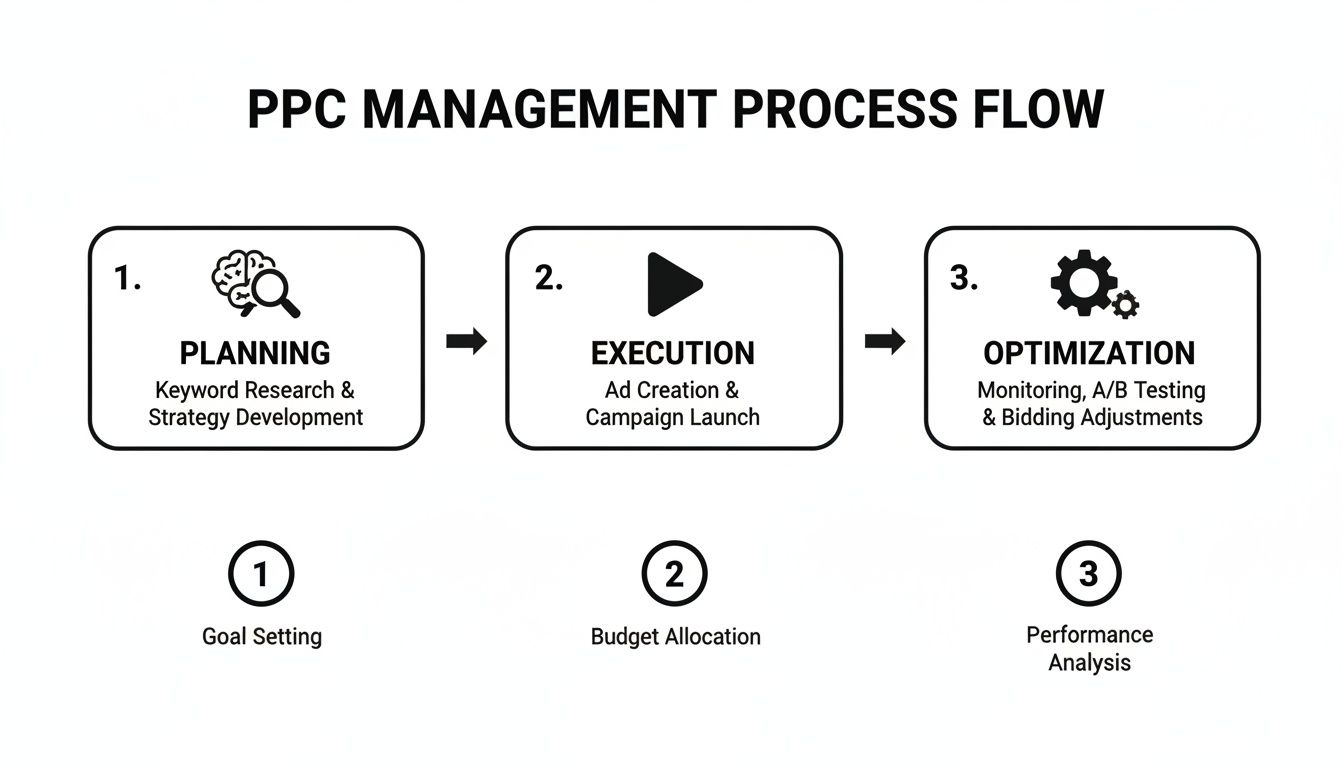
As you can see, this isn't a "set and forget" task. It’s a loop. What you learn from optimisation feeds straight back into your next round of planning, making your campaigns smarter and sharper over time.
Before you spend a single dollar, you need to know what winning looks like. Without clear goals, your campaigns are like a ship without a rudder—just drifting aimlessly and burning through your budget. Solid PPC management starts by translating your big business objectives into measurable advertising outcomes.
Are you trying to generate qualified leads for your sales team? Is it all about driving direct e-commerce sales? Or maybe you’re just trying to build brand awareness in a new market? Each of these goals requires a completely different strategy, from the keywords you chase to the ads you write.
Once your goals are locked in, the next step is finding the right people. The days of blasting a generic ad to a massive, undefined audience are long gone. Modern PPC lets you get incredibly specific with your targeting, moving way beyond simple demographics like age and location.
This is about connecting with people based on their recent search behaviour, their genuine interests, and even their past interactions with your website.
By layering these targeting options, you make sure your message lands in front of the people who are most likely to care, which dramatically improves your campaign's efficiency.
Even with perfect targeting, a boring ad is an invisible ad. Your ad creative—the mix of headlines, descriptions, images, and videos—is your digital handshake. It has to grab attention, communicate value, and inspire action, all in the blink of an eye.
A great ad doesn't just sell a product; it solves a problem. It speaks directly to what's keeping a user up at night and positions your offer as the obvious solution, making that click irresistible.
Getting this right involves constantly A/B testing different headlines, calls-to-action, and visuals to figure out what truly resonates with your audience.
This is where your financial strategy meets data science. It’s not just about how much you spend, but how you spend it. A smart bidding strategy makes sure you’re paying the right price for every click, based on its potential value to your business.
For example, a click from someone searching "emergency plumber Adelaide" is far more valuable than one for "how to fix a leaky tap." Modern platforms like Google Ads offer automated bidding strategies that use machine learning to adjust bids in real-time, aiming to either maximise conversions or hit a specific Return on Ad Spend (ROAS). Budgeting is about smartly allocating your funds to the campaigns, ad groups, and keywords that are actually delivering results, instead of spreading your spend too thin.
You can't manage what you don't measure. This pillar is all about setting up a solid tracking framework to capture useful data on every single part of your campaigns. Without proper conversion tracking, you’re flying blind—you have no way of knowing which campaigns are making you money and which are just wasting it.
Key tracking elements include:
This data is the raw fuel that powers all your optimisation efforts.
Finally, and most importantly, PPC management is never finished. The data you gather from tracking fuels a relentless cycle of testing, learning, and refining. This is the pillar that separates the wildly successful campaigns from the ones that just fizzle out.
Optimisation is an ongoing job. It means pausing underperforming keywords, adjusting bids for high-value audiences, testing fresh ad copy, and tweaking landing pages to improve conversion rates. It’s all about making small, consistent improvements that compound over time to deliver significant, lasting growth.
Picking the right stage for your ads is one of the most critical decisions you'll make in PPC. Not all platforms are built the same; each one caters to a different audience with a completely different mindset. A smart advertiser doesn’t just throw money at one platform and hope for the best. They build a strategy that layers multiple platforms to hit specific business goals.
The biggest difference usually boils down to user intent.
Think of it like fishing. On a platform like Google, you're casting a line where you know the fish are actively looking for bait. That’s high-intent search. On social media, you’re placing attractive lures in a stream where fish are just casually swimming by—what we call passive discovery. Both methods can land a catch, but they need different gear and completely different techniques.
When someone needs an answer or a solution right now, they head straight to a search engine. This is what makes platforms like Google Ads and Microsoft Ads so potent for capturing demand that’s already out there.
Google Ads: The undisputed giant of search. Google Ads gives you access to a staggering volume of daily searches. It’s the go-to for any business wanting to reach a massive audience at the very moment they’re ready to buy. Our detailed guide on Google Ads management dives deep into turning this huge reach into profitable conversions.
Microsoft Advertising (formerly Bing Ads): It’s a smaller pond, but Microsoft's network often reaches an older, more affluent demographic and can be less competitive. For certain industries, this translates to lower costs-per-click and a healthier return on your ad spend.
These platforms are perfect for generating leads, driving e-commerce sales, and for local service businesses where customers are actively looking for a provider. They’re masters of the bottom-of-the-funnel conversion.
Social media, on the other hand, is built for connection and scrolling, not immediate problem-solving. Here, successful ppc ad management is all about interrupting someone's feed with something compelling enough to make them stop and pay attention.
The secret to social PPC is creating demand, not just capturing it. Your ads have to be visually striking and emotionally engaging enough to pull a user out of their feed and into your world.
This approach is brilliant for building brand awareness, launching new products, and getting in front of audiences based on incredibly detailed demographic and interest data.
Meta (Facebook & Instagram): With its powerful visual ad formats and deep well of user data, Meta is a top choice for B2C businesses, especially in e-commerce, retail, and local services. Its targeting lets you build custom audiences with laser-like precision.
LinkedIn: As the premier professional network, LinkedIn is the king of B2B advertising. It's the perfect place to target users by their job title, industry, company size, and professional interests, making it ideal for generating high-value leads.
The cost and best use case for each platform can vary wildly. To help you navigate this, here's a look at how the major players stack up for businesses here in Australia. While a search ad might cost more per click because of the high intent, social ads can be a more budget-friendly way to build general awareness and fill the top of your sales funnel.
| Platform | Primary User Intent | Best For | Targeting Strengths | Typical AU Cost Structure |
|---|---|---|---|---|
| Google Ads | Active Problem Solving ("I need…") | Capturing existing demand, lead gen, e-commerce, local services. | Keyword-based, remarketing, in-market audiences. | CPC (Cost-Per-Click), can be high for competitive terms. |
| Microsoft Ads | Active Problem Solving (often older demographic) | Reaching affluent, professional audiences with less competition. | Similar to Google, but with unique LinkedIn profile targeting. | CPC, often lower than Google for similar keywords. |
| Meta (FB/Insta) | Passive Discovery & Social Connection | Brand awareness, e-commerce, community building, event promotion. | Deep demographic, interest, and behavioural data. Lookalike audiences. | CPM (Cost-Per-Mille) & CPC, generally cost-effective for reach. |
| LinkedIn Ads | Professional Networking & Career Growth | B2B lead generation, account-based marketing, high-ticket services. | Job title, company size, industry, skills, seniority level. | CPC & CPM, typically the highest cost but for high-value leads. |
| YouTube Ads | Entertainment & Education | Brand storytelling, product demos, building brand recall. | Integrates with Google's data; topic, channel, and affinity targeting. | CPV (Cost-Per-View) & CPM, very scalable for video content. |
As you can see, the right choice really hinges on who your customer is, what you're selling, and what you’re trying to achieve.
For Australian businesses, Facebook Ads has proven to be a particularly cost-effective channel. In 2025, the average Cost-Per-Click (CPC) for Facebook Ads in Australia sat around AUD $2.10, with the average Cost-Per-Thousand-Impressions (CPM) at AUD $11.04. These numbers show a real competitive edge, as Australian CPMs were consistently about 21% lower than the global average all year.
When deciding on your platform mix, don't forget the power of video. Platforms like YouTube Ads, managed right inside the Google Ads interface, offer a powerful way to engage audiences with rich, visual stories. The most effective strategies often use both search and social platforms working together, guiding a customer all the way from their first flicker of awareness right through to the final purchase.
It’s easy to drown in data but much harder to pull out any real wisdom. Proper PPC ad management isn't about chasing every metric under the sun. It's about zeroing in on the key performance indicators (KPIs) that directly link your ad spend to actual business outcomes. Too many advertisers get sidetracked by vanity metrics like impressions or clicks, but let's be honest, those numbers don't pay the bills.
The real story of your campaign’s success is told through the numbers that measure profitability and efficiency. When you shift your focus from surface-level activity to bottom-line impact, you start making smarter, data-backed decisions that drive genuine growth. This leads to more strategic conversations about performance and lets you optimise for what truly matters.
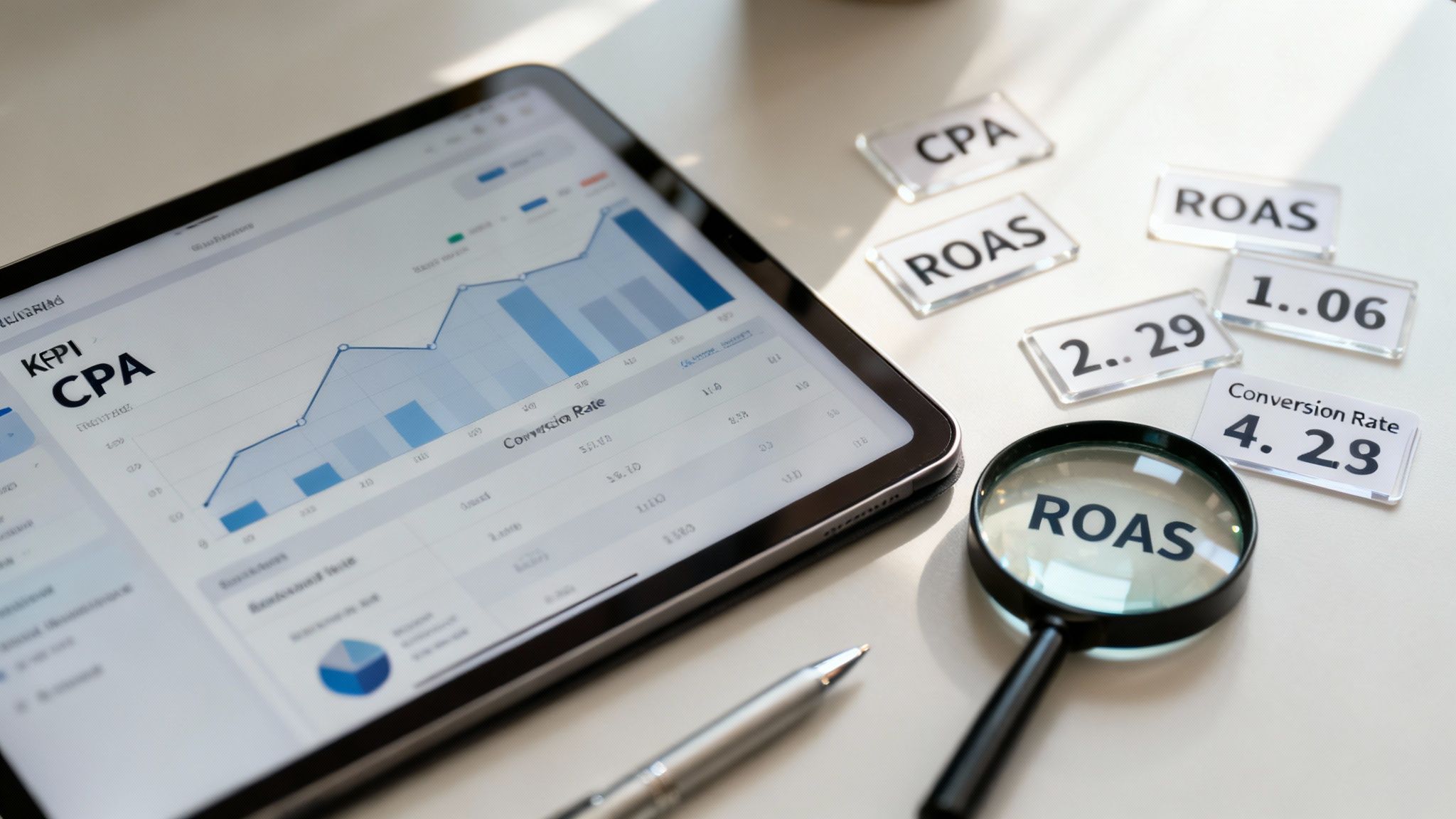
Impressions and clicks feel good. They show your ads are live and getting attention. But on their own, they’re just half the story. An ad can get thousands of clicks and still be a total failure if none of those clicks turn into customers. The first step toward meaningful measurement is learning to tell the difference between activity metrics and business metrics.
The most dangerous number in business is a big one that doesn't matter. In PPC, focusing solely on clicks without tracking conversions is like celebrating the number of people who walk into your shop without checking if anyone actually buys something.
To truly get a handle on performance, you have to prioritise the KPIs that reflect the financial health of your campaigns.
These are the numbers that should live on your main dashboard. They cut through the noise and tell you whether your PPC efforts are a profitable investment or just an expensive hobby.
Conversion Rate: This is the percentage of clicks that lead to a meaningful action—a sale, a lead form submission, a phone call. A high conversion rate is a great sign that your ad message and landing page are perfectly in sync with what your audience wants.
Cost Per Acquisition (CPA): Sometimes called Cost Per Conversion, this tells you exactly how much you spend, on average, to get one new customer or lead. A winning campaign consistently keeps its CPA well below the lifetime value of that customer.
Return on Ad Spend (ROAS): This is the ultimate test of profitability. For every dollar you put into ads, how many dollars in revenue are you getting back? A 4:1 ROAS means you're generating $4 for every $1 spent. Simple as that.
Click-Through Rate (CTR): While clicks alone aren't enough, CTR is still a vital health check. It measures the percentage of people who see your ad and actually bother to click it. A strong CTR signals that your ad copy is relevant and compelling to your target audience. You can get a deeper look into this metric in our guide on what is Click-Through Rate.
Knowing what "good" looks like is critical for judging your own performance. Google Ads is still the dominant force in Australia, and local benchmarks give your campaigns valuable context. For instance, in 2025, Google Ads hit an impressive average Click-Through Rate (CTR) of 6.42% across all industries, a solid jump from previous years.
For Australian businesses, aiming for average Google Ads conversion rates of 7–8% is a healthy target. Realistic goals for Return on Ad Spend often land between a 2–4x ROAS for e-commerce and retail, and a 3–6x ROAS for professional services. This really highlights why expert ppc ad management is so crucial for getting the most out of your budget.
A great report does more than just throw data on a page; it tells a clear and concise story about performance. Instead of overwhelming your team or clients with massive spreadsheets, build dashboards that visualise the KPIs that matter most. Use charts to show trends over time for ROAS and CPA.
The goal here is to provide actionable insights, not just raw data. Your report should answer key business questions like:
To understand the full impact of your PPC campaigns, you need to look beyond the ad platforms themselves. A solid analytics setup is non-negotiable. For getting the most out of your data, consider resources like this guide on mastering Google Analytics. It's an essential tool for tracking the entire customer journey, connecting ad performance to on-site behaviour so you can make smarter decisions and prove the true value of your advertising.
Sooner or later, every business running paid ads hits a major crossroad: who should actually manage the campaigns? Do you build a team of experts inside your own walls, or do you bring in a specialised agency? There’s no easy, one-size-fits-all answer here. The right choice is all about your company’s resources, what you’re trying to achieve, and how fast you plan to grow.
This isn’t just a simple cost comparison. It’s a strategic choice that weighs up deep expertise, access to powerful tech, and the ability to scale up (or down) as needed. Let’s unpack the pros and cons of each path to figure out which one makes the most sense for you.
Bringing your PPC management in-house offers one massive advantage: total control. An internal team lives and breathes your company culture every single day. They know your products inside and out and can pivot on a dime when your business strategy changes. That direct line of communication is hard to beat.
But make no mistake, building a proper in-house PPC team is a serious commitment. It’s rarely about hiring just one person and calling it a day.
To really nail it, you need a mix of specific skills:
Pulling this off means a hefty investment in salaries, benefits, ongoing training, and the professional development needed to keep their skills from going stale.
Hiring a dedicated PPC agency is like plugging a ready-made team of seasoned specialists directly into your marketing department. You get instant access to a deep well of knowledge they’ve built from managing campaigns across dozens, if not hundreds, of different industries and accounts. They’ve seen what works—and what spectacularly fails—in countless situations.
This diverse experience means they can bring fresh ideas and sophisticated strategies to your campaigns that an in-house team might never have come across.
An agency's true value is its collective intelligence. You’re not just getting one campaign manager; you’re getting the combined brainpower of their entire team, their battle-tested processes, and their expensive suite of analytical tools you wouldn't buy for yourself.
On top of that, agencies are built to scale. When you’re ready to double your ad spend or expand onto three new platforms, a good agency has the people and systems to handle it without skipping a beat. They already have the frameworks in place to manage complex, multi-channel campaigns effectively.
So, how do you make the call? It all comes down to an honest look at where your business is today and where you want it to be tomorrow. A small business with a tight budget might start in-house to learn the ropes, while a company in hyper-growth mode might need an agency’s firepower just to keep up.
Ask yourself these four key questions to guide your thinking:
Ultimately, the choice is a balancing act between control and expertise. If you have the resources and patience to build your own dream team, going in-house offers incredible brand alignment. But if you want immediate access to specialised knowledge and a proven roadmap for growth, partnering with a professional pay-per-click agency is often the faster, more reliable path to a strong return on your investment.

Picking a PPC agency isn't just about handing over a task; it's about finding a strategic partner who will be right there in the trenches with you, driving a critical part of your business growth. With so many agencies out there, it’s easy to get overwhelmed. A great one becomes a true extension of your own team, genuinely invested in seeing you win.
A smart decision goes way beyond a slick sales pitch. It means digging into the real nuts and bolts of what makes an agency effective. You need a partner who gets the mechanics of PPC ad management, sure, but who also understands your industry, your customers, and what you’re ultimately trying to achieve as a business.
First things first: have they done this before in your world? An agency with a proven track record in your industry already knows the lay of the land—the competitors, the customer habits, and the unique hurdles you're up against. They won't be learning on your dime.
Ask to see specific case studies from clients who have a similar business model or the same goals as you. You're looking for clear, tangible proof of their process and, most importantly, results you can measure.
This initial homework helps you filter out the noise and focus on agencies that have already proven they can deliver in a space that matters to you.
Clear, consistent communication is the absolute foundation of a healthy agency relationship. You should never be left wondering how your campaigns are doing, what changes are being made, or what the plan is for next month. Any vagueness here is a massive red flag.
A trustworthy agency operates with total transparency. Their reports should tell a clear story about performance, focusing on business outcomes like leads and revenue, not just vanity metrics like clicks and impressions.
When you're chatting with them initially, don't be shy about asking direct questions about their processes. A good partner will welcome this and have confident, straightforward answers ready to go.
To really understand what an agency is made of, you have to ask the right questions. These are the queries that cut through the fluff and show you how they think, strategise, and operate on a day-to-day basis.
By running through this checklist, you can move past generic pitches and find a genuine partner for your PPC ad management. This is how you pick a team that’s truly equipped to help you hit your goals.
Diving into the world of paid advertising always brings up a few key questions. It's only natural. Getting your head around these common queries is the first step to building a solid, successful PPC strategy and cutting through the jargon. Let’s tackle some of the most frequent questions we hear.
Honestly, there’s no single magic number. The right budget really depends on your industry, your specific business goals, and just how crowded your market is.
A really practical way to get started is to figure out your target Cost Per Acquisition (CPA) and simply work backwards from there. For example, if you make $100 profit on a product, you might decide you’re comfortable spending up to $40 to land a new customer. This gives you a tangible figure to build a monthly budget around based on how fast you want to grow. We always recommend starting with a smaller test budget, seeing what the initial data tells you, and then confidently scaling up the campaigns that are actually working.
While you'll see clicks and impressions almost straight away, getting real, meaningful business results doesn't happen overnight. It’s best to think of the first one to three months as a crucial data-gathering and learning phase.
Think of the first 90 days as your campaign's 'schooling' period. This is when your PPC manager is busy refining your targeting, testing different ad copy, and tweaking bidding strategies based on what real people are actually doing.
Within this window, you should start to see clear performance trends and a tangible return on your investment. From that point on, your results should just keep getting better as the campaigns are fine-tuned with more and more data.
PPC and SEO are two sides of the same search marketing coin. They each play a very different, but equally important, role.
PPC (Pay-Per-Click): This is all about paying for ads to show up right at the top of the search results. It's designed to get immediate, highly-targeted traffic flowing to your website.
SEO (Search Engine Optimisation): This is the organic, long-game approach of optimising your website to rank higher in the unpaid search results. SEO builds sustainable, long-term traffic but it definitely takes more time to get things moving.
A truly effective digital strategy uses both. PPC can bring in quick wins and uncover valuable keyword data that can feed your SEO efforts, while SEO builds that foundational brand authority and what many call 'free' traffic over the long haul.
Ready to stop guessing and start getting real results from your paid advertising? The expert team at Virtual Ad Agency specialises in full-funnel marketing strategies that drive measurable growth. Let us build and manage a PPC campaign that delivers the return on investment you've been looking for. Find out how we can help your business today.

 previous