
A pay per click agency brings together a specialist team focused on turning your ad spend into clicks, conversions and lasting growth. They take charge of your bidding strategy, creative testing, campaign optimisation and performance tracking, so you can concentrate on running your business. With expert eyes on every click, you pay only for tangible outcomes.

Imagine your business as a ship cutting through a crowded sea of ads and noise. A PPC agency acts like a seasoned navigator, plotting the most efficient course. Every bid tweak and creative update serves as a course correction that steers you toward more profitable waters.
Key Benefits:
“Specialists accelerate results by focusing on data, not guesswork.”
These processes ensure your campaigns adapt as markets shift and competitors react. Next, we’ll dive into each core service, outline expected outcomes and KPIs, and guide you through picking the ideal agency partner. Stay tuned for sections on service offerings, pricing models, selection checklists and real-world ROI examples.

Imagine your PPC agency as a racing pit crew. One moment your ads cruise; the next, a bid tweak or fresh A/B test gets you back on pole position.
Before diving into advanced tactics, it’s worth unpacking how we bring clients onboard, set KPIs and kick off ongoing optimisation loops.
Onboarding kicks off with a full campaign audit. This uncovers quick wins and highlights where your budget can work hardest.
Next, we map out goal hierarchies—think awareness, consideration and conversion—so every ad channel has a clear mission.
Goals need numbers. That’s where KPIs come in.
Common indicators include click-through rate (CTR), cost-per-click (CPC) and conversion rate. For instance, an early benchmark might be a 2.5% CTR to gauge initial traction.
Learn more about click-through rate in our guide on click-through rate.
From there, the focus shifts to continuous testing—experimenting with ad copy, refining keyword match types and reallocating budget to top performers.
“Precision in PPC comes from never settling—there’s always a faster tyre change or cleaner line to try.” – PPC Specialist
Australia’s digital ad spend hit AUD 16.4 billion in 2024, underlining why businesses are investing in expert management for search and social campaigns (source).
Optimisation follows a simple loop: analyse, test and implement.
First, we review keyword performance by match type to find overlooked opportunities. Then, we run small-batch tests on headlines, descriptions and calls to action. Finally, the winning variants roll out at scale while underperforming elements are paused.
| Tactic | Purpose | Outcome |
|---|---|---|
| Exact Match Tweaks | Focus spend on high-value searches | 15% drop in wasted spend |
| Audience Refinement | Zero in on high-intent segments | 20% boost in conversions |
| Bid Modifier Adjust | Raise bids during peak hours | 12% lift in impression share |
Every pit stop counts. Typical agency actions include:
Choosing the right match type is crucial.
Mastering this blend sets the stage for precision bidding and more sophisticated strategies down the track.
An online retailer paired match-type tuning with audience segmentation. Within eight weeks they tripled ROAS and slashed CPA by 25%, proving that small adjustments can deliver big gains. This foundation paves the way for deeper optimisation in later phases.
PPC agencies cover every stage of the customer journey, from discovery through to conversion and loyalty. Think of each channel as a musician in an orchestra—search ads, shopping, display, remarketing, programmatic and social ads each bring their own melody. Together, they create a seamless path that guides prospects naturally towards a purchase.
Search campaigns respond the moment someone types their question into Google or Bing. A local retailer dialled in exact-match keywords and saw online sales double in just two months. At the same time, average CPC dropped by 18% and conversions jumped 42%.
Shopping ads turn search results into mini storefronts, showing an image, price and link all at once. After a B2B supplier refreshed its product feed, demo requests climbed 30%. Over on the display network, a service provider used banners and video spots to lift site visits by 25% and cut bounce rates.
Remarketing leaves digital breadcrumbs that lead past visitors right back to your site. A local gym recaptured 40% of abandoned sign-ups with a dynamic ad sequence. Programmatic buys, by contrast, use real-time bidding across ad exchanges—this retail chain ramped up impressions fivefold while shaving 25% off CPM.
“Remarketing reconnects your brand with curious visitors.” – Digital Marketing Expert
Social platforms like Facebook, LinkedIn and Instagram let you meet audiences where they already spend their time. By combining precise targeting with dynamic formats—video, carousel or full-screen stories—Australian advertisers hit an average 1.74% CTR over the year to December 2025 (ranging from 1.43% to 2.07%). Learn more about Facebook CTR trends on SuperAds.
Below is a quick comparison of these core PPC services. Use it to guide your channel mix and budget allocation.
| Service Type | Platform | Key Metric |
|---|---|---|
| Search Ads | Google Ads, Bing | CTR, CPC |
| Shopping Campaigns | Google Shopping, Microsoft Ads | Conversion Rate |
| Display Networks | Google Display Network, DV360 | Impression Lift |
| Remarketing Ads | AdRoll, Google Ads | Re-engagement Rate |
| Programmatic Buys | DSPs like The Trade Desk | CPM |
| Social Ads | Facebook, LinkedIn, Instagram | 1.74% CTR |
Each service slots neatly into the next, reducing waste and reinforcing your message at every touchpoint. Search ads capture high-intent buyers. Shopping and display build awareness. Remarketing and programmatic re-engage prospects. Social ads spark conversations. Together, they form a full-funnel strategy that performs like a well-choreographed symphony.
Up next, we’ll unpack pricing models—from flat management fees to performance-based structures—outlining pros, cons and which client profiles suit each.
Choosing the right fee structure can feel like picking the perfect running shoes—it directly impacts your ROI visibility and how closely your agency runs alongside your goals.
Most pay-per-click agencies lean on four main fee structures. Each one shifts risk and reward in different ways.
Flat Management Fee
A consistent monthly retainer that covers campaign setup, ongoing optimisation and regular reports. You know exactly what you’ll pay each month.
Percentage Of Ad Spend
Fees move in step with your budget—typically 10%–20% of ad spend. As your campaigns grow, so does the agency’s reward.
Performance Based Fee
Costs link to real outcomes like cost per acquisition (CPA) or return on ad spend (ROAS). Agencies only get paid when they hit your targets.
Blended Rate
Combines a modest base retainer with bonus elements tied to performance metrics. You get both stability and motivation under one roof.
Below is a side-by-side look at agency fee structures and their ideal use cases to help you pick the right approach.
| Model | Fee Structure | Ideal Use Case |
|---|---|---|
| Flat Management Fee | Fixed monthly retainer covering setup, ongoing optimisation and reporting | Small e-commerce or budget-sensitive businesses |
| Percentage Of Ad Spend | Scaled fee of 10%–20% of ad budget | Growing mid-market brands looking for scalable investment |
| Performance Based Fee | Fees tied to CPA or ROAS targets | High-volume advertisers who want pay-for-performance |
| Blended Rate | Base retainer plus variable performance component | Businesses seeking balance between predictability and incentive |
Use this table to quickly match your budget style and growth ambitions with the right fee model.
Flat Management Fee
Pros: Predictable spend, easy budgeting.
Cons: Agency may lack urgency when volumes dip.
Percentage Of Ad Spend
Pros: Grows with your budget, keeps goals aligned.
Cons: Costs can spike in peak seasons or large campaigns.
Performance Based Fee
Pros: Agency motivation peaks—if you win, they win.
Cons: Variable billing if targets aren’t met, forecasting gets tricky.
Blended Rate
Pros: Stability plus upside, shared risk.
Cons: Complexity can muddy financial forecasts.
Picture a boutique online retailer with tight monthly budgets. A flat fee offers peace of mind—even if ad volumes wobble, their cost stays steady.
Now imagine an enterprise brand driving thousands of clicks daily. A performance-based approach rewards the agency only when they hit ambitious ROAS goals. It’s a natural fit for high-volume campaigns.
Before you dive in, your agency should set clear KPI targets based on past performance. Common metrics include:
In Australia, Google Ads average CPCs range from about AUD 1.82 for retail campaigns up to AUD 13.37 for finance keywords. Agencies often bundle vertical-specific packages or offer conversion guarantees to safeguard margins. For more on local ad costs, check out the Marketing Statistics in Australia.
New or budget-conscious businesses usually start with flat fees. It caps costs and keeps planning straightforward.
Fast-scaling enterprises with flexible budgets often favour performance-based deals. Sharing risk and reward can turbocharge growth—just make sure everyone agrees on the measurement criteria from day one.
Start with the right fee structure to keep goals aligned and friction at bay.
Consider where you are on your growth journey. Then pick the model that best supports your next phase.
Check out our guide on How Much Does Advertising On Google Cost for a detailed walkthrough of budgeting strategies and common pitfalls when planning ad spend.
Picking a pay-per-click partner can feel like sorting through dozens of trial offers. Break the process into clear steps, and suddenly you’ll see which agencies really know your goals.
Use this checklist as your baseline for side-by-side comparisons.
Before you sign on the dotted line, dig into their day-to-day methods. Ask:
“Clarity in reporting builds trust; insist on seeing raw data exports.” – PPC Consultant
Keep an eye out for warning signs that an agency may overpromise and underdeliver.
These red flags often point to misaligned priorities.
| Criteria | Ideal Indicator |
|---|---|
| Conversion Tracking Setup | Event-based tracking in Google Tag Manager |
| Performance Guarantees | Benchmarked to your historical metrics |
| Account Support Structure | Named manager with clear communication plan |
Below is an infographic showing common agency pricing models and how to pick the right one based on your budget and risk appetite.
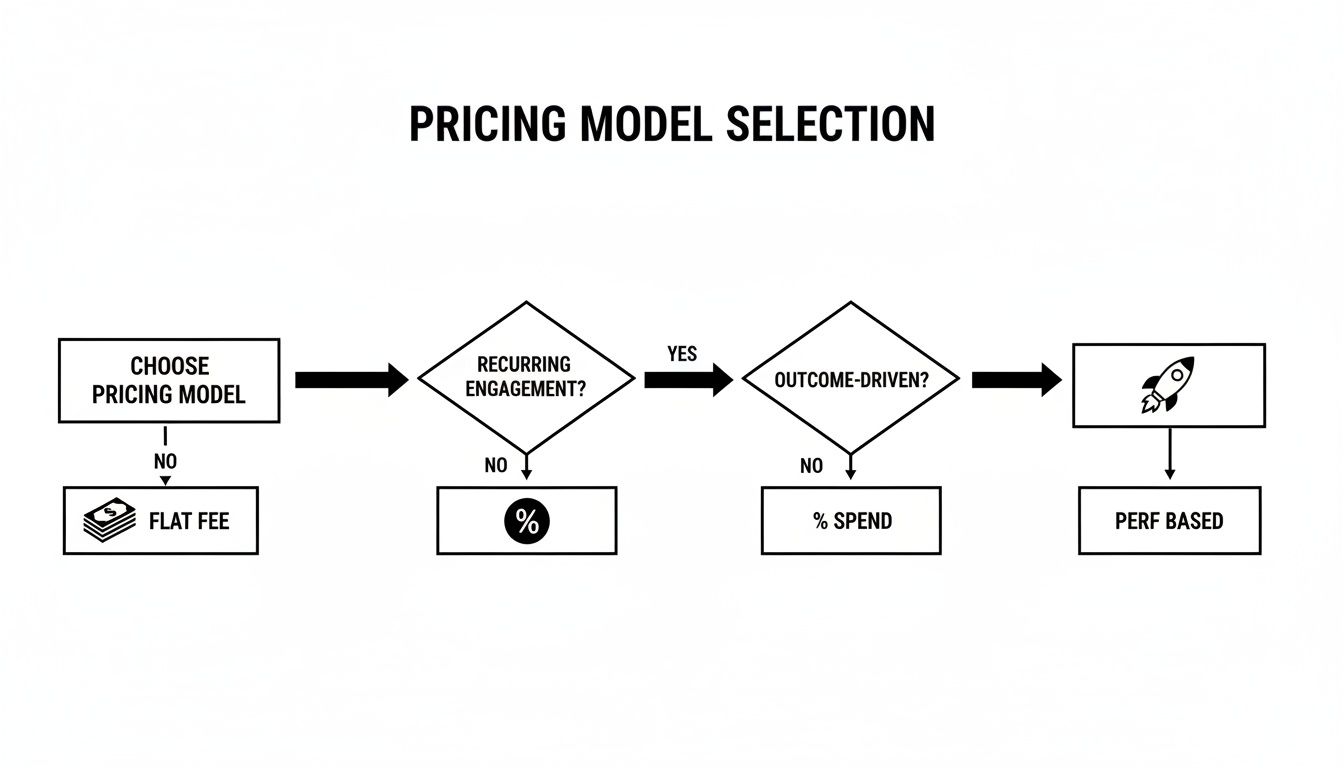
This decision tree visualises three models: flat fee, percentage of spend, and performance-based. Align your fee structure with budget flexibility to keep incentives in tune with performance goals.
A true extension of your team will map its services directly onto your objectives.
A structured alignment process ensures your agency acts as part of your in-house team.
Learn more about Google Ads consulting in our detailed guide on Google Ads Consulting.
With all your research in hand, it’s time to choose.
“Securing alignment early prevents misunderstandings and boosts campaign momentum.” – Marketing Director
Cultural fit matters—pick an agency whose working style matches your internal team. Regular check-ins and performance reviews keep you in control of campaign direction. Remember: the best agency communicates clearly and adapts quickly.
Your chosen pay-per-click agency becomes an extension of your team, helping you scale securely and with full confidence.
For businesses in Australia, the right pay-per-click agency cuts waste, scales campaigns effectively and turns clicks into measurable, sustainable revenue growth.

Think of these as front-line stories showing how a pay-per-click agency drives measurable growth. Each snapshot breaks down the initial hurdle, the tactics we deployed, the budget involved and the results we tracked.
A national retailer was watching acquisition costs creep up in an overcrowded market. We dove into the data, tested ad variations and fine-tuned bids to make every dollar count. By week eight, the cost to acquire a customer had plummeted by 30%, padding their profit margin.
Key Metrics:
“Working with Virtual Ad Agency we gained clear insights and rapid cost savings.”
Next, a B2B SaaS provider needed more high-quality trial sign-ups. We mapped intent-driven keywords, overhauled landing pages and ran iterative A/B tests on calls to action. The result? Lead volume doubled while cost per lead dipped 25%, and the MQL rate jumped 45%.
Key Figures:
“Iterative tests empower fast improvements in lead quality.” – Marketing Lead
Finally, a local service brand wanted more bookings without expanding its ad budget. We built a layered remarketing sequence and shifted bids to peak hours. The outcome was a 5x return on ad spend, a 60% bump in bookings and a 20% drop in CPA.
Impact Summary:
“Strategic remarketing unlocked our most profitable audience segment.” – Small Business Owner
In a nutshell, these examples show how a focused pay-per-click approach pays off across retail, B2B and services.
What We Learned:
| Case Study | CPA Change | Lead Growth | ROAS |
|---|---|---|---|
| Retail | -30% | N/A | 4:1 |
| B2B | N/A | +100% | N/A |
| Service | -20% | N/A | 5x |
These highlights underline the real ROI potential when you team up with a specialist pay-per-click agency like Virtual Ad Agency.
Start by checking your current CPA, CTR and conversion rates against these benchmarks. Then plan small experiments around ad copy, targeting and bid strategies to see what truly moves the needle.
Here’s a quick roadmap:
Ready to replicate these successes? Contact Virtual Ad Agency today for a complimentary ROI review and a custom action plan.
Our team applies deep data diagnostics, continuous A/B testing and smart bid management across search, shopping, display, remarketing, programmatic and social ads. Discover how we can cut your CPA, double your leads or drive a 5x ROAS for your business.
Start your PPC audit
Curious how a PPC agency spends its days? Think of them as your digital pit crew: they fine-tune your ads, adjust bids and steer campaigns across multiple channels.
This full-service setup means you have an expert at every turn, ensuring nothing slows down your ad performance.
Just like a car’s dashboard, you need clear indicators. The main gauges are CTR (click-through rate), CPC (cost per click) and ROAS (return on ad spend).
Watching these metrics over time highlights which levers to pull and where to redirect your budget.
Fees usually follow one of three approaches—pick what aligns best with your goals and cash flow.
Every model affects transparency and how motivated your agency will be to hit your numbers.
Much like planting a garden, you won’t harvest overnight. Patience pays off.
External factors—such as competition and daily budget—can speed things up or slow things down.
“You’ll often notice real improvements right after the first optimisation cycle.”
Feel free to tweak campaigns anytime. A quick call to your account manager lets you shift budgets, swap creatives or pause keywords on the fly.
Ready for expert PPC support? Get in touch with Virtual Ad Agency for a free audit.

 previous