
Think of SEO services as your secret weapon for getting noticed online. For a small Aussie business, it’s all about making sure that when a local customer jumps on Google looking for what you sell, your website is front and centre. It's the ultimate way to punch above your weight and take on the big guys.

Imagine search engine optimisation (SEO) as getting the best shopfront location in a massive digital shopping centre. It isn't some dark art filled with techy tricks or keyword stuffing; it's a core business strategy that connects you with customers at the very moment they need you.
When someone in Perth types "emergency plumber" into their phone, or a tourist in Melbourne searches for the "best cafe near me," SEO is what puts your business on their screen as the answer.
For a small business, this kind of visibility is a total game-changer. Unlike old-school advertising where you're shouting your message to anyone who'll listen, SEO pulls in people who are already looking for what you do. That means you’re talking to warm leads who have a problem you can fix, right now.
One of the best things about a smart SEO strategy is how it lets you go toe-to-toe with national chains and massive corporations. A local, family-run shop can absolutely outrank a corporate giant in local search results simply by being more relevant to the neighbourhood. It all comes down to leaning into what makes your business unique and valuable to your specific customers.
This guide will walk you through the essential ideas you need to get real, tangible growth, including:
SEO gives you the power to show up when it matters most, turning your website from a simple online brochure into a consistent source of leads and sales. It's an investment in a long-term asset that grows in value over time.
Businesses all over the country are catching on. The Australian SEO industry has ballooned to a market value of around $1.5 billion, jumping a massive 12% in just one year. That kind of rapid growth shows just how seriously Aussie businesses are taking search to stay ahead of the competition.
You can dive deeper into the state of Australian marketing with this comprehensive industry report. By getting a handle on effective SEO, you’re positioning your business to grab a slice of this massive and very active online market.
Investing in SEO services for small businesses can feel a bit abstract. What are you actually paying for? It helps to think of it like building a successful physical shop—it’s not one single thing, but four core pillars working together to create a powerful online presence.
To help you visualise this, the infographic below shows how the key pillars of SEO—local search, content, and site performance—form the foundation of your digital storefront.
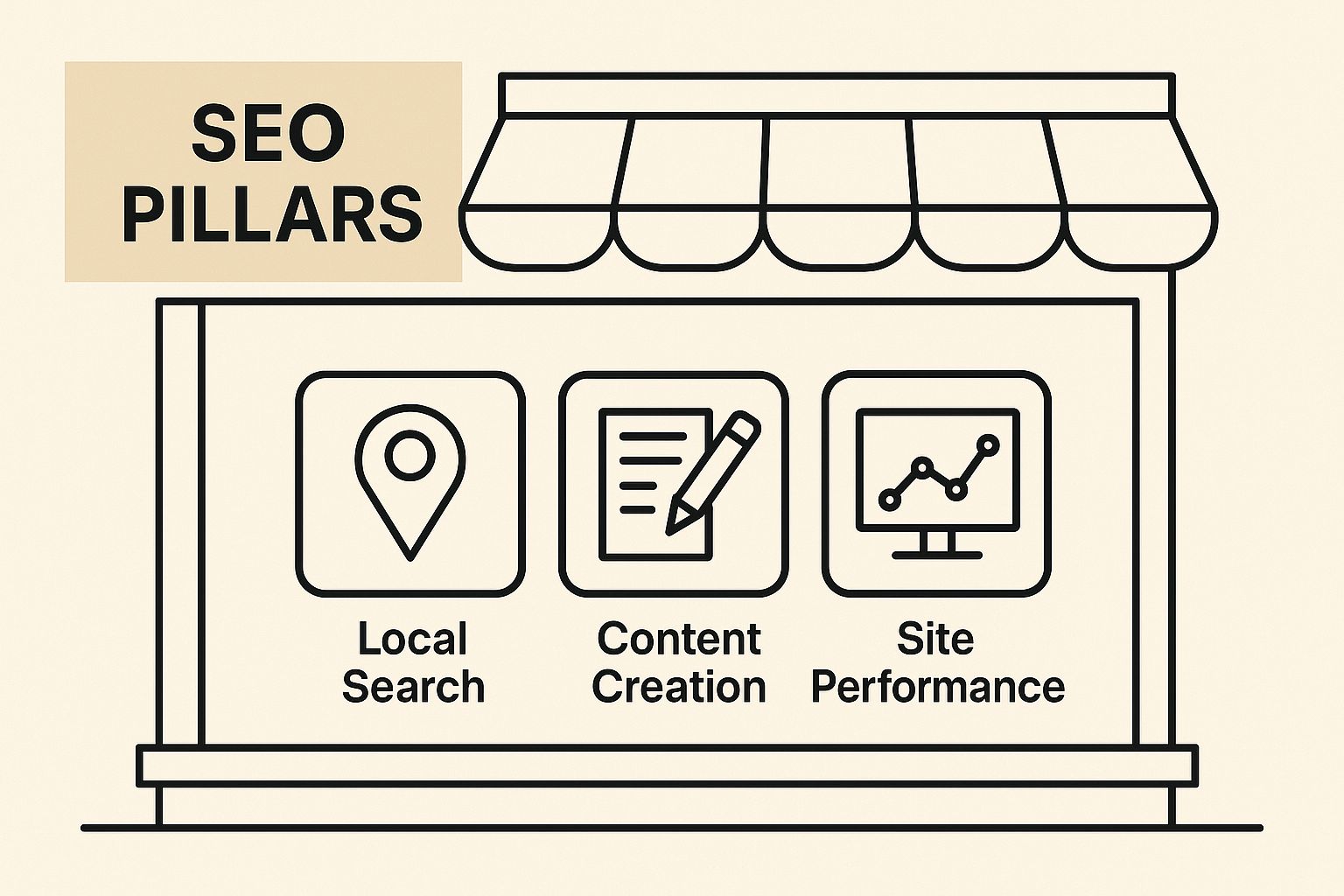
This gives you a great snapshot of how each element helps to attract customers, from getting found by locals to making sure your website is a welcoming and functional place to be. Let's break down exactly what that means for your business.
To make sense of it all, here's a quick look at the essential SEO services, what they aim to do, and the real-world impact they have on a small business.
| SEO Service | Primary Goal | Key Activities | Business Impact |
|---|---|---|---|
| Technical SEO | Ensure search engines can easily crawl, understand, and index your site. | Site speed optimisation, mobile-friendliness, fixing crawl errors, XML sitemaps. | A better user experience, higher rankings, and ensures your content can be found. |
| On-Page SEO | Optimise individual web pages to rank higher and earn more relevant traffic. | Keyword research, content creation, title tags, meta descriptions, internal linking. | Attracts your target audience, answers their questions, and guides them to take action. |
| Local SEO | Increase visibility in local search results and Google’s "Map Pack." | Google Business Profile optimisation, local citation building, managing reviews. | Drives foot traffic and local online leads from customers in your service area. |
| Off-Page SEO | Build your website's authority, credibility, and reputation online. | Earning backlinks from reputable sites, brand mentions, guest posting. | Boosts search rankings, builds trust, and establishes you as an industry leader. |
Now, let's explore what each of these pillars looks like in practice.
Think of Technical SEO as the structural integrity of your building. It’s the plumbing, the wiring, and the solid foundation that everything else is built on. While customers might not see it directly, they absolutely feel its effects when things go wrong.
This pillar is all about making sure search engines like Google can easily crawl, understand, and index your website. Without a solid technical setup, even the most beautiful site or brilliantly written content might as well be invisible.
Key jobs include:
A technically sound website delivers a smooth, frustration-free experience, which is a massive signal to Google that your site is high-quality and worth showing to people.
If Technical SEO is your foundation, then On-Page SEO is your shop’s interior design and eye-catching window display. This is all about optimising the elements on your website that customers (and search engines) actually see.
It involves creating content that isn't just valuable to your audience but is also structured in a way that helps Google understand what it’s all about. This means strategically using keywords in your page titles, headings, and throughout your text. But more importantly, it's about writing genuinely helpful blog posts, service pages, and product descriptions that answer your customers' questions and solve their problems.
On-Page SEO is the art of communicating value. It’s how you tell both Google and your potential customers, "This is what I do, and this is why I'm the best choice for you."
For a deeper dive into crafting content that connects and converts, check out our guide on SEO optimisation best practices.
For most Australian small businesses, Local SEO is the absolute game-changer. This is the process of fine-tuning your online presence to attract more customers from relevant local searches, like "best coffee in Adelaide" or "plumber near Belrose".
The main goal? To land your business in Google’s "Map Pack"—that prime real estate at the top of the search results showing three local businesses.
This involves:
It's no secret that Local SEO is one of the most powerful strategies for Aussie small businesses. In fact, data shows the local service sector has boosted its average SEO budget by a massive 29% year-over-year, which tells you everything you need to know about its value.
Finally, Off-Page SEO is all about building your website’s authority and reputation across the web. Think of it as word-of-mouth marketing for the digital age. It mainly revolves around earning backlinks—which are simply links from other reputable websites pointing back to yours.
When another quality website links to you, it’s like a vote of confidence in the eyes of search engines. It tells Google that your content is trustworthy, credible, and valuable. A strong backlink profile can seriously boost your rankings, proving that you’re a genuine authority in your field.
To really get to grips with what makes SEO tick, you can explore some great, practical insights into five ways to improve your website’s SEO and see how other local businesses are getting it right.
To really get SEO right, you have to get inside your customer's head. You need to understand how they think, what they need, and how they go about finding it. The old days of someone typing a simple two-word search into Google are pretty much gone. Today’s customers are way more specific.
This is a massive shift for any small business. It’s no longer good enough to aim for a generic term like "Sydney cafe." You have to be the answer when someone pulls out their phone and asks, "Where can I find the best dog-friendly cafe in Surry Hills?" This is the new reality of search, and it’s all about providing direct, genuinely helpful answers.
Getting your head around this modern search behaviour is the first real step to building a strategy that works. It's about changing your focus from just 'ranking' to becoming the most trusted and relevant solution to your customers' very specific problems.
People now search the way they speak. Instead of using clunky, robotic keywords, they ask full-blown questions. This is largely thanks to the explosion of voice search on smartphones and smart speakers, which has completely rewired how we talk to search engines.
It's a big deal. About one-third (33%) of Australians use voice search every single day, often looking for local businesses and services. These searches are almost always longer, conversational phrases—think 6 to 10 words long. This trend means small businesses have to adapt, focusing their content on natural language and question-based keywords.
This conversational style directly influences how Google serves up answers. The search engine’s main goal is to give the most direct, useful answer it can find. Often, this comes in the form of a featured snippet—that prized box right at the top of the results page that gives a quick, clear-cut answer.
To have any chance of landing in these snippets, your website content needs to be structured to answer specific questions with authority and clarity.
So, how do you actually do this? It's more straightforward than you might think.
By focusing on providing answers, you're aligning your website perfectly with how real people search, which massively boosts your chances of being found.
"Modern SEO is less about tricking algorithms and more about genuinely helping people. When your website becomes the most helpful resource for your target audience, Google rewards you with visibility."
In the online world, trust is everything. Before a customer even thinks about visiting your shop, calling for a quote, or booking your service, you can bet they’re checking your online reviews. Your reputation isn't just built by word-of-mouth anymore; it's on full display for everyone on Google, Facebook, and other industry sites.
Having plenty of positive reviews and a high star rating does more than just win over new customers—it also gives your search rankings a direct boost. Google sees a business with lots of recent, positive feedback as a credible and trustworthy choice, making it far more likely to feature you in local search results. This is a non-negotiable part of a solid digital strategy. For a wider view, it's worth exploring the top digital marketing tips for small businesses to see how everything fits together.
Ultimately, it all comes back to understanding the customer's journey. By mapping out every step they take—from first hearing about you to making a purchase—you can build a much more effective marketing strategy. We dive deeper into this in our guide on what is customer journey mapping. This approach ensures you’re there with a helpful answer at every critical moment.
Choosing an SEO provider is one of the biggest marketing decisions you’ll make. It can feel like walking through a minefield of tech jargon and over-the-top promises, but finding a genuine partner who gets your business is absolutely critical.
You're not just hiring a service; you're looking for a team that acts like an extension of your own. They should be just as invested in your growth as you are, ready to lay out clear strategies and deliver results you can actually measure against your business goals.
To make the right call, you need a solid framework for checking out potential agencies. It's about looking past the slick sales pitch and really digging into their process, their history, and how they communicate.
First things first, look for proof they can do the job. A reputable SEO agency will be proud to show you their work and won’t hesitate when you ask for evidence of the results they’ve delivered for businesses like yours.
Don't just take their word for it. Ask for specific case studies or real-world examples. You want to see the challenges they faced, the strategies they rolled out, and—most importantly—the tangible outcomes they produced for their clients.
This is also your chance to suss out their experience in your industry. An agency that's already ranked a local plumbing business will know the ins and outs of that market way better than a generalist ever could.
These questions cut through the hypotheticals and get straight to real-world performance. A confident, capable partner will have these answers ready to go.
Choosing an SEO partner is like hiring a key employee. You need to see their resume (case studies), check their references (testimonials), and ensure they're a good cultural fit for your business (communication style).
One of the biggest red flags in the SEO world is a lack of transparency. If a potential partner is cagey about their methods or hides behind confusing language, that's your cue to be cautious. A great partner will educate you, not try to baffle you with buzzwords.
They should be able to walk you through their proposed strategy in plain English. You need to understand what they plan to do, why they’re doing it, and how it will help you hit your targets. This covers everything from how they earn backlinks to their process for keyword research.
Regular, clear reporting is also a non-negotiable. You should expect easy-to-digest reports showing your progress on key metrics like organic traffic, keyword rankings, and—most critically—the leads and conversions that actually grow your business.
Ultimately, finding the right SEO services for small businesses is about finding a partner you can trust. They should feel like a dedicated member of your team, committed to helping you navigate the complexities of search and achieve sustainable, long-term growth.
Let's talk money. Figuring out the cost of professional SEO services for small businesses is a big step, but it helps to frame it the right way. This isn't just another line item on your monthly expenses; think of it as a long-term investment in a crucial business asset—your online presence—that's built to deliver returns for years to come.
Setting an SEO budget means taking an honest look at your business goals, how tough your industry is, and how fast you’re looking to grow. A bigger investment can often get you there quicker, but a smaller budget just means you need to be patient and laser-focused with your strategy. It’s all about finding a model that fits your bank account and your ambitions.
SEO agencies usually work with a few different pricing structures. Each has its own benefits and drawbacks, and the best one for you will depend on what you need, the scope of the work, and whether you're after ongoing support or just a one-off project.
Here’s a look at the three most common models you’ll come across:
To help you get your head around it, here’s a simple table comparing how these models stack up.
| Pricing Model | Best For | Pros | Cons |
|---|---|---|---|
| Monthly Retainer | Businesses seeking consistent, long-term growth and a strategic partnership. | Predictable monthly costs, builds momentum over time, fosters a deep agency-client relationship. | Requires a longer-term commitment; results are cumulative, not immediate. |
| Project-Based | Businesses with a specific, one-time need like a website migration or an initial SEO setup. | Clear deliverables and a fixed cost. Great for defined, short-term goals. | Doesn't provide ongoing optimisation; can be less cost-effective for continuous needs. |
| Hourly Consulting | Companies that need specific advice, training, or small, intermittent tasks completed. | High flexibility; you only pay for the time you use. Ideal for expert guidance. | Can become expensive for large-scale work; lacks the strategic oversight of a retainer. |
The right investment level ultimately comes down to how it affects your bottom line. At its core, SEO is all about lowering what you spend to bring in new business. By attracting organic leads, you can significantly reduce your reliance on paid ads and boost your overall profitability.
A smart way to think about this is to weigh the cost against what you currently spend to get a new customer. To get a better handle on this critical metric, you can learn more about what is customer acquisition cost and how to calculate it for your business. When you see SEO through that lens, its true value as a powerful growth engine really becomes clear.
Getting your head around SEO services for small businesses can feel like learning a new language. To wrap things up, we’ve pulled together some of the most common questions we hear from business owners just like you, with clear, straightforward answers to help you move forward.
This is probably the number one question we get, and the honest answer is this: SEO is a marathon, not a sprint. While a few quick technical fixes might give you a small, early bump, you can typically expect to see significant, meaningful results—like a real lift in organic traffic and leads—within four to six months.
Think of it like planting a tree. You have to water it and care for it consistently long before it starts bearing fruit. The exact timeline depends on things like how competitive your industry is, the current state of your website, and how consistently you work the plan. Early signs of progress, like climbing up the keyword rankings or getting more clicks from search results, are great indicators that you're on the right track.
This is a great question, and the answer is usually a bit of both. You can absolutely get started with some foundational SEO tasks on your own. Things like creating and optimising your Google Business Profile, actively asking customers for reviews, and writing helpful blog posts are fantastic ways to build momentum.
But a full-blown SEO strategy involves deeper technical know-how, strategic link building, and in-depth data analysis that can get complicated and eat up a lot of your time. Hiring a professional gives you access to specialised tools and years of experience, which can speed up your results and help you dodge common, costly mistakes. Many businesses find a hybrid approach works best, handling the content in-house while outsourcing the more technical stuff.
Key Takeaway: A DIY approach is a great start, but partnering with an expert is often what turns those foundational efforts into significant, long-term business growth.
It’s easy to get these two mixed up because they're so closely related. Both are designed to get you more visibility on search engines, but they go about it in different ways.
The main difference really comes down to speed versus staying power. SEM can bring you traffic today, but that traffic disappears the moment you stop paying. SEO takes longer to gain traction, but it creates a sustainable source of traffic that keeps delivering value over time, without a direct cost for every click.
This is a critical distinction for any business with a physical shopfront or a specific service area. While general SEO might aim to attract a national or even global audience, local SEO is laser-focused on grabbing the attention of customers right in your neighbourhood.
The tactics are different, too. Local SEO is all about optimising your Google Business Profile, building citations in local online directories (think Yelp or TrueLocal), and getting reviews from your local customers. The big prize is appearing in Google's "Map Pack"—that highly visible block of three local businesses you see for searches like "cafe near me" or "electrician in Sydney". For any small business serving a local community, nailing local SEO isn't just a good idea; it's absolutely essential.
Ready to turn search engine visibility into real business growth? The team at Virtual Ad Agency specialises in creating powerful SEO strategies that connect you with the customers you need. Explore our SEO services and book a consultation today.

 previous