
At its heart, Customer Acquisition Cost (CAC) is simply the total price you pay to win over a single new customer. Think of it as the final, all-inclusive price tag on each new person who decides to buy from you. This isn't just another bit of business jargon to memorise; it's a make-or-break metric for building a business that lasts.

Getting a handle on your CAC is the first real step toward making smarter decisions with your marketing budget. It’s a bit like fishing. Your total cost isn't just the bait you put on the hook; it includes the rod, the fuel for your boat, and even the time you spend out on the water. In the same way, CAC isn't just your ad spend—it’s the entire investment needed to bring a customer through your door.
This number is so important because it's directly tied to your profitability and your ability to scale. Let’s be blunt: if it costs you $100 to land a customer who only ever spends $50, you’ve got a fundamental problem with your business model. On the flip side, knowing your CAC lets you invest confidently in the channels that are actually delivering profitable customers, time and again.
In this guide, we're going to build your understanding of Customer Acquisition Cost from the ground up, moving from the basic ideas to more advanced strategies. You won't just learn what it is, but how to calculate it, what drives it, and most importantly, how to improve it. We’ll keep the focus practical, especially for businesses operating in the unique Australian market.
For local Aussie businesses, CAC is a critical number that shows the total expense of getting a new customer on board. In fact, Australian businesses typically pour around 7.2% of their total revenue into marketing activities aimed at just that. This investment is crucial when you consider Australia's unique challenges, like a population of about 26 million spread across a massive continent, which really demands clever and efficient marketing.
Understanding CAC is the difference between guessing and knowing. It turns your marketing from a blind expense into a measurable investment, giving you the power to build a resilient and profitable business.
Before we dive in, let’s quickly break down the key pieces that make up this metric.
Here’s a simple table summarising the core elements you’ll need to get familiar with. It's a handy reference for what goes into the CAC calculation.
| Component | Description | Example |
|---|---|---|
| Sales & Marketing Costs | All expenses directly related to acquiring new customers over a specific period. | Ad spend, salaries of sales/marketing staff, agency fees, software subscriptions (e.g., CRM, marketing automation). |
| New Customers Acquired | The total number of new customers you gained during that same period. | The number of people who made their first-ever purchase. |
| Time Period | The specific timeframe you're measuring (e.g., monthly, quarterly, annually). | A specific calendar month like March, or Q1 (January-March). |
With these components in mind, you have the building blocks for calculating and understanding your CAC.
We'll provide a clear roadmap to help you master this essential metric. By the time you're done, you'll be able to:
This journey starts by seeing how every single marketing dollar contributes to your growth, connecting individual campaigns directly to your bottom line. An effective strategy often means looking at the entire customer journey, which is why understanding concepts like omnichannel marketing can give you a massive advantage. This guide will give you the tools to do just that.
Alright, let's get down to brass tacks. Turning the idea of 'customer acquisition cost' into a hard number you can actually use starts with a simple formula. At its core, figuring out your CAC is pretty straightforward, but it gives you a powerful lens for judging how well your marketing is really working.
This visual breaks down the core formula and the pieces that go into it.
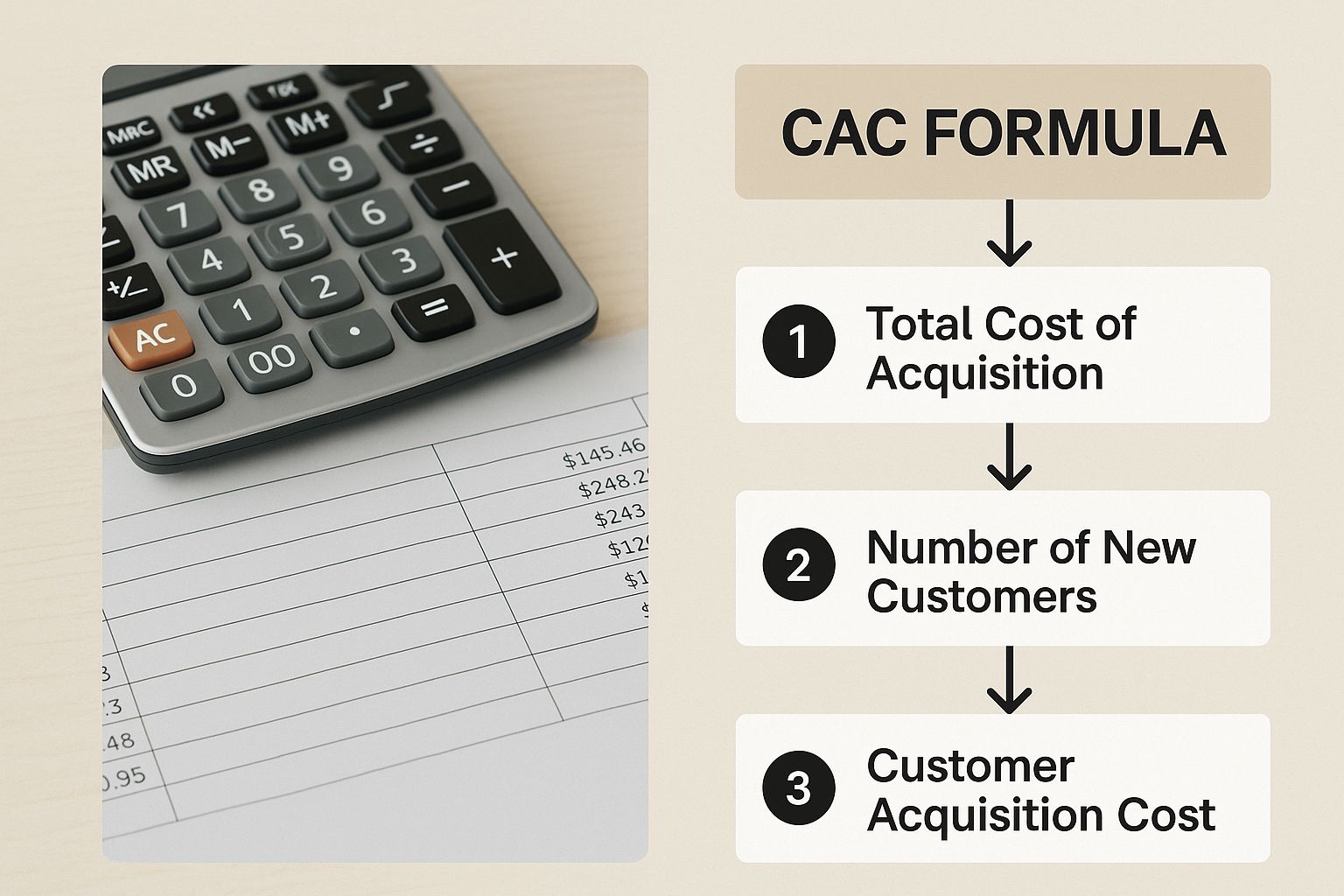
As you can see, it boils down to two fundamental parts: your total costs and the number of new customers you've won. Simple, right?
The basic formula for customer acquisition cost is elegant in its simplicity. It’s designed to give you a clear, high-level snapshot of your spending efficiency over a specific time.
Total Acquisition Costs / Number of New Customers Acquired = Customer Acquisition Cost (CAC)
To put this to work, you first need to decide on the timeframe you want to measure—a month, a quarter, or a full year. The key is to be consistent. Pick a period that lines up with how your business already reports on performance.
Once you’ve set your timeframe, it’s just a matter of gathering your data and plugging it into the equation. For a really thorough breakdown, mastering an accurate customer acquisition cost calculation is crucial to truly understand your spending.
The real magic in calculating your CAC comes from understanding what "Total Acquisition Costs" actually includes. It’s tempting to just look at your ad spend, but that’s only a tiny piece of the puzzle. A proper calculation has to account for every single dollar related to winning new business.
Here are the key things you need to track:
By adding up every one of these expenses, you build an honest, no-fluff picture of what it really costs to bring a new customer through the door.
Let's make this tangible. Imagine an Australian online retailer, "Aussie Apparel Co.," wants to calculate their CAC for the last quarter (Q1).
First, they pull together all their acquisition-related expenses for that period.
During that same quarter, they dug into their analytics and found they brought in 500 brand-new customers.
Now, we just need to apply the formula.
The calculation is just simple arithmetic: total costs divided by new customers.
Using our example:
$47,500 (Total Costs) / 500 (New Customers) = $95
This tells us that for every new customer Aussie Apparel Co. won in Q1, they spent an average of $95. This one number is now a critical benchmark. It allows them to judge campaign profitability, forecast future budgets, and make smarter decisions about where to put their marketing dollars for the best possible return.
If you’ve ever looked at your customer acquisition cost and thought, "Why is this so high?", you're definitely not alone. The simple truth is that winning new customers in Australia often comes with a unique set of challenges that can push this critical number skyward. Getting a handle on these local market forces is the first real step toward building a smarter, more cost-effective growth strategy.
It's not just about what you're spending on ads. The real drivers are often baked into the very fabric of the Australian market, from our population spread to what Aussie consumers expect from a business. If you ignore these specifics, you're just throwing generic advice at a very local problem, and that rarely ends well.
Once you unpack these factors, you can stop feeling frustrated by your CAC and start actively managing it. You'll be armed with an informed approach that actually connects with Australian customers.
One of the biggest, and most frequently overlooked, reasons for a higher CAC is the cost of the people running your campaigns. Australia's higher wages and strong worker protections mean that hiring skilled sales and marketing professionals is a significant investment. This isn't just an expense line item; it's the cost of getting the top-tier talent you need to compete effectively.
In fact, local ecommerce businesses often see CACs that are 20-35% higher than their US counterparts. A big part of this difference comes down to the higher salaries for the marketers and salespeople executing your growth plans.
These higher staff costs put immense pressure on teams to be incredibly efficient. Every hour spent on marketing has to deliver a solid return, making campaign effectiveness absolutely crucial.
Australia is a massive continent with a population of around 26 million, mostly huddled in a few major cities along the coast. For businesses, this geographic reality creates some real headaches that feed directly into your CAC.
The bottom line is that the cost to convert a customer in Perth can be wildly different from one in Sydney, and your CAC needs to reflect that.
A high CAC in Australia isn't always a sign you're doing something wrong. It's often just a reflection of the market's unique economic and geographic realities. The trick isn't to just accept it, but to understand it. That's how you build strategies that work with these factors, not against them.
Aussie shoppers are savvy. They do their homework, compare their options carefully, and value trust and authenticity above almost everything else. While this is great for building a loyal customer base down the track, it also stretches out the sales cycle and makes that first conversion a lot more work.
This kind of buyer behaviour means a single, punchy ad just won't cut it. You need to invest in a multi-touchpoint strategy that builds trust over time. This often involves:
Every one of these trust-building steps adds to your overall marketing spend, nudging that initial CAC upwards. This is all compounded by the fierce competition in the digital ad space. With so many businesses fighting for the same eyeballs, the cost of Facebook ads and other paid channels can be significant, turning every single click into a precious investment you can't afford to waste.
Once you’ve got a handle on your customer acquisition cost, the next question is always the same: "Is this number any good?" Knowing your CAC is one thing, but seeing how it stacks up against the competition is where the real strategic insights lie. This is where industry benchmarks become your best friend, giving you some much-needed context.
For Aussie ecommerce businesses, this context is especially important. Our local market has its own unique pressures and customer behaviours that directly shape how much you need to spend to win a sale. Just grabbing a global average can be seriously misleading and set you up for disappointment.
One of the biggest trends hitting local online retailers is the sharp jump in the cost of winning new customers. This isn’t just an Australian problem; it’s a global pattern where digital advertising is getting more crowded and, you guessed it, more expensive.
The data makes it crystal clear. The average Customer Acquisition Cost for ecommerce brands has shot up by nearly 40% in recent years. This makes getting your spending right more critical than ever if you want to stay profitable. While the global average ecommerce CAC hovers around $70, Australian figures often sit right there with it, or even slightly higher. It just goes to show how competitive things are down under. You can dig deeper into these rising costs in this report on average ecommerce CAC.
This trend forces an uncomfortable but necessary truth for many businesses: you will probably lose money on a customer's first purchase. And that's precisely why looking at CAC all on its own is a recipe for disaster.
To truly get a feel for the health of your acquisition strategy, you need to bring another metric into the mix: Customer Lifetime Value (LTV). Simply put, LTV is the total amount of money you can reasonably expect to make from a single customer over their entire relationship with your business.
When you compare what a customer is worth over time (LTV) to what it cost to get them in the door (CAC), you get the LTV:CAC ratio. This one number is one of the most powerful signs of a sustainable, profitable business. It answers the ultimate question: Are the customers we're paying for actually worth the price?
A healthy LTV:CAC ratio is the true north for a sustainable business. It shifts the focus from just winning a single sale to acquiring customers who will deliver value long-term, ensuring your marketing spend is an investment, not just an expense.
While the perfect ratio can shift a bit depending on your industry and how long you've been around, the gold standard for a healthy, scalable business is 3:1.
Let’s break down what that actually means:
By aiming for that 3:1 benchmark, you can move beyond just calculating CAC and start judging its effectiveness. It gives you a clear, actionable goal for your marketing, forcing you to focus not just on getting customers, but on getting the right kind of profitable customers.
To give you a clearer picture of what's typical in the Australian market, we've put together a table outlining average CAC ranges across different marketing channels. Keep in mind that these are just guides—your own costs will depend on your industry, audience, and how well you run your campaigns.
| Marketing Channel | Typical CAC Range (AUD) | Key Consideration |
|---|---|---|
| Paid Search (e.g., Google Ads) | $40 – $120 | Highly dependent on keyword competitiveness and industry. |
| Paid Social (e.g., Meta, TikTok) | $30 – $90 | Varies widely based on targeting precision and creative quality. |
| Content & SEO | $25 – $75 | Lower direct cost but requires significant upfront time/resource investment. |
| Email Marketing | $10 – $40 | Extremely cost-effective, but relies on having an existing, engaged list. |
| Influencer Marketing | $50 – $200+ | Costs can fluctuate wildly based on the influencer's reach and engagement. |
| Affiliate Marketing | $20 – $60 | Generally lower risk as you're often paying per conversion. |
This table helps illustrate that there’s no single "good" CAC. A $150 CAC from an influencer campaign might be fantastic if it brings in high-value customers, while a $30 CAC from social media could be a waste if those customers never buy again. It’s all about context and, most importantly, how it stacks up against your LTV.

Knowing your Customer Acquisition Cost is the first step. Actually doing something about it? That's where the real money is made. Lowering your CAC isn't about frantically slashing your marketing budget and hoping for the best. It's about making every single dollar you spend pull its weight.
This means shifting your focus to smarter, more sustainable tactics that polish up the entire customer journey, from that very first click right through to the final sale. Forget just throwing more cash at ads. The real goal is to plug the leaks in your funnel and build marketing assets that keep delivering value long into the future.
Let's dive into a toolkit of proven strategies designed to bring those acquisition costs down without slamming the brakes on your growth.
One of the quickest ways to slash your CAC is to get more out of the website traffic you already have. That’s the whole game of Conversion Rate Optimisation (CRO). Think of it like this: if you can double your conversion rate, you've just halved the cost of acquiring each of those customers. Simple as that.
You’re not spending a cent more on advertising; you're just getting better at turning the visitors you already have into paying customers. The best way to shrink your CAC is to constantly be tweaking your website and marketing funnels. Learning how to increase website conversions is non-negotiable if you want your marketing spend to actually translate into sales.
Here are a few areas you can focus on for an immediate impact:
Your happiest, most loyal customers are your secret weapon—a marketing channel you're probably not using enough. A solid referral program can turn these fans into a powerful, low-cost customer acquisition machine. After all, people trust a recommendation from a mate far more than they'll ever trust a flashy ad.
The real beauty of a referral program is just how cost-effective it is. You're generally only paying out a reward—like a discount or a bit of store credit—after a sale has been locked in. This makes it a pure performance-based channel with an almost unbeatable return on investment.
A strong referral program transforms your existing customer base into an extension of your marketing team. It leverages trust and word-of-mouth to bring in highly qualified leads at a fraction of the cost of paid advertising.
Getting one off the ground is easier than you think. Start with these steps:
Paid ads get you traffic today, but the meter is always running. Content marketing and Search Engine Optimisation (SEO), on the other hand, are about building a long-term asset. It's an engine that generates a steady flow of organic, low-cost leads for years to come.
When you create genuinely useful content that answers the questions your target audience is punching into Google, you attract people who are already looking for what you offer. A single, well-written blog post or a helpful guide can rank on search engines for months, or even years, pulling in qualified traffic long after you hit publish.
This approach has a snowball effect. Every piece of content you create builds your authority online, making it easier to rank for competitive keywords over time. Yes, it takes an upfront investment of time and creativity, but the long-term CAC from organic search is almost always drastically lower than paid channels. One killer article can generate thousands of leads over its lifetime, making the initial cost look like pocket change.
Getting a handle on your Customer Acquisition Cost is a massive step forward, but looking at it in a vacuum can be dangerously misleading. A high CAC isn't automatically a red flag, just like a low CAC doesn't guarantee you're winning. The real story only comes into focus when you pair it with another powerhouse metric: Customer Lifetime Value (LTV).
LTV is the total revenue you can realistically expect from a single customer over their entire relationship with your business. It forces a shift in thinking from a one-off transaction to the long-term partnership that a customer represents.
When you weigh that long-term value against what it cost you to get them through the door, you get a clear, unfiltered view of your business's health. This powerful combination is your LTV:CAC ratio, and it’s the ultimate health check for your growth strategy.
The LTV:CAC ratio answers the most critical question for any business: are the customers you're paying for actually worth the investment?
A high CAC might seem alarming at first glance. But if those customers stick around for years, making repeat purchases and becoming advocates for your brand, that initial cost could be a brilliant investment.
On the flip side, a low CAC feels great on the surface. But if those customers buy once and vanish, you're stuck on a treadmill, constantly fighting an uphill battle to replace them. For a deeper dive into this vital metric, check out our complete guide on how to calculate customer lifetime value.
The goal isn't just acquiring customers; it's about acquiring the right customers. The LTV:CAC ratio is your compass, guiding you toward profitable, sustainable growth by revealing whether your marketing spend is an investment or just another expense.
While every industry has its own quirks, a widely accepted benchmark for a healthy, scalable business is a ratio of at least 3:1.
Let's break down what the different ratios are telling you:
Ultimately, managing your customer acquisition cost isn't a one-and-done task—it's a continuous cycle. It demands constant measurement, sharp analysis, and strategic adjustments to ensure every single marketing dollar contributes directly to long-term, profitable success.
Once you get your head around the basics of customer acquisition cost, a few specific questions always seem to pop up. Let's tackle some of the most common queries we hear from business owners and marketers.
For any new or growing business, the magic number you're aiming for is at least a 3:1 ratio of LTV to CAC. Put simply, for every dollar you spend getting a new customer through the door, you should be making three dollars back over their lifetime with you.
A 3:1 ratio is a strong signal that you've got a sustainable business model. It means you have enough margin to cover your costs, absorb shocks, and—most importantly—reinvest in growth. If you’re hovering around 1:1, you're essentially just treading water, which is a dangerous place for a new venture. Anything below that? It’s a red flag that you're bleeding cash to acquire customers who just aren't valuable enough.
There's no one-size-fits-all answer here; it really depends on your business's rhythm. How long is your sales cycle? What kind of marketing are you running? Here’s a bit of a guide:
The real key here is consistency. Pick a rhythm that makes sense for your reporting cycle and stick to it. That's the only way you'll spot the trends that matter over time.
It’s a nice thought, but no. While organic channels like SEO or word-of-mouth don't have a direct ad spend attached, they are never truly free. There’s always a cost involved in acquiring a customer, even if it’s not an obvious line item on an invoice.
Take that "free" traffic you get from a blog post. Someone had to write it, someone had to edit it, and you're likely paying for software subscriptions to host and promote it. That all boils down to salaries and time. Customer acquisition cost can never be zero because there are always resource and time investments fuelling the machine.
Ready to stop guessing and start building a predictable, profitable marketing funnel? The team at Virtual Ad Agency specialises in optimising the entire customer journey to lower your CAC and maximise your ROI. Learn how we can help your business grow.

 previous