
Knowing when to bring an Instagram ads agency into the picture is a massive tipping point for any business. It’s usually that moment you realise managing campaigns yourself is costing you more in missed chances and wasted ad spend than an agency's retainer would. This is the shift from just running ads to strategically scaling your growth.
Are your Instagram ad campaigns hitting a wall? So many businesses get to a point where their early wins start to flatten out, and pushing past that plateau takes a level of expertise and time they just don't have. This isn't a sign of failure; it's a signal that your business is ready for the next level of strategic investment. A good first move is to get a solid handle on what specialized Instagram advertising agencies actually do and how they operate.
Spotting the specific symptoms of this growth ceiling is the first step toward making a confident decision.
A classic red flag is when your Return on Ad Spend (ROAS) stays flat—or worse, starts to dip—even when you're pumping more money in. You're increasing the budget, but the returns just aren't keeping pace. This usually happens when your initial targeting strategies have run their course, and you need a much more sophisticated approach to audience segmentation and creative testing.
Think of a local boutique, for example. They might see great results targeting people in their own city but hit a brick wall trying to expand profitably to a national audience. An agency can step in to identify new lookalike audiences and build out advanced retargeting funnels to break through that barrier.
Let's be real: effective ad management is not a 'set it and forget it' job. It demands constant monitoring, analysis, and tweaking. If you or your team are sinking more than 10 hours a week into managing ads—time that could be spent on your actual business—that's a clear sign you need backup. The Meta platform is always changing, and just keeping up requires dedicated focus.
The real cost of DIY ad management isn't just the hours you put in; it's the strategic growth you're missing out on. When you're bogged down in operational tasks instead of high-level strategy, it’s time to hand the reins to an expert.
Are you still running the same ad visuals and copy you were months ago? Creative fatigue is a massive campaign killer. Your audience becomes 'ad blind' to repetitive creative, which leads to lower click-through rates and higher costs. An agency brings a dedicated creative team to the table, ready to consistently produce and test fresh ad concepts. We're talking everything from slick video content to engaging carousel ads that keep your campaigns feeling new and effective. This is where partnering with a skilled social media marketing firm really provides the resources to get ahead.
This decision tree infographic is a great way to visualise the key trigger points for hiring an agency.
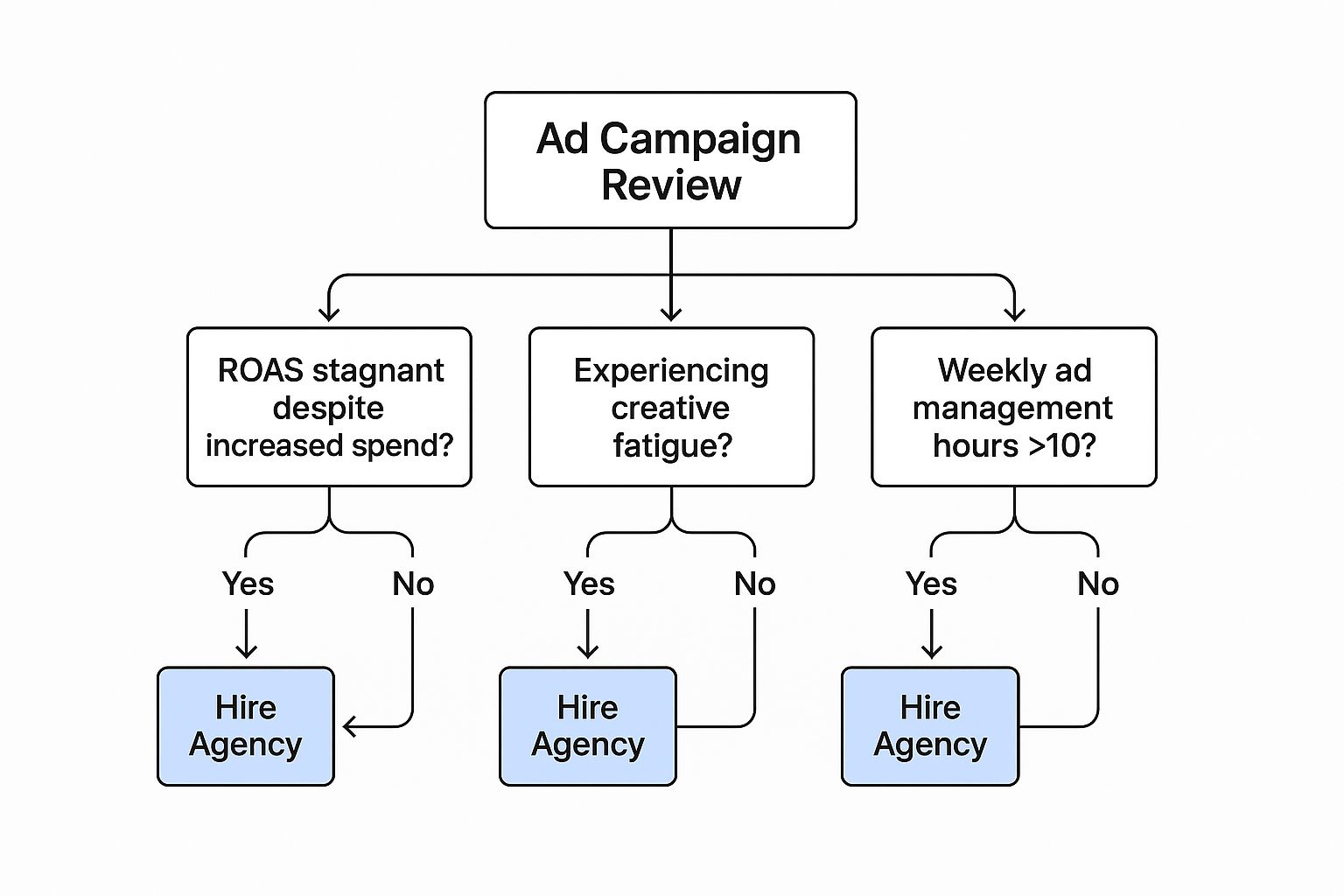
As you can see, major issues with ROAS, creative burnout, or just the sheer time drain are all direct paths pointing toward the need for professional help.
Before you make the final call, it’s worth weighing up the realities of keeping things in-house versus bringing on a partner.
This quick comparison helps you weigh the true costs and benefits of managing Instagram ads internally versus hiring a specialised agency.
| Key Factor | Managing In-House | Partnering with an Agency |
|---|---|---|
| Cost | "Free" on paper, but includes staff salaries, training, and ad spend. High opportunity cost. | A predictable monthly retainer plus a percentage of ad spend. Covers all expertise and tools. |
| Expertise | Limited to your team's current knowledge. Keeping up with platform changes is a challenge. | Access to a team of specialists in strategy, creative, copywriting, and analytics. Always current. |
| Time | Significant time sink for your team, pulling focus from core business activities. | Frees up your internal team completely. The agency handles everything from strategy to reporting. |
| Tools & Tech | You pay for all necessary analytics, design, and management software subscriptions. | Top-tier professional tools are included in their service fee, saving you thousands. |
| Creative | Relies on internal capacity, often leading to creative burnout and stale ads. | A dedicated creative team provides a constant flow of fresh, tested ad concepts. |
Ultimately, the choice comes down to resources. While managing ads in-house seems cheaper upfront, the hidden costs in time, missed opportunities, and slower growth can be substantial. An agency provides a clear path to scalable, expert-led results.
So, you’re ready to bring in the experts. But how do you pick a winner from a lineup of agencies that all seem to promise the world? Spotting a high-performing Instagram ads agency in Australia means looking past the slick presentations and focusing on hard evidence of their strategic smarts.
Great agencies don’t just talk about results; they show you, with absolute clarity. They’ll steer the conversation away from fluffy metrics like 'reach' and 'impressions' and get straight to the numbers that actually grow your business.
The very first sign of a top-tier agency is their obsession with real business outcomes. When you’re looking at their case studies, hunt for the important stuff: Cost Per Acquisition (CPA), Customer Lifetime Value (LTV), and Return on Ad Spend (ROAS). These are the figures that prove they can make a real dent in your profitability.
For instance, one agency might boast about a campaign that reached a million people. It sounds impressive, sure. But a truly great agency will show you a campaign that generated $50,000 in sales from a $10,000 ad spend, hitting a 5x ROAS. That kind of focus on commercial results is non-negotiable.
An agency that already gets the quirks of your industry and the Australian market has a massive head start. They won’t be wasting your budget learning the basics about your customers.
Let's say you're in Australian eCommerce. An experienced agency will already know the peak shopping seasons, the differences in consumer behaviour between Sydney and Perth, and which creative styles actually connect with a local audience. This specialised knowledge means more effective campaigns from day one, which translates into higher conversion rates and less wasted ad spend.
When you're shortlisting partners, it’s always a good idea to check out resources that identify some of the best digital marketing agencies in Australia to get a feel for what the top performers look like.
A truly great agency isn’t afraid to talk about failure. They see it as a data point—a lesson learned that makes future campaigns stronger. Transparency about what didn't work is often a clearer indicator of expertise than a portfolio of only flawless victories.
The world of Instagram ads is always changing. What worked like a charm last month might fall flat today. A high-performing agency not only accepts this reality but thrives on it, building a culture of relentless testing and optimisation. They aren’t just setting campaigns and hoping for the best; they are constantly experimenting.
To get a sense of their approach, try asking some sharp questions:
A slick sales pitch can promise the world, but an agency’s real worth is written in its history. Vetting a potential partner isn’t about being distrustful; it’s about doing your homework to make sure their past wins are the kind you want for your future. You’ve got to dig past the flashy headlines to find real, verifiable proof of what they can do.
Your first stop? Their case studies. Don’t just skim the big numbers. Look for a pattern of success across different types of clients and industries. Anyone can get lucky once, but an Instagram ads agency that consistently delivers a solid ROAS for all sorts of businesses has a strategy that’s both robust and adaptable. That’s what you’re looking for.
Every agency puts its best foot forward, but you need the full story, not just the highlight reel. This is where you need to get forensic with your questions and really probe the context behind their success stories.
Here are a few questions I always recommend asking:
A massive part of this is figuring out how they prove their value. Can they actually deliver measurable returns and, just as importantly, report on them clearly? Understanding how to measure influencer marketing ROI isn't just on them; having a grasp of it yourself helps you assess their past work and set crystal-clear expectations from day one.
The agency’s structure is a huge clue to its capabilities. Is it a one-person show or a team of specialists? A freelancer might be an absolute wizard with analytics, but a top-tier Instagram campaign needs a whole crew: creatives, copywriters, and data analysts all working together.
The complexity of the Instagram ads platform pretty much demands a team approach. The best campaigns are a perfect mix of art and science—that is, compelling creative backed by obsessive data analysis. It's incredibly rare for a solo operator to be a master of both.
Think about the sheer scale of the audience in Australia. We're talking about 14.3 million users, which is 62.6% of everyone aged 13 and over. Reaching the right people in that crowd takes specialised skills. A dedicated team is just better equipped to navigate this landscape and find your ideal customers.
Getting a handle on their team structure will tell you if they have the people-power to do things properly, like keeping a close eye on your competitors. If you want to get a head start, check out our guide on how to conduct competitor analysis to arm yourself for these conversations.
Trying to make sense of an agency proposal can sometimes feel like you’re deciphering a secret code. But before you can find the right partner, you need to get your head around the financial models that drive an Instagram ads agency and the contracts that protect your business.
Getting this part right from the get-go is the key to building a transparent and successful relationship. Most agencies in Australia stick to a few core pricing structures, and each one has its pros and cons depending on your business type and where you are in your growth journey.
The way an agency charges you directly impacts your cash flow and, just as importantly, what motivates them. Let’s break down the common models so you can find a financial setup that works for you.
| Pricing Model | How It Works | Best Suited For |
|---|---|---|
| Percentage of Ad Spend | The agency's fee is a cut of what you spend on ads, usually between 10% and 20%. | Businesses in a growth phase that are scaling their ad budget and want their agency's fee to scale with it. |
| Flat Monthly Retainer | You pay a fixed fee every month for a clearly defined scope of work. | Businesses that need predictable marketing expenses and have a stable budget month-to-month. |
| Performance-Based Fee | The fee is tied directly to results, like a percentage of revenue or a set cost per lead generated. | High-growth eCommerce stores or lead-gen businesses that want to tie agency fees directly to tangible outcomes. |
The main takeaway here? There's no single "best" model—it all comes down to what makes sense for your business goals and budget. A startup might prefer a performance-based deal to minimise risk, while an established brand might opt for a flat retainer for its predictability.
A word of caution: be wary of any contract that tries to lock you into a long-term commitment without a clear, performance-based exit clause. A fair agreement should give you a way out if things aren't working after a reasonable period, say 90 days.
The contract isn't just a formality; it's the blueprint for your entire partnership. A poorly written one can cause massive headaches down the track, so it pays to scrutinise the fine print.
Keep an eye out for these common red flags:
Vague Deliverables: If the contract is fuzzy on specifics—like how many campaigns they'll run, the number of ad variations they'll test, or how often they'll report to you—it leaves the door open for disappointment. Nail this down.
Unclear Asset Ownership: This one is non-negotiable. The contract must state, in no uncertain terms, that you own your Meta Business Manager, ad account, and all creative assets. An agency should only ever have partner-level access. Never, ever transfer ownership of these critical business assets.
Restrictive Exclusivity Clauses: A bit of exclusivity is normal. But you need to be careful with clauses that are overly broad or lock you in for too long, as they could stop you from working with other marketing partners on completely unrelated channels.

Signing the contract isn't the finish line; it’s the starting block. The real work of building a powerhouse partnership with your new Instagram ads agency begins the moment you both commit. It’s the difference between a simple client-vendor relationship and a genuine strategic alliance that drives incredible growth.
This shift doesn't happen by accident. It needs a structured and collaborative onboarding process. It’s not just about handing over your account logins, either. The goal is to get the agency so deeply integrated into your business that they understand your brand, your customers, and your commercial goals on a gut level.
Those first few weeks are absolutely critical for setting the tone. A thorough kickoff and discovery process is non-negotiable. This is where a good agency really shines—they should be asking sharp questions, digging into your customer personas, and understanding what’s worked (and what hasn’t) in your past marketing.
To get this phase right, you need to be organised on your end. A bit of prep work prevents friction down the track and helps your agency hit the ground running.
Once the initial discovery is done, the focus shifts to metrics and communication. You can't improve what you don't measure, and clear KPIs are the foundation of any successful agency relationship. Define exactly what success looks like. Is it a target ROAS? A specific cost per lead? A certain number of monthly sales? Be specific.
Equally important is finding a regular communication rhythm. This doesn't mean you need daily check-ins, but a predictable schedule keeps both teams aligned and accountable. A weekly or fortnightly call to review performance and discuss strategy is often the sweet spot.
True partnership is built on trust and transparency. A great agency will be proactive in sharing both the wins and the challenges, giving you insights into what the data is telling them and explaining the strategic pivots they plan to make.
This investment in social media advertising is part of a bigger picture in Australia. With social media ad spend hitting around AU$6.7 billion—a 12.1% jump from the previous year—the pressure to get it right is immense. You can explore more about Australia's digital advertising spend and see how this shift impacts businesses. In this climate, a strong, data-driven agency partnership isn't a luxury; it's essential.
Ultimately, a successful relationship comes down to shared ownership of the results. When your agency celebrates your wins as their own, you know you've found the right partner.
Even when you're sold on the idea of bringing in an agency, a few practical questions always pop up. It's completely normal to have concerns about budgets, when you'll see results, and who owns what. Getting straight answers to these questions is the final piece of the puzzle before you can confidently team up with an Instagram ads expert.
Let's dive into some of the most common queries we hear from businesses on the verge of hiring a pro.
This is usually the first question off the bat, and for good reason. While the numbers can vary, most solid Australian agencies need a minimum monthly ad spend to get their strategies off the ground and working effectively. You’re typically looking at a starting point in the $3,000 to $5,000 range.
On top of that ad spend, you'll have the agency's management fee. This usually comes in one of two flavours:
Be wary of any agency promising the world on a shoestring budget. Good campaigns need enough fuel in the tank for proper testing, learning, and eventually, scaling up.
This is where a little patience goes a long way. Realistically, you should expect a 60 to 90-day period for the agency to properly test, learn, and start optimising your campaigns for performance. Anyone promising immediate, overnight success is selling you a fantasy.
Think of the first month as the discovery phase. The agency will be digging into your existing account, getting to know your audience inside and out, and launching those first test campaigns. By the end of month three, you should be seeing a clear, positive trend in your key metrics, which gives you the confidence that things are heading in the right direction.
An agency that promises instant, massive returns is waving a huge red flag. A true professional sets realistic expectations, explaining that the first 90 days are an investment in building a data-driven foundation for long-term, scalable growth.
Okay, this one is a biggie. It's a non-negotiable point that needs to be crystal clear in your contract. The only right way to do this is to ensure that you, the client, always retain ownership of your Meta Business Manager, your ad account, and every single creative asset made for your campaigns.
The agency should only ever have partner-level access to work within your accounts. They are your strategic partner, not the owner of your digital property. Never, ever agree to a setup where an agency builds an account under their own name to run your ads. If you ever decide to part ways, it can turn into an absolute nightmare, and you risk losing all your valuable campaign data and pixel history.
Ready to team up with an agency that delivers transparent strategies and measurable growth? The team at Virtual Ad Agency specialises in building high-performance Instagram ad campaigns that drive real business results. Find out how we can help you scale by visiting us at https://www.virtualadagency.com.au.

 previous