
Diving into small business SEO marketing can feel like a huge leap, but honestly, it’s the most powerful tool you have for competing with the bigger players in the Australian market. It’s how you get found by local customers who are right now searching for what you sell. It turns your website from an online brochure into a growth engine that actually brings in business.

Think about your own habits. When your car breaks down or you’re desperate for a good local coffee, you pull out your phone and search. That’s the modern customer journey, plain and simple. If you’re invisible in those moments, you’re missing out on your best potential customers.
It’s a common myth that SEO is just for big corporations with bottomless budgets. That couldn’t be further from the truth. Local SEO completely levels the playing field. It’s how a small, family-owned bakery in Adelaide can outrank a national chain for a search like “best sourdough bread near me”—all by being more relevant to that local searcher.
Good small business SEO marketing isn’t about getting just anyone to your website; it’s about attracting the right people. We’re talking about individuals who are already looking for the exact solution you provide. They aren’t just scrolling through social media—they have a real need and are actively trying to find a business to help them.
This direct line to customer intent is what makes SEO one of the most cost-effective marketing channels out there. You’re not pushing a message out to a massive, uninterested audience. Instead, SEO pulls in customers who have already raised their hand.
This leads to some fantastic outcomes:
The impact is undeniable. When you line up what’s on your website with what local customers are actually searching for, you’re not just getting traffic. You’re generating real business opportunities that directly boost your bottom line.
Australian businesses are catching on fast. The local SEO industry here is valued at around $1.5 billion, with a solid growth rate of 12% every year. This shows a clear trend: companies are getting serious about their online visibility.
Small businesses are now putting an average of $1,350 per month into their SEO efforts, a big jump from previous years. You can dig into more insights on these Australian SEO trends in recent industry reports. This isn’t just a fleeting fad; it’s a fundamental shift in how businesses connect with their local communities and lock in future growth.
To really drive home why this matters, let’s look at the numbers. These statistics paint a clear picture of how Australian consumers behave online and why a local SEO focus is a non-negotiable for small businesses.
| Metric | Statistic | Why It Matters for Your Business |
|---|---|---|
| Local Search Intent | 46% of all Google searches are seeking local information. | Nearly half of all potential customers are looking for a business just like yours, right in their area. Being visible here is crucial. |
| “Near Me” Searches | “Near me” or “close by” searches have grown by over 900% in the past few years. | Customers want convenience. Optimising for “near me” searches puts you directly in front of the most motivated local buyers. |
| Search to In-Store Visit | 76% of people who search for something nearby on their phone visit a related business within a day. | An online search translates directly into real-world foot traffic. This is the bridge between your digital presence and physical sales. |
| Mobile-First Indexing | Over 60% of searches in Australia happen on mobile devices. | If your website isn’t mobile-friendly, you’re alienating the majority of your potential customers before they even see what you offer. |
These figures aren’t just interesting data points; they represent real people looking for real solutions. Tapping into this local search behaviour is your single biggest opportunity for growth.
Great SEO for a small business all comes down to one thing: knowing the exact words your ideal customers are typing into Google. This isn’t about guesswork. It’s about a strategic discovery process to make sure you’re pulling in people who are actually ready to open their wallets.
Forget those massive, generic terms for a moment. Instead, get specific about the problems you solve for people. A customer rarely just searches for “plumber.” They’re much more likely to search for “emergency plumber Adelaide” or “fix leaking tap Newtown,” especially when they’re in a panic.
These longer, more precise phrases are what we call long-tail keywords. For a small business, they’re pure gold because they signal someone is serious about buying.
To kick things off, you need to put yourself in your customer’s shoes. What questions are rattling around in their head? What’s the pain point that’s driving them to search in the first place? A good brainstorm is a great starting point, but you’ve got to back it up with data. That’s what separates the campaigns that fly from the ones that flop.
Your goal is to build a solid list of potential search terms that line up with the different stages of their journey.
This is where you start to really understand what potential customers are looking for. It’s absolutely crucial to learn how to conduct effective keyword research to build a strong foundation for everything that comes next. When you organise your keywords this way, you can create content that meets people at every single step.
Once you have a seed list of ideas, it’s time to branch out with some keyword research tools. While there are plenty of powerful paid platforms out there, you can actually get a ton of insight from free resources.
Google itself is your first port of call. Just type one of your main services into the search bar and see what autocomplete suggests. These aren’t guesses; they’re real searches from real people. Don’t forget to scroll down to the “People also ask” and “Related searches” sections at the bottom—it’s a goldmine of topics and questions your audience genuinely cares about.
For more granular data, tools like Ahrefs, SEMrush, or even Google’s own Keyword Planner can give you juicy metrics like monthly search volume and keyword difficulty.
A tool like Ahrefs’ Keywords Explorer shows you related keyword ideas, their search volume, and a difficulty score, which helps you pick your battles.
This data helps you prioritise. You’re looking for keywords that have a healthy search volume but aren’t so competitive that you’ll be fighting a losing battle. Honestly, a keyword with 100 monthly searches and low competition is often far more valuable than one with 10,000 searches that’s completely dominated by the big players.
One of the smartest things you can do is to see what’s already working for your competitors. There’s no need to reinvent the wheel.
Pick three to five local competitors who always seem to be at the top of Google for your main services. Use an SEO tool to peek under the hood of their websites and find out which keywords are sending the most traffic their way. You’ll be surprised at the opportunities this can uncover.
Look for “keyword gaps”—these are the terms your competitors rank for that you don’t. This is the low-hanging fruit, a clear path to start chipping away at their market share. It’s not about copying them blindly; it’s about understanding the lay of the land and finding your strategic openings.
By zeroing in on high-intent, locally-focused keywords, you make sure that every blog post, service page, and piece of content you create has a clear purpose: attracting customers who are actively looking for what you do. This targeted approach is the cornerstone of an SEO strategy that delivers real, measurable growth for your business.
Alright, you’ve got your keywords. Now it’s time to actually put them to work by weaving them into the fabric of your website. This is where on-page and technical SEO come into play, sending clear signals to Google that your site is the best, most user-friendly answer to a potential customer’s search.
Think of it as setting the stage. You wouldn’t invite guests over without tidying up first, and the same principle applies here. Getting these foundational pieces right ensures both search engines and human visitors have a great experience from the get-go.
Your title tag and meta description are your first impression in the search results. Seriously. They’re like a mini-advertisement for your page, and a good one can dramatically increase the number of people who click through to your site, even if you aren’t sitting in that coveted number one spot.
Here’s how to make them count:
These small tweaks are a massive part of effective small business seo marketing because they directly influence your click-through rates—a huge signal to Google that your page is relevant.
While the words on the page are crucial, what’s happening behind the scenes is just as important. Technical SEO is all about making sure your site is easy for search engines to crawl, index, and understand. Don’t stress, you don’t need to be a coding whiz to get the basics sorted.
A fast-loading website isn’t just a nice-to-have anymore; it’s a must. Studies show that 47% of consumers expect a website to load in two seconds or less. A slow site is frustrating for users and a major red flag for Google.
For instance, Google’s PageSpeed Insights is a fantastic free tool that gives you a clear report card on your site’s performance. It will highlight specific issues, from massive images to clunky code, essentially giving you a to-do list for improvement.
Additionally, with over 60% of searches in Australia now happening on mobile devices, a mobile-friendly website is completely non-negotiable. If your site doesn’t automatically adapt to different screen sizes (a feature known as ‘responsive design’), you’re giving the majority of your visitors a clunky, frustrating experience.
Key Takeaway: Technical health is the bedrock of your SEO. A fast, secure, and mobile-friendly website provides a better user experience, which Google directly rewards with higher search rankings.
How you organise the information on a page matters a lot more than you might think. Using headings (H1, H2, H3) correctly creates a logical hierarchy that helps both your readers and search engine bots quickly grasp what your content is about.
Your main page title should always be your one and only H1 tag. Then, use subheadings (H2s) to break up the major sections, and H3s for any sub-points within those sections. This simple structure makes your content scannable and gives you natural spots to incorporate those secondary keywords you found earlier. For a more detailed look, exploring these SEO optimisation best practices can provide a much deeper understanding.
When you combine compelling on-page elements with a solid technical setup, you create a powerful signal of quality and relevance. This comprehensive approach is what separates businesses that just have a website from those that truly thrive online.
For any small business with a physical location or a defined service area, winning locally is everything. This is where small business seo marketing really hits its stride, turning online searches into actual customers walking through your door. It’s all about being the first and best answer when someone nearby needs exactly what you offer.
The game has completely changed. If you’re an Australian business, local SEO is the absolute cornerstone of your digital marketing. Why? Because ‘near me’ searches have exploded by a staggering 500% since 2015. This isn’t just a fleeting trend; it’s a fundamental shift in how your customers are trying to find you.
Think about it: local SEO is responsible for 28% of all search traffic for small to medium businesses. Better yet, that traffic converts at three times the rate of general organic searches.
Your Google Business Profile (GBP) is, without a doubt, your most important local SEO asset. It’s often the very first interaction a potential customer has with your business—that prominent box on the right of the search results or the pin on Google Maps. Neglecting it is like leaving your physical shopfront boarded up.
A fully optimised profile does more than just list your opening hours. It builds immediate trust and gives potential customers quick answers, making it a no-brainer for them to choose you. This means you need to treat it like a dynamic part of your marketing, not a set-and-forget task.
This visual guide breaks down the core steps to getting noticed in local search.
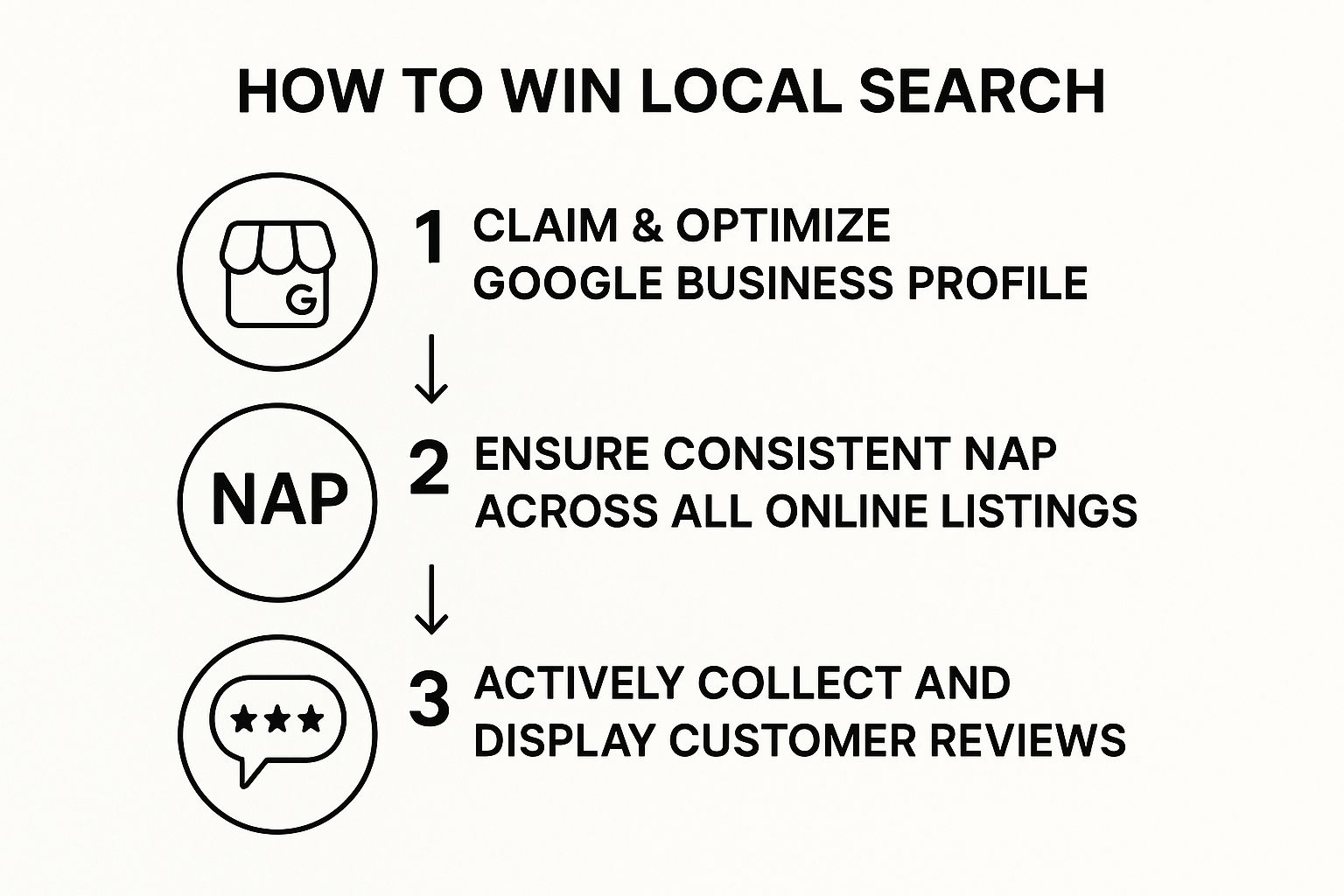
As you can see, a strong local presence is built on a foundation of accurate information and real social proof, and it all starts with your Google profile.
Before you dive in, here’s a quick checklist to make sure your Google Business Profile is pulling its weight. A well-optimised profile is your best tool for attracting local customers, so it pays to get the details right.
| Optimisation Area | Action Item | Impact on Local Rank |
|---|---|---|
| Core Information | Verify business name, address, phone number, and website are 100% correct. | High |
| Categories | Select the most specific primary category and add relevant secondary categories. | High |
| Photos & Videos | Upload high-resolution images of your storefront, team, and products/services weekly. | Medium |
| Services/Products | Add detailed descriptions and prices for every service or product you offer. | Medium |
| Google Posts | Publish updates, offers, or events at least once a week to show activity. | Medium |
| Customer Reviews | Actively request reviews and respond to every single one (positive and negative). | High |
| Q&A Section | Proactively add and answer frequently asked questions about your business. | Low |
| Attributes | Select all applicable attributes (e.g., “Wi-Fi,” “Outdoor seating,” “Women-led”). | Low |
Getting these elements right signals to Google that you’re a legitimate, active, and customer-focused business, which is exactly what it wants to show its users.
Imagine a potential customer finds three different phone numbers for your business online. Which one do they call? This kind of confusion is a massive trust-killer for both customers and search engines.
This is where NAP consistency comes in. It’s the simple but vital task of ensuring your Name, Address, and Phone number are identical across every single online directory and platform. Inconsistencies send mixed signals to Google, making it less confident about your business details, which can seriously tank your local rankings. It’s a tedious job, but it’s completely non-negotiable.
Start with the big directories like Yelp and TrueLocal, then move on to any industry-specific sites. Make sure every single detail matches your GBP perfectly. For true local dominance, it’s also worth mastering Google Maps lead generation to capture those ready-to-buy customers nearby.
Expert Tip: Create a master document with the one “true” version of your business’s NAP details. Use this exact format every single time you create a new listing or update an old one. Even a tiny difference like “St.” versus “Street” can cause issues.
Reviews are the lifeblood of local SEO. They provide powerful social proof and are one of the most important factors in Google’s local ranking algorithm. A steady stream of recent, positive reviews tells Google that your business is not only real but also valued by the local community.
You need an active strategy for gathering feedback. Don’t just sit back and hope customers will leave a review; make it easy and natural for them to do so. This could be as simple as sending a follow-up email after a purchase with a direct link to your GBP review page, or even including a small note on your receipts. Any experienced Adelaide SEO consultant will tell you that building a strong review profile is a key pillar of any local strategy.
Most importantly, respond to all reviews—the good and the bad. Thanking customers for positive feedback shows you appreciate their business. Addressing negative comments professionally shows you care about customer satisfaction and are committed to fixing problems. This public engagement builds immense trust with potential customers who are checking you out.

Content is the fuel for your whole small business seo marketing machine. It’s how you answer your customers’ questions, build up that all-important trust, and gently show a curious visitor why they should become a paying client.
The game isn’t about churning out articles for the sake of it. It’s about creating genuinely useful resources that cement your business as the go-to expert in your local area. Every single piece you create needs a clear purpose, one that links directly to a customer’s real-world problem. Think of it like a conversation starter.
Your best content ideas will always come straight from your customers’ pain points. Instead of guessing what they’re thinking, just listen to the questions they’re already asking you. This simple shift ensures your content is relevant and valuable from the very first sentence.
Get started by jotting down every question you or your team have been asked over the last month. You’ll spot patterns pretty quickly. A local electrician might notice constant queries about safety switches, while a café owner might hear endless questions about their gluten-free options. These aren’t interruptions; they’re content goldmines.
Here are a few ways to turn those questions into powerful content:
This strategy moves you from selling to helping. By consistently providing the answers, you build authority and become the first business people think of when they’re ready to buy. For a deeper dive, you can explore these content marketing best practices.
The way people search is changing fast, especially here in Australia. Any decent small business seo marketing plan has to keep up with the rise of voice search and people asking full-blown questions. They aren’t just typing in “plumber Sydney”; they’re asking their phones, “Where can I find a reliable plumber near me?”
This is a massive opportunity for small businesses. About a third (33%) of Aussies now use voice search every day, mostly to find local info. These searches are longer, averaging 6 to 10 words, and around 8% of local searches are phrased as direct questions like ‘Where can I find the best coffee near Strathfield?’.
To catch this traffic, your content needs to feel more conversational. Write like you speak, and structure your articles to give direct, clear answers. A simple FAQ section at the bottom of your service pages is a brilliant way to target these long, question-based searches.
Not every person landing on your website is ready to pull out their wallet. Good content meets people where they are in their decision-making process, from just realising they have a problem to being ready to make a choice.
Let’s break it down into three simple stages:
By creating a mix of content that serves each stage, you build a relationship with potential customers over time. You become the helpful expert who guided them through the process, making your business the clear choice when it’s time to act.
Putting a smart small business seo marketing strategy into action feels great, but how do you actually prove it’s working? The final, crucial piece of the puzzle is tracking what’s happening and connecting your efforts to a genuine return on investment (ROI). Without the data, you’re just guessing.
This isn’t about getting lost in complicated spreadsheets. It’s about zeroing in on a handful of key performance indicators (KPIs) that truly show your business is growing. You need to know which numbers move the needle and which are just noise.
The best part? The most powerful tools for this job are completely free. Google provides a fantastic suite of products that gives you all the essential data you need to make smart decisions.
For any small business, there are two non-negotiable platforms you need to get familiar with: Google Analytics and Google Search Console. They work hand-in-hand to paint a complete picture of your website’s performance.
Setting them up is pretty straightforward, and the insights they give you are invaluable for tweaking and improving your SEO strategy over time.
This screenshot from Google Search Console shows the Performance report, which is your main dashboard for understanding how you’re doing in search.
Here, you can clearly see the total number of clicks and impressions, along with your average click-through rate (CTR) and average ranking position over a set period.
It’s incredibly easy to get lost in the data. To stay focused, just concentrate on a few core metrics that directly reflect business growth. Don’t get distracted by vanity metrics like page views; instead, track the numbers that actually impact your bottom line.
Your SEO efforts should lead directly to tangible business outcomes. The goal isn’t just to rank higher; it’s to generate more qualified leads, phone calls, and sales. Measuring these conversions is the only way to accurately figure out your ROI.
Here are the top KPIs to keep a close eye on:
By regularly checking these numbers, you can analyse what’s working, spot areas for improvement, and confidently prove the value of your investment in small business seo marketing.
Even with the best plan, you’re bound to have questions about small business SEO marketing. That’s totally normal. Here are some quick, no-nonsense answers to the questions we get asked most often by business owners just like you.
Ah, the million-dollar question. The honest answer is: it depends. Generally, you’ll start to see some positive movement in your rankings within three to six months.
But for the really juicy results—like a noticeable jump in leads and sales—you’re typically looking at a six to twelve-month timeframe. SEO is a marathon, not a sprint. Things like how competitive your industry is, where you’re starting from, and how consistently you work at it will all affect your timeline.
Yes, you absolutely can. A lot of the foundational stuff, like optimising your Google Business Profile and writing genuinely helpful blog posts, is perfectly manageable in-house.
It definitely takes a commitment to learning and a bit of consistent effort, but it’s well within reach for a dedicated business owner.
The trick is to start small and not get overwhelmed. Nail your local SEO and on-page basics first. As your business grows, you can then decide if it makes sense to bring in an expert to tackle the more technical heavy lifting.
SEO budgets can be all over the map. Some businesses get fantastic results by simply investing their own time and sweat equity. Others might work with an agency and spend several thousand dollars a month.
For a small business looking to get some professional help, a reasonable starting point is usually somewhere between $500 and $2,000 per month.
But instead of getting fixated on the cost, try to think about the value. A solid SEO strategy should bring in more customers than you spend to get them, delivering a healthy return on your investment.
Ready to stop guessing and start growing? The team at Virtual Ad Agency specialises in creating data-driven marketing strategies that deliver real results for businesses. Let us help you navigate the complexities of SEO and build a powerful online presence. Discover how we can help your business thrive.

 previous