
So, what exactly are lead generation services? Think of them as a professional scouting team for your business. Their one and only mission is to find and pre-qualify potential customers, which means your sales team doesn't waste precious time chasing down cold trails.
This is a whole lot more than just your standard advertising; it’s a strategic process built from the ground up to create a steady, reliable flow of sales opportunities.
Instead of just blasting out a message and hoping someone bites, these services build a proper system for finding new customers. They figure out exactly who your ideal customer is, find out where they hang out online, and then create compelling reasons for them to put their hand up and show interest in what you're offering. This frees up your in-house team to do what they do best: building relationships and closing deals.
It's a common mistake to think that lead generation is just about buying a list of names and email addresses. Real professional services are much, much more involved than that. Their focus is on generating qualified leads—people who haven't just handed over their contact details, but have actually shown genuine interest and properly fit your customer profile.
This qualification step is absolutely crucial. It’s what separates the curious window-shoppers from the serious buyers, making sure your sales team is only spending their time on conversations that have a high chance of success. A top-quality lead is someone who has already been nurtured and educated a bit, making them far more open to a sales call.
Getting someone from a complete stranger to a sales-ready lead doesn't happen by accident. It takes several deliberate steps, and a lead gen agency handles this entire journey for you. It usually looks something like this:
To give you a real-world example, a key part of many modern strategies is hosting educational events. An agency might design, promote, and run targeted lead generation webinars to attract high-intent B2B prospects, gathering detailed information along the way that qualifies them for a follow-up call.
By outsourcing this function, you're not just buying leads; you're investing in a proven system for sustainable business growth. It turns the unpredictable nature of finding new customers into a reliable, measurable, and scalable operation, which is a significant strategic advantage for any Australian business aiming to grow.
A solid lead generation service doesn't just have one trick up its sleeve. Instead, it builds a powerful engine using a mix of strategic channels, each designed to meet potential customers at different points in their journey. Think of it as a well-oiled machine where every part has a specific job, working together to deliver a qualified lead.
This multi-channel approach is vital because no two customers are the same. Some are actively hunting for a solution right now, while others are only just starting to realise they even have a problem. A smart strategy meets them wherever they are.
This flowchart gives you a simplified look at how these channels work together to attract people, build their interest, and ultimately qualify them as leads for your business.
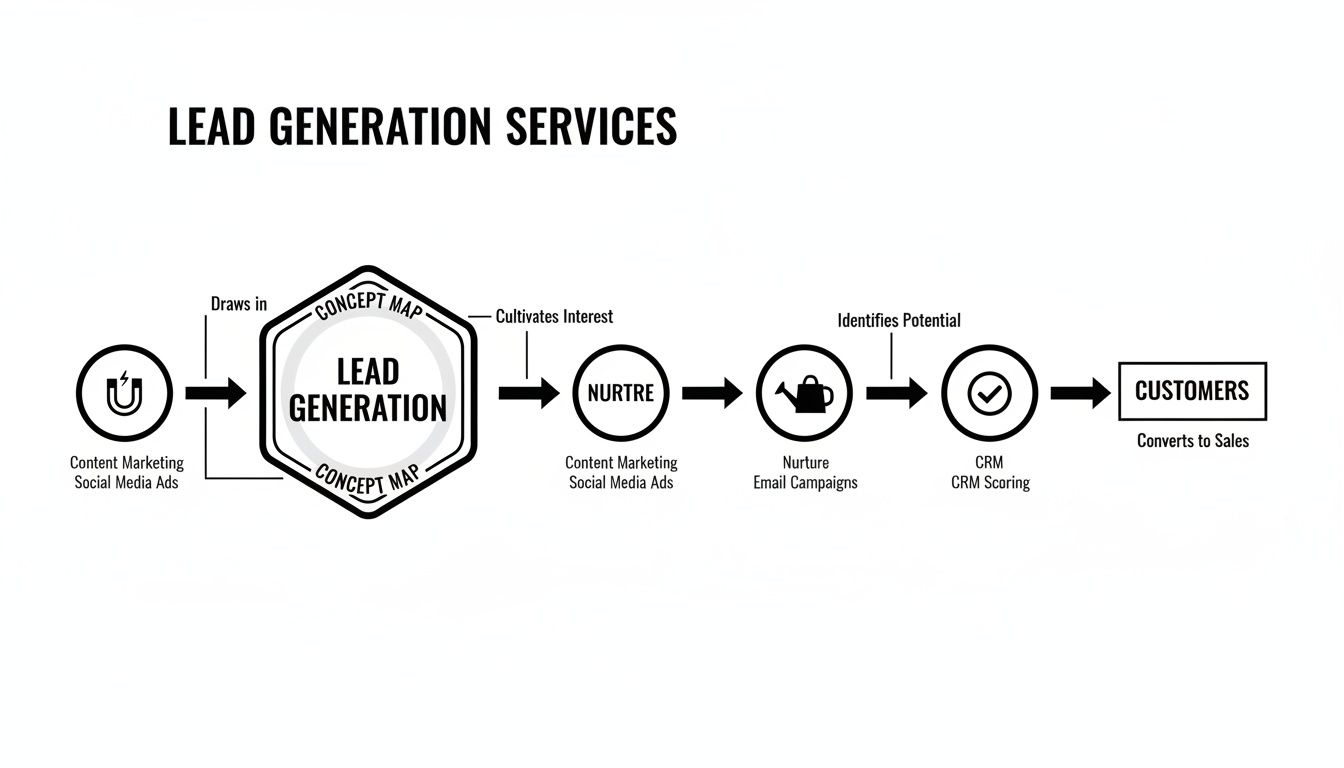
What this shows is that great lead generation isn't a one-off event. It's a continuous process of building interest and trust long before a prospect is ready to talk to sales.
To really get a feel for how these channels differ, let's compare them side-by-side.
| Channel | Primary Use Case | Common Platforms | Best For |
|---|---|---|---|
| Search Engine Marketing (SEM) | Capturing high-intent users actively searching for a solution. | Google, Bing | Businesses with a clear product/service that people actively search for. |
| Social Media Marketing | Building brand awareness and engaging with communities early. | LinkedIn, Facebook, Instagram, Twitter | B2B and B2C companies looking to build a community and nurture long-term relationships. |
| Content Marketing | Educating the audience, building trust, and generating organic traffic. | Blogs, YouTube, Podcasts, Gated Resources (eBooks) | Companies with expertise to share, especially in complex or high-consideration industries. |
| Account-Based Marketing (ABM) | Targeting specific high-value companies with personalised campaigns. | LinkedIn, Email, Direct Mail, Personalised Landing Pages | B2B businesses targeting a small list of large, strategic enterprise accounts. |
Each channel plays a unique role, and the best strategies often blend several of them to create a constant stream of opportunities.
When someone types "commercial cleaning services in Adelaide" into Google, they aren't just window shopping—they have an immediate need. This is where Search Engine Marketing (SEM) comes in. It’s all about getting your business in front of people who are actively looking for exactly what you offer.
SEM is generally split into two key activities:
By using both SEO and PPC, a lead generation agency can capture immediate demand while building a sustainable, long-term source of leads.
While SEM targets people who already know they have a problem, Social Media Marketing gets their attention much earlier. Platforms like LinkedIn, Facebook, and Instagram are where your potential customers hang out, chat about industry challenges, and stumble upon new brands.
A lead generation service uses social media for more than just brand awareness. It’s a strategic tool for starting conversations and building a community. This could mean sharing valuable insights, running targeted ad campaigns to specific job titles, or jumping into relevant groups to help people out. It’s about building a relationship first.
Social media allows you to be a part of the conversation, not just an interruption. By providing value upfront, you establish credibility and become the go-to provider when a need finally arises.
Content marketing is the backbone of most other lead generation activities. It’s the art of creating and sharing valuable, relevant content to attract and keep a specific audience. This isn't about a hard sell; it's about educating and solving problems.
For Australian businesses, this approach works wonders. The data shows that content marketing generates 3x as many leads as old-school marketing methods, and it costs 62% less. That kind of efficiency shows a massive shift in where companies should be putting their marketing dollars. You can dig deeper by exploring more Australian marketing statistics.
Common types of content include:
This content fuels your SEO, gives you great assets to share on social media, and helps nurture leads through email.
For B2B companies chasing a small number of very valuable clients, casting a wide net just doesn't make sense. This is where Account-Based Marketing (ABM) comes into play. Forget the net; ABM is like laser-focused spear fishing.
With ABM, marketing and sales teams work together to pick a list of target companies. From there, they create intensely personalised campaigns designed to speak directly to the key decision-makers inside those specific businesses. Every single communication—from emails to ads—is tailored to the unique pain points of that one account, making it a powerful way to land big, strategic clients.
Behind every killer lead generation campaign, there’s a seriously powerful stack of technology. Let's be honest: trying to run things with spreadsheets and manual tracking just doesn't cut it anymore. Today’s lead generation services rely on a smart set of tools to automate the grunt work, pull out deep insights, and make the whole journey seamless for potential customers.
This tech turns what used to be a bit of a guessing game into a precise, measurable science. It’s what lets an agency juggle thousands of interactions across a dozen different channels without ever letting a single hot lead slip through the cracks. It's the engine running the whole show, from the very first click to the final handshake.
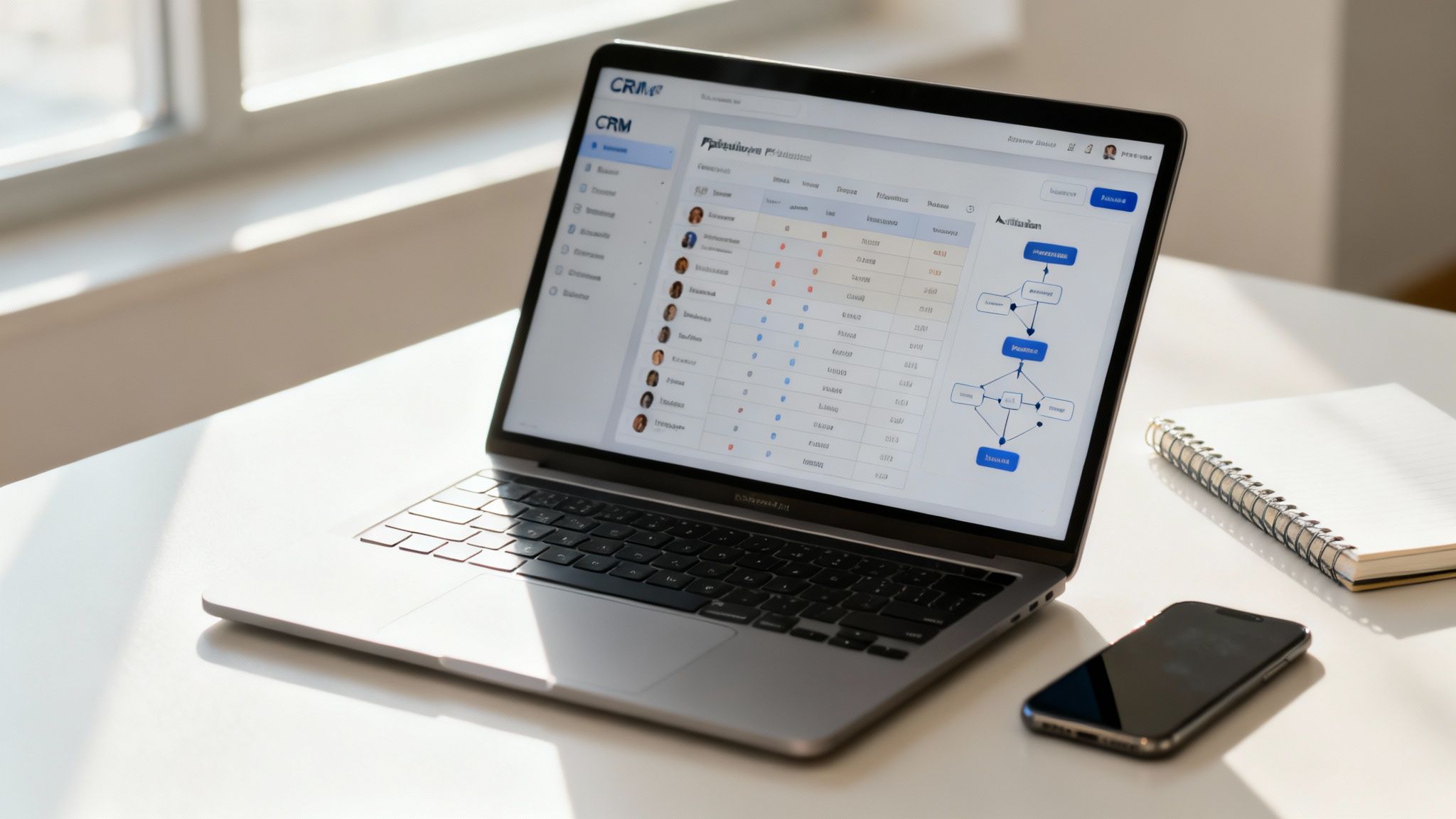
At the very heart of it all is the Customer Relationship Management (CRM) system. Think of it as the central brain for your entire sales and marketing operation. It’s a smart database that stores every single bit of information about every lead and customer you have.
A CRM logs every touchpoint—every email they open, every page they visit on your site, every phone call you make. This creates a single source of truth, giving both your marketing and sales teams a complete, unified picture of each prospect's journey so far. That visibility is absolutely crucial for personalising follow-ups and making sure the handover from marketing to sales is smooth as silk.
Without a well-integrated CRM, your lead data ends up scattered and chaotic. That chaos leads to missed opportunities and, frankly, a frustrating experience for the people you’re trying to turn into customers. It's the foundation that all the other tools are built on.
If the CRM is the brain, then marketing automation is the powerful nervous system that gets things done without you lifting a finger. This tech is designed to take all that repetitive, manual work off your plate, freeing up your team to focus on the big-picture strategy and building real relationships.
Marketing automation software plugs straight into your CRM and triggers actions based on what a lead does. It’s the magic that allows an agency to nurture thousands of leads at once with a personal touch—a task that would be flat-out impossible for a human team to manage.
Here’s where its power really shines:
Marketing automation makes sure no lead is ever left behind. It’s all about delivering the right message to the right person at exactly the right time, scaling your nurturing efforts far beyond what any team could do on their own.
Artificial intelligence (AI) is quickly becoming a non-negotiable part of the modern tech stack. AI tools chew through enormous amounts of data to spot patterns and make predictions that guide your entire strategy. It’s a huge shift, and by 2025, it's expected that 58% of B2B companies will be using AI-powered chatbots to generate and qualify leads.
On top of that, AI-driven lead scoring helps sales teams prioritise who to call first based on their likelihood to buy, making sure they’re always focused on the most valuable opportunities. For those looking to get ahead of the curve, exploring compliant, AI-driven lead generation strategies is becoming essential for capturing top-tier leads.
Finally, you have the analytics and reporting tools that tie everything together. These platforms connect to your CRM, marketing automation software, and ad channels to give you a crystal-clear view of what’s working and what’s falling flat.
They track the key metrics, visualise performance on easy-to-read dashboards, and help agencies make data-driven calls to tweak campaigns for better results. This tech provides that crucial feedback loop you need for continuous improvement, ensuring your investment is actually delivering a return you can measure.
Once you’ve got your strategy and technology sorted, the conversation naturally turns to the bottom line. How do you actually know if your investment in lead generation services is paying off?
It all comes down to tracking the right numbers and understanding how agencies structure their fees.
Measuring success isn’t just about counting how many leads trickle in. A flood of a thousand unqualified leads is far less valuable than ten genuinely sales-ready prospects. The real goal is to measure the entire journey, from that first flicker of interest all the way to actual revenue in the bank.
This means we need to look past the vanity metrics and zero in on the Key Performance Indicators (KPIs) that directly map to business growth. It's about getting a firm grip on the quality, cost, and ultimate value of every single lead you generate.
To properly gauge how well a lead generation campaign is working, you need to track a handful of critical metrics. Think of these KPIs as the dashboard for your marketing engine – they give you a clear, data-driven picture of your return on investment and help you make smarter decisions on the fly.
Here are the essential numbers every business should be watching:
Cost Per Lead (CPL): This is the most straightforward metric of the bunch. It calculates exactly how much you spend to acquire a single lead. A low CPL looks great on paper, but only if the lead quality is high.
Lead-to-Customer Conversion Rate: This KPI measures the percentage of leads that actually become paying customers. It's a powerful indicator of both lead quality and how effective your sales process is.
Customer Lifetime Value (CLV): This metric forecasts the total revenue you can expect from a single customer over the entire course of your relationship. High-CLV customers are the ultimate prize.
Return on Investment (ROI): The final boss of success metrics. It compares the revenue generated from your converted leads against the total cost of the campaign, telling you in black and white if your investment was profitable.
Focusing on these core metrics shifts the conversation from "How many leads did we get?" to "How much revenue did our leads generate?" This is the fundamental difference between simply being busy and being profitable.
By keeping a close eye on these KPIs, you can accurately assess the performance of your lead generation services and make sure they’re contributing directly to your business goals. For a deeper dive, you can learn more about a related metric, what customer acquisition cost is, and how it fits into the bigger picture.

Tracking these key numbers is non-negotiable for understanding campaign performance. Below is a simple table breaking down the most important ones.
| KPI (Key Performance Indicator) | What It Measures | Why It Matters |
|---|---|---|
| Cost Per Lead (CPL) | The total marketing spend divided by the number of leads generated. | A fundamental efficiency metric; helps you budget and scale campaigns profitably. |
| Lead-to-Customer Conversion Rate | The percentage of leads that convert into paying customers. | A crucial indicator of lead quality and sales effectiveness; tells you if you're attracting the right people. |
| Customer Lifetime Value (CLV) | The total net profit a company can expect from a single customer over time. | Puts acquisition costs into perspective; a high CLV justifies a higher CPL. |
| Return on Investment (ROI) | The total revenue generated from a campaign minus the cost, divided by the cost. | The ultimate measure of profitability; tells you if your marketing dollars are actually making you money. |
Ultimately, a clear view of these KPIs allows you to fine-tune your strategy, ensuring every dollar spent is working as hard as it can to grow your business.
Understanding how lead generation agencies charge for their services is just as important as measuring the results. Pricing isn't one-size-fits-all, and picking the right structure really depends on your budget, appetite for risk, and business objectives.
Most agency pricing falls into one of these common models:
Monthly Retainer: This is a fixed fee you pay each month for an agreed-upon scope of services. It’s predictable for budgeting and is perfect for long-term, multi-channel strategies that need ongoing management and optimisation.
Performance-Based (Pay-Per-Lead): In this model, you pay a set price for each qualified lead the agency delivers. This can be tempting as it directly ties cost to results, but it's absolutely crucial to have a crystal-clear, agreed-upon definition of what a "qualified lead" actually is.
Hybrid Model: This model blends a smaller monthly retainer with a performance-based component. It offers a nice balance, ensuring the agency has a stable foundation to work from while also being incentivised to deliver a high volume of quality leads.
Choosing the right pricing model is a strategic decision. A retainer might be best for a comprehensive content and SEO strategy that takes time to build momentum, while a pay-per-lead model could be perfect for a highly targeted ad campaign. The key is to find a structure that aligns with your growth ambitions and gives you complete transparency on costs and deliverables.
Picking a partner for your lead generation is one of the biggest marketing calls you’ll ever make. This isn’t just about hiring another supplier; it’s about finding a strategic partner who’ll be on the hook for fuelling your sales pipeline.
Get it right, and the agency becomes an extension of your team, driving predictable growth month after month. Get it wrong, and you can burn through your budget with precious little to show for it.
Making the smart choice means having a clear framework for vetting potential agencies. You need to look past the slick sales pitches and focus on tangible proof, transparent processes, and whether they genuinely understand your business and the Australian market.
Before you even think about jumping on calls, you need to nail down your non-negotiables. These are the fundamentals that separate the seasoned pros from the pretenders and make sure you’re only talking to partners who can deliver real-world results.
Start by ticking off these key boxes:
Choosing an agency is like hiring a key employee. You need to be confident in their skills, trust their process, and feel certain that they are fully invested in your success.
Once you've got a shortlist, it’s time to start digging. The questions you ask now will reveal an agency’s true colours and how they operate. Don't be shy about pressing for specific, detailed answers.
Here are a few essential questions to get the conversation rolling:
Just as important as knowing what to look for is knowing what to run from. Certain warning signs can signal an agency that's more interested in getting your signature on a contract than delivering long-term value.
Be wary of any agency that:
Finding a high-growth partner takes a bit of diligence, but this framework should make the whole process much clearer. For more detailed advice, you can also check out this guide to choosing a lead gen agency to help you make a confident decision.
Deciding to bring in a professional lead generation service is a big move. It’s the point where you choose to stop relying on sporadic, inconsistent leads and start building a proper sales pipeline—one that’s predictable, scalable, and fuels your business growth every single day. We’ve gone through the channels, the tech, and the metrics that make up a modern, results-focused approach.
If there’s one thing to take away, it’s this: great lead generation isn’t about one magic trick. It's a carefully crafted system. You attract prospects with genuinely useful content, connect with them where they hang out, and use smart technology to guide them along until they’re actually ready to talk to your sales team. This integrated approach is what separates the campaigns that fly from the ones that just burn cash.
To go from reading this guide to actually doing something about it, you need a plan. And the best place to start is by looking inward, long before you start looking for an agency to partner with. A bit of groundwork now makes a world of difference later, ensuring you find a team that’s a perfect fit and can start delivering results fast.
Here are three practical steps you can take right now:
Take a Hard Look at What You’re Already Doing: You can't fix what you don't understand. Get brutally honest about your current lead generation. What's actually working? What’s a total flop? Write down your existing channels, your conversion rates, and what you think a lead is costing you right now. Even ballpark figures are better than nothing.
Set Goals You Can Actually Measure: A vague goal like "we need more leads" doesn't help anyone. Be specific. Is the target 50 sales-qualified leads a month? Do you need to slash your customer acquisition cost by 15%? Concrete numbers give an agency a clear target to hit.
Put Together a Simple Agency Brief: This doesn't need to be a 50-page document. Just a simple outline covering who your ideal customer is, your main business goals, your budget, and what you learned from your own audit. Arming yourself with this brief will make those first calls with agencies incredibly productive.
Taking these steps first changes the whole dynamic. You're no longer just a passive buyer; you're an informed partner. It gives you the confidence to ask sharp questions and pick a lead generation service that will become a true growth engine for your company.
Stepping into the world of professional lead generation often brings up a few questions. It’s a big decision, so to help you get your head around it, we've answered some of the most common queries we hear from Australian businesses just like yours.
This is always the first question, and the honest answer is: it really depends. The cost is tied directly to the scope of work, the channels we use, and the pricing model that makes the most sense for you. A straightforward, local Google Ads campaign will naturally cost a lot less than a nationwide strategy that pulls in content creation, SEO, and marketing automation.
Generally, you'll see pricing fall into one of three buckets:
The key is figuring out which model lines up with your budget and your ambitions for growth.
It helps to think of it less as a cost and more as an investment. The right question isn’t "How much does it cost?" but "What’s the return I can expect for my business?"
The timeline for seeing a return really hinges on the strategy we put in place. Some channels are built for speed, others are more of a slow burn.
For example, a sharp Pay-Per-Click (PPC) ad campaign can have the phone ringing within days, sometimes even hours, of going live. It's a fantastic way to get momentum.
On the flip side, strategies like Search Engine Optimisation (SEO) and content marketing are about building for the long haul. They create sustainable, organic traffic and establish your authority, but you’re typically looking at three to six months before you see a significant, steady stream of leads. A good agency will be upfront about this, often mixing quick-win tactics with long-term plays to give you both immediate value and lasting growth.
This distinction is absolutely crucial to getting it right. Think of a lead as anyone who’s raised their hand. They’ve shown some interest, maybe by downloading an eBook, and given you their contact details. They’re at the very top of the funnel.
A sales-qualified lead (SQL) is a different beast altogether. This is someone who has been properly vetted and is ready for a real sales conversation. They match your ideal customer profile, have a clear need for what you do, and their behaviour shows they’re seriously considering a purchase.
When you partner with an agency that focuses on delivering SQLs, you ensure your sales team isn't wasting time on dead ends. They're spending their days having high-potential conversations with people who actually want to buy.
Ready to stop guessing and start growing? The team at Virtual Ad Agency builds predictable, high-quality sales pipelines for Australian businesses. Let's talk about building yours.

 previous