
Think of a lead generation service as an extension of your team, a specialist partner laser-focused on one thing: building a reliable pipeline of potential customers. They don't just hand you a list of names; they build an entire system to attract, engage, and qualify prospects who are actually interested in what you sell.
Imagine your sales team is an elite group of finishers. Their job is to close deals and look after clients. A lead generation service, then, is the one building the bridge that connects those finishers with their next big customer. They take on the heavy lifting—the complex, often tedious work of finding and nurturing potential buyers until they're ready for a sales conversation.
This becomes a game-changer when you hit those all-too-common growth walls. For instance, with digital ad costs constantly climbing, just throwing more money at the problem isn't a strategy anymore. A specialist service knows how to get the most out of your budget, making sure every dollar is put to work reaching the right people.
A modern lead generation service is built to solve some of the most critical challenges that can stall a company's growth. Their whole purpose is to bring a sense of efficiency and predictability to what can often feel like a chaotic sales process.
Their core work usually boils down to a few key functions:
The real measure of a lead generation service isn't the number of leads it generates, but the quality. A short list of genuinely qualified, sales-ready prospects is infinitely more valuable than a huge database of people who will never buy.
At the end of the day, the goal isn't just to fill a spreadsheet with contacts; it's to create real sales opportunities. This is where vetting prospects properly becomes absolutely essential. A service's ability to deliver high-quality leads is everything, and knowing how to qualify sales leads is the foundation of that success.
Without a solid qualification process, your sales team ends up wasting precious time chasing people who aren't a good fit or just aren't ready to buy. When you partner with a service that gets this right, you free up your team to do what they're best at: building relationships and closing deals with prospects who are already warmed up and waiting for the call. That perfect alignment between marketing effort and sales results is what a truly great partnership looks like.
Picking the right way to generate leads isn't a one-size-fits-all deal. Think of it like choosing a vehicle for a trip. A flashy sports car is great for a quick dash down the highway, but you’d want a rugged 4×4 for an off-road adventure. In the same way, the best lead generation model for your business depends entirely on your destination—your specific goals, your industry, and the resources you have on hand.
To make a smart choice, you first need to get your head around the basic approaches. The first big fork in the road is deciding between inbound and outbound strategies. These two philosophies shape how you connect with potential customers and really set the tone for your entire sales process.
Inbound lead generation is all about being a magnet. You create valuable, genuinely helpful content—like insightful blog posts, detailed guides, or useful webinars—that naturally pulls potential customers towards you. They find you through Google or social media because you're offering solutions to problems they're already trying to solve. This approach builds trust from the get-go and positions your brand as an authority, often bringing in higher-quality leads who are already warmed up to what you have to say.
Outbound lead generation, on the other hand, is more like being a hunter. Instead of waiting for prospects to find you, you proactively go out and find them. This is your targeted email outreach, cold calling, paid advertising, and showing up at industry events. While it can feel more direct, a well-planned outbound campaign can deliver results much faster, especially when you have a crystal-clear picture of your ideal customer.
The most powerful strategies often blend both inbound and outbound. An outbound campaign can drive traffic to your valuable inbound content, creating a cycle that warms up cold prospects and nurtures them into sales-ready leads.
This flowchart helps visualise the core decision of whether to partner with an expert or manage efforts yourself.
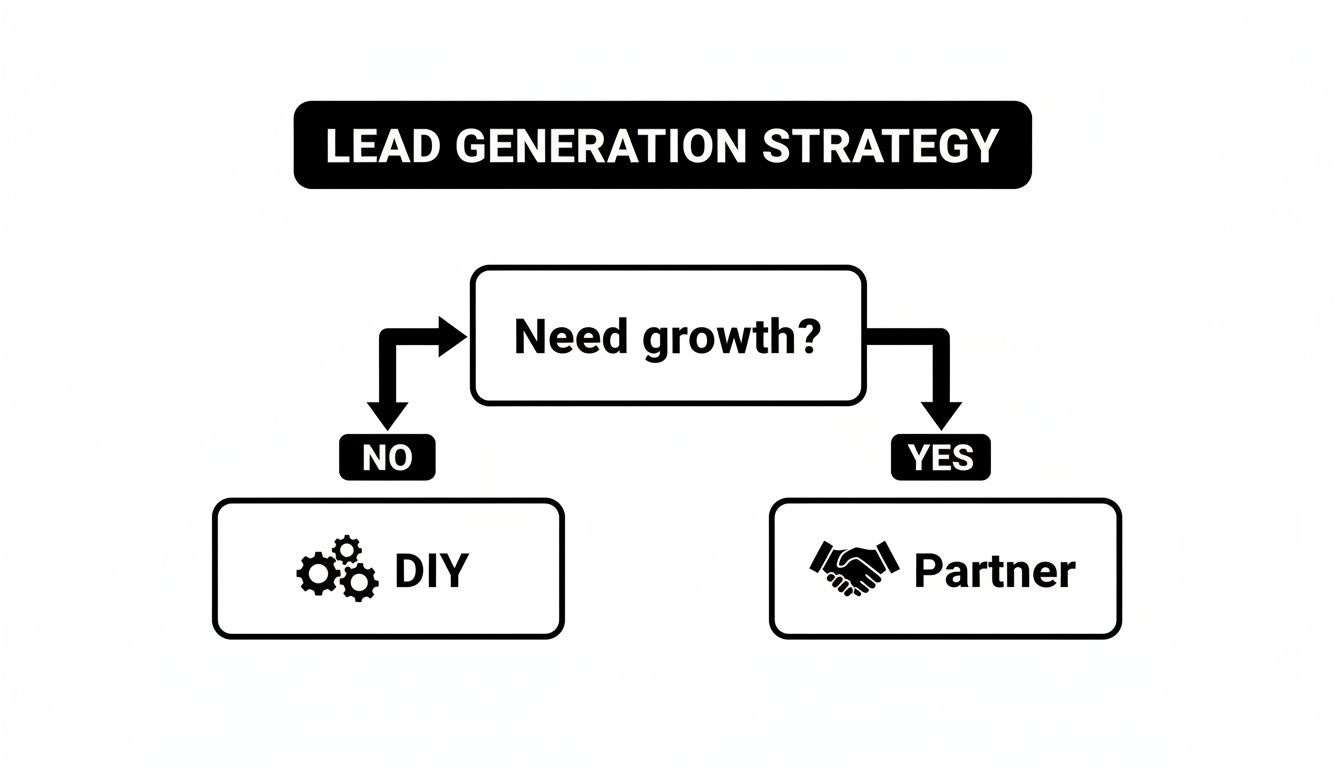
As the graphic shows, if serious growth is the goal, teaming up with a specialist is often the most direct path to getting there.
Choosing your model means weighing up the trade-offs between cost, control, and the expertise you have at your disposal. This table breaks down the common choices to help you see where your business fits best.
| Model | Best For | Typical Cost Structure | Level of Control | Scalability |
|---|---|---|---|---|
| In-House Team | Businesses wanting deep brand immersion and total process control. | Fixed salaries, benefits, software & training costs. | High | Moderate; limited by hiring speed. |
| Agency Partner | Companies needing immediate expertise, proven processes, and rapid scaling. | Retainer, per-lead, or performance-based fees. | Medium | High; can scale up or down quickly. |
| SaaS Platform | Tech-savvy teams with the time and skill to manage their own campaigns. | Monthly/annual subscription fees. | High | High; dependent on team capacity. |
| Freelancers | Businesses needing specialised skills for specific, short-term projects. | Project-based or hourly rates. | Medium | Low; reliant on individual availability. |
Each model has its place. An in-house team offers unmatched brand alignment, while an agency provides instant firepower. It all comes down to balancing your internal capabilities with your growth ambitions.
The next critical decision is figuring out who will actually do the work. You can either build your own internal team or partner with a specialised lead generation agency. Each path has its own distinct pros and cons.
Building an in-house team gives you the ultimate level of control. Your people will be completely immersed in your company culture and have a deep, nuanced understanding of your products that’s hard to replicate. However, this route requires a serious upfront investment in hiring, training, and buying the necessary tech stack. For a lot of organisations, the time and money needed to build an expert team from scratch can be a major hurdle.
Partnering with a lead generation agency gives you immediate access to a team of seasoned pros and their already-established processes and tools. Agencies bring a wealth of experience from working across different industries, letting them apply proven strategies to your business from day one. This model is often more cost-effective and scalable, as you can adjust your spend based on campaign performance without the overheads of full-time employees. You can dig deeper into the specific tactics agencies use by exploring different B2B lead generation strategies.
Finally, you need to think about the level of hands-on involvement you want. A full-service partnership is a world away from using a self-service software (SaaS) platform on your own.
For instance, a fast-growing B2B tech company might go for a full-service agency to rapidly scale its outreach on LinkedIn. On the flip side, a local construction business with a savvy marketing manager might use a self-service tool to run targeted email campaigns to a list of contacts they already have. The right model is simply the one that best lines up with your team's skills, budget, and growth plans.
When it comes to B2B, not all social platforms are built the same. While some are great for showing off your brand’s personality, LinkedIn is the undisputed heavyweight champ for professional networking and, more importantly, for drumming up high-value sales opportunities. Think of it less like a social network and more like a digital boardroom, making it an essential tool for any serious lead generation service.
Unlike other platforms where people are scrolling for entertainment, professionals are on LinkedIn with a business mindset. They’re there to connect, stay on top of industry trends, and hunt for solutions to their business problems. This creates a unique atmosphere where reaching out with a relevant business proposition isn’t just accepted—it's expected.
The real magic of LinkedIn lies in its incredibly detailed targeting options. A savvy lead generation specialist can go way beyond basic demographics to pinpoint the exact decision-makers you need to get in front of. This level of precision is simply in a league of its own.
Let’s say you’re a professional services firm trying to connect with Chief Financial Officers in the logistics industry, specifically at companies with over 500 employees. On LinkedIn, you can build a campaign that targets exactly that person. This granular control means your marketing budget is spent talking to people who can actually sign off on a purchase, which drastically boosts your efficiency and ROI.
This surgical approach completely changes the game for cold outreach. Instead of casting a wide, hopeful net, you’re using a laser-guided system to engage prospects who are a perfect fit. That focus on quality over quantity is what separates a winning campaign from a wasteful one.
The platform's power isn't just theoretical; the numbers tell the story. In the competitive Australian B2B marketing scene, LinkedIn is the undisputed king, capturing a massive 80% of all B2B leads that come from social media.
For businesses like Virtual Ad Agency, which specialises in full-funnel digital solutions, this means LinkedIn is the top priority for media planning and buying. It’s the direct line to decision-makers in medium to large enterprises who are looking to improve their digital presence. This market dominance makes LinkedIn an indispensable part of any solid lead generation strategy targeting the Australian market. Ignoring it is like leaving the vast majority of potential B2B social media leads on the table for your competitors to scoop up.
LinkedIn is the only platform where you can verify a person's professional credibility in seconds. This inherent trust makes it easier to initiate meaningful business conversations and build relationships that lead to real revenue.
Let's walk through a real-world example. An IT consultancy wants to sell its new cybersecurity solution. Using LinkedIn, they don't just throw up generic ads. Instead, they identify IT managers and directors in the financial sector who have recently engaged with content about data security.
Their lead generation service then rolls out a multi-touch campaign:
This methodical process turns a completely cold contact into a warm, qualified sales appointment. It’s a sophisticated play that builds trust and positions the consultancy as a helpful expert, not just another vendor pushing a product. For those wanting to dig deeper into specific tactics, exploring proven LinkedIn lead generation strategies can give you a real competitive edge.
When you're sizing up a lead generation service, it’s all too easy to let the price tag do all the talking. But fixating on the lowest quote is a classic rookie error. It often leads to a pipeline clogged with lukewarm prospects, a sales team chasing ghosts, and ultimately, a terrible return on your investment.
Real value isn’t found in the cheapest price, but in the quality and efficiency of the leads that land on your desk. A low-cost service might throw a high volume of names your way, but if your sales team spends weeks on contacts who were never going to buy, you’re bleeding money, not saving it.
A smart partnership is all about cost-effectiveness, not just cost. It’s about investing in a system that delivers qualified, sales-ready opportunities that actually turn into revenue.
It’s not just you; getting new customers online is getting more expensive. The whole game is changing, mostly thanks to more competition and crowded markets. The latest data paints a pretty clear picture.
Australia's digital ad market is on a tear, swelling to AUD $16.4 billion on the back of 11.1% year-on-year growth. In this dog-eat-dog environment, the average Cost Per Lead (CPL) for paid search campaigns shot up 25% to $66.69, a sting felt by 86% of industries. Broader lead generation campaigns weren't spared either, with the average CPL climbing 20% to $27.66, against a conversion rate of just 7.72%. For anyone in marketing, these numbers are a wake-up call to get smarter with strategy.
This upward trend means that expert budget management is no longer a 'nice-to-have'. A specialist lead generation service knows how to navigate these choppy waters by fine-tuning campaigns, zeroing in on niche audiences, and blending channels to squeeze every drop of value from your budget.
The real question isn't "How much does a lead cost?" It's "How much does a customer cost?" A cheap, unqualified lead that goes nowhere is infinitely more expensive than a higher-cost, qualified lead that becomes a long-term client.
To make a good call, you need to get your head around how different services structure their fees. While the details can vary, most models fall into one of three buckets, each with its own quirks.
Getting to grips with these structures helps you compare apples with apples. It's also crucial to connect these costs to the bigger picture of your investment. You can get a much clearer view by learning more about the customer acquisition cost formula and how to apply it.
Choosing the right model really comes down to your budget, your appetite for risk, and your growth ambitions. The main takeaway? A strategic investment in an expert partner helps you spend your budget wisely, ensuring your efforts lead to sustainable, profitable growth, not just a long list of dead-end contacts.
Choosing a lead generation partner is a massive decision, one that can make or break your entire sales pipeline for the year. Think of it like bringing a specialist into your business's growth team; you wouldn't hire just anyone without checking their credentials, track record, and how they actually operate.
Get it right, and your new partner will feel like a seamless extension of your own team. Get it wrong, and you’ll burn through your budget only to end up with a list of dead-end leads. This isn’t a decision to be taken lightly. You need to look past the slick sales pitch and get a good look at the engine room.
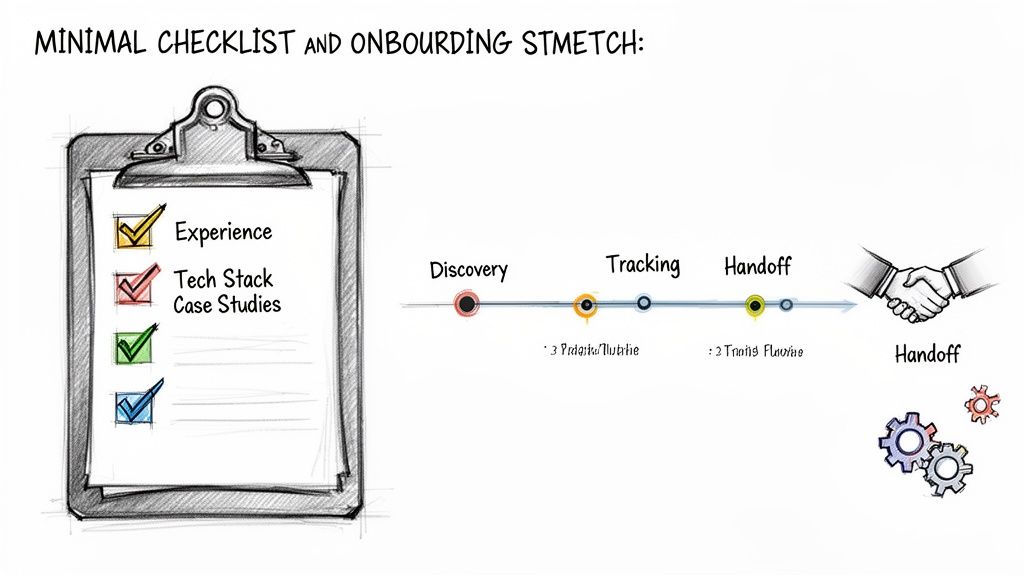
A great partner doesn't just promise the world; they show you proven processes, communicate with total transparency, and genuinely understand your specific corner of the market. To find them, you need a solid evaluation framework—a checklist to help you systematically vet potential agencies and figure out if they have the strategic chops to deliver real results.
Before any contracts are signed, make sure you work through these critical points. Each one is designed to pull back the curtain on a potential lead generation service and see if their approach truly lines up with your business goals.
A partner’s value isn't just in the leads they generate, but in the clarity and insight they provide. Demand transparency in their process, technology, and reporting from day one.
Once you’ve got a shortlist, it’s time to dig in. These questions are designed to cut through the fluff and get to the strategic thinking behind their operations.
Their answers will tell you everything you need to know about their honesty, flexibility, and whether they’re genuinely interested in a partnership. A top-tier lead gen agency will welcome this kind of scrutiny.
The first 90 days of any new partnership are absolutely crucial. A well-structured onboarding process lays the groundwork for long-term success, making sure everyone is aligned and chasing the same goals from the get-go.
A reliable partner will walk you through a clear, multi-stage process that looks something like this:
1. Discovery and Strategy Workshop
This is the deep-dive phase. The agency should spend a good amount of time with your team to properly understand your brand, your value proposition, who you're up against, and what you’ve tried in the past. This workshop should end with clear, agreed-upon goals and KPIs.
2. Technical Setup and Integration
Next, it's time to get the technical foundations right. This usually involves setting up tracking pixels, integrating with your CRM, and making sure all the analytics platforms are talking to each other correctly. It’s a vital step for accurate attribution and measuring performance down the track.
3. Defining the Service Level Agreement (SLA)
A formal SLA is essential. This document clearly lays out the responsibilities for both sides. It should detail the lead qualification criteria, the exact hand-off process for your sales team, and the expected follow-up times. No grey areas.
4. Establishing Communication Cadence
Clear, consistent communication is the bedrock of any healthy partnership. Agree on a regular schedule for check-ins—whether that’s weekly calls, monthly performance reviews, or a shared Slack channel for quick questions. This keeps things transparent and allows for nimble strategy adjustments as the campaign gets rolling.
By following this kind of methodical approach, you shift from hoping you've found a good partner to actively selecting the right one. This ensures the lead generation service you choose isn’t just another vendor, but a strategic ally who is genuinely invested in your growth.
Jumping into a partnership with a lead generation service is a big step. It's a serious investment of both your budget and your trust, so getting straight answers to your questions is non-negotiable before you sign on the dotted line. This is where we tackle the common queries we hear from businesses, giving you the practical insights needed to make a confident, well-informed decision.
Think of this as your final checklist. We'll cover everything from realistic timelines and the finer points of lead quality to how you should actually measure the return on your investment. Let’s make sure you’re fully prepared to build a profitable partnership.
This is always the first question, and the only honest answer is: it depends on the strategy. While everyone’s chasing immediate results, a truly smart lead generation plan knows how to balance quick wins with long-term, sustainable growth.
If you’re using paid advertising strategies, like targeted campaigns on LinkedIn or Google Ads, you can expect to see the first leads trickling in within one to three months. These methods are fantastic for getting some early traction and seeing how the market responds to your offer.
But inbound strategies like Search Engine Optimisation (SEO) and content marketing play a different game entirely. These are about building your authority and organic visibility, and that simply takes time. You’ll start to see real momentum building over three to six months, but the leads you get this way are often higher quality and come at a much lower cost in the long run.
A good lead generation service will be upfront about this from day one. They should set clear projections for each strategy and highlight early success indicators—like website traffic and engagement—while they work on building a solid pipeline of qualified leads.
Getting your head around these two lead types is crucial for getting your marketing and sales teams on the same page. Confusing one for the other is a classic recipe for friction and wasted effort, so let's clear it up.
A Marketing Qualified Lead (MQL) is someone who has shown some initial interest by interacting with your marketing. Maybe they downloaded an ebook, signed up for your newsletter, or sat in on a webinar. They’re curious about the problem you solve, but they’re not ready for a sales call just yet.
A Sales Qualified Lead (SQL), on the other hand, is a prospect who’s been properly vetted and is showing clear intent to buy. This is the person who has taken a high-value action, like requesting a demo or asking for a personalised quote. They’ve moved past idle curiosity and are now actively looking at solutions.
The real job of an effective lead generation service is to expertly nurture those MQLs with targeted content and communication until they’re ready to become SQLs. This makes sure your sales team spends their valuable time only on the most promising, sales-ready opportunities, which massively boosts their efficiency and close rates.
Measuring the real return on investment (ROI) from a lead partner goes way beyond just counting leads. A mountain of leads means nothing if none of them turn into actual revenue. The only way to measure success properly is to connect their work directly to your bottom line.
To get this right, you have to track the total revenue generated from the leads they provide and compare it against what you’ve spent on the service. Two metrics are absolutely essential for this:
A successful partnership is one where your LTV is significantly higher than your CAC. Any great lead generation service will give you transparent, detailed reports that clearly show this connection, proving exactly how their activities are fuelling your company’s growth and profitability.
Ready to build a predictable pipeline of high-quality leads? The team at Virtual Ad Agency specialises in creating full-funnel marketing strategies that deliver measurable results. Find out how we can help you grow.

 previous