
In today's competitive B2B landscape, a steady stream of high-quality leads is the lifeblood of sustainable growth. Yet, the playbook is constantly evolving. What worked last year might fall flat in 2025 as buyers become more discerning and channels more saturated. Simply casting a wide net is no longer enough; success now demands a sophisticated, multi-channel approach that prioritises value, precision, and authentic connection.
This comprehensive guide moves beyond the basics to explore 10 proven b2b lead generation strategies, from foundational content marketing to advanced intent data tactics. We are not just listing ideas; we are providing a blueprint for execution. For a comprehensive look at what's working now, explore the Top B2B Lead Generation Ideas for 2025.
Throughout this article, you will discover actionable steps, real-world examples, and expert tips to help you build a robust and predictable lead generation engine. Whether you are looking to refine your LinkedIn outreach, implement an Account-Based Marketing (ABM) program, or leverage strategic partnerships, the insights here are designed for immediate application. We will delve into a diverse mix of tactics including:
Our goal is to equip you with the knowledge needed to attract, engage, and convert high-value clients, ensuring your sales pipeline remains full for the year ahead and beyond. Let's begin.
Content marketing is a cornerstone of modern B2B lead generation strategies, focusing on creating and distributing valuable, relevant, and consistent content to attract and retain a clearly defined audience. Rather than directly pitching your products or services, you provide genuinely useful information that solves problems, answers questions, and addresses the pain points of your target clients. This approach establishes your organisation as a trusted authority and thought leader in your industry.

When B2B buyers are researching solutions, they overwhelmingly turn to educational content before ever speaking to a sales representative. By providing this content, you capture their attention early in the buyer's journey, build credibility, and generate organic, high-quality leads. For instance, Salesforce’s annual "State of Marketing" report is a prime example, attracting C-level executives with original data and industry insights, positioning them as the definitive source on marketing trends.
To effectively leverage content for lead generation, a structured approach is crucial. Your goal is to guide prospects from initial awareness to making a purchase decision with targeted content for each stage.
By consistently producing high-quality, problem-solving content, you create a powerful inbound engine that attracts, educates, and converts your ideal customers. To refine your approach, you can explore more detailed guidance on content marketing best practices.
LinkedIn outreach and social selling involve leveraging the world's largest professional network to identify, connect with, and engage decision-makers. This strategy moves beyond cold outreach by focusing on building genuine relationships through personalised messaging and value-driven content sharing. It combines targeted prospecting with authentic social engagement to warm up leads before initiating a sales conversation.

Unlike traditional cold calling, social selling allows you to build rapport and establish credibility within your target market. By consistently providing value and engaging with a prospect’s content, you transform from an unknown vendor into a recognised industry peer. For instance, SaaS company Cognism successfully generates over 400 sales-qualified leads each month through highly targeted and personalised LinkedIn outreach campaigns, demonstrating the power of this B2B lead generation strategy when executed at scale.
A successful LinkedIn strategy requires more than just sending connection requests. It's about systematically building a network and nurturing relationships through meaningful interactions that lead to business opportunities.
By combining a well-optimised profile with a consistent, value-first engagement strategy, you can turn LinkedIn into a predictable pipeline of high-quality B2B leads. A valuable framework to follow is the "5-3-1 rule": for every one connection request, interact with five pieces of their content and make three comments.
Account-Based Marketing (ABM) flips the traditional lead generation funnel on its head. Instead of casting a wide net to capture as many leads as possible, ABM is a highly focused B2B lead generation strategy where marketing and sales teams collaborate to target a select list of high-value accounts. This approach treats each target company as a "market of one," delivering personalised campaigns designed to resonate with the specific challenges and goals of all key decision-makers within that organisation.
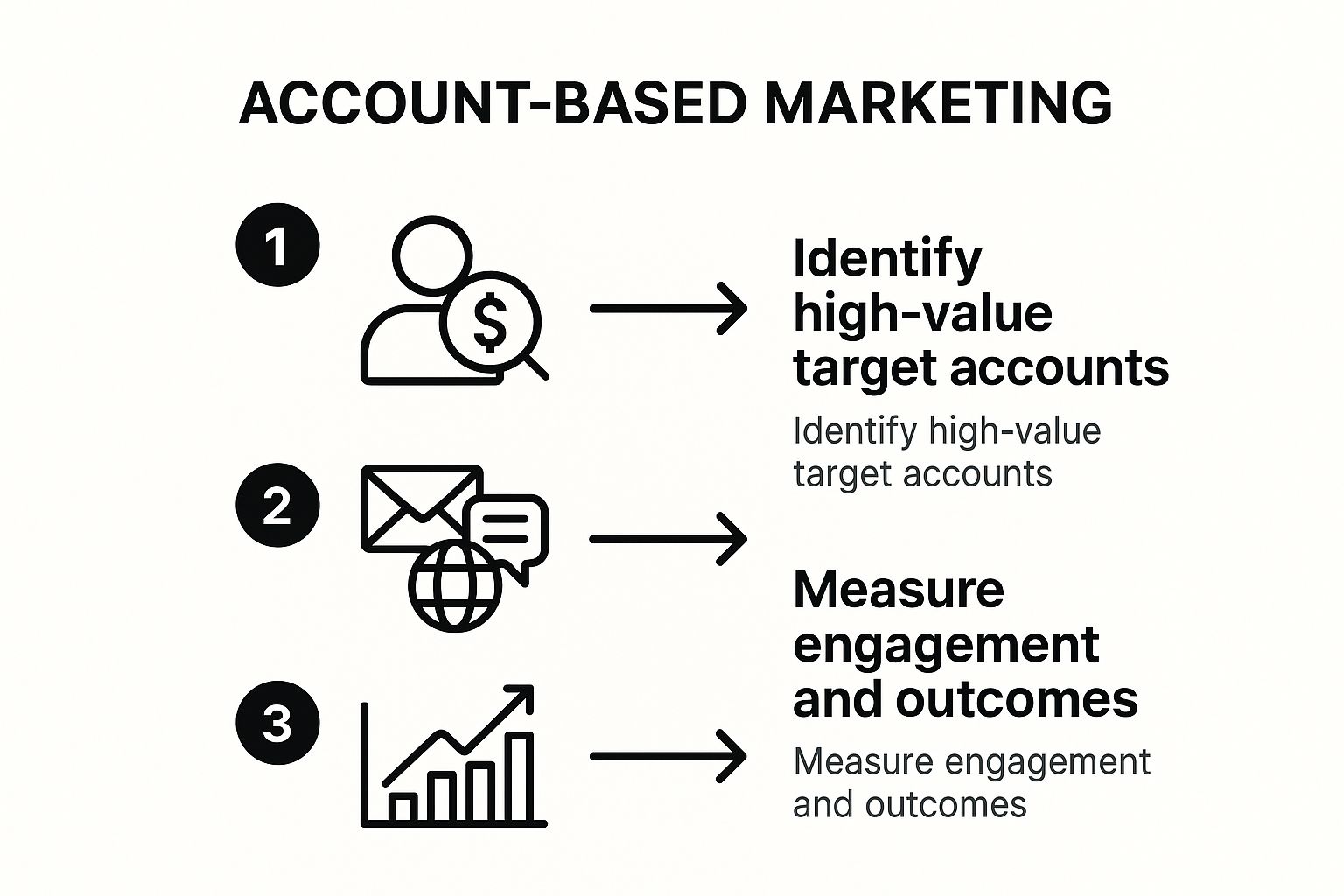
This strategic alignment between sales and marketing is crucial for engaging complex buying committees. The infographic above illustrates the core ABM process flow, moving from identification to personalised engagement and measurement. Rather than just generating leads, the goal is to build relationships and demonstrate deep understanding, which drives significant results. For example, DocuSign’s targeted ABM program generated a 22% increase in its average deal size by focusing resources on accounts with the highest revenue potential.
A successful ABM pilot programme requires meticulous planning and cross-functional coordination. The aim is to create a seamless and highly relevant experience for your most important target accounts, guiding them through their unique buying journey.
By treating high-value prospects like partners before they even become customers, ABM builds a strong foundation for long-term, high-revenue relationships. You can find more detailed guidance on building your first campaign by exploring a guide to starting ABM.
Email marketing remains one of the most effective and high-ROI B2B lead generation strategies, serving as a direct line to nurture prospects through the entire buyer's journey. It encompasses both cold outreach to initiate conversations with new accounts and automated nurture campaigns designed to educate, build trust, and guide warm leads toward a sales-ready state. This dual approach allows businesses to proactively engage new targets while systematically cultivating interest from inbound leads.
This strategy works because it meets buyers where they are. A well-timed, personalised cold email can open doors to high-value accounts, while automated sequences ensure no inbound lead is forgotten. For instance, Grammarly’s user onboarding sequence uses behaviour-triggered emails to boost engagement and product adoption, effectively nurturing free users into paying customers. This strategic communication builds a relationship over time, making a sales conversation feel like a natural next step rather than an interruption.
A successful email strategy requires a blend of precise targeting for cold outreach and thoughtful automation for lead nurturing. The goal is to deliver value in every message, building credibility and guiding prospects forward.
By combining disciplined cold outreach with intelligent, value-driven nurture campaigns, you can create a powerful system for converting prospects into qualified leads. To further enhance your campaigns, you can find in-depth guidance on email marketing best practices.
Webinars and virtual events are powerful B2B lead generation strategies that involve hosting educational online sessions, workshops, or panel discussions. Rather than delivering a direct sales pitch, these events provide high-value content that addresses specific industry challenges or trends. This format allows companies to demonstrate deep expertise, engage with a captive audience in real-time, and capture detailed registrant information for targeted follow-up.
In the modern B2B landscape, where buyers seek education before engagement, virtual events serve as a dynamic middle-of-funnel asset. They bridge the gap between initial awareness and a sales conversation. A prime example is Gong's "#celebrate" virtual events, where they analyse sales calls and share data-driven insights, attracting thousands of sales leaders and cementing their position as an industry authority, all while generating a high volume of qualified leads.
A successful virtual event strategy goes beyond just hosting a presentation; it involves careful planning, promotion, and post-event nurturing to maximise lead generation.
By delivering genuine value and creating an interactive experience, webinars become a highly effective mechanism for converting interested prospects into warm, sales-ready leads. For further insights, you can explore resources on how to run a successful webinar.
Search Engine Optimisation (SEO) is a fundamental B2B lead generation strategy focused on enhancing your website's visibility in search engine results. By optimising your site's content, technical structure, and backlink profile, you can rank higher for keywords your target customers use when actively researching solutions. This long-term approach captures high-intent leads precisely when they are looking for answers, positioning your brand as the top solution.
When B2B buyers begin their search, they are not just looking for a vendor; they are looking for information and solutions. Capturing this organic traffic is incredibly valuable because it's driven by the buyer's own initiative. For example, a company like Zapier excels at this by creating individual pages for every app integration they offer. These pages rank for highly specific searches like "connect Slack to Google Sheets," intercepting users with a clear need and offering an immediate solution.
A successful SEO strategy requires a multifaceted approach, blending technical precision with high-quality content that meets user intent. The goal is to build a sustainable source of organic leads that grows over time.
By systematically optimising for organic search, you build a powerful and cost-effective channel for attracting qualified B2B leads. To dive deeper, you can find valuable insights from industry experts like Brian Dean.
Strategic partnerships are a powerful force multiplier in B2B lead generation strategies, allowing you to tap into new, relevant audiences by collaborating with non-competing businesses. Instead of building an audience from scratch, you leverage the established trust and reach of a partner whose customers align with your ideal client profile. This approach generates warm, high-quality leads through shared credibility and value.
This method works because it's a win-win. Both companies gain exposure and access to qualified prospects who are already engaged with a trusted brand. For instance, HubSpot’s agency partner program is a masterclass in this strategy, generating a significant portion of its revenue by empowering marketing agencies to resell its software. This creates a powerful sales channel and a constant stream of leads for HubSpot, while partners gain a valuable service to offer their own clients.
A successful partnership requires clear communication, aligned goals, and mutual benefit. It's about creating a combined value proposition that is more compelling than what either company could offer alone.
By building a strong partner ecosystem, you create a sustainable and scalable engine for lead generation that is built on trust and shared value. For more insights on building these relationships, you can review some partner marketing best practices.
Paid advertising encompasses a range of strategies, such as Pay-Per-Click (PPC) and display networks, that provide immediate visibility and a controllable flow of targeted traffic. Unlike organic methods that require time to build momentum, paid campaigns can drive high-intent visitors to dedicated landing pages almost instantly. This makes it one of the most powerful B2B lead generation strategies for businesses needing quick results and granular control over their audience targeting.
The primary advantage of paid advertising is its precision. Platforms like Google Ads and LinkedIn Ads allow you to target prospects based on specific industries, company sizes, job titles, and even specific account lists for ABM campaigns. For example, Zendesk effectively uses search advertising to capture high-intent searches for support software, while HubSpot’s LinkedIn campaigns have famously generated a 5x return on investment by targeting marketing decision-makers with relevant content.
A successful paid advertising campaign requires meticulous planning, setup, and ongoing optimisation. The goal is to maximise return on ad spend (ROAS) by converting clicks into qualified leads efficiently.
Referral and advocacy programs systematically leverage your most valuable asset: your satisfied customers. This B2B lead generation strategy focuses on incentivising existing clients, partners, and industry connections to refer new business, transforming happy customers into a proactive, volunteer sales force. Rather than relying on cold outreach, this method generates warm, high-trust introductions that typically have shorter sales cycles and significantly higher conversion rates.
A lead from a trusted peer is inherently more valuable than one generated from a marketing campaign. The referred prospect arrives with pre-established trust and a positive perception of your brand, bypassing much of the initial scepticism. For instance, HubSpot’s Solutions Partner Program is a masterful example, creating a network of agencies that not only use its software but also refer new clients, contributing billions in revenue. This organised approach turns word-of-mouth from a passive hope into an active, measurable lead generation channel.
To build a successful referral engine, you must make it easy, rewarding, and repeatable for your customers to advocate on your behalf. The program should feel like a natural extension of a positive customer experience, not a transactional obligation.
By formalising your referral process, you create a scalable and predictable pipeline of high-quality leads, driven by the authentic endorsement of your happiest customers. To explore further, consider this guide on building a B2B referral program.
Intent data and predictive lead scoring represent a proactive shift in B2B lead generation strategies, moving from waiting for inbound interest to identifying active buyers before they make contact. This approach involves analysing behavioural signals, both on your own digital properties (first-party) and across the broader web (third-party), to pinpoint companies actively researching solutions like yours. By combining this with predictive analytics, you can score and prioritise accounts that are not only a good fit but are also demonstrating purchase intent right now.
This strategy allows sales and marketing teams to engage prospects at the most opportune moment with highly relevant messaging. Instead of casting a wide net, you focus resources on accounts already in-market. For example, a platform like 6sense can identify that a target account is suddenly consuming a high volume of content related to "cybersecurity compliance". This signal allows a sales team to launch a personalised outreach campaign focused on that exact pain point, dramatically increasing the likelihood of engagement.
Effectively using intent data requires a systematic approach to integrate signals into your sales and marketing motions. The goal is to turn raw data into timely, personalised outreach that drives pipeline growth.
By operationalising intent data, you equip your revenue teams with the insights needed to find and engage active buyers, giving you a significant competitive advantage. To see how this works in practice, you can explore case studies from leading platforms like 6sense.
| Strategy | Implementation Complexity | Resource Requirements | Expected Outcomes | Ideal Use Cases | Key Advantages |
|---|---|---|---|---|---|
| Content Marketing & Thought Leadership | Medium to High | Skilled writers, SMEs, multi-channel distribution | Trust building, organic qualified leads, long-term ROI | Complex solutions, longer sales cycles, technical products | Builds credibility, reusable content, attracts high-quality leads |
| LinkedIn Outreach & Social Selling | Medium | Time-intensive manual effort, LinkedIn Sales Navigator | Direct access to decision-makers, relationship building | Enterprise sales, SaaS, professional services targeting specific roles | Highly targeted prospecting, authentic engagement, high response rates |
| Account-Based Marketing (ABM) | High | Sales-marketing alignment, tech stack, personalized campaigns | Higher ROI, shorter sales cycles, larger deal sizes | Enterprise B2B with defined target accounts and complex sales | Focused resources, coordinated sales-marketing effort, personalized outreach |
| Email Marketing & Nurture Campaigns | Medium | Marketing automation, list segmentation, content creation | Scalable lead nurturing, measurable engagement | All B2B sectors, SaaS, consulting, multi-product businesses | Highly scalable, cost-effective, detailed analytics |
| Webinars & Virtual Events | Medium to High | Event planning, tech platform, content prep | High-quality engaged leads, brand positioning | SaaS, education, complex products needing demos, thought leadership | Real-time interaction, repurposable content, global reach |
| SEO & Organic Search Optimization | High | Technical SEO expertise, ongoing content creation | Sustainable high-intent traffic, long-term lead generation | Companies with patience and content resources, active search demand | Cost-effective long-term ROI, competitive advantage, 24/7 lead gen |
| Strategic Partnerships & Co-Marketing | Medium | Partner alignment, co-creation, legal agreements | Access to new, trusted audiences, shared costs | SaaS with integration options, service businesses, new markets | Shared resources, increased credibility, higher conversion rates |
| Paid Advertising (PPC & Display) | Medium to High | Budget, campaign management, creative assets | Immediate lead generation, predictable and scalable | Companies with clear ROI goals and budget for sustained campaigns | Fast results, precise targeting, flexible budgets |
| Referral & Advocacy Programs | Low to Medium | Program management, tracking, customer engagement | Highest conversion rates, warm qualified leads | Companies with satisfied customer base and network effects | Low cost per acquisition, builds loyalty, self-sustaining growth |
| Intent Data & Predictive Lead Scoring | High | Data subscriptions, CRM integration, analytics expertise | Focused outreach, improved conversion, shorter sales cycles | Mid-market to enterprise B2B with ICP and advanced tech budget | Data-driven prioritization, real-time alerts, personalized messaging |
Navigating the landscape of B2B lead generation can feel complex, but as we've explored, the path to a robust sales pipeline is paved with strategic, integrated actions. We've journeyed through a comprehensive toolkit, from the foundational authority-building power of content marketing and thought leadership to the precision targeting of Account-Based Marketing (ABM) and intent data. Each of these B2B lead generation strategies offers a unique lever to pull, capable of generating significant momentum for your business.
The core takeaway is not to view these ten strategies as a checklist to be completed, but as a dynamic playbook. The most successful organisations don't just execute tactics in isolation; they build a cohesive, interconnected system. Your SEO efforts should amplify your content, which in turn fuels your email nurture campaigns. Insights from your referral program can inform the messaging for your paid advertising, while the engagement from a successful webinar provides a warm audience for your LinkedIn outreach. This synergy is where true, sustainable growth is realised.
The difference between a list of ideas and a high-performing lead generation engine lies in deliberate implementation and consistent optimisation. Merely understanding what ABM is or how SEO works is not enough. The key is to translate this knowledge into a tailored, actionable plan that fits your unique business context, ideal customer profile (ICP), and available resources.
To move forward effectively, consider this three-step framework:
Building a world-class B2B lead generation function is a marathon, not a sprint. It requires patience, a commitment to testing, and a relentless focus on delivering value at every touchpoint. By embracing this strategic, integrated mindset, you transform individual tactics into a powerful, predictable engine for long-term revenue growth. Your future pipeline depends on the disciplined, data-informed actions you take today.
Ready to transform these B2B lead generation strategies from theory into tangible results? At Virtual Ad Agency, we specialise in designing and executing integrated, full-funnel marketing campaigns that drive measurable growth for Australian businesses. Contact our team of experts today to build a powerful and predictable lead generation engine for your organisation.

 previous