
Acquiring a new customer is a triumph, but the real, sustainable victory lies in keeping them. In an increasingly competitive market, the focus has decisively shifted from one-off transactions to building lasting, profitable relationships. Effective customer retention strategies are no longer a 'nice-to-have'; they are the core engine of scalable growth. The data is clear: increasing customer retention rates by just 5% can increase profits by 25% to 95%. This isn't just a marginal gain; it's a fundamental shift in business trajectory.
Loyal customers consistently spend more over their lifetime, act as powerful word-of-mouth marketers by referring new business, and provide the invaluable, honest feedback necessary for innovation. They create a powerful and resilient moat around your business that competitors find difficult to cross. While many articles offer surface-level tips, this guide moves beyond generic advice. We will provide a deep dive into 10 actionable, proven strategies you can begin implementing today to significantly reduce churn, maximise customer lifetime value, and transform satisfied buyers into passionate brand advocates.
We'll explore everything from leveraging data for hyper-personalisation and building vibrant online communities to structuring proactive customer support systems. For a broader perspective on the subject, you can explore various customer retention strategies to complement the detailed tactics we cover here. The following list is your comprehensive playbook for building a loyal customer base that not only stays but also fuels your long-term success.
Personalisation is a powerful customer retention strategy focused on tailoring communications, products, and experiences to individual customer data and behaviour. Rather than offering a one-size-fits-all approach, this method uses customer insights to create unique interactions that make each person feel seen and valued. This deepens the customer relationship, fostering loyalty that goes beyond mere transactions.

When customers receive relevant offers and content, their engagement increases, leading to higher conversion rates and repeat business. This strategy has been famously popularised by pioneers like Amazon, whose recommendation engine drives a significant portion of its sales, and Netflix, which saves over $1 billion annually in retention costs thanks to its content-tailoring algorithm.
Successfully integrating personalisation requires a strategic, data-driven approach.
Customer loyalty programs are structured marketing strategies designed to reward and encourage repeat purchases and continued engagement. By offering points, discounts, or exclusive benefits, these programs create a powerful incentive for customers to choose your brand over competitors. This approach transforms transactional relationships into long-term, reciprocal partnerships, making it a cornerstone of effective customer retention strategies.

The psychological principle of reciprocity makes these programs incredibly effective; when customers feel rewarded, they are more inclined to reciprocate with their loyalty and spending. Iconic examples like Starbucks Rewards, which drives over half of its U.S. sales, and Sephora's Beauty Insider, with 25 million members accounting for 80% of sales, demonstrate the immense power of a well-executed loyalty program in fostering a dedicated customer base.
A successful loyalty program requires thoughtful design and consistent execution to deliver genuine value.
Proactive customer service is a forward-thinking strategy that involves anticipating customer needs and resolving potential issues before customers realise a problem exists. Instead of waiting for a support ticket, this approach uses data and customer insights to offer solutions, guidance, or assistance preemptively. This demonstrates exceptional care and attention to detail, transforming the customer relationship from a reactive transaction into a trusted partnership.

This method significantly boosts customer satisfaction and loyalty by preventing frustration. Companies like Amazon set the standard by proactively notifying customers of delivery delays, while software platforms like Gainsight pioneered the customer success field by focusing on predictive support. Similarly, Tesla pushes over-the-air updates to fix issues before owners even notice them, showcasing how proactive support can be a powerful differentiator and one of the most effective customer retention strategies available.
Implementing a proactive support model requires a shift in mindset from problem-solving to problem-prevention, backed by data.
An omnichannel customer experience creates a seamless, integrated journey across all touchpoints and channels, including online, mobile, in-store, and social media. Unlike multichannel approaches where channels operate in silos, omnichannel ensures consistency and continuity. This allows customers to start an interaction on one channel and seamlessly continue on another without repetition or friction, a crucial factor for modern customer retention strategies.
This cohesive experience is fundamental for retention in today's fragmented customer journey. Companies like Disney have perfected this, with their MagicBand integrating park entry, hotel room access, and purchases into one device. Similarly, Starbucks enables mobile ordering with seamless in-store pickup, creating a unified and convenient brand experience that fosters loyalty.
The following infographic highlights key statistics that underscore the powerful impact of a well-executed omnichannel approach on customer retention and value.
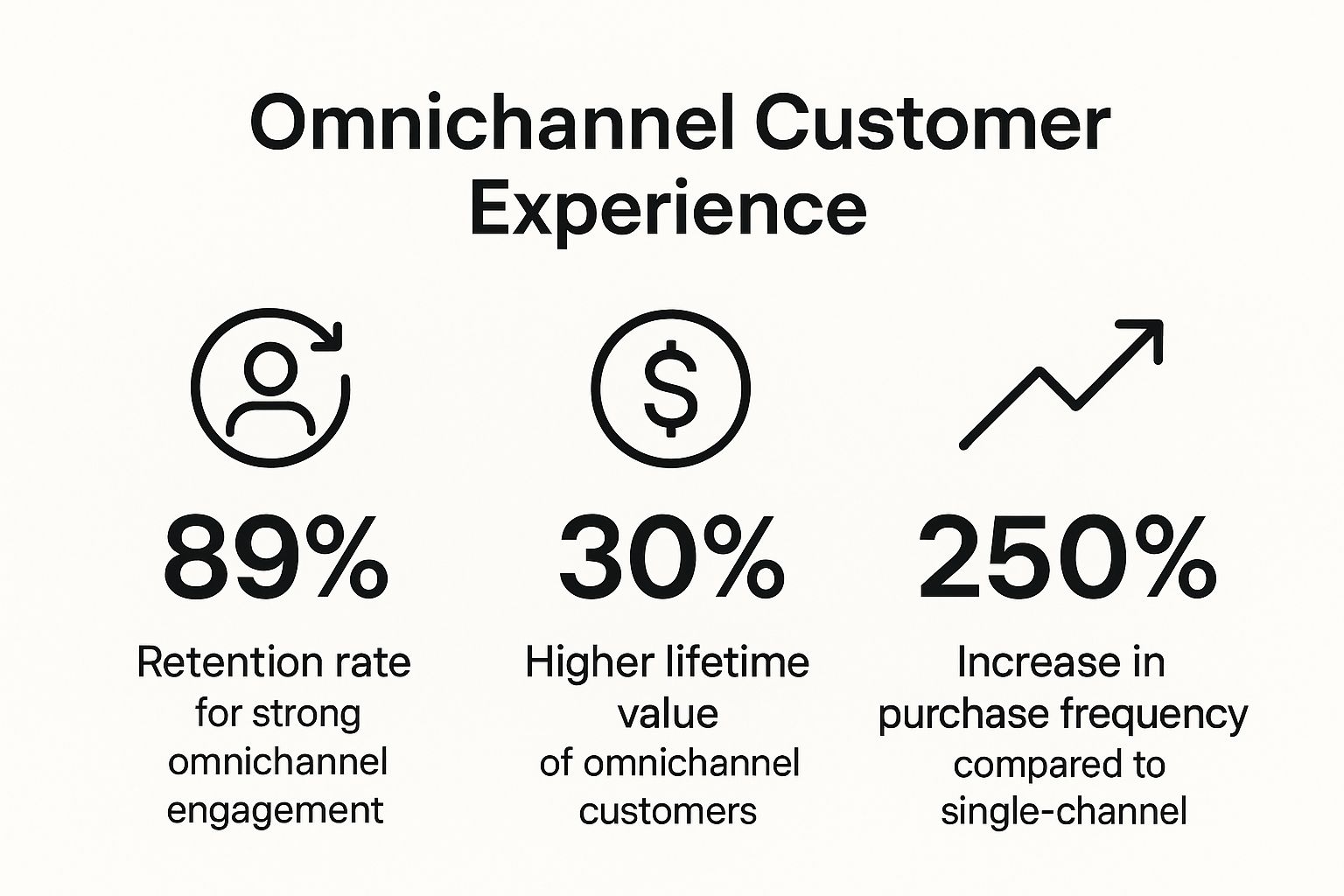
These figures demonstrate that an integrated experience not only keeps customers coming back but also significantly increases their long-term value and purchase behaviour.
Deploying a successful omnichannel strategy requires careful planning and a deep understanding of the customer journey.
Customer education and onboarding programs systematically teach customers how to derive maximum value from a product or service. This strategy recognises that retention begins at the first interaction. Effective onboarding reduces the time it takes for a customer to experience value, decreases early-stage churn, and builds product proficiency that leads to deeper, long-term engagement and loyalty.
Educated customers who experience quick wins are far more likely to remain loyal. For example, Slack’s guided onboarding with Slackbot ensures users send their first message quickly, a key action linked to its 93% retention rate. Similarly, Canva’s interactive tutorials help users create their first design in minutes, immediately demonstrating the tool's value and solidifying its place as one of the most effective customer retention strategies.
A successful onboarding process is proactive, guiding users toward success from day one.
Regular communication and engagement is a cornerstone of effective customer retention strategies. It involves maintaining a consistent, valuable dialogue with your customers across various channels to stay top-of-mind and nurture the relationship beyond the point of sale. Instead of purely promotional messages, this approach delivers educational content, company updates, and personalised check-ins that continuously demonstrate your brand's value.
When customers hear from a brand regularly with useful information, it reinforces their decision to choose you and builds a deeper connection. A prime example is Grammarly's weekly writing statistics email, which provides personalised insights and boasts exceptionally high engagement rates. Similarly, Peloton's community features and instructor interactions have helped it achieve a remarkable 92% retention rate, proving that consistent engagement builds powerful loyalty.
A successful communication strategy requires planning, relevance, and respect for the customer's inbox.
Actively collecting, analysing, and acting on customer feedback is a cornerstone of modern customer retention strategies. This approach involves systematically soliciting input to drive product and service improvements, demonstrating a genuine commitment to meeting evolving customer needs. By making customers feel heard and invested in your brand's journey, you build a powerful sense of partnership that fosters deep, long-lasting loyalty.
This strategy turns customers into collaborators. When companies close the feedback loop by communicating how customer suggestions led to tangible changes, it validates their opinions and strengthens the relationship. Tech giant Adobe famously refined its transition to the Creative Cloud subscription model through extensive customer feedback, while beauty brand Glossier built its entire product line from the ground up based on insights from its blog community.
A successful feedback system is organised, responsive, and integrated into your company culture.
Subscription and membership models transform the business relationship from discrete, one-off transactions into a continuous, ongoing commitment. This powerful customer retention strategy involves customers paying a recurring fee for consistent access to products, services, or exclusive benefits. This model inherently centres on retention, as sustained success relies on minimising customer churn rather than a constant cycle of new acquisitions.
The predictable revenue stream created by subscriptions incentivises companies to continuously deliver and enhance value, fostering a virtuous cycle of customer satisfaction and loyalty. Industry pioneers like Adobe have demonstrated the model's power, transitioning its Creative Suite to a cloud subscription and growing annual revenue from $4 billion to over $15 billion. Similarly, Peloton’s connected fitness subscription boasts an impressive 92% 12-month retention rate, highlighting how ongoing value solidifies customer relationships.
Deploying a successful subscription model requires careful planning to ensure long-term customer value and business viability.
Building a community around your brand creates connections not just between the company and customer, but among customers themselves. This powerful customer retention strategy leverages the human need for belonging by creating spaces where customers can interact, share experiences, and learn from each other. When customers form relationships within a brand community, their loyalty extends beyond the product to the social connections they've formed, creating powerful retention through network effects.
This approach transforms customers from passive consumers into active participants and advocates. Brands like Sephora, with its highly engaged Beauty Insider Community, and Salesforce, with its massive Trailblazer Community, have demonstrated that a well-managed community drives significant business value, reduces churn, and provides invaluable product feedback. The loyalty generated is deep-seated, as leaving the brand would also mean leaving a valued social circle.
A thriving community requires careful planning, dedicated resources, and a genuine commitment to fostering connections.
This customer retention strategy centres on continuously enhancing your core offering with additional services, features, and innovations that increase its value over time. Instead of letting a product become static, this approach gives customers new reasons to stay loyal by providing an evolving solution that adapts to their needs. It transforms the customer relationship from a single transaction into a long-term partnership built on growing value.
When customers see that the product or service they use is consistently improving, they feel confident in their investment and are less likely to seek alternatives. This method has been mastered by companies like Apple, whose regular iOS updates add significant new features to existing devices, and Tesla, which enhances vehicle performance and adds new capabilities through over-the-air software updates long after the initial purchase.
Successfully integrating continuous innovation requires a clear vision and a commitment to customer-centric development.
| Strategy | Implementation Complexity | Resource Requirements | Expected Outcomes | Ideal Use Cases | Key Advantages |
|---|---|---|---|---|---|
| Personalization and Customization | High – requires advanced data infrastructure | Significant investment in analytics, integration | Higher engagement, conversion, loyalty | E-commerce, digital platforms, marketing | Strong emotional connection, competitive edge |
| Customer Loyalty Programs | Medium – program design and management needed | Resources for rewards, management, communication | Increased repeat purchases and predictable revenue | Retail, subscription services, hospitality | Builds switching barriers, enhances advocacy |
| Proactive Customer Service | High – requires predictive analytics and multi-channel systems | Investment in monitoring tools and trained staff | Reduced churn, higher satisfaction, fewer support tickets | SaaS, tech, service industries | Prevents issues, demonstrates care, reduces effort |
| Omnichannel Customer Experience | Very High – complex system integration | Large tech infrastructure, organizational alignment | Improved retention, lifetime value, purchase frequency | Retail, banking, hospitality | Seamless cross-channel experience, competitive advantage |
| Customer Education and Onboarding | Medium – content creation and process design | Investment in learning platforms, ongoing content | Reduced early churn, faster time-to-value | SaaS, complex products, subscription services | Increases proficiency, builds early loyalty |
| Regular Communication and Engagement | Low to Medium – ongoing content and management | Content creation, multi-channel tools | Maintains brand awareness, nurtures relationships | B2B/B2C marketing, community-driven brands | Builds trust, supports upsell, low-cost retention |
| Customer Feedback and Continuous Improvement | Medium – feedback systems and analysis frameworks | Resources for surveys, analysis, follow-up | Identifies issues, directs product improvements | Product-led companies, SaaS, consumer goods | Drives trust and co-creation, reduces churn |
| Subscription and Membership Models | High – billing, retention, and value delivery | Tech for recurring billing, customer success teams | Predictable revenue, habit formation, higher LTV | Digital media, SaaS, fitness, curated products | Recurring revenue, lowers acquisition pressure |
| Community Building and Social Engagement | Medium to High – platform and management intensive | Community managers, moderation resources | Higher retention, brand advocacy, peer support | Lifestyle brands, tech communities, memberships | Creates emotional bonds, reduces support costs |
| Value-Added Services and Continuous Innovation | High – ongoing R&D and product development | Sustained investment in R&D and product teams | Fresh engagement drivers, increased switching costs | Tech, SaaS, consumer electronics | Justifies pricing, keeps product competitive |
We’ve explored a comprehensive suite of ten powerful customer retention strategies, moving from the granular details of personalisation to the broad, community-building power of social engagement. Each strategy represents a vital piece of a much larger puzzle: creating an ecosystem where your customers don’t just purchase from you; they feel valued, understood, and connected to your brand. The journey from a transactional relationship to one of genuine loyalty is not built on a single campaign or a clever tactic. It’s the result of a deliberate, sustained commitment to placing the customer at the very centre of every business decision.
The overarching theme is clear: retention is not a passive outcome. It is an active, ongoing process of delivering exceptional value that extends far beyond the initial sale. Whether it’s through proactive customer support that solves problems before they escalate, loyalty programs that offer tangible rewards, or continuous innovation that anticipates future needs, the goal is to make staying with your brand the easiest and most logical choice for your customers. Remember, your existing customers are your most valuable asset. They have already chosen you once; your mission is to give them compelling reasons to choose you again and again.
Reading through a list of powerful customer retention strategies is the first step, but turning that knowledge into measurable results is what truly matters. Building a robust retention framework can feel daunting, so it’s crucial to approach it methodically. Don't try to implement everything at once. Instead, adopt a focused, iterative approach to ensure your efforts are both manageable and impactful.
Here’s a practical roadmap to get you started:
Conduct a Customer Journey Audit: Before you select a strategy, you must first diagnose the problem. Map out your entire customer journey, from onboarding to post-purchase follow-up, and identify the key points of friction. Where are customers dropping off? What are the most common complaints your support team receives? This data-driven analysis will reveal the most critical areas for improvement.
Prioritise Based on Impact and Effort: Once you have identified your weak points, review the ten strategies discussed in this article. Which one or two directly address your biggest challenges? For example, if your audit reveals confusion during the initial setup process, focusing on Customer Education and Onboarding will yield the highest return. If you see high churn after six months, a Customer Loyalty Program or more Regular Communication might be the solution.
Start Small and Measure Everything: Choose your priority strategy and launch a pilot program. This could be as simple as sending a new series of educational emails to a small segment of new users or introducing a basic points system for repeat purchasers. The key is to define your key performance indicators (KPIs) from the outset. Track metrics like churn rate, repeat purchase rate, customer lifetime value (CLV), and Net Promoter Score (NPS) to objectively measure the impact of your initiative.
Key Takeaway: The most successful retention programs are not born from guesswork. They are built on a foundation of deep customer understanding, prioritised based on data, and refined through continuous measurement and optimisation.
Ultimately, mastering customer retention is about cultivating a culture of customer-centricity throughout your entire organisation. It’s a commitment to listening, adapting, and consistently exceeding expectations. Every email you send, every support ticket you resolve, and every new feature you launch is an opportunity to reinforce your value and strengthen your customer relationships. By making these powerful customer retention strategies an integral part of your business operations, you aren’t just reducing churn; you are building a sustainable foundation for long-term growth, powered by your most passionate advocates.
Ready to transform your customer journey into a powerful engine for growth? The team at Virtual Ad Agency specialises in designing and implementing holistic, data-driven customer retention strategies for Australian businesses. We can help you audit your current processes, identify key opportunities, and build a comprehensive framework that turns one-time buyers into lifelong fans. Visit Virtual Ad Agency to learn how our full-funnel marketing expertise can elevate your retention efforts.

 previous