
So, what exactly are Google PPC services? At their core, they are professional management solutions where an agency takes the reins of your entire Google Ads campaign. This covers everything from keyword research and ad creation to managing the budget and analysing performance, all to make sure your advertising spend is actually working for you.
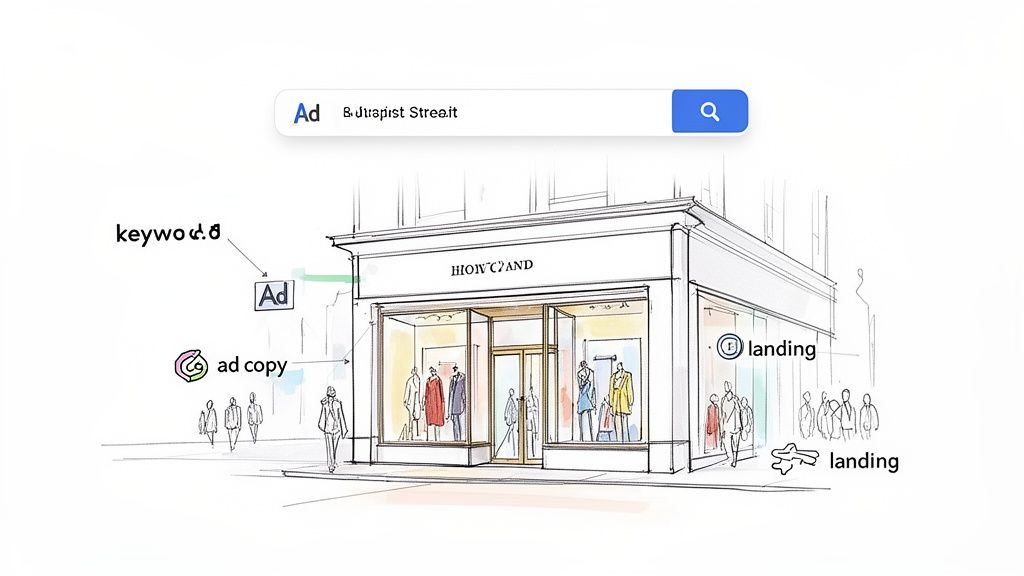
Picture Google as the world's biggest, busiest marketplace. Bringing in a firm for Google PPC services is like hiring a team of expert architects and marketers to build, place, and run your shop in the absolute prime location of that marketplace. It’s so much more than just paying for an ad spot; it's about building a smart system that connects you with people at the exact moment they’re ready to buy.
This isn't just about throwing an ad up and hoping for the best. It's a full-on customer-attraction engine, built from the ground up. Instead of guesswork, these services use hard data to pinpoint your perfect customers and give them a compelling reason to choose you.
Professional PPC services are built on a few key pillars that all have to work together. Each one is critical for turning an advertising budget into a reliable stream of revenue. If any of these areas are weak, campaigns usually fizzle out without delivering a positive return.
The main components nearly always include:
A great marketer finds the ceiling of potential; a terrible one finds the floor of loss. Professional PPC management is about systematically finding that ceiling to maximise your growth potential without wasting your budget.
At the end of the day, the goal of these services is to manage this whole process efficiently and effectively. To a customer, a well-run campaign feels effortless—they search for something, see a helpful ad, click it, and land on a page that makes it easy to get what they want. Behind the scenes, that seamless journey requires constant monitoring, testing, and tweaking.
This methodical approach ensures every dollar you spend is an investment toward real business goals. As you continue through this guide, you’ll see how the right Google Ads management can turn simple clicks into loyal, paying customers. It's not about just being seen; it's about being chosen.
For any medium-to-large business in Australia today, standing still online is the same as falling behind. The digital marketplace is more crowded and competitive than ever, and just having a website simply isn't enough to cut through the noise.
This is where professional management of google ppc services shifts from being an optional extra to a vital investment in your growth. It's about seizing an immediate, powerful advantage. While long-term plays like Search Engine Optimisation (SEO) build your foundation over months or years, PPC delivers speed and precision right now. You get instant visibility at the very top of Google, placing your brand directly in front of customers the moment they’re searching.
Imagine launching a new service line or expanding into a new city like Perth or Brisbane. Instead of waiting for organic rankings to slowly climb, a professionally managed PPC campaign generates buzz and brings in leads from day one. In a fast-moving market, that kind of agility is priceless.
It gives you the power to:
This level of control creates a consistent, measurable stream of high-quality leads. Really understanding the different strategies to get leads, from content marketing to paid ads, is key to appreciating how expert PPC management can light a fire under your business development and keep your sales pipeline full.
Beyond the immediate leads, a well-run Google Ads campaign is an absolute goldmine of market data. Every click, impression, and conversion offers up priceless insights into how your customers behave, what they're searching for, and what your competitors are up to.
This intelligence doesn’t just make your ads better; it can inform your entire business strategy.
Professional PPC management transforms your advertising from a simple expense into a strategic asset. It provides the speed to compete today and the data to win tomorrow, giving you a significant and sustainable competitive advantage.
The investment is substantial because the opportunity is enormous. The Australian digital ad market, driven heavily by google ppc services, recently soared to AUD $16.4 billion, marking an impressive 11.1% jump year-on-year. That surge shows just how central Google Ads has become, with businesses from Adelaide to Sydney using paid search to fuel targeted growth.
Finally, it’s a mistake to see PPC as a replacement for SEO. They are essential partners. The data you get from your PPC campaigns—which keywords actually convert, what ad copy gets the best response—can directly inform and speed up your SEO efforts.
It creates a powerful feedback loop where each strategy makes the other stronger. For any Australian business serious about growth, the question isn’t if you should use Google Ads, but how you can manage them to get the absolute maximum impact. Professional management ensures your budget is spent wisely, turning clicks into customers and data into a decisive market edge.
When you're choosing a partner for your Google PPC services, you've got to get your head around how they charge for their work. An agency's pricing model isn't just a line item on an invoice; it's a window into their philosophy on partnership, growth, and performance. Getting clear on these models is the first step toward building a partnership that’s both effective and makes good financial sense.
It might feel a bit complicated at first, but most agency pricing structures fall into one of three main buckets. Each has its own set of pros and cons, making them a better fit for different businesses and campaign goals. Knowing which one lines up with what you want to achieve is the key to a great relationship.
This is one of the most common models you’ll come across, especially for businesses with bigger, more fluid budgets. The agency simply charges a fee that’s a percentage of your total monthly ad spend, usually somewhere between 10% and 20%.
The logic is pretty simple: as your ad budget grows and the campaigns get more complex, the management fee scales right alongside it. This model gives the agency a clear incentive to manage bigger budgets well, making it a fantastic fit for a national e-commerce brand looking to scale its campaigns hard during peak seasons.
For businesses that run on predictability, a flat-rate model is often the perfect match. You pay a fixed fee every month, no matter how much you spend on ads. This figure is worked out based on the scope of work, the size of your account, and the level of strategic input you need.
This structure is ideal for, say, a B2B company with consistent lead generation targets and a stable monthly budget. It gives you complete clarity on your costs, which makes financial planning a breeze. The focus stays squarely on hitting the agreed-upon performance goals, rather than getting caught up in how much is being spent. You can get a deeper understanding of the factors that influence how much an ad on Google costs in our detailed guide.
An agency's pricing model should align directly with your business goals. Whether you need a partner that scales with your spend or one that provides predictable costs, the right structure creates a foundation of trust and shared objectives.
This one is less common but can be a seriously attractive option. With performance-based pricing, the agency's fee is tied directly to specific results—think number of leads generated, sales completed, or hitting a target Cost Per Acquisition (CPA).
This model creates a powerful alignment of interests because the agency only gets paid well when you see real results. It’s often used for specific, high-stakes campaigns where the conversion goals are crystal clear. It does, however, require rock-solid tracking and a mutual agreement on what "success" actually looks like, making it a more complex but potentially very rewarding setup.
To help you get a clearer picture, here’s a breakdown of the typical pricing structures. This should help you figure out the right model for your business budget and goals.
| Pricing Model | Best For | Typical Cost Structure (AU) | Pros | Cons |
|---|---|---|---|---|
| Percentage of Ad Spend | Businesses with large or fluctuating ad budgets aiming for aggressive growth and scalability. | 10% – 20% of monthly ad spend. | Incentivises agency to scale spend effectively; simple to calculate; flexible for seasonal campaigns. | Can encourage spending over efficiency; less budget predictability; potential conflict of interest. |
| Flat-Rate Retainer | Businesses seeking budget predictability and consistent, long-term management. | $1,500 – $10,000+ per month, based on scope. | Predictable monthly costs; focus on performance, not spend; easier for financial planning. | Fee is fixed even if spend decreases; may not be suitable for rapid scaling; requires clear scope. |
| Performance-Based | Businesses with very clear, trackable conversion goals (e.g., leads, sales) and high confidence in their offer. | A base fee + a bonus per lead/sale, or a percentage of revenue generated. | Strong alignment of goals; you only pay for results; high potential ROI. | Can be complex to set up and track; requires deep trust and data transparency; less common model. |
Ultimately, the best pricing model is the one that fosters a true partnership. It should feel fair, transparent, and built around achieving the results that matter most to your business.
Trying to measure the success of your google ppc services can feel a bit like drinking from a firehose. You open a dashboard and are immediately hit with a flood of data—impressions, clicks, and a dozen other figures. But here’s the thing: impressions and clicks are mostly vanity metrics. They show activity, not achievement.
Think of it like this: impressions are the number of people who walk past your shop window. Clicks are how many people decide to step inside. While that's interesting, it doesn't tell you if you actually sold anything. To see real growth, you have to focus on what happens after that initial click.
These are the numbers that tell the real story of your campaign’s health. A high-value performance report doesn’t just spit out data; it gives you the why behind the numbers and explains how the strategy will adapt to get even better results next month.
The first big mindset shift is to stop obsessing over clicks and start focusing on conversions. A conversion is simply the valuable action you want someone to take after they click your ad. This could be anything from filling out a contact form to downloading a brochure or buying a product.
Two key metrics paint this picture:
A high CTR is great, but a high conversion rate is what pays the bills. It doesn’t matter if you get 1,000 clicks if none of them become a lead or a customer. A professional PPC service obsesses over optimising the entire post-click journey to push this number as high as possible.
Once you’re turning clicks into conversions, the next question is simple: are those conversions profitable? This is where the most important KPIs live, because they connect your ad spend directly to your revenue. To get this right, proper tracking is non-negotiable. Using tools like Google Analytics UTM parameters is essential for proving ROI.
The two financial metrics you should care about most are:
True campaign success isn’t found in how many people see your ads. It’s found in how cost-effectively you can turn ad spend into profitable customer action. CPA and ROAS are the north stars that should guide every strategic decision.
Recent Australian benchmarks really drive this home. The average Google Ads conversion rate across industries here sits around 6.96%, with a typical CPA of $66.69. But these numbers swing wildly between sectors. Home improvement can see conversion rates as high as 8.62%, while finance is closer to 2.78%, which shows just how important it is to set realistic goals for your own industry.
Getting your head around these core KPIs is the first step to properly evaluating your PPC efforts. For a deeper dive, check out our guide on the most important digital marketing performance metrics. By keeping your eyes on these numbers, you can make sure your agency partnership is driving genuine, measurable growth for your business.
Getting a single click is the easy part. The real art is turning that click into a loyal, repeat customer, and that’s where an experienced Google PPC services agency really shows its value. It means moving beyond a simple, one-dimensional view of advertising and embracing a full-funnel strategy that guides customers through their entire journey with your brand.
Too many businesses fall into the trap of focusing all their energy and budget on the final click—that moment of purchase. Think of it like only talking to people who are already standing at the checkout. A full-funnel approach is much smarter; it’s about nurturing potential customers from the very first time they hear your name to long after they’ve bought from you.
Imagine the customer journey as a path with distinct stages. Each stage requires a different kind of conversation and, naturally, a different type of Google Ad. A proper full-funnel strategy maps out this entire path, deploying the right ad format at the perfect moment to gently nudge people forward.
Let’s walk through an example. Say there’s a hypothetical Australian company called “EcoBuild Supplies,” selling sustainable building materials online. Their goal is to grow from a local supplier into a national name.
Right at the top of the funnel, most builders and renovators have never heard of EcoBuild. The goal here isn’t to push for a sale. It’s simply to introduce the brand and what it stands for.
Once potential customers know EcoBuild exists, the next step is to catch their attention when they start actively looking for solutions. They’re now comparing options and digging for specific information. This is where you need to show up and be helpful.
This is the bottom of the funnel. Your high-intent customers are ready to buy. The advertising here needs to be direct, compelling, and make the purchase as frictionless as possible. Any small obstacle can cost you the sale.
A full-funnel strategy ensures your marketing budget works smarter, not just harder. It transforms PPC from a simple sales tool into a comprehensive customer acquisition and retention engine, maximising lifetime value.
This integrated approach means each stage supports the next, creating a smooth and efficient path from stranger to customer.
The infographic below shows the logical flow of the key metrics that measure the health of this journey.
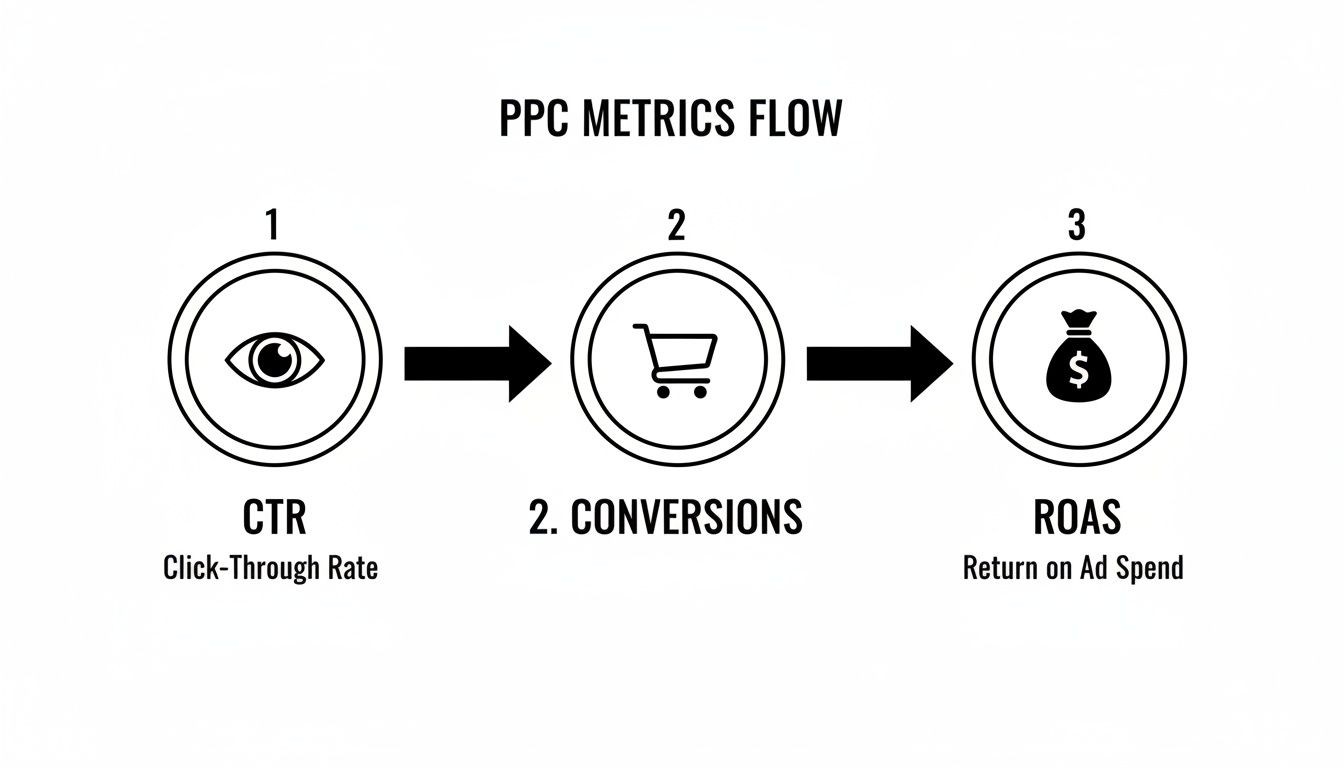
This process visualises how initial user interest (CTR) must translate into tangible business actions (Conversions) to ultimately deliver a profitable outcome (ROAS).
Picking a partner to manage your Google PPC services is one of the most critical marketing decisions you'll make. This isn't just about hiring another supplier; you're entrusting a massive part of your business's growth engine to an outside team.
Slick sales presentations are a dime a dozen. You need to look straight past the pitch and ask for hard proof of real-world success. The right partner acts as a genuine extension of your own team, bringing strategic thinking that goes way beyond just tweaking bids.
They should be obsessed with your business goals, not just hitting vanity metrics in the ads platform. This means finding an agency that can show you, point-blank, that they've delivered tangible results for businesses just like yours.
A top-tier agency doesn't just tick boxes and run through a checklist. They think strategically about your entire business. They get that their job is to capture existing demand efficiently, but they also know that real, sustainable growth comes from scaling the brand, not just fiddling with keywords.
When you're vetting potential partners, laser-focus on these core areas:
The best Google PPC partners don't just act as skilled technicians for your ad account. They serve as strategic C-Suite whisperers, using data to diagnose the real bottlenecks to growth and guiding your leadership team toward the right solutions.
Once you’re in a conversation with an agency, it's time to dig deeper. Their answers to specific, technical questions will tell you everything you need to know about the true depth of their expertise. Don't be afraid to get into the weeds—if they can answer clearly, that’s a massive green flag.
To help you get started, we've put together a checklist of key areas to investigate. Think of this as your guide to separating the real experts from the talkers.
This table outlines what to look for—and what to run from—when evaluating a potential Google PPC agency.
| Evaluation Area | What to Look For | Red Flags to Avoid |
|---|---|---|
| Strategic Approach | A clear methodology for aligning PPC with your business goals. They ask "why" before they talk about "what." | A "one-size-fits-all" approach or focusing only on keywords and bids without understanding your business model. |
| Case Studies & Proof | Specific, verifiable results for clients in a similar industry or with similar challenges (e.g., lead gen, e-commerce). Metrics should focus on ROAS and CPA, not just clicks. | Vague promises, "secret formulas," or an unwillingness to share specific client results. |
| Team Expertise | Direct access to the strategists who will work on your account. Look for years of hands-on experience and a genuine passion for data. | Being passed off to a junior account manager after the sales pitch. High staff turnover. |
| Reporting & Transparency | Customised dashboards that clearly show performance against your core KPIs. A willingness to explain the "what" and the "why" behind the numbers on a regular basis. | Generic, auto-generated reports filled with vanity metrics (impressions, clicks) but lacking business-focused insights. Hiding poor performance. |
| Technical Skills | Deep knowledge of conversion tracking, attribution models, A/B testing methodologies, and landing page optimisation. They should understand the entire user journey. | A blank stare when you ask about conversion rate optimisation (CRO) or multi-touch attribution. They only focus on what happens inside Google Ads. |
| Communication | Proactive updates, clear communication channels, and a single point of contact. They feel like a true partner who is invested in your success. | Poor responsiveness, jargon-filled emails, or making you chase them for updates. You feel like just another number. |
Here are a few essential questions to have ready during your conversations, expanding on the checklist above:
"How do you approach A/B testing for ad creative and copy?"
You're listening for a structured, data-driven process for continuous improvement, not just a "set it and forget it" mentality.
"What is your process for optimising landing page conversions?"
This is non-negotiable. A good agency knows the click is just the beginning and should have a clear method for improving what happens after the click.
"How do you determine the 'efficiency plateau' for an account?"
A sophisticated partner can pinpoint the moment where just adding more budget won't deliver efficient returns. More importantly, they can advise on the broader business strategies needed to break through that plateau and unlock the next level of growth.
Ultimately, choosing the right Google PPC services provider boils down to finding a team that is as invested in your bottom line as you are. They need to be proactive, data-obsessed, and brilliant at translating complex ad account activity into clear, bottom-line business outcomes.
Stepping into the world of Google Ads can feel a bit daunting. Business leaders and marketing managers across Australia often have the same handful of questions crop up when they’re thinking about investing in professional PPC services. What should we expect? How does it really work? And of course, what's it going to cost?
Getting straight answers is key before you put your budget on the line. We’ve tackled some of the most common queries below to give you the clarity you need to make a smart decision.
This is the big one, isn't it? While you'll see traffic and clicks almost straight away—sometimes within a day or two of launching a campaign—real, meaningful business results take a bit more time to cultivate. Think of the first month as a data-gathering mission where we establish a solid performance baseline.
You can typically expect to see the first conversions and clear trends taking shape within 4-6 weeks. But hitting a consistent, scalable Return on Ad Spend (ROAS) usually takes somewhere between 3-6 months. That's the time needed for an agency to properly fine-tune everything—the targeting, the ad copy, the bidding—based on real-world data, moving from those first few wins to predictable growth.
Think of PPC and SEO as two different ways to get a prime spot on Google’s high street. They work brilliantly together, but they do very different jobs.
A truly powerful digital strategy doesn’t pick one over the other; it blends them. PPC brings in immediate data and leads, while SEO builds the kind of brand equity that lasts.
"PPC is like renting a storefront; you pay for immediate visibility, but it stops when you stop paying. SEO is like buying and building the property; it becomes a long-term asset."
There's no magic number here. The right budget really depends on how competitive your industry is, your geographic targets, and how quickly you want to grow. A local service business, for instance, might start making a real impact with a $1,500-$3,000 per month ad spend to capture their local market.
On the other hand, a national B2B company in a fiercely competitive space could be investing $15,000 or more each month to hit their targets. A good agency will analyse your market and recommend a starting budget designed to prove ROI first, then give you a clear roadmap for scaling up once the performance is there.
You absolutely can, but it’s a bit like trying to be your own CFO instead of hiring one. The Google Ads platform is incredibly powerful, but it’s also massively complex and changes constantly.
Without genuine expertise, it's shockingly easy to burn through thousands of dollars on clicks that go nowhere, messy targeting, and missed opportunities. A professional agency brings specialist knowledge, advanced tools, and experience from countless other campaigns. That expertise helps you get far more out of every dollar you spend, turning their management fee into a high-return investment, not just another cost.
Ready to stop asking questions and start seeing real results? The expert team at Virtual Ad Agency builds and manages full-funnel Google PPC campaigns that drive measurable growth for Australian businesses. Find out how our strategic approach can turn your ad spend into your most valuable asset by visiting us at https://www.virtualadagency.com.au.

 previous