
Exceptional PPC management for agencies isn't about how fast you can launch a campaign. It's about building a rock-solid foundation from day one. This means digging deep to find out what the business really wants, auditing what’s already there for some quick wins, and setting up clear communication so you can build a profitable partnership that lasts.
Too many agencies rush straight into campaign creation, desperate to show the client they’re busy. But the client relationships that stick around, the ones that are truly successful, are built on a bedrock of careful, upfront work. Skipping this phase is like building a house on sand – it looks okay for a minute, but it’s guaranteed to crumble when the pressure is on.
A true partnership starts with a deep dive into the client's business, not just their ad account.
This foundational stage is where you stop being just another vendor and become a trusted strategic partner. It’s all about asking the right questions, listening properly, and aligning your agency's skills with what the client actually needs to achieve. Putting in the time here pays off massively in client retention, campaign performance, and your own agency's profitability.
First things first: you need to get past the marketing manager and understand the business from the top down. An interview with key stakeholders—think the CEO, sales director, or head of product—gives you invaluable context that you’ll never find in a marketing brief.
Your goal is to uncover the numbers that genuinely matter to the business. You have to ask direct questions to get past the vanity metrics:
Knowing these figures is non-negotiable. If a client tells you their maximum profitable CPA is $100 but you find their current campaigns are bringing in leads at $150, you know exactly where to focus your attention. This kind of information instantly changes your role from campaign manager to growth consultant.
Once you have the business context, it’s time to get your hands dirty in any existing ad accounts. This isn't just a quick glance at campaign settings; it’s a full forensic investigation to find historical trends, hidden opportunities, and any lurking red flags.
A thorough account audit should tell a story. It reveals past struggles, highlights untapped potential, and gives you the data-backed evidence you need to justify your proposed strategy. It's your blueprint for delivering immediate value.
Look for specific patterns. Is there a tonne of wasted spend on keywords that never convert? Are the campaigns structured logically by theme or user intent? Is conversion tracking even working properly? Sometimes, just uncovering a simple tracking error that's messing up attribution can be a massive "quick win." It builds instant trust and proves your value inside the first 30 days. Finding these low-hanging fruit early on sets a positive tone for the whole relationship. For more on what to look for, check out our guide on how to choose the right PPC marketing agencies and the standards they should be meeting.
You’re not managing PPC in a bubble. A proper competitor analysis is crucial for positioning your client effectively. Use the tools at your disposal to figure out who their main paid search competitors are, what keywords they’re bidding on, and what their ad copy and landing pages look like.
Keep an eye out for weaknesses you can exploit. Are competitors ignoring long-tail keywords? Is their ad copy bland and uninspired? Do their landing pages have a weak call-to-action? Spotting these gaps lets you build a strategy that hits the market right where the competition is weakest, giving your client a head start right out of the gate.
By getting this groundwork right, you create a partnership that’s built for success from the very beginning.
Once you’ve locked in a solid client foundation, the real work of building the campaign begins. A disorganised account is easily the fastest way to burn through a client's budget and kill any trust you've built. A logical, well-thought-out structure, on the other hand, is what separates the average pay-per-click agency from those that deliver exceptional, scalable results.
The secret is to build campaigns that actually mirror your client's business funnel. You want to guide people from that first flicker of awareness all the way through to the final purchase. This is about so much more than just grouping keywords; it's about creating a logical path that makes for a better user experience, drives up Quality Scores, and makes your reporting infinitely more insightful.
This whole process starts with the partnership, which then flows directly into discovery, auditing, and strategy.
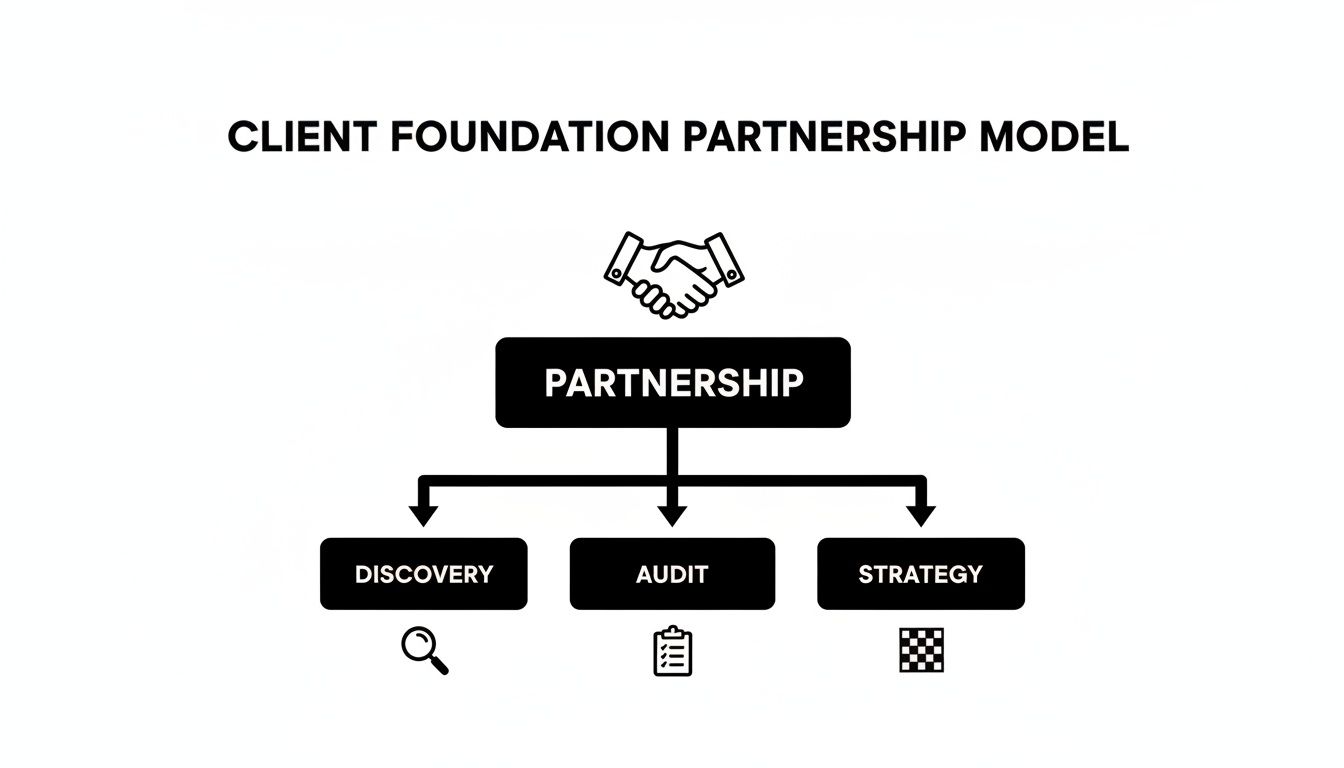
Following this model ensures that every single campaign you build is grounded in a deep understanding of what makes your client's business tick and where they sit in the market.
The absolute cornerstone of a high-performing account is keyword research that goes way beyond just looking at search volume and competition. You have to slice and dice your keywords based on user intent to catch potential customers at every single stage of their journey.
I find it helps to think of intent in three main buckets:
By splitting these into separate campaigns or ad groups, you can tailor your ad copy and landing pages to match the user's mindset perfectly. Someone searching "how to fix a leaky tap" needs a helpful blog post, not a hard sell on your plumbing services—at least, not yet.
Google rewards relevance. It's that simple. Tightly-themed ad groups, where every keyword is closely related to the ad copy and the landing page, are absolutely essential for achieving high Quality Scores. A higher Quality Score means lower costs-per-click (CPCs) and better ad positions. It’s a non-negotiable.
So, instead of a single clunky ad group for "women's shoes" with keywords for boots, sandals, and heels all jumbled together, you need to create separate, focused ad groups for each.
This level of granularity ensures your ads are hyper-relevant. That leads to much higher click-through rates (CTRs) and, ultimately, far better performance for your client.
A well-structured account isn’t just about neatness; it’s a strategic asset. It allows for precise budget allocation, clear performance analysis, and makes it easier to scale what’s working without breaking what isn’t.
To bring this all together, here’s a framework I often use to structure campaigns based on where the customer is in their journey.
| Funnel Stage | Objective | Recommended Campaign Type (Google) | Recommended Campaign Type (Meta) | Key Metrics |
|---|---|---|---|---|
| Top of Funnel (TOFU) | Generate awareness, educate potential customers | Display, YouTube (In-Stream), Discovery | Brand Awareness, Video Views, Reach | Impressions, Views, CPM, Reach, Frequency |
| Middle of Funnel (MOFU) | Drive consideration, capture leads, engage prospects | Performance Max, Search (Non-brand), Shopping | Traffic, Lead Generation, Engagement | Clicks, CTR, Leads, Cost Per Lead (CPL) |
| Bottom of Funnel (BOFU) | Secure conversions, drive sales, retarget users | Search (Brand), Shopping, Remarketing Lists | Conversions, Catalogue Sales, Store Traffic | Conversions, ROAS, CPA, Conversion Rate |
This table isn't rigid, but it's a solid starting point for mapping out your campaign architecture and ensuring every dollar spent has a clear purpose.
The bidding strategy you select has to line up directly with the campaign's objective. For example, using "Maximize Conversions" for a top-of-funnel brand awareness campaign is a classic recipe for wasted spend. You need to be more strategic.
Here’s a practical breakdown of the big ones:
This strategic alignment is critical. With Australia's digital advertising market recently hitting AUD $16.4 billion, a massive 11.1% year-over-year increase, agencies must use precise strategies to capture their clients' fair share of that growth.
In the world of PPC, still relying on manual bidding is like turning up to a Formula 1 race with a pushbike. You're just not going to keep up. It’s slow, exhausting, and you'll get left in the dust. Modern PPC management, especially for agencies, is all about using AI and automation to make sharper, faster decisions for your clients.
This isn't about setting and forgetting. Not at all. It's about taking your team's focus off the tedious, repetitive tasks and pointing it toward high-level strategy, nurturing client relationships, and genuine creative problem-solving. This shift is what separates agencies that coast from agencies that grow.
Google's smart bidding strategies are incredibly powerful, but they’re not a one-size-fits-all solution. Nailing the right strategy is absolutely crucial, and it all comes down to the client’s business model and what they’re trying to achieve. Get this wrong, and you can burn through a budget with shockingly little to show for it.
For a service-based client that just wants more leads, Target CPA (Cost Per Acquisition) is almost always the best fit. You decide the absolute maximum you're willing to pay for a solid lead, and Google's algorithm gets to work optimising bids to hit that number. This gives you predictable lead costs—perfect for clients who have a clear sales process.
Switch gears to an e-commerce client with thousands of products at different price points, and Target ROAS (Return On Ad Spend) is the clear winner. This strategy is laser-focused on squeezing the most revenue out of every dollar spent on ads, making it ideal when your conversion values are all over the place.
Smart bidding is only as smart as the data it’s given. To get the best out of these systems, you need to be feeding them clean, consistent conversion data right from the get-go. I know the "learning phase" can make clients nervous, but there are ways to speed it up.
Make sure your conversion tracking is bulletproof from day one. This means tracking everything that matters:
Clean data helps the algorithm quickly learn what a valuable user looks like, which leads to smarter bid adjustments and a much shorter, more effective learning period.
The real win with automation is giving your team their time back. Instead of tweaking bids every hour, your strategists can dig into market trends, brainstorm better ad creative, and find new growth opportunities for the client. That’s where the value is.
Nothing kills client trust faster than sloppy budget management. Blowing through a monthly budget in two weeks is just as bad as massively underspending—both scream "inattentive agency." A disciplined approach to budget pacing is a massive competitive advantage.
It can be as simple as setting a daily target. Just divide the total monthly budget by the number of days in the month. Track the actual daily spend against this target in a shared spreadsheet or your agency's project management tool.
This proactive approach lets you make smart adjustments on the fly. See a campaign crushing it with a fantastic CPA? You can confidently pull budget from an underperformer to double down on what's working, all without putting the total monthly spend at risk.
This kind of financial discipline is the hallmark of a professional PPC management for agencies. The whole industry is moving this way; with 95% of CMOs making AI a priority, your role is becoming one of strategic oversight, using automation to handle the details. You can explore more on how agencies are adapting to these trends over at i4s.au.
Let's be blunt: all the clicks in the world mean nothing if they don't turn into actual business for your client. It’s a harsh truth. The post-click experience is where the real money is made or lost, and frankly, it's a critical part of PPC management for agencies that often gets overlooked. This is the moment you prove the click was worth paying for.
A smooth, seamless user journey from the ad to the landing page isn't just a nice-to-have; it's completely non-negotiable. It’s all about building trust and momentum from the second they arrive.
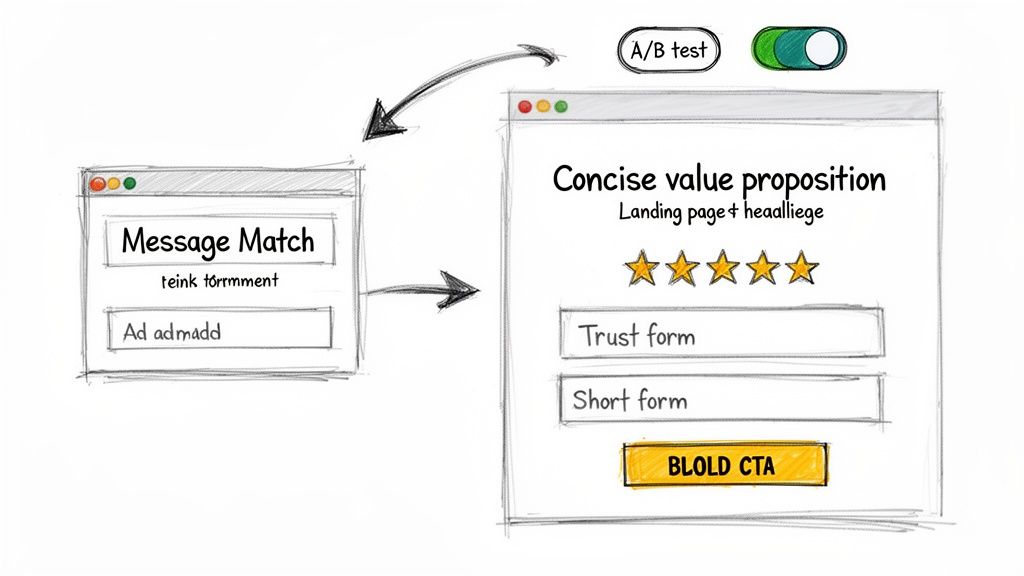
This obsessive focus on what happens after the click is what separates a good agency from a great one. It shows you're committed to your client's bottom line, not just vanity metrics like click-through rates.
Message match is a beautifully simple but incredibly powerful idea: your landing page needs to be a direct, logical continuation of your ad. If your ad promises "50% Off Emergency Plumbing Services," the headline on the page they land on had better say something remarkably similar.
Any disconnect creates instant friction. The user starts to wonder if they’ve clicked the wrong link, their trust evaporates, and they’re quick to hit that back button. This wasted click not only costs your client money but also signals to Google that your page isn't relevant, which can tank your Quality Score over time.
To really nail message match, you need to:
Here’s a common mistake: sending PPC traffic to your client's homepage. Don't do it. A homepage is usually too broad and full of distractions. A dedicated landing page, on the other hand, is a focused conversion machine with one job and one job only: get the user to take a specific action.
A high-converting landing page isn’t just about looking good; it's about absolute clarity and persuasion. Every single element should guide the user towards that one goal.
Key elements always include:
A landing page is not a brochure; it's a closing argument. You need to be ruthless. Remove everything that doesn't directly support the single most important action you want the user to take. It's all about focus.
You should never, ever assume you know what works best. A systematic approach to A/B testing is the only way to genuinely improve conversion rates over time. The key is to test just one element at a time so you can be sure what actually caused the change in performance.
Start with the highest-impact elements first. Here’s a simple testing hierarchy we use:
To truly squeeze every last drop of ROI from a PPC budget, agencies have to constantly analyse and refine the customer journey post-click. For a deeper dive, check out these strategies to improve website conversion rates and boost results. You can also explore our detailed guide on how to improve conversion rates for more agency-specific tips.
Let's be honest, reporting can feel like a chore. But it's so much more than a data dump. It’s your monthly (or weekly) opportunity to have a strategic conversation, translating clicks and impressions into a compelling story of progress, challenges, and what's coming next.
Get this right, and your report transforms your agency from a vendor just ticking boxes into an indispensable strategic partner. This is where you shift the mindset. Instead of just presenting numbers, your job is to craft the narrative that gives those numbers meaning. It’s what truly demonstrates the value of your PPC management for agencies and keeps clients happily paying your invoices for the long haul.
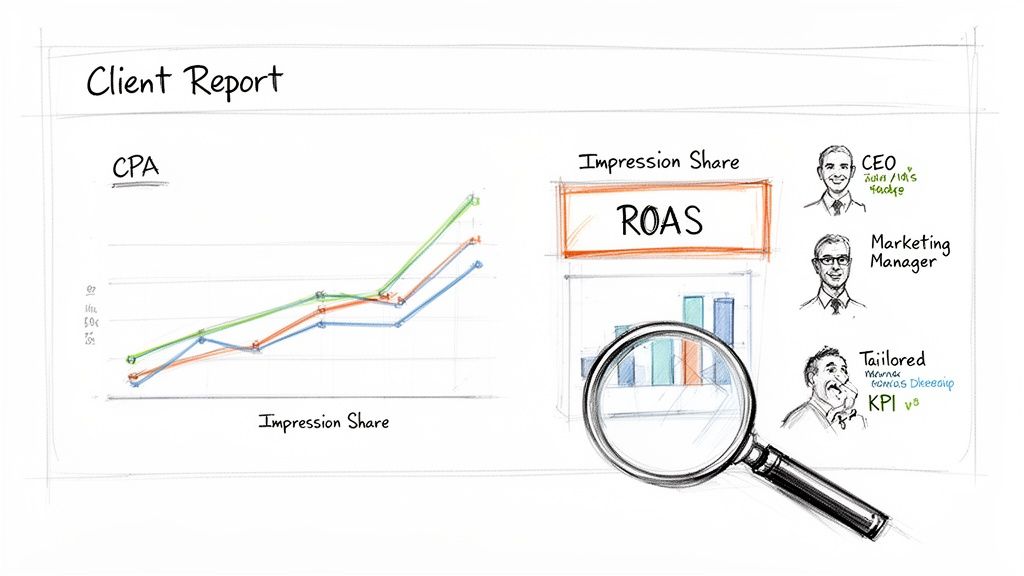
Not everyone in your client's organisation gives a toss about the same metrics. A CEO and a marketing manager have vastly different priorities, so a one-size-fits-all report is guaranteed to miss the mark with at least one of them. Tailoring your story to the audience isn't just a good idea; it's non-negotiable.
You need to know who you're talking to and frame the data in a way that resonates with their world.
Reporting is all about context. Presenting the right KPIs to the right person makes the difference between a report that gets filed away and one that sparks a productive conversation about strategy and growth. The table below breaks down how to tailor your reporting narrative for different stakeholders you'll encounter.
| Stakeholder | Primary Focus | Key KPIs to Report | Narrative Angle |
|---|---|---|---|
| CEO / Business Owner | Business Growth & Profitability | ROAS, CPA, Revenue, Contribution to CLV | "Here's how our ad spend is directly fuelling your bottom line and making each customer acquisition more profitable." |
| Marketing Manager | Campaign Efficiency & Market Position | Impression Share, CTR, Quality Score, Conversion Rate | "We're outperforming Competitor X in key auctions, and our new ad creative is driving a higher click-through rate, leading to more efficient leads." |
| Sales Team Lead | Lead Quality & Volume | Lead Volume, Cost Per Lead, Lead-to-Sale Conversion Rate | "We generated 150 marketing-qualified leads this month at a stable CPL, and the conversion rate from these leads is up 5%." |
| E-commerce Manager | Online Sales & AOV | ROAS, Conversion Value, Average Order Value (AOV), Cart Abandonment Rate | "Our Shopping campaign optimisations increased ROAS by 15%, and we're seeing a healthier average order value from paid traffic." |
Understanding these different perspectives allows you to turn a simple data update into a powerful communication tool, reinforcing your value to every part of the client's business.
A spreadsheet full of raw data is where insights go to die. It's intimidating, uninspiring, and frankly, a bit lazy. To make complex information digestible and instantly highlight the key takeaways, you absolutely have to use data visualisation tools like Looker Studio (the platform formerly known as Google Data Studio).
A well-designed dashboard doesn't just show data; it guides the viewer's eye to what's most important.
Your report shouldn't just answer the question, "What happened?" It needs to answer, "So what?" and "What's next?" Use your data to build a compelling case for your strategic recommendations for the coming month.
This move towards greater transparency is becoming a key differentiator for agencies. In Australia, for instance, brands are ploughing more money into retail media, with 79% of companies planning to increase their spend. For these brands, reporting and clear measurement are top criteria when choosing an agency partner. You can read more on this trend in PPC Land's latest report on Australian retail media. It's a huge industry push for the kind of data-driven transparency that live dashboards provide.
The final, and most crucial, piece of the puzzle is to graduate from reporting on surface-level metrics. Reporting on impressions is fine, but explaining what those impressions actually mean for the business is where you provide real, tangible value.
Don't just state that impression share increased by 10%.
Explain that this increase came at the direct expense of a major competitor, which could suggest their budget is faltering and now is the time to apply more pressure.
Don't just report that CPA went down.
Connect it directly to the new landing page A/B test you launched last week, proving your optimisation efforts are delivering more efficient results.
This is how you tell a story that sticks. You connect your actions to their results and then tie those results directly to the client's ultimate business goals. This is the stuff that builds unshakeable client trust and turns a 6-month contract into a multi-year partnership.
When you're running PPC for clients, the game changes. You're not just tweaking bids and writing ad copy; you're managing relationships, proving your worth, and trying to build a business that can actually scale. It’s a whole different ball game. Here are some of the most common questions that land on our desk from agency owners and account managers.
This is the big one, and the honest answer is: there's no single "best" model. Trying to fit every client into the same pricing box is a surefire way to create friction and leave money on the table. The right structure really depends on the client’s size, how deep your services go, and your own agency's goals.
Think of it like a toolkit. You need the right tool for the job.
For smaller clients or those just testing the waters, a flat monthly retainer is perfect. It’s simple, everyone knows where they stand, and it gives your agency predictable income. It’s a great starting point.
As accounts get bigger, a percentage of ad spend (usually 10-20%) makes a lot of sense. This model is popular for a reason—it aligns your success directly with the client's. When they invest more and see results, you both win. It’s a natural incentive to scale their campaigns.
But where we see the most successful agencies land is with a hybrid model. This really gives you the best of both worlds:
This hybrid approach gives your agency stability while directly rewarding you for knocking it out of the park.
It happens to everyone. A campaign that’s been humming along nicely suddenly takes a nosedive. The key here is to get on the front foot—fast. Be proactive, transparent, and come prepared. Don't wait for the client to send that dreaded "what's going on?" email.
The second you spot a serious dip in performance, book a call. But don't just show up with an apology. You need to walk in with a data-backed analysis of what you think is happening and a clear plan to fix it.
Owning a problem is the fastest way to build trust. Presenting a data-backed action plan alongside that problem is how you solidify your role as a strategic partner, not just a campaign manager.
Your plan needs to be specific. Instead of a vague "we'll test some new ads," try this: "We've seen a 15% drop in conversion rate since Competitor X launched their new offer last week. We've already developed three new ad concepts to counter their messaging, and our plan is to get them live in the next 48 hours for a two-week test."
See the difference? That level of detail shows you're in control and turns a scary moment into a chance to prove your expertise.
Proving your value is everything in this business. It's the core of client retention. To really show your Return on Investment (ROI), you have to draw a straight, undeniable line from your PPC work to their bank account. Just showing a list of conversions from the Google Ads dashboard isn't enough.
First, your conversion tracking has to be bulletproof. That means every form fill, every phone call, every online sale is tracked perfectly. But that's just table stakes.
The next step is to work with your client to understand their business numbers. You need to ask them for key metrics like:
Once you have this data, you can connect your ad spend not just to a "lead," but to the actual revenue that lead generated over time. This lets you calculate a true Return on Ad Spend (ROAS). Pop that into a visual reporting dashboard, and suddenly your value becomes impossible to ignore.
You can't run a lean, scalable PPC operation without a solid tech stack. While everyone has their favourites, there are a few key functions your toolkit absolutely needs to cover.
At Virtual Ad Agency, we pair deep strategic expertise with the right tech to build and scale PPC campaigns that drive genuine business growth. Find out how we can become a true extension of your marketing team by visiting us at https://www.virtualadagency.com.au.

 previous