
Search engine optimisation services are what a professional agency does to get your website seen in search results. The whole point is to drive more of the right kind of organic traffic your way by making your site more appealing to search engines like Google. This usually involves a mix of technical fixes, creating great content, and building up your site's authority online.
Imagine you’ve just built a brilliant retail store. It’s stocked with amazing products, the service is fantastic, but you’ve built it on a quiet backstreet where no one ever goes. Nobody knows it exists.
Search engine optimisation is the process of picking up that store and moving it to the busiest intersection in the city. It puts you directly in front of customers who are actively searching for exactly what you sell.
For any Australian business, being visible when a potential customer searches for a solution isn't just a nice-to-have—it's absolutely essential for survival and growth. This is why professional SEO is a core business investment, not just some technical checklist. It connects you directly with high-intent buyers at the precise moment they need you.
To really get what SEO services are all about, it's helpful to separate SEO from its broader marketing family. While they both want to increase your visibility, SEO is purely focused on earning unpaid, organic traffic from search engines. If you're curious, you can learn more about the difference between SEM and SEO to see how they fit into a larger strategy.
This distinction matters because the value of that organic traffic is massive. The market trends reflect this; in 2025, Australian businesses are projected to spend over $1.5 billion on SEO services, a huge 12% jump from 2024. This isn't just random spending—it shows a clear understanding that capturing the 85-90% of clicks that go to organic results is a primary driver of digital success.
To make this a bit clearer, let's break down the main parts of an SEO strategy using our retail store analogy again. Each piece plays a distinct role in making your digital storefront a success.
Here's a quick table to show how it all fits together:
| SEO Component | Analogy (The Retail Store) | Primary Business Objective |
|---|---|---|
| Technical SEO | The store's foundation, wiring, and accessibility. | Ensure search engines can easily find, crawl, and understand your website without any roadblocks. |
| On-Page SEO | Your store's clear signage, logical layout, and helpful staff. | Optimise individual pages so both users and search engines instantly know what they're about. |
| Content Creation | Your high-quality product inventory. | Attract and engage your target audience by answering their questions and solving their problems. |
| Authority Building | Powerful word-of-mouth and a stellar reputation. | Build trust and credibility with search engines by earning links and mentions from other reputable websites. |
Each pillar supports the others, creating a strong, stable structure that helps your 'store' not only get found but also become the go-to destination for customers in your industry.
A powerful SEO strategy isn't just one thing; it's a bunch of different elements working together, just like the foundations, walls, and roof of a house. Get one part wrong, and the whole structure feels a bit shaky.
Think of your website as your digital shopfront. Each part of SEO plays a specific role in getting customers through the door, making sure they have a great experience, and giving them a reason to come back. A truly solid campaign doesn't just obsess over one thing, like keywords or links. It weaves multiple disciplines into a single, cohesive plan.
This approach makes sure the entire customer journey is dialled in for performance, from the moment Google first discovers your site to the second a visitor decides to buy from you.
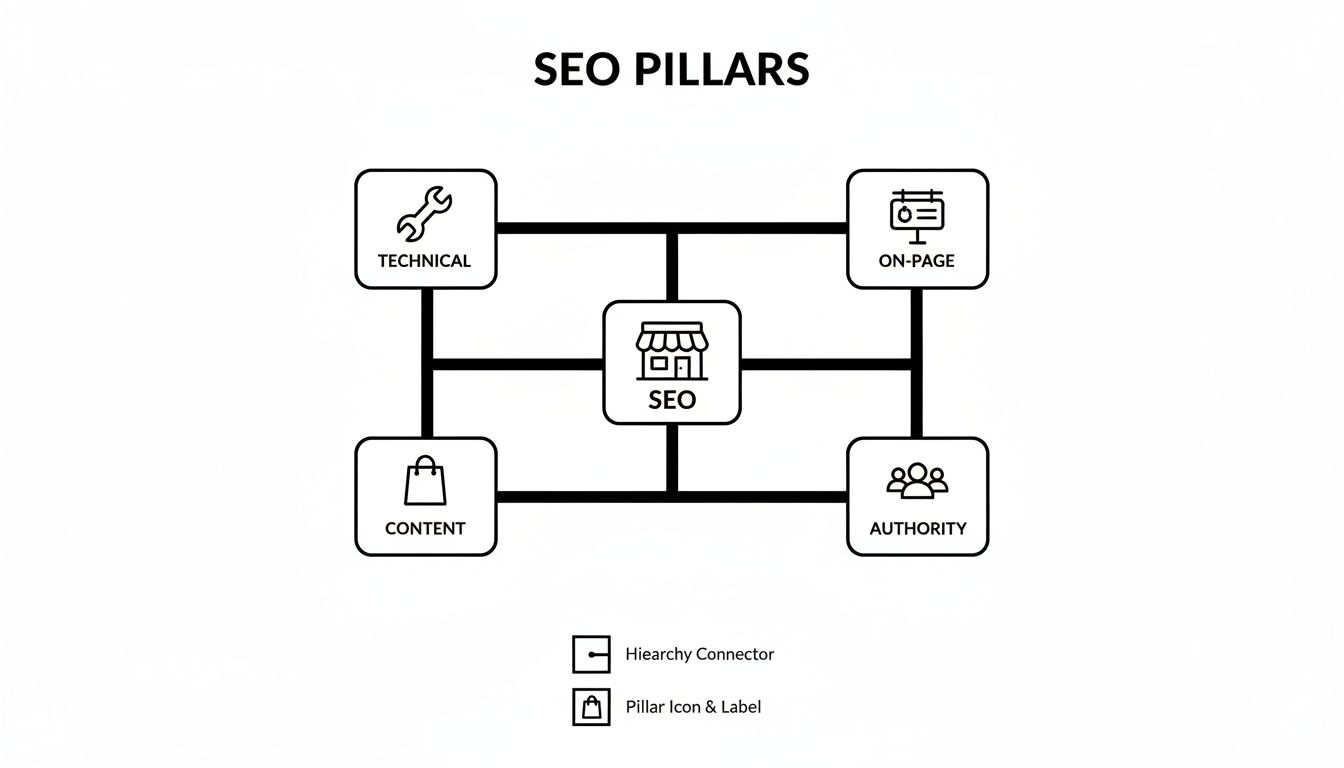
As you can see, a central strategy branches out into distinct but interconnected pillars, from the technical nuts and bolts of your site to the trust signals that build your reputation.
Technical SEO is the bedrock of your entire online presence. It's all the behind-the-scenes work that makes your website fast, secure, and dead simple for search engines like Google to crawl and make sense of. If your digital shopfront has a broken door or the service is painfully slow, customers will just turn around and leave.
This foundational pillar involves tweaking things the average user might not even notice, but they're absolutely critical for search engines. Without a solid technical base, even the most brilliant content will fall flat because Google will struggle just to access and index your site properly.
A few key parts of technical SEO include:
If technical SEO is the foundation, then your content and on-page optimisation are the products on your shelves and the helpful signs that guide people around the store. This is all about creating high-quality, genuinely useful content that directly answers the questions your audience is asking.
It's about matching every single page to a specific search intent—the real reason behind someone's search query. When your content nails what a user is looking for, you create a smooth journey that builds trust and gets them closer to a sale. This is so much more than just stuffing keywords into a page; it’s about becoming a go-to resource.
On-page optimisation is the art and science of making your content understandable to both search engines and humans. It signals relevance, clarifies context, and ultimately helps your pages rank for the right queries.
For those keen to get into the nuts and bolts of what drives digital success, this comprehensive guide to improving search engine rankings offers some fantastic insights into both technical SEO and content strategy.
Authority building, which you’ll often hear called link building, is the digital version of getting a powerful word-of-mouth recommendation. When other credible, relevant websites link to yours, it sends a strong signal to Google that your site is a trustworthy source of information.
Think of it as modern-day digital PR. The game isn't about grabbing hundreds of cheap, low-quality links. It’s about earning meaningful mentions and building real relationships that boost your brand's reputation online. A single backlink from an industry-leading website can have a bigger impact than dozens of links from dodgy directories.
For any Australian business with a physical address, local SEO isn't just nice to have; it's essential. This specialised pillar focuses on grabbing the attention of high-intent customers searching for products or services "near me." It’s what gets your business showing up in the local map pack right when potential customers are nearby and ready to spend.
Optimising your Google Business Profile is the absolute centrepiece of any local strategy. This means keeping your business info accurate, gathering a steady stream of positive reviews, and posting regular updates. It makes you more visible and drives real-world foot traffic through your door.
Finally, performance analytics is the pillar that ties it all together. This is how you prove the value of your investment in search engine optimisation services, tracking the metrics that actually matter and connecting SEO activities directly to your business goals.
Instead of getting distracted by vanity metrics, a professional SEO agency focuses on key performance indicators (KPIs) that show a tangible return on your investment. This includes:
By focusing on these outcomes, you can see exactly how SEO contributes to your bottom line, turning it from a business expense into a powerful engine for growth.
Bringing an SEO agency on board can feel like a leap of faith, especially if you've never done it before. You've signed the contract, so… what happens now? A proper, professional engagement isn't about throwing things at the wall to see what sticks. It's a structured journey, a clear partnership designed from day one to deliver real, measurable growth for your business.
Think of it like hiring an expert builder for a major home renovation. You wouldn't expect them to just show up and start knocking down walls. First, they need the blueprints. In the same way, a sharp SEO agency kicks things off with a deep-dive discovery phase to really get under the skin of your business, your customers, and what a "win" actually looks like for you.
This initial stage is all about getting on the same page. We need to know your end game. Are you after more e-commerce sales? Better quality leads for your service team? Or maybe you want to completely own the local search results for your area? Setting these goals clearly from the get-go ensures every single thing we do is pulling in the same direction.
Once we're crystal clear on your business goals, the next step is a comprehensive SEO audit. This is our version of the builder surveying the land, checking for structural issues, and understanding the council regulations. It’s a complete diagnostic of your online presence, designed to uncover strengths we can build on, weaknesses we need to fix, and opportunities your competitors have missed.
This isn't just a quick scan for a few broken links. It's a forensic investigation that lays the strategic foundation for everything that follows. Time and time again, we find critical issues hiding in plain sight that are holding a website back from its true potential.
A professional audit digs into three core areas:
If you're curious about what this deep-dive involves, you can learn more about our professional SEO auditing service and see how this vital first step works in detail.
The audit findings are then translated into a bespoke strategic roadmap. This is not some generic, cookie-cutter template. It's your customised, prioritised action plan that spells out exactly what we'll be doing, why we're doing it, and the kind of progress you can expect to see along the way. It’s all about total transparency and setting clear expectations.
Your SEO roadmap is a living document. It's the blueprint that guides all our activities, but it's also agile enough to adapt to algorithm updates, market shifts, and new opportunities we uncover.
This roadmap is what moves your SEO from the planning phase into real, tangible action. It breaks the often-complex world of SEO into clear monthly activities, ensuring we're always making steady progress toward your main business goals.
With a solid strategy and roadmap in hand, the real work begins. This is the ongoing, month-in-month-out process of optimising your website. It’s a mix of technical fixes, on-page tweaks, creating new and valuable content, and building your website's authority across the web.
Throughout this phase, communication is absolutely critical. You should expect regular performance reports that are easy to understand and cut through the technical jargon. A good report isn't just a data dump; it tells a story. It should highlight the key wins, explain the trends we're seeing, and outline what the focus will be for the next period.
This cycle of implementation, measurement, and refinement is the engine room of any successful SEO campaign. It's a continuous loop of improvement, always adapting to the data to ensure your investment is working as hard as it possibly can to grow your business.
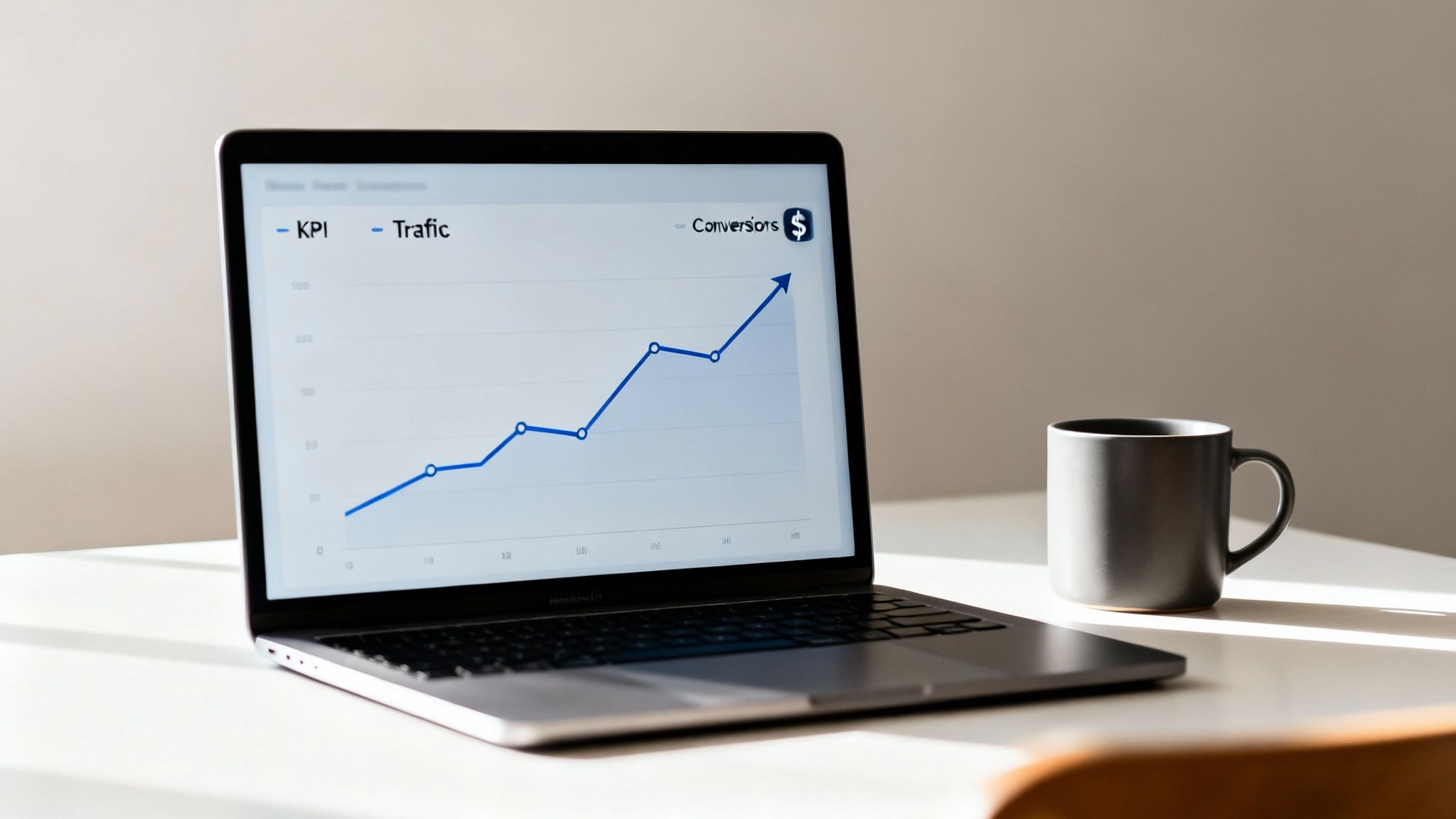
True success from search engine optimisation services isn't just about climbing to the top of Google. While seeing your keyword rankings improve is a great sign, it's what happens after the click that really matters.
Think of it this way: rankings and traffic are like the number of people walking past your shop. It’s a promising start, but it doesn't pay the bills. The real goal is to get them inside, making purchases, and turning into loyal customers.
That's why any good SEO strategy splits success into two types of metrics. Leading indicators are the early signals that tell you the plan is working. Lagging indicators are the ultimate business results you’re actually aiming for. A great SEO partner tracks both to paint the full picture of your return on investment.
Leading indicators are the forward-looking metrics that show your SEO efforts are gaining momentum. They tell you you're on the right track, often well before the big results start rolling in. Think of these as the green shoots of growth.
Key leading indicators to watch include:
These numbers are crucial for gauging progress, especially in the early months. Monitoring them helps refine the strategy and confirms the foundational work is paying off. While free tools can track some of this, a deeper analysis often requires some of the best SEO tools for agencies for more detailed insights.
While leading indicators are exciting, the lagging indicators are what truly define SEO success. These are the bottom-line results that connect your investment directly to business growth. They measure the outcomes your leadership team and stakeholders actually care about.
Lagging indicators are the proof that your search engine optimisation services are not just an expense, but a powerful engine for revenue generation. They translate visibility into tangible commercial value.
The most important lagging indicators are:
One of the most critical parts of measuring SEO is understanding that it’s a long-term game. Unlike paid ads that deliver instant visibility, SEO builds a sustainable asset over time. Expecting overnight results is a recipe for disappointment.
A realistic timeline generally looks like this:
By focusing on both leading and lagging indicators within these realistic timeframes, you can accurately measure the powerful and cumulative impact of your SEO investment.
Trying to figure out the price of search engine optimisation services is a bit like buying a car. You know you need one, but the final price really depends on what model you choose, the features you want, and the kind of performance you're after. Getting your head around how agencies price their work is the first step to making a smart investment for your business.
Most SEO pricing structures fall into one of three buckets, each built for different business needs. You wouldn't take a tiny sports car on a family camping trip, and in the same way, you don't want a pricing model that doesn't fit your goals. Nailing the right fit means you get the most bang for your buck.
The most common way to engage an SEO agency for ongoing work is the monthly retainer. You pay a fixed fee each month, and in return, you get a consistent, agreed-upon scope of work. Think of it as having an expert SEO team on your payroll, constantly working to push your online presence forward.
This model is perfect for any business serious about long-term growth. It allows for a sustained, holistic strategy that covers all the bases—from the technical health of your site and content creation to building your authority in your industry. A retainer gives you the stability needed to build real momentum and achieve results that actually last.
Sometimes, you don't need an ongoing commitment. You just have one specific thing you need to get done. That's where project-based pricing comes in. It's ideal for one-off tasks with a clear start and finish, like a deep-dive technical SEO audit, a tricky website migration, or a focused campaign to rank for a new service in your local area.
With this approach, you get a single, fixed quote for the entire project, so there are no surprises about the cost. It’s the best option when you have a specific problem to solve or a single goal to hit, rather than needing continuous, wide-ranging optimisation work.
What if you just need some expert advice or a bit of strategic guidance? For that, hourly consulting is the most flexible choice. You might bring in a consultant to help you navigate a specific technical issue, workshop an in-house content strategy, or provide some up-to-the-minute training for your marketing team.
This model lets you tap into high-level expertise without being locked into a long-term contract. You simply pay for the time you need, when you need it.
The final price of any SEO work is shaped by a few key things. How fierce the competition is in your industry, the current state of your website's technical health, and the sheer amount of work required all play a massive part in determining the final investment.
For instance, a campaign targeting local customers in Adelaide is going to have a very different price tag than a national campaign aiming to dominate search results right across Australia. If you want to see how these factors translate into real-world numbers, have a look at our search engine optimization packages to get a clearer idea of what might be the best fit for your business.
Picking the right partner for your search engine optimisation services is easily one of the most critical marketing decisions you'll make. This isn't just about hiring a supplier; it's about bringing on a partner who will get deeply involved in the digital side of your business. The right agency can become a powerful engine for growth, while the wrong one can burn through your budget and time with very little to show for it.
The key is to look past the flashy sales pitches and focus on what really matters—the qualities that signal a truly effective and trustworthy partner. It all comes down to asking the right questions and knowing what a good answer looks like.
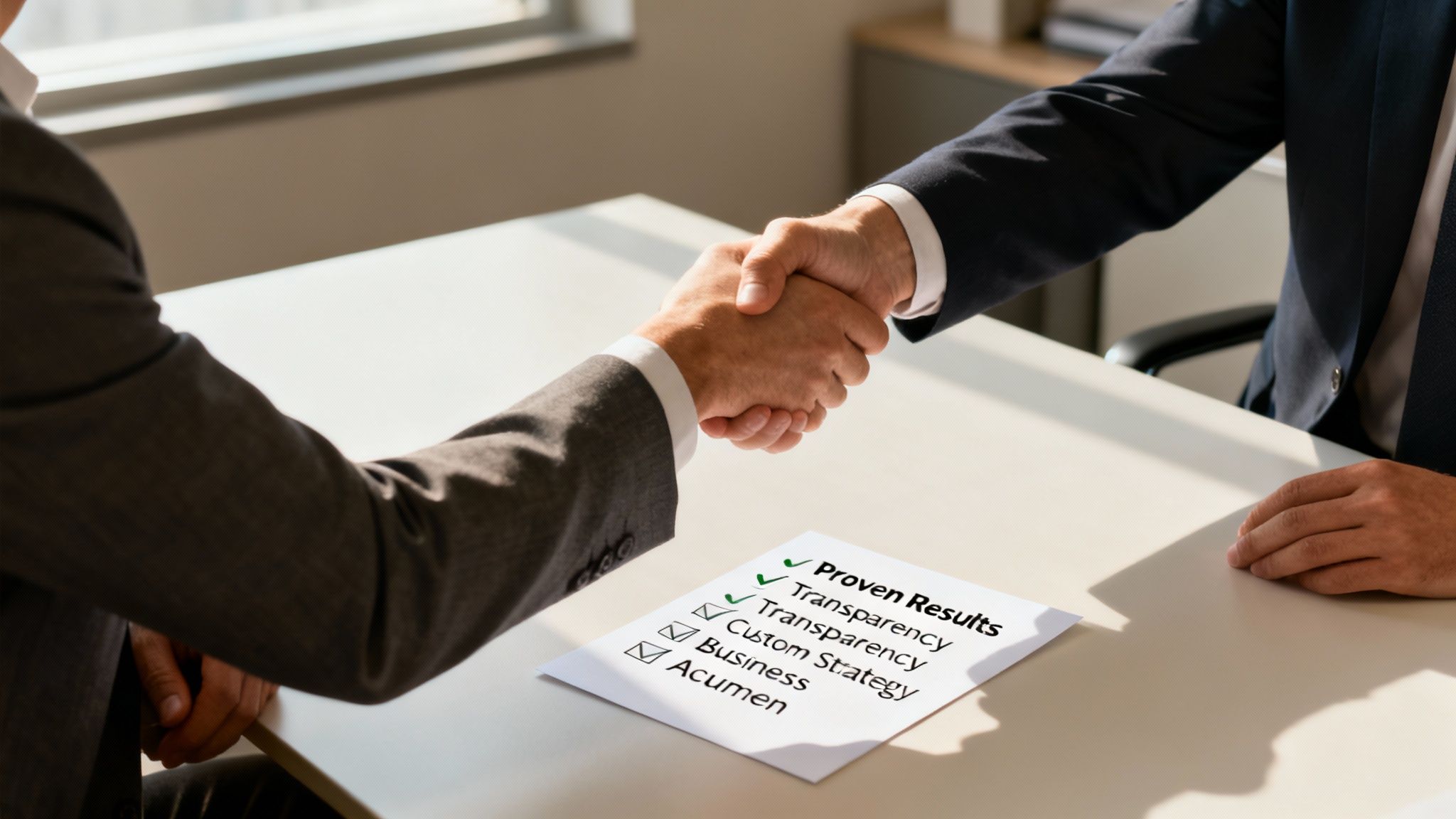
To help you get it right, we've put together a practical checklist of what to look for. Use these points to size up any potential agency and find a partner who is genuinely invested in your long-term success.
An agency's past performance is the single best predictor of how they'll perform for you. Vague promises are easy to make, but what you really need is concrete proof that they have delivered real-world results for businesses like yours.
A reputable agency will be more than happy to show off its wins. When you're talking to them, make sure you ask for specific case studies that break down the client's challenges, the strategies they implemented, and—most importantly—the measurable business outcomes.
Here’s what to zero in on:
Trust is everything in an agency partnership, and that trust is built on a foundation of transparency. A great partner is an open book—they're clear about their methods, honest about what's achievable, and proactive in keeping you in the loop.
You should never be left wondering what’s being done or why. From the first audit to the monthly performance reports, every conversation should be clear, insightful, and tied directly to your business goals.
A huge red flag is any agency that gets secretive about their methods, calling them "proprietary" or "trade secrets." Good SEO is built on well-established best practices, not some mysterious black-box formula. If they won't explain their process in detail, walk away.
And let's be realistic: with Google holding a massive 93.95% search engine market share in Australia as of July 2024, any strategy has to be transparent and built for long-term success on that platform. While others like Bing exist, the overwhelming majority of your customers are on Google, making a solid, ethical strategy completely non-negotiable. You can learn more about Australian search engine usage statistics and their implications for businesses.
Your business is unique, so your SEO strategy should be, too. Be very cautious of agencies pushing one-size-fits-all packages or, even worse, "guaranteed rankings." These are almost always signs of a cookie-cutter approach that completely ignores the unique details of your market, your audience, and your specific goals.
A true SEO partner invests the time upfront to really understand your business. They'll conduct a deep dive into your current online presence, analyse what your competitors are doing right (and wrong), and work with you to build a tailored roadmap designed to hit your specific targets.
Finally, you want an agency that thinks like a business owner, not just an SEO technician. A great partner gets that rankings and traffic are just steps along the way. The real goal is to drive business growth.
They should speak your language, focusing on how their search engine optimisation services will impact the metrics that matter, like customer acquisition cost, lead quality, and overall revenue. They see SEO not as some siloed marketing task, but as a core piece of your bigger commercial strategy. This business-first mindset is what separates a good technician from a genuinely great strategic partner.
Stepping into the world of search engine optimisation services can feel a bit like learning a new language. To help clear things up and give you the confidence to make the right call, we’ve put together answers to the questions we hear most from business leaders just like you.
This is the big one, and the honest answer is: it's a long game. While you'll likely spot some encouraging early movement in keyword rankings within the first 3 months, the kind of results that really move the needle for your business typically take 6 to 12 months to come through.
Think of it like building a house. The first few months are about laying a solid foundation – technical fixes, research, and planning. After that, you start building the structure with great content and authoritative links. The real, lasting value comes when it all works together, creating a powerful, sustainable asset that keeps bringing in customers. It’s a marathon, not a sprint.
They aren't competitors; they're teammates. Each plays a different, vital role. SEO is all about building long-term organic authority and trust, which delivers a steady stream of traffic over time without you paying for every click. Paid ads, like Google Ads, are fantastic for getting immediate visibility. They're perfect for testing a new offer or driving traffic to a campaign right now.
A smart digital strategy doesn't choose one over the other. It uses both:
You absolutely can handle some of the basics yourself, like creating content and tweaking your page titles. But a truly comprehensive SEO strategy is a different beast entirely. It demands deep technical know-how, constant learning to keep up with Google's changes, and access to some pretty sophisticated (and expensive) analytics tools. Honestly, it’s a full-time job.
An expert agency doesn't just bring tools; they bring years of experience. They know how to conduct deep competitive analysis, build strategic authority, and fix the tricky technical issues that are incredibly difficult to spot, let alone solve, in-house. That expertise gets you results faster and helps you sidestep costly mistakes that could harm your website's reputation with Google.
Bringing in professional search engine optimisation services means you have a dedicated crew whose only job is to focus on getting your business found online.
Ready to turn your website into your hardest-working salesperson? The team at Virtual Ad Agency builds SEO strategies that are all about delivering real, measurable growth. Get in touch with us today and let's talk about your goals.

 previous