
Search engine optimisation packages are basically ongoing service agreements, all geared towards systematically improving how visible your website is in search results. It helps to think of them not as a one-time cost, but as a strategic investment in building a powerful, long-term digital asset for your business.
Picture this: your website is a beautiful, high-end retail shop. It's got the best products in the world. But it's tucked away down a hidden laneway with no signs pointing the way. If nobody can find you, it doesn't really matter how great your stuff is, does it?
A well-put-together SEO package is the strategic plan that builds a direct highway from Google right to your front door. It’s the bright, welcoming signage that flags down your ideal customers and brings them in. It's a continuous process of optimising, refining, and promoting your digital presence to make sure you get found.
For businesses here in Australia, this isn't just about getting a few extra clicks. It's about forging a real connection with a local and national audience who are actively looking for the exact solutions you offer. The real value in these packages is their methodical approach to building growth that lasts, rather than just chasing quick, temporary wins.
Every solid SEO package is built on a few core components that all work together. These aren't just random items on an invoice; they're interconnected activities that build on each other, creating momentum over time. The fundamentals usually include:
A common trap people fall into is thinking SEO delivers instant, overnight results. The reality is, it’s all about building a strong digital foundation and earning trust—with both your users and the search engines. That takes consistency and expertise. True ROI comes from sustained effort, not short-term tricks.
This holistic approach transforms your website from a simple online brochure into a dynamic, lead-generating machine. The goal of any good search engine optimisation package is to kickstart a positive feedback loop: better rankings lead to more traffic, which brings in more leads and sales, which in turn reinforces your site's authority and leads to even higher rankings.
For small businesses trying to get an edge, understanding these moving parts is absolutely vital. You can get a better sense of how this works by exploring search engine optimisation services for small business and how they're structured. And if you're really focused on local customers, this comprehensive guide to local SEO for small businesses is a great resource for clarifying what you should be looking for in a package.
To figure out the real value of different search engine optimisation packages, you have to look past the price tag and get under the bonnet. Think of it like a high-performance engine; every part has a job to do, and they all have to work together perfectly to generate power and speed. A solid, modern SEO package is built on four distinct pillars that all lean on each other to drive real, sustainable growth.
These pillars are the foundation of any decent strategy that aims to get you seen, get you traffic, and build your reputation online. Let's break down how all the moving parts of a package come together to hit those core goals.
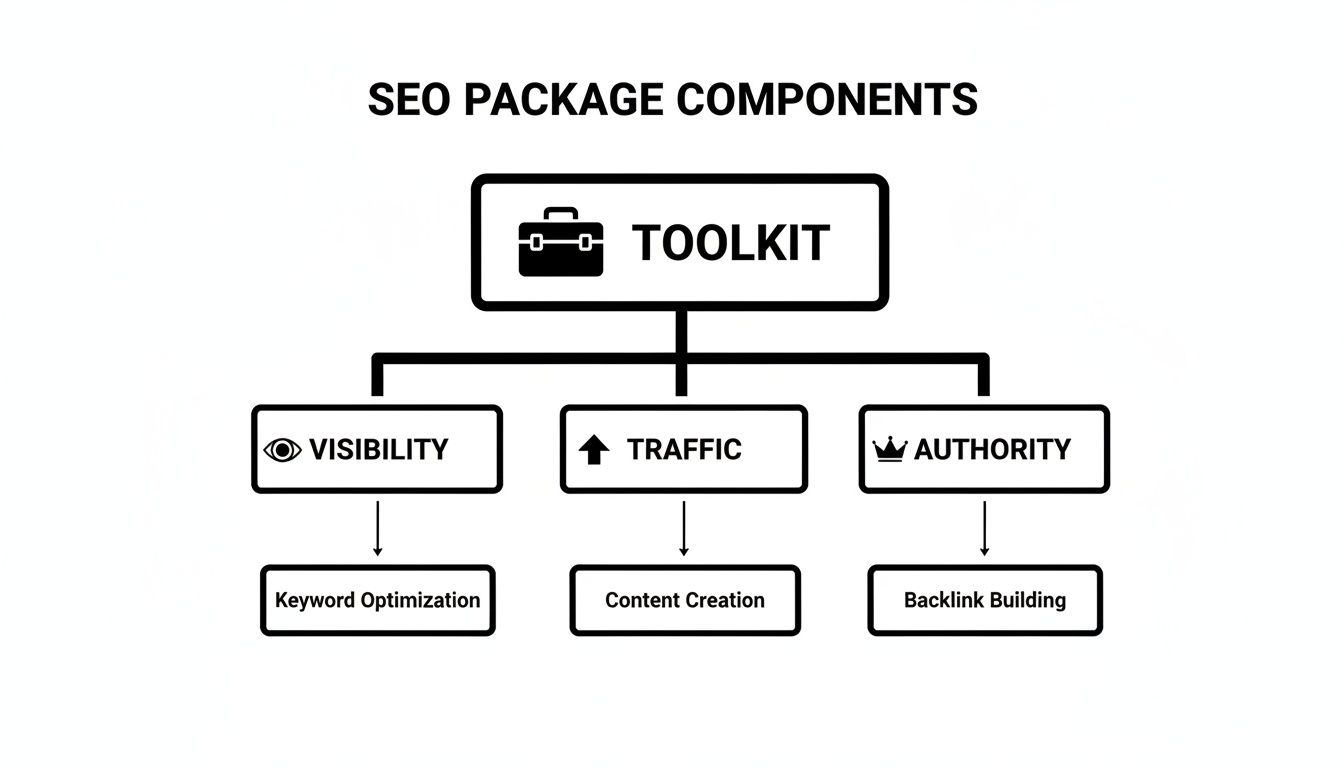
As you can see, a complete SEO toolkit is designed to deliver on visibility, traffic, and authority—the absolute essentials of any campaign worth its salt.
First up is Technical SEO. This is all about the nuts and bolts of your website's health. If search engines can't easily crawl, understand, and index your site, then even the most brilliant content in the world will just sit there, invisible. It’s the digital version of making sure your shop has a solid foundation, working lights, and clear aisles for customers to walk down.
Key jobs here usually include:
A common deliverable for this is a Technical Health Audit Report, which points out all the problems and confirms what’s been fixed.
Next, we have On-Page SEO. This is where we fine-tune the individual pages of your website to target specific keywords and tell search engines exactly what each page is about. It's how you line up your content perfectly with what your ideal customers are actually typing into Google.
This involves getting into the details, refining elements like title tags, meta descriptions, header tags, and your internal linking structure. These tweaks help search engines make sense of your content's context and relevance, which has a direct impact on where you rank. For a deeper dive, check out our guide on SEO optimisation best practices.
Then there's Off-Page SEO, which covers all the things you do outside of your own website to boost your rankings. This pillar is all about building your site’s authority and reputation. When search engines see high-quality links pointing to you from other reputable websites, they see it as a vote of confidence—a sign that your content is trustworthy and valuable.
The heart of off-page SEO is earning trust. It’s not about just grabbing any old link; it’s about building genuine relationships and creating content so good that other industry leaders can’t help but reference it.
Here, you might get a Monthly Link Building Report that shows all the new, high-quality backlinks you've earned, or a report tracking mentions of your brand across the web. This pillar is non-negotiable if you want to compete in a crowded market.
Finally, Content Strategy is the fuel for the entire SEO engine. This isn't just about writing blog posts; it's the planning, creation, and sharing of genuinely valuable content that attracts, engages, and converts the right audience. Think useful guides, in-depth articles, and compelling case studies. Great content is what earns you those backlinks, keeps visitors on your site, and proves you know your stuff.
In Australia's search market, where Google absolutely dominates with a 93.95% share, a rock-solid content strategy is essential. This means any SEO package worth considering must be built around Google's algorithms, including the new AI-powered features that are changing how people search.
To give you a clearer picture, let's break down what you can typically expect to see in a comprehensive SEO package.
| SEO Pillar | Core Activities | Example Deliverables |
|---|---|---|
| Technical SEO | Site health audits, speed optimisation, mobile-friendliness checks, schema markup, XML sitemap management. | Technical Audit Report, Page Speed Insights Scorecard, Mobile Usability Report. |
| On-Page SEO | Keyword research & mapping, title tag & meta description optimisation, content optimisation, internal linking. | Keyword Ranking Report, On-Page Optimisation Checklist, Content Briefs. |
| Off-Page SEO | Backlink acquisition, digital PR outreach, local citation building, brand mention monitoring. | Monthly Link Building Report, Citation Consistency Report, Online Reputation Summary. |
| Content Strategy | Content gap analysis, topic ideation, content calendar creation, blog/article writing, performance analysis. | Content Calendar, Published Articles/Guides, Content Performance Dashboard. |
While a good SEO package is built on these four pillars, many also include advanced features to get an edge. Digging into resources on SEO automation tools can offer a glimpse into these more powerful capabilities. Ultimately, it's the seamless integration of these four areas—technical, on-page, off-page, and content—that defines an effective SEO package that delivers tangible results.
Trying to get a straight answer on how much SEO should cost can feel like navigating a maze. Prices are all over the place, and without a clear map, it’s tough to know if you’re getting real value or just paying for hot air.
The trick is to stop thinking of SEO as a cost. It’s not. It’s a direct investment into the growth engine of your business. The price tag on any search engine optimisation package is tied directly to the scope, intensity, and expertise being poured into your campaign. A local business in a small town just won’t need the same firepower as a national e-commerce brand fighting it out in a crowded market.
Factors like your industry's competitiveness, what you’re trying to achieve, and the current health of your website all play a massive role in shaping the final number.
Once you start looking around, you’ll notice most Australian agencies build their packages around a few common models. Each has its own rhythm and suits different business needs, so getting your head around them is the first step to making a smart choice.
Three main pricing structures really dominate the market:
Monthly Retainer: This is the go-to model for any serious, ongoing SEO effort. You pay a set fee each month for a clearly defined scope of work. It’s perfect for long-term strategies because it lets the agency build momentum through consistent content creation, technical tune-ups, and authority building. Retainers also give you predictable budgeting and help build a proper partnership with your agency.
Project-Based Pricing: Got a specific, one-off SEO job that needs doing? This is the model for you. Think of things like a deep-dive technical audit, a complex website migration, or a targeted link building push. You agree on a fixed price for a project with a clear start and end date. It’s a great way to solve specific problems without locking into a long-term contract.
Performance-Based SEO: This one can sound mighty tempting because you only pay for results, like hitting certain keyword rankings or traffic goals. But be careful. To get those quick wins, some operators might be tempted to use "black-hat" tactics that can get your site penalised down the track. If you go this route, you have to be absolutely sure the contract is built around safe, sustainable strategies.
So, what should you actually budget for a quality SEO package here in Australia? The investment landscape is pretty broad, which makes sense given the different needs of businesses. Industry analysis shows a clear link between how much a business spends and its size, with Australian businesses on track to spend over $1.5 billion on SEO services.
As a general guide, startups and small local businesses typically invest between $1,000 and $5,000 a month. Mid-sized companies often need packages in the $5,000 to $15,000 monthly range, while large corporations can easily commit $20,000 or more for enterprise-level campaigns. For a closer look at these trends, check out the latest local SEO statistics in Australia.
It's essential to understand what drives these price differences. A higher investment doesn't just mean "more SEO." It means access to a more experienced team, more advanced tools, a greater volume of high-quality content, and more aggressive authority-building campaigns—all necessary to compete in tougher markets.
Several variables will ultimately shape the quote you get from an agency. Knowing what they are will help you have more productive chats and properly weigh up your options.
At the end of the day, the right price is one that matches your goals and gives you a clear path to a positive return on your investment. The cheapest option is almost never the best value. Instead, focus on finding a package that delivers the specific expertise and resources you need to actually grow your business.
Picking the right search engine optimisation package is a huge business decision. You’re not just buying a service; you’re choosing a partner to help you grow. Getting it right means taking a practical, step-by-step approach to make sure your investment lines up with your business goals and budget.
Too many businesses rush this part and end up with mismatched expectations and wasted cash. You need a solid framework to cut through the marketing fluff and figure out what an agency can really do for you.

Before you even think about signing a contract, it’s time to put potential agencies through their paces. A good partner will be happy to answer your questions and be totally transparent. Use this checklist to guide your conversations.
The right agency doesn't just sell you a package; they invest time in understanding your business. They should feel like an extension of your marketing team, focused on shared goals and mutual success.
To make things simpler, most agencies tier their search engine optimisation packages to suit different business needs and budgets. Knowing where your business fits in is the key to picking a package that delivers real value without breaking the bank.
Let’s break down three common package tiers you'll likely come across in the Australian market. This should help you pinpoint which level of service matches where you are now and where you want to be.
Here’s a look at how these tiers typically stack up, helping you match your business needs with the right set of services.
| Package Tier | Ideal For | Primary Goal | Key Inclusions |
|---|---|---|---|
| Starter SEO Package | Small to medium businesses, local service providers, or companies new to SEO. | Establish a strong local search presence and build a foundational online authority. | Local SEO setup (Google Business Profile), foundational keyword research, on-page optimisation for core pages, basic technical audit, monthly reporting. |
| Growth SEO Package | Established businesses in competitive markets looking to increase market share and scale lead generation. | Aggressively target a broader set of commercial keywords, expand content footprint, and accelerate organic traffic growth. | Everything in Starter, plus ongoing content creation (blogs, articles), strategic link building campaigns, advanced technical SEO, conversion rate optimisation (CRO). |
| Enterprise SEO Package | Large national corporations, e-commerce giants, or businesses aiming for complete market dominance. | Dominate national search rankings for high-volume keywords, manage large-scale websites, and integrate SEO with broader marketing efforts. | Everything in Growth, plus large-scale content strategy, digital PR outreach, advanced schema implementation, in-depth competitor analysis, and multi-location SEO. |
Each tier is really about a different level of intensity and investment. A Starter package is all about nailing the fundamentals and winning in your local area. The Growth package is for scaling that success and starting to challenge the bigger players. And finally, the Enterprise package is built for market leaders who need to defend and expand their top spot on a national stage.
By taking a good, honest look at your business needs, you can confidently pick the search engine optimisation package that will be the best fuel for your growth.
An investment in a search engine optimisation package is only as good as the results it brings in. It's really easy to get sidetracked by flashy-looking numbers, but genuine success isn't about vanity metrics; it's about tracking the key performance indicators (KPIs) that actually affect your bottom line. To understand the real value your SEO efforts are creating, you have to move beyond simple traffic counts.
This means shifting your focus to solid, meaningful data that tells a story of real growth. The whole point is to draw a straight line from the strategic work in your package—like creating content and building links—to measurable business outcomes.
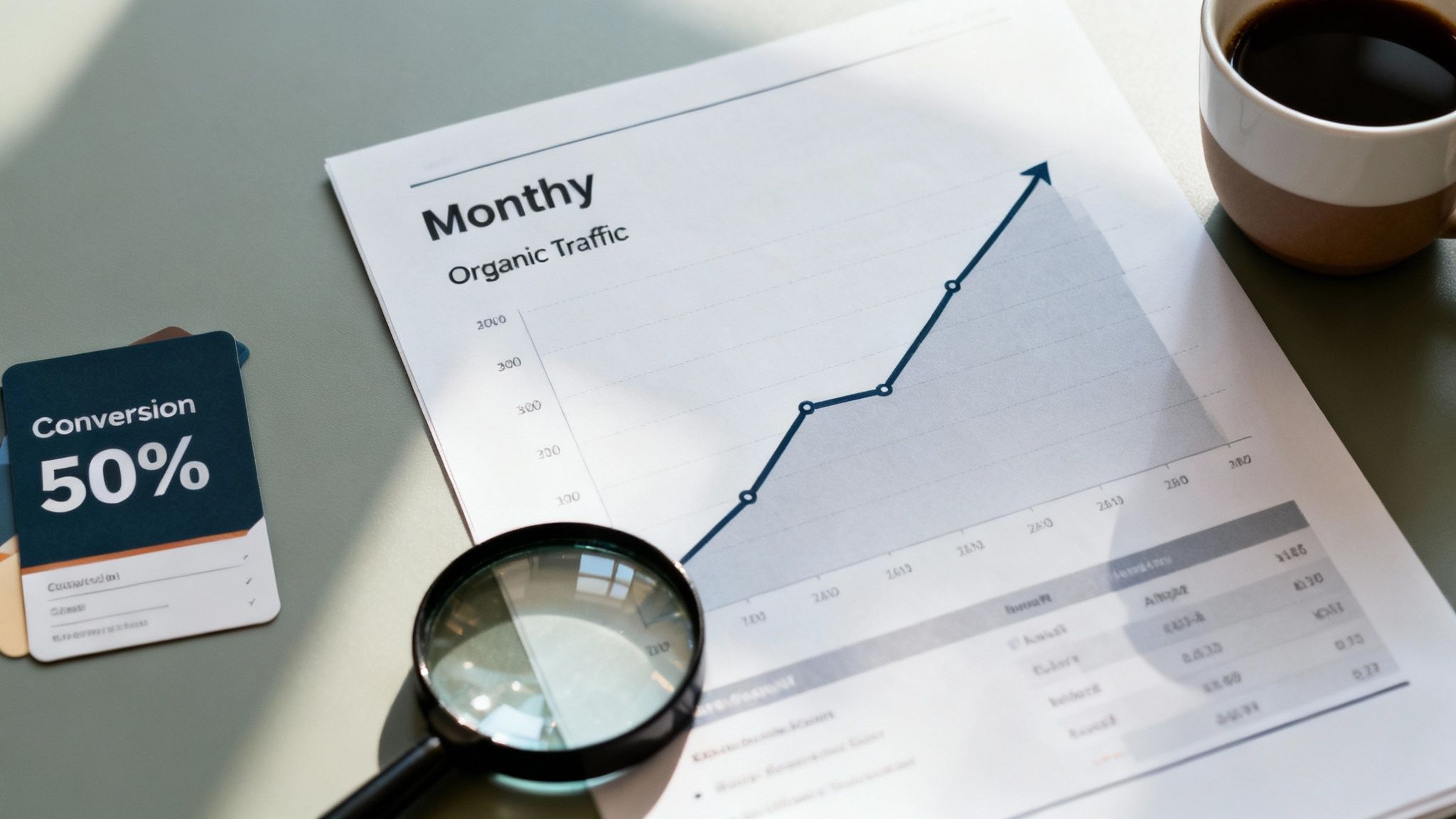
To truly gauge your ROI, you need to track the metrics that show you're getting closer to your business goals. Any decent agency will give you reports that are transparent and actionable, not just a confusing dump of data.
Here are the core KPIs you should have your eye on:
For a deeper dive into which numbers matter most, check out our complete guide to key digital marketing performance metrics.
For a huge number of Australian businesses, the biggest returns come from local search. Local SEO packages have become a cornerstone for SMEs, and it’s no surprise when you learn that 46% of all Google searches include local intent.
The business in that top local search spot scoops up an incredible 24.4% of all clicks. This means if you don't have a strong local presence, you're practically invisible to almost half of your potential customers. What's even more shocking is that 56% of local businesses haven't even claimed their Google Business listings, leaving a massive opportunity on the table for savvy operators.
Let's look at a real-world example. An Adelaide-based B2B equipment supplier put their money into a growth-focused search engine optimisation package. Their main goal was to get more qualified leads through their website because their sales team was wasting too much time on cold calls.
The first three months were all about a technical site audit, optimising their core service pages for high-value keywords like "commercial kitchen fitouts Adelaide," and properly building out their Google Business Profile. The next phase was dedicated to creating in-depth blog content that answered common customer questions.
After six months, the results spoke for themselves:
By connecting specific SEO activities to a tangible increase in high-quality leads, the business could easily calculate a positive return on their investment. It was clear proof of the package's direct contribution to their sales pipeline.
Stepping into the world of SEO packages can feel a bit like learning a new language. It's a big investment, and you absolutely should have questions before you commit. To help clear things up, we've tackled some of the most common ones we hear from businesses just like yours.
Getting these things straight from the start is all about setting realistic expectations and building a solid partnership. It’s knowing what you’re getting into so you can move forward with confidence.
The honest answer? It depends. SEO is a marathon, not a sprint, and you should be very wary of anyone promising instant number-one rankings. How quickly you see results comes down to a few key things, like how competitive your industry is, the current health of your website, and the intensity of the package you choose.
For a local business in a less crowded market, you might start seeing some nice upward movement in rankings and traffic within three to six months. But if you're a national e-commerce store in a fiercely competitive space, getting those significant, lasting results could take closer to nine to twelve months.
The first chunk of any package is all about laying the groundwork—think technical audits, keyword strategy, and fixing on-page issues. The real, tangible growth comes from the steady, month-over-month effort of creating content and building your site's authority. Any decent agency will be upfront about this, showing you the small wins and key milestones along the way.
While a low price tag always looks good on paper, super-cheap SEO packages are a huge red flag. They often come with serious risks that can do a lot more harm than good. Quality SEO is a hands-on discipline that requires time, deep expertise, and some pretty sophisticated tools. There are no shortcuts.
Packages priced way below the market average are usually cutting corners somewhere. This often means using outdated or "black-hat" tactics, like building spammy, low-quality links or using auto-generated content. These methods don't just fail to work long-term; they can land you a nasty penalty from Google.
A Google penalty can make your website practically invisible overnight, sometimes for years. Fixing it is often way more expensive and time-consuming than just investing in a proper strategy from day one.
It’s far smarter to see SEO as an investment in a professional service. A fairly priced package means you have skilled experts dedicating the right amount of time to high-quality, sustainable strategies that deliver genuine, long-term value and protect your brand's reputation.
This is a really common point of confusion, but the distinction is pretty simple. Think of Search Engine Marketing (SEM) as the big umbrella covering all strategies used to get seen on search engines. Search Engine Optimisation (SEO) is just one crucial piece under that umbrella.
A truly powerful digital strategy often uses both SEO and PPC working together. SEO builds long-term authority, trust, and a sustainable flow of free traffic. PPC, on the other hand, delivers immediate, highly targeted traffic—perfect for specific campaigns or testing new markets. Often, the insights you get from one can be used to make the other even better, creating a powerful synergy that drives fantastic results.
Ready to invest in an SEO package that delivers real, measurable growth? The team at Virtual Ad Agency builds customised strategies designed to hit your specific business goals. Contact us today for a complimentary strategy session and find out how we can build your online authority.

 previous