
A click-through rate calculator is a straightforward tool that cuts right to the chase, measuring how effective your digital marketing is by showing the percentage of people who click your link after seeing it.
The formula is simple: divide the total number of clicks by the total number of impressions, then multiply by 100 to get your percentage. This one metric is a vital health check for everything you do online, from your latest Google Ad to your weekly email newsletter.

Before you start plugging numbers into a calculator, it’s worth taking a moment to appreciate what click-through rate actually tells you. Think of it as a direct line of communication from your audience.
It’s not just a number on a dashboard; it’s a clear signal of how well your message is landing. When someone clicks, they’re essentially raising their hand and saying, "Yes, this is relevant to me."
A high CTR is a great sign. It means your ad copy, email subject line, or meta description is hitting the mark and aligning perfectly with what the user wants. On the flip side, a low CTR is an early warning that something’s off. Maybe your targeting is too broad, your offer isn’t compelling enough, or your creative just isn't cutting through the noise.
Across pretty much every digital channel, CTR is a foundational performance metric. It’s so important because it measures that first flicker of engagement and directly impacts your campaign costs and visibility.
Let’s break down its influence in a few key areas:
Simply put, CTR is the bridge between getting seen (impressions) and getting action (clicks). When you focus on optimising it, you’re making sure you’re not just shouting into the void—you’re starting a genuine conversation with potential customers.
It can be tempting to write CTR off as a vanity metric, but its impact on your return on investment is undeniable. A healthy CTR is often the very first step in a successful conversion funnel. Without that initial click, there’s no chance for a sale, a lead, or a new subscriber.
For example, if you manage to double your CTR from 2% to 4% on a paid search campaign, you've just doubled the amount of traffic hitting your landing page from the same number of impressions. That’s twice as many opportunities to convert visitors into customers, often without spending a dollar more on ads.
What’s more, the platforms reward relevance. By working to improve your CTR, you are naturally fine-tuning your messaging to better resonate with your audience. This creates a powerful feedback loop: better messaging leads to a higher CTR, which leads to lower costs and better visibility, which ultimately drives more qualified traffic and makes your entire campaign more efficient.
For a deeper dive into the nuances of this metric, you can explore our detailed guide on what is click-through rate and why it's a cornerstone of any effective digital strategy.
All the theory in the world doesn't mean much until you put it into practice. That’s where our simple click-through rate calculator comes into play. It’s built to give you quick, accurate insights without getting tangled up in manual calculations or complicated spreadsheets.
Using the calculator couldn't be easier. You only need two numbers: the total clicks your ad, email, or link got, and the total number of impressions it served. Just pop those two figures into the fields, and the tool instantly spits out your CTR percentage.
The growing power of simple tools like this one highlights a bigger shift towards tool marketing, which we're seeing outperform traditional content strategies more and more often.
Before you can crunch the numbers, you need to know where to find them. Luckily, this info is sitting right inside the analytics dashboard of whatever platform you’re using.
Right, let's walk through three real-world scenarios to see how this works in practice.
Picture this: you're running a Google Ads campaign for an Adelaide-based shoe store, targeting the keyword "buy running shoes online." After a week, you dive into your dashboard and pull these numbers:
Plug those into the calculator and you get a CTR of 5.0%. For a commercial keyword, that's a solid start. It's a great sign that your ad copy is connecting with people who are ready to buy.
Next up, let's say you've just sent a newsletter announcing a flash sale. The main goal was to get subscribers clicking through to your website's sale page. Your email platform gives you this report:
This works out to a CTR of 2.35%. What's interesting here is that for the Australian market, this is pretty much bang on average for email campaigns—which actually perform better than the global benchmark. It shows your performance is standard, but there's definitely an opportunity to tweak your subject lines or calls-to-action to beat the local average.
A single number from a click-through rate calculator can tell a compelling story. It’s the first clue that tells you whether your message is compelling, your targeting is accurate, or if you need to go back to the drawing board.
Finally, let’s look at a blog post you published, "The Top 5 Hiking Trails Near Adelaide." You want to know how it's performing in Google search. You log into Google Search Console and find this:
The calculator shows a CTR of 5.0%. This is a strong signal that your page title and meta description are doing their job, catching people's attention and convincing them to choose your result over all the others on the page.
As you can see, a simple click-through rate calculator gives you immediate, practical insights across all your marketing channels. It takes CTR from being an abstract idea and turns it into a real number you can use to figure out what's working and what needs to change.
You’ve plugged your numbers into a click-through rate calculator and now you have a percentage staring back at you. But what does that number really mean?
Is a 3% CTR a reason to pop the champagne, or a red flag that your campaign is missing the mark? The honest answer is: it depends. A CTR is pretty much meaningless without context.
There’s no magic "good" number that fits every situation. It shifts dramatically depending on the channel you're on, your industry, the type of campaign you're running, and even what a user was hoping to find with their search. A CTR that would be fantastic for a Facebook display ad might be a total flop for a highly targeted branded search ad on Google.
This chart gives you a quick visual on just how different the expectations can be across the major marketing channels.
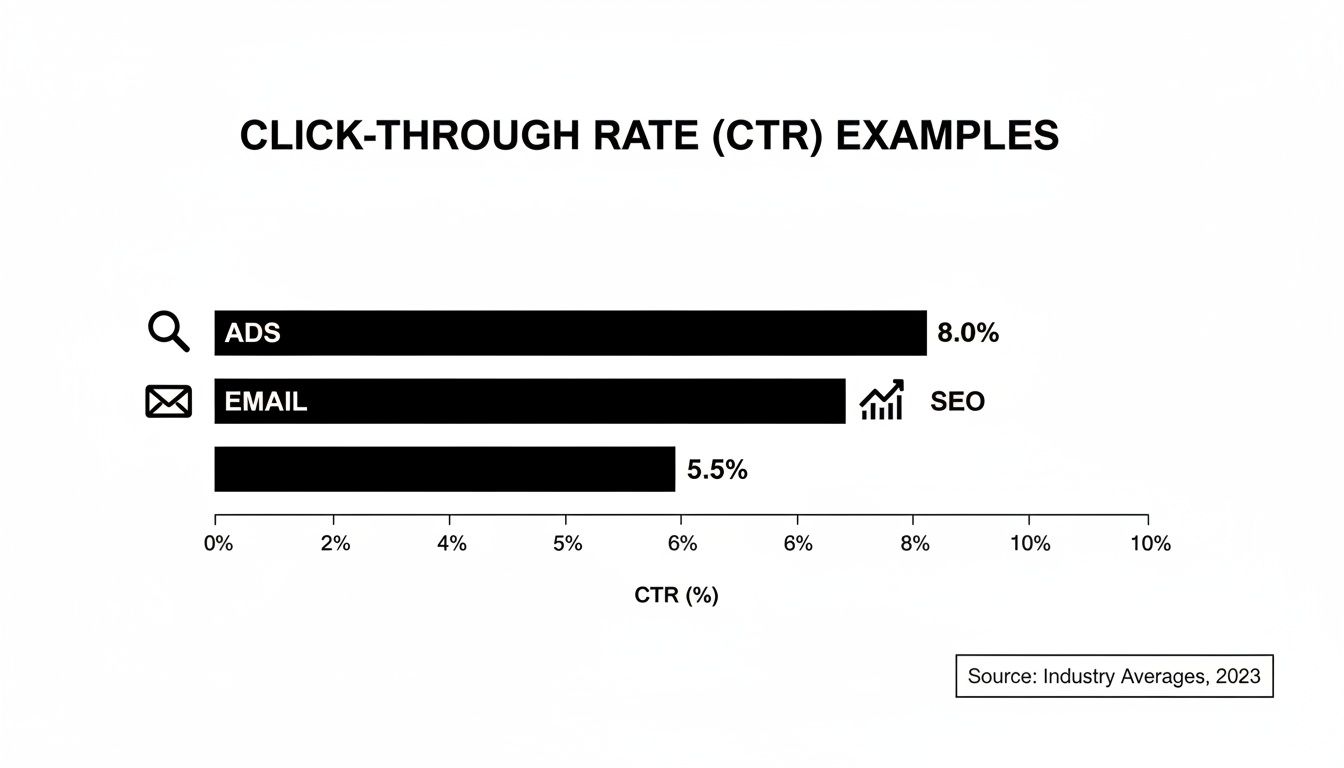
As you can see, the engagement you can expect varies wildly. It’s a perfect illustration of why you need to use channel-specific benchmarks to get an accurate read on your performance.
To really get a feel for how you’re doing, you need to compare your results against relevant benchmarks. Global averages are a decent starting point, but local data gives a much clearer picture, especially in a unique market like Australia.
For example, a recent look at Australian Facebook Ads benchmarks shows just how wide the gap can be between industries. The shopping and gifts sector saw an incredible 4.13% CTR—a massive 146% jump from the previous year. When you pair that with a low cost-per-click (CPC) of just $0.34 AUD, you can see why a click-through rate calculator is so vital for getting the most out of your ad spend in a competitive eCommerce space.
In stark contrast, the real estate industry saw its CTR drop by 36%. This is a classic example of why you can't just apply one sector's strategy to another. It's also why we rely on localised, industry-specific data to build campaigns that are set up for success right from the get-go.
Beyond the big-picture stuff like industry and channel, a bunch of other factors can cause your CTR to fluctuate. Getting your head around these variables is the key to a more sophisticated analysis of your campaign's health.
A few of the main culprits include:
We see a lot of people make the mistake of chasing a high CTR at all costs. While it's a crucial sign that your message is relevant, a high CTR that doesn't lead to conversions is just an expensive way to buy traffic. The real goal is to attract the right clicks.
Let's put all this into a more practical context. This table breaks down some typical Australian benchmarks across different marketing channels, which should help you frame your own results and set more realistic goals for your campaigns.
| Industry/Channel | Google Search Ads CTR | Facebook Ads CTR | Email Marketing CTR | Organic Search CTR (Non-Branded) |
|---|---|---|---|---|
| eCommerce (Retail) | 5.2% | 4.1% | 2.5% | 3.8% |
| B2B Services (e.g., Finance) | 2.9% | 1.2% | 2.1% | 2.5% |
| Real Estate | 4.1% | 1.0% | 1.9% | 3.1% |
| Travel & Hospitality | 4.7% | 2.3% | 2.1% | 4.2% |
The table makes the disparity crystal clear. A 4.1% CTR in real estate would be exceptional on Facebook but just average on Google Search. Likewise, email marketing CTRs often look lower because the "impression" is simply someone receiving the email, not necessarily seeing a specific offer inside it.
It's also worth remembering that metrics like 'impressions' are measured differently across platforms. Our guide on the cost per impression formula digs into how this number forms the backbone of many campaign costs.
Ultimately, interpreting your CTR correctly means understanding all the pieces of the puzzle. It’s what moves you from simply using a click-through rate calculator to making genuinely data-driven decisions that grow your business.

So, you've used a click-through rate calculator and have your baseline number. Now the real work begins. Seeing a low CTR isn’t a sign of failure; it's a massive green flag telling you exactly where to focus your energy. Think of it as a roadmap for optimising your message, tightening your targeting, and ultimately, driving better traffic.
Boosting your CTR boils down to one thing: making your link the most compelling, must-click option on the screen. Whether it's standing out on a packed Google results page, in a chaotic social media feed, or a jam-packed inbox, your goal is to create a magnetic pull that demands a click.
Google Ads is a battlefield. Even tiny improvements in your CTR can have a huge ripple effect on your campaign's profitability. A higher CTR boosts your Quality Score, which Google then rewards with lower costs-per-click and better ad positions. It’s a beautiful, powerful cycle.
One of the quickest wins is to write truly irresistible ad copy. Your headlines are everything. Ditch the generic statements and try asking a question that hits on your user's pain point, or use numbers to catch the eye. A headline like "5 Top-Rated Running Shoes for Plantar Fasciitis" is worlds away from the forgettable "High-Quality Running Shoes."
Next up, you have to get serious about using ad extensions. These are extra snippets of information that literally make your ad bigger on the results page, making it more prominent and far more useful to the searcher.
A classic mistake we see is businesses throwing all their keywords into one bucket. You need to align your ad copy tightly with the searcher's intent. Someone typing in "best running shoes" is in a different mindset than someone searching for "Nike Pegasus price."
Finally, become a master of negative keywords. This is where you tell Google which search terms you don't want your ads to appear for. If you sell premium running shoes, you might add "cheap," "discount," or "second-hand" as negative keywords. This simple clean-up job stops you from wasting money on impressions from people who were never going to buy, which naturally lifts the CTR of the relevant audience you do reach.
In the world of email marketing, your subject line is the gatekeeper. If it doesn't hook them, the amazing content inside doesn't matter one bit. The average person gets hit with dozens, if not hundreds, of emails a day. Yours has to cut through the noise.
Personalisation is your secret weapon. Using a first name is table stakes now; you need to go deeper. Try referencing a past purchase, their location, or how they've previously engaged with you. A subject line like, "Sarah, are your new running shoes holding up?" feels personal and is far more likely to get an open than a generic "Customer Survey."
Creating a sense of urgency or curiosity also works wonders.
Once they've opened the email, the call-to-action (CTA) is the next hurdle. Your CTA needs to be crystal clear and action-focused. Forget vague phrases like "Click Here." Go for specific commands like "Shop the Sale Now" or "Get Your Free Training Plan." And please, make your CTA button pop with a contrasting colour so it's impossible to miss.
When it comes to SEO, your meta title (the blue link in Google) and meta description (the little snippet of text underneath) are your weapons for boosting CTR. These elements are your organic ad copy, and they deserve just as much attention as a paid ad.
Your meta title should always include your main keyword, but it also needs a hook to make it compelling. Using brackets or parentheses can help certain words stand out. Adding "[Complete Guide]" or "(2024 Update)" can seriously lift click-throughs because it signals that your content is comprehensive and fresh.
While your meta description doesn't directly affect rankings, it’s your sales pitch. It’s your chance to convince the searcher that your page is the best answer to their query. It should expand on the title, clearly communicate the value, and wrap up with a subtle call to action.
Let's look at an example for a blog post about hiking trails:
See the difference? The second version is much more engaging and clearly spells out the value you'll get by clicking. For an even deeper dive into boosting engagement, check out these 10 powerful strategies to increase click-through rate and start driving better results.
Even the most determined DIY marketing efforts eventually hit a wall. You’ve used the click-through rate calculator, you've agonised over ad copy, and you’ve optimised your email subject lines until you can’t see straight. And yet, your growth has started to flatten out.
This plateau isn't a sign you've failed. Far from it. It's actually a common signal that it might be time to bring in the heavy hitters.
Recognising this moment is a strategic move. It’s about knowing when your time is better spent actually running your business, rather than getting tangled up in the ever-changing weeds of advanced campaign management. If you consistently find yourself short on time or lacking the specialised tools for deep-dive optimisation, an agency can bring the firepower you need.
Another big tell-tale sign is a disconnect between your CTR and your actual business goals. Sure, you might have a fantastic click-through rate, but if those clicks aren't turning into quality leads or sales, you’ve got a classic leaky funnel on your hands. This is often where a professional, outside perspective makes all the difference.
A specialised agency doesn’t just get fixated on isolated metrics like CTR. Instead, they zoom out to see the full funnel, connecting every single click to the entire customer journey. The goal shifts from just getting more clicks to attracting the right clicks—the ones most likely to convert and actually contribute to your bottom line.
This holistic approach means your CTR improvements become part of a cohesive growth strategy, not just a lonely number on a dashboard. An agency can help you answer the critical questions:
When your campaign performance has stalled despite your best efforts, it's often because the next level of growth requires a more integrated strategy. An agency can provide the framework to connect all the moving parts, from initial impression to final sale.
Ultimately, bringing on a marketing agency is about gaining a strategic ally who is 100% dedicated to your growth. They bring the experience to diagnose complex problems, the resources to execute sophisticated campaigns, and the accountability to deliver results you can measure.
If you're wondering what this kind of partnership looks like in practice, exploring the scope of digital marketing consulting can shed some light on how an external team plugs into your own to drive real, sustainable growth. It’s a calculated move to scale your efforts and finally achieve those results that have felt just out of reach.
Once you start using a click-through rate calculator regularly, a few common questions always seem to surface. This is where the real learning begins. Getting the nuances right is what separates simply reporting on a number from genuine strategic analysis.
So, let's clear up some of the most frequent queries that pop up. Think of this as your quick-fire guide to mastering CTR and sidestepping common mistakes.
Not always, no. While a high click-through rate feels great—it means your ad copy or email subject line is definitely grabbing attention—it's only telling you half the story. The real goal isn't just to get a mountain of clicks; it's to get the right clicks that turn into sales, leads, or whatever action you're aiming for.
Picture this: you're running an ad for premium leather shoes with a killer headline: "Free Shoes Here!" You'd probably get a massive CTR. But what happens next? Visitors land on your page, realise the shoes aren't free, and bounce immediately. The result? A sky-high bounce rate and zero conversions.
A high CTR paired with a low conversion rate is a major red flag. It almost always points to a disconnect between what your ad is promising and what your landing page is actually delivering. The sweet spot is a strong CTR that funnels high-quality, ready-to-convert traffic to your site.
The perfect rhythm for checking your CTR really comes down to the channel you're using and how fast your campaign is moving. There’s no single right answer, but here are some solid guidelines based on what we see in the field:
This is a classic point of confusion, especially in the world of email marketing. They sound almost identical, but they're measuring two very different levels of engagement.
CTOR gives you a crystal-clear look at how persuasive the actual content inside your email was. CTR, on the other hand, gives you a broader view of the campaign's success, including how well your subject line worked. You really need both to get the full story.
Ready to move beyond spreadsheets and see how metrics like CTR fit into your entire marketing funnel? The team at Virtual Ad Agency specialises in connecting the dots, turning data into a comprehensive strategy that drives real growth. Find out how we can help at https://www.virtualadagency.com.au.

 previous