
Good marketing for real estate is all about creating a reliable, repeatable system to find, connect with, and sign on new clients. It's a world away from just throwing a property listing online and hoping for the best. We’re talking about building a proper, full-funnel strategy that guides people from the moment they first hear about you, right through to becoming your biggest fans. In the cut-throat Australian property market, this isn't just a nice-to-have; it's essential.
Years ago, real estate marketing often felt a bit disconnected. You’d place an ad in the local paper, get some flyers printed, and cross your fingers. But today, a winning strategy is a carefully planned journey that meets potential clients exactly where they are, online or off. Think of it less like shouting from a megaphone and more like a series of smart, helpful conversations that build trust over time.
This full-funnel approach gets one thing right: not everyone is ready to buy or sell right now. Some are just daydreaming about their first home, while others are frantically googling for the best agent in their suburb. A solid marketing plan speaks to all of them, making sure you grab their attention early and stay top-of-mind when it’s finally time to make a move.
Before we dive into the nitty-gritty, let's look at the core components of a modern strategy. This table breaks down the essential pillars that hold up any successful real estate marketing plan.
| Pillar | Objective | Key Channels |
|---|---|---|
| Audience & Segmentation | To identify and deeply understand your ideal client personas. | Market research, CRM data analysis, local community insights. |
| Multi-Channel Presence | To be visible wherever your target audience spends their time. | SEO, Google Ads, Facebook & Instagram, Email, Display Ads, Events. |
| Value-Driven Content | To build trust and authority by providing genuinely helpful information. | Blog posts, market reports, neighbourhood guides, video tours. |
| Lead Nurturing & Automation | To guide prospects through their journey with timely, relevant communication. | CRM systems (HubSpot, Pipedrive), email marketing platforms (Mailchimp). |
| Measurement & Optimisation | To track what's working, what's not, and make data-backed decisions. | Google Analytics, CRM reporting, ad platform dashboards. |
Each pillar supports the others, creating a system that doesn't just generate leads, but turns those leads into profitable, long-term relationships.
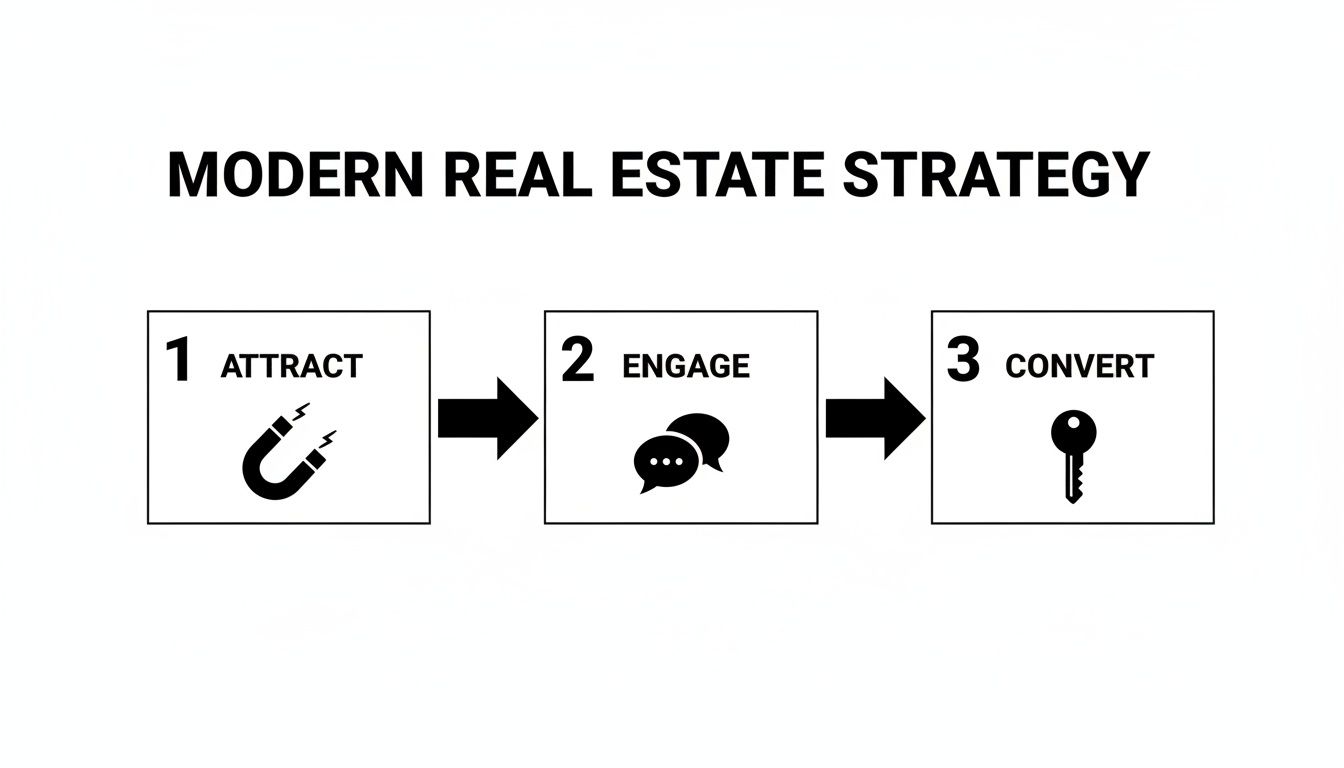
We can boil the entire client journey down to three key phases. Getting your head around these stages helps you tailor your message, pick the right channels, and actually measure what’s moving the needle.
Attract: This is the top of the funnel. Your goal here is to make potential clients aware that you exist and that you know your stuff. It’s about casting a wide but targeted net to catch the attention of anyone who might need an agent down the track.
Engage: Once you’ve got their attention, it’s all about building a relationship. This is the middle of the funnel, where you provide value, answer their questions, and position yourself as the go-to local expert they can trust.
Convert: This is the bottom of the funnel, where all that hard work pays off. These leads have been nurtured and are ready to act. Your marketing should be clear and direct, making it incredibly easy for them to book an appraisal, schedule a viewing, or sign on the dotted line.
This simple flowchart shows how it all fits together, moving from initial awareness to a signed client.
It’s a deliberate process. You’re guiding them every step of the way, not just blasting a cold audience with a "list with me" message and hoping for a miracle.
Before you can attract anyone, you have to know exactly who you’re talking to. This is where creating detailed client personas comes in, and it's a non-negotiable first step. Are you targeting first-home buyers in up-and-coming suburbs? Or maybe affluent downsizers in blue-chip neighbourhoods? Or is your sweet spot savvy investors hunting for their next opportunity?
A well-defined client persona is more than just age and income. It's the story of your ideal client: their goals, their pain points, what keeps them up at night. This story dictates every single thing you do in your marketing—the words you use, the content you create, and where you spend your budget.
For example, a marketing campaign aimed at millennial first-home buyers will be all about Instagram, TikTok, and helpful blog posts breaking down the daunting buying process. On the other hand, if you're targeting luxury downsizers, your strategy might focus on premium print magazines, exclusive local events, and a highly personal, one-on-one approach.
By defining these personas first, you make sure every marketing dollar is spent with purpose, pushing you towards a clear business goal.
Paid ads are great for getting noticed today, but a smart content and Search Engine Optimisation (SEO) strategy is what gets you found forever. Think of it less as an expense and more as building a valuable digital asset for your business. Instead of constantly paying for attention, you're creating a system that naturally attracts motivated buyers and sellers right to your digital doorstep.
This approach is all about playing the long game. Every blog post you write and every webpage you tweak is like planting a seed. Over time, these seeds grow into a forest that consistently pulls in high-quality organic traffic from places like Google, cementing your reputation as the definitive property authority in your area.

The whole strategy boils down to one simple idea: become the most helpful answer to the questions your ideal clients are typing into Google. When someone searches "best real estate agent in Richmond" or "how to prepare a house for sale in Adelaide," you want your name to be the first thing they see. It's that simple.
For real estate agents, let's be clear: all SEO is local SEO. Your entire goal is to show up when people search for property-related terms within your specific patch. The most critical, non-negotiable tool for this is your Google Business Profile (GBP).
Think of your GBP listing as your digital shopfront. It’s that info box that pops up in Google Maps and on the side of the search results, showing your agency's name, address, phone number, reviews, and photos. Getting this profile dialled in is one of the highest-impact things you can do for your business, period.
Here’s where to focus your energy:
Content is the fuel for your SEO engine. Without it, Google has nothing to show people. Your mission is to create hyper-local resources that answer the specific questions and solve the problems of buyers and sellers right there in your market.
Forget generic, boring articles. Your content needs to scream local expertise. For a deeper look at building your brand and attracting clients this way, check out these comprehensive content marketing strategies for real estate agents.
Here are a few ideas to get you started:
SEO isn't some dark art. It's just the process of making your website the most trustworthy and authoritative resource on a topic. For you, that topic is real estate in your local community. Answer people's questions better than anyone else, and Google will reward you.
Of course, the technical side of your website is just as crucial. A fast-loading, mobile-friendly website isn't a "nice-to-have" anymore—it's a requirement. With well over half of all web traffic now coming from mobile devices, a clunky mobile site will send potential clients running and signal to Google that your site isn't user-friendly. These foundations are essential, and our guide on SEO for a small business can help you get them right.
When you combine a technically sound website with hyper-local content and a perfectly optimised Google Business Profile, you create a powerful, self-sustaining system. This system doesn't just generate leads; it builds your brand as the trusted, go-to real estate expert in your patch, ensuring you have a pipeline of clients for years to come.
While SEO and content are brilliant for building your long-term authority, sometimes you just need leads right now. This is where paid advertising steps in. Think of it as an accelerator, putting your properties and brand directly in front of motivated buyers and sellers at the exact moment they’re ready to listen. It’s the difference between waiting for clients to find you and actively going out to find them.
Forget just "boosting" a post and crossing your fingers. Effective marketing for real estate through paid channels is a science. It's about using the sophisticated targeting tools on platforms like Google, Facebook, and Instagram to reach very specific, high-intent audiences. You can zero in on demographics, interests, and even online behaviours that scream "I'm ready to make a move."

Just think about the possibilities. You could serve an ad for a new family home specifically to young couples in Melbourne who have recently shown interest in mortgage calculators. Or, you could target property investors in Brisbane with an ad for a multi-unit development. This level of precision means your budget is spent wisely, turning ad spend into actual, measurable appointments and listings.
Not all paid platforms are created equal; each has a distinct job to do in your marketing funnel. The secret is to align the channel with your specific campaign goal, whether that’s getting your name out there or capturing leads who are ready to sign on the dotted line.
Google Ads (Search)
Facebook & Instagram Ads (Social)
Paid advertising allows you to bypass the queue. While your organic efforts grow, paid campaigns create immediate visibility, putting your most compelling offers in front of a hand-picked audience to drive instant action and fill your pipeline.
In a crowded feed, you’ve got less than three seconds to grab someone's attention. Generic stock photos and bland copy just won't cut it anymore. Your creative—the images, videos, and text—is your most powerful weapon for making a property feel completely irresistible.
The Australian real estate market has seen a massive shift towards dynamic, visual content. Recent data shows a clear link between video-heavy social media strategies and successful sales, with savvy marketers using trends on Instagram and TikTok to make properties pop. This makes sense in a market where the Australian Bureau of Statistics recorded 395,642 dwelling transfers, an increase of 8.93% year-over-year. It’s a huge number that highlights the immense value of using compelling visuals to turn online searches into sales.
Here are a few creative approaches that just plain work:
Ultimately, the goal is to create a seamless journey from the ad click to your landing page. Make sure your call-to-action is crystal clear and the page they land on delivers exactly what the ad promised. To really get a consistent stream of prospects flowing, you should also explore these powerful real estate lead ideas.
By combining surgical targeting with scroll-stopping creative, you can transform your paid advertising from a simple expense into a predictable, lead-generating machine.
Getting leads is really only half the job in real estate marketing. A list of names and emails is just a starting point; the real prize is turning that initial interest into actual appointments, appraisals, and listings. This is where smart automation completely changes the game. It takes your follow-up from a manual, time-consuming chore and turns it into a powerful, relationship-building engine that works for you 24/7.
The foundation of this whole system is a solid Customer Relationship Management (CRM) platform. Honestly, moving away from scattered spreadsheets and into a proper CRM is like swapping an old street directory for a live GPS. It gives you one central place for every single interaction, making sure no lead ever slips through the cracks and every opportunity is followed up with care.
This tech allows you to build out clever communication workflows that engage potential clients on a large scale, but without losing that all-important personal touch. Once you get the hang of it, you can create a seamless journey that guides people from their first flicker of curiosity right through to signing on the dotted line. You can take a closer look at what marketing automation is and how it can be put to work in your agency.
An email nurture sequence is just a series of pre-written, automated emails that are sent to a contact over a set period. Think of it as your digital assistant, methodically building trust and providing value while you focus on the big-ticket items like negotiations and client meetings.
Crucially, each sequence needs to be designed with a specific audience and goal in mind. One size definitely does not fit all.
Your automation strategy isn't about spamming people. It’s about delivering the right message, to the right person, at the right time. When you get this right, your follow-up feels incredibly personal, relevant, and genuinely helpful.
This targeted approach is particularly powerful in a hot market. For example, the Australian housing market has seen massive demand lately, which is reflected in soaring online searches. Data from the Australian Bureau of Statistics showed 395,642 dwelling transfers in a recent period—an 8.93% jump year-over-year. Smart marketers jumped on this, using automated emails that highlighted rising property values to attract first-home buyers, many of whom were being spurred on by government incentives.
The content inside your automated sequences is what really does the heavy lifting. Each email should offer genuine value, not just a sales pitch. Your aim is to position yourself as the indispensable local expert they can’t imagine buying or selling without.
A well-planned nurture campaign can build this trust piece by piece over time. Here’s a sample sequence for a potential seller lead, showing how you can guide them from that initial curiosity towards booking an appraisal.
This table outlines a simple but effective automated email workflow designed to engage a homeowner who has downloaded a property value guide, nurturing them towards becoming a listing client.
| Email # | Subject Line | Content Focus | Goal |
|---|---|---|---|
| 1 | Your [Suburb] Property Value Guide Is Here! | Delivers the requested lead magnet (e.g., a suburb report) and a brief, friendly introduction to you and your agency. | Deliver Value |
| 2 | 3 Common Mistakes to Avoid When Selling in [Suburb] | Offers actionable tips and showcases your expertise on the local market's specific challenges and opportunities. | Build Authority |
| 3 | A Look Inside a Recent Sale We Managed Near You | Presents a mini case study with professional photos and key outcomes, providing powerful social proof. | Showcase Results |
| 4 | Curious About Your Home's Current Market Value? | Transitions from providing general advice to a soft call-to-action for a no-obligation, personalised property appraisal. | Drive Conversion |
By automating these thoughtful touchpoints, you ensure consistent follow-up that builds rapport and keeps your agency top of mind. When they are finally ready to make a move, you’ll be the first person they call.
Effective marketing for real estate is so much more than just eye-catching ads and clever social media posts. The agencies that truly pull ahead of the pack treat their marketing not as an expense, but as a calculated investment. To get there, you need to ditch the guesswork and start making decisions based on cold, hard data.
This means shifting away from a "spray and pray" approach – throwing money at different channels and just hoping something sticks. Instead, you need a precise system where every single dollar is accountable. When you track the right metrics, you can see with total clarity what's driving results and what's just burning through your budget.
To make smart decisions, you first need to know what you're measuring. It's easy to get bogged down in vanity metrics like page views or social media likes, but for a real estate business, only a handful of Key Performance Indicators (KPIs) truly tell the story of your growth and profitability.
These are the numbers that draw a straight line from your marketing efforts to your bottom line.
Cost Per Lead (CPL): This is your total campaign spend divided by the number of leads it brought in. It tells you exactly how much you're paying to get a potential client's details.
Lead-to-Appointment Rate: This is the percentage of leads that actually turn into a tangible meeting, like a property appraisal or a buyer consultation. It's a massive indicator of your lead quality.
Marketing Cost Per Transaction: This is the ultimate measure of ROI. It calculates all the marketing costs associated with a single closed deal, showing you the direct cost to acquire that commission.
Tracking these core KPIs is like giving your marketing a regular financial health check. It strips emotion and opinion out of your budget decisions, replacing them with undeniable proof of what is—and isn't—delivering a return.
Once you're consistently tracking your KPIs, you can start building a smarter, more dynamic budget. The goal is to strike a healthy balance between long-term brand building (think SEO and content) and short-term lead generation (like your paid ad campaigns).
This data-driven approach means you can be nimble. For instance, if you see your Google Ads campaign is generating leads at a CPL of $50 while your Facebook campaign's CPL is sitting at $150, you know exactly where to shift your ad spend for better results. Your CRM and tools like Google Analytics are your best friends here, giving you the dashboards needed to monitor performance as it happens.
Recent Australian market conditions are a perfect example of why this matters. With residential property sales profitability hitting a 20-year high, a staggering 95.5% of sellers made a nominal profit, with the median gain reaching a record $335,000. The sharpest marketers jumped on this data, running campaigns that dialled up the profit potential. This drove a 7.43% rise in house transfers by positioning properties as smart investments. You can dive deeper into these Australian housing market trends and see how data shaped these winning strategies.
You don't need to overcomplicate things. Start with a simple framework to guide your spending, then adjust it based on the data you collect each month.
Set a Baseline: A common rule of thumb is to allocate around 10% of your Gross Commission Income (GCI) to marketing.
Divide and Conquer: Split that budget between "Now" and "Future" activities. For example, put 70% towards immediate lead generation channels like paid ads and 30% into long-term brand assets like SEO and content creation.
Review and Reallocate: At the end of each month, look at your KPIs. Did one channel smash it out of the park? Move a portion of the budget from the underperformer to the winner for the next month.
This continuous loop of spending, measuring, and optimising is what ensures your marketing budget is always working as hard as possible to grow your business.
Jumping into the world of property marketing can feel like you're trying to drink from a firehose. There's so much to learn. To make things a bit clearer, we’ve tackled some of the most common questions agents and agencies ask us, with real-world answers to help you market smarter.
A great rule of thumb is to put about 10% of your gross commission income (GCI) straight back into your marketing. If you’re a new agent just starting to build a name for yourself, you’ll probably need to nudge that figure a little higher to get the ball rolling and build some initial momentum.
Here’s the thing: you have to stop thinking of marketing as just another expense on the P&L sheet. It's a direct investment in the growth of your business. The smartest way to start is with cost-effective, high-impact strategies like getting your local SEO right and creating genuinely useful content. As the deals start to close and you can see a clear return, that’s when you can confidently start dialling up the spend on paid ads.
If only it were that simple! The truth is, there’s no silver bullet. The "best" channel comes down to what you're trying to achieve right now and who you're trying to talk to.
Need to generate a flood of buyer enquiries for a brand-new listing, and fast? You can’t beat laser-targeted Facebook and Instagram ads. But if your goal is to build long-term authority and become the go-to agent for high-value sellers in your patch, a consistent diet of hyper-local SEO and genuinely helpful content is your best bet.
The most successful agencies we see don't rely on just one thing. They weave everything together—their digital ads, their local networking, their community involvement—into one seamless, integrated strategy.
Think of AI as your super-powered assistant, not a replacement for your hard-earned market knowledge. It’s brilliant for knocking out the first drafts of property descriptions, spinning up a few different versions of a social media post, or even brainstorming blog post ideas about your local community.
Some of the newer CRMs are even using AI to analyse lead behaviour, giving you a nudge on the perfect time to make that follow-up call. The golden rule is to always, always add your human touch. Let AI do 80% of the heavy lifting, then you come in and spend your time on the final 20%—refining the copy, adding your personal insights, and injecting your brand’s voice.
At Virtual Ad Agency, we build data-driven, full-funnel marketing strategies that turn browsers into buyers and prospects into listings. To see how we can help you build a predictable system for growth, check out our services at https://www.virtualadagency.com.au.

 previous