
At its core, SEO for lawyers is all about making your firm’s website show up when potential clients are looking for legal help online. It’s the process of optimising your digital presence so you appear higher in search engine results, making it dead simple for the right people to find you.
Think of it this way: a solid SEO strategy turns your website from a simple digital brochure into a powerful, automated pipeline for high-quality cases. You're not just casting a wide net; you're attracting individuals actively searching for the exact legal services you provide, establishing your firm's authority and driving consistent, sustainable growth.
It wasn’t that long ago that a law firm's reputation was built almost entirely on word-of-mouth referrals and a few ads in the local paper. While those things still have their place, the game has completely changed. Today, the very first place clients look for legal representation is Google.
When someone urgently needs a family lawyer, a criminal defence solicitor, or a commercial litigator, their first move isn't flipping through the Yellow Pages—it's typing a query into their phone. This fundamental shift in behaviour has made SEO a non-negotiable part of running a modern law firm. It's the most direct path to connect with clients at the precise moment they need your expertise. If you're not on the first page of search results, you're practically invisible to most of your market.
When you're looking at your marketing budget, it often boils down to a choice between organic search (SEO) and paid advertising (like Google Ads). Paid ads can get you to the top of the search results almost instantly, which is tempting. But that visibility is rented—the second you stop paying, your ads disappear, and so do the leads. It’s a short-term fix that demands constant cash flow.
Organic SEO is a different beast entirely. It’s about building a long-term, valuable asset for your firm. Every piece of content you write, every backlink you earn, and every technical tweak you make builds your website's authority. This is something your firm owns. Over time, it creates a steady, reliable stream of traffic and leads without a direct cost-per-click, delivering a far greater return on your initial investment.
"Investing in SEO is like buying commercial property. Paid ads are like renting. One builds equity and lasting value, while the other is a temporary expense."
The numbers don't lie. The Australian market's investment in search is exploding, with projected SEO spending set to hit $1.5 billion in 2025. Firms are catching on because they see the results.
Organic search results capture a staggering 85-90% of all clicks, with the top three spots gobbling up more than half of that traffic. For law firms specifically, organic search is the undisputed champion, driving over 53% of all web traffic. Compare that to paid search, which brings in just 15%. You can dig deeper into these Australian SEO trends to see the data for yourself.
Why the massive difference? It all comes down to trust. People instinctively see organic results as more credible and authoritative than paid ads. Earning a top spot is a powerful signal that Google—and by extension, the market—views your firm as a leading expert in your practice area. This isn't just about getting clicks; it's about building the trust that convinces a potential client to pick up the phone.
A good SEO strategy makes sure your firm is the trusted, authoritative choice they find first.
To put it into perspective, let's break down how organic and paid channels stack up for a typical legal practice.
| Metric | Organic SEO | Paid Search (PPC) |
|---|---|---|
| Cost Per Click | $0 (after initial investment) | Varies, often high ($50-$200+) for competitive legal terms |
| Time to Results | Slower (3-9+ months) | Immediate |
| Long-Term Value | Builds a lasting asset; cumulative benefits | No long-term value; traffic stops when payment stops |
| Credibility & Trust | High; seen as an earned, authoritative placement | Lower; users know it's a paid advertisement |
| Click-Through Rate | Generally higher; captures the majority of clicks | Lower; attracts a smaller percentage of searchers |
| Sustainability | High; creates a self-sustaining lead source | Low; requires continuous budget allocation |
While paid search has its place for short-term campaigns or testing new markets, the long-term goal for any serious law firm should be to dominate the organic search results. It’s where the trust, the traffic, and the sustainable growth are found.
For most law firms in Australia, the best clients are right in their own backyard. This simple fact makes local search the single most important battlefield to win. While many firms stop after just claiming their Google Business Profile (GBP), the real results come from turning that profile into a client-generation machine.
Your GBP is often the very first interaction a potential client has with your firm. It's not just a listing; it's your digital front door. Getting it right means that when someone searches for "family lawyer Parramatta" or "criminal solicitor near me," your firm doesn't just show up—it stands out as the obvious choice.
The process is powerful in its simplicity: rank at the top, and you connect with clients at their point of need.
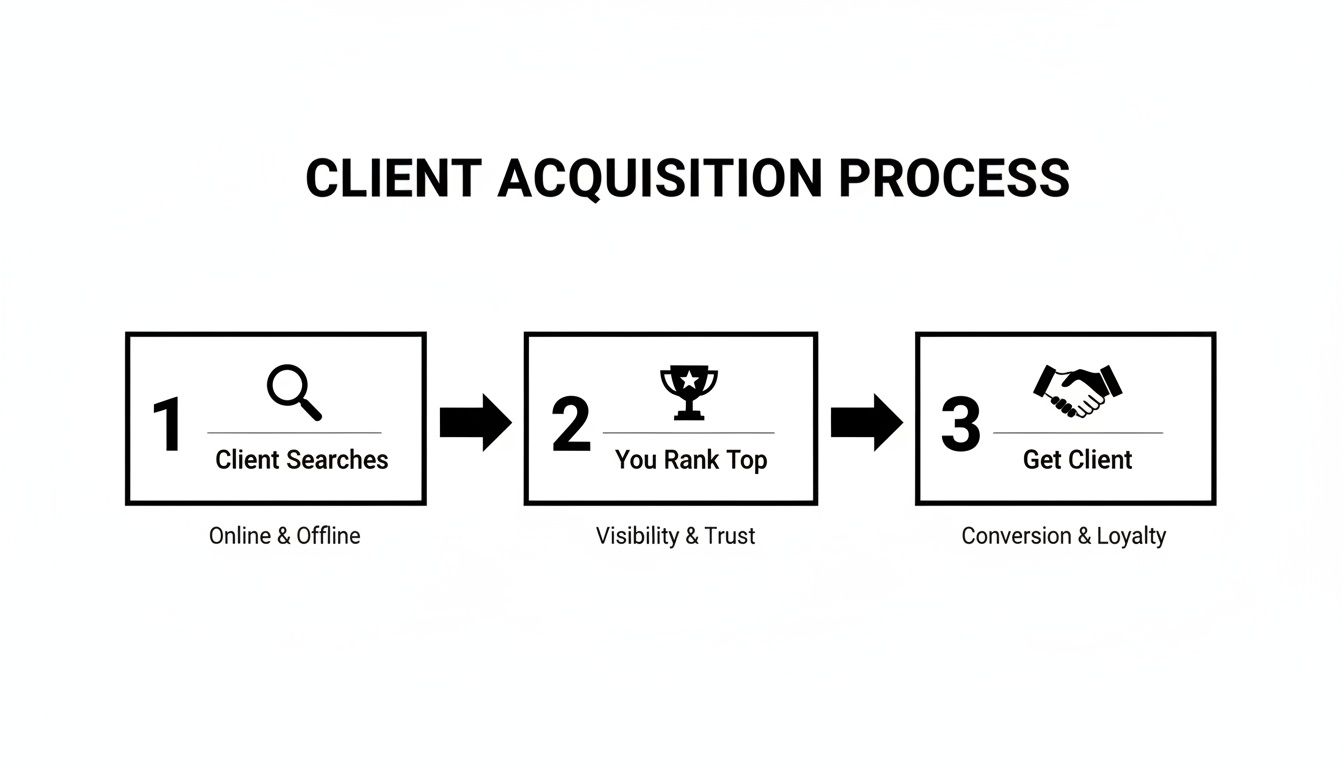
This highlights how being at the top of local search results is the critical bridge between a person's urgent legal problem and them picking up the phone to call you.
Think of your GBP dashboard as the control centre for your local presence. A complete, active profile is a massive signal to Google that your firm is legitimate, active, and highly relevant to people searching nearby.
Here’s where to focus your energy:
Your Google Business Profile isn't a "set it and forget it" task. Think of it more like an active social media profile. Consistent updates, fresh photos, and quick responses to reviews are all trust signals for Google.
The payoff for a sharp local SEO strategy is huge. We've seen Australian law firms that dial in their local search achieve a 71% increase in local traffic. For a keyword like 'family lawyer Sydney', which gets around 1,600 searches a month, ranking on top could realistically bring in 12 new clients every month. From just one keyword. You can explore more about these client acquisition metrics at https://virtualadagency.com.au/seo-consultant-adelaide/ to see how they might apply to your firm.
That little "Questions & Answers" section on your GBP? It's a goldmine. It lets you proactively address common questions and concerns before a potential client even has to ask.
Keep a close eye on this section. If someone asks a question, jump on it with a prompt, thorough answer. Better yet, seed this area yourself by asking and answering the questions you get all the time. Think: "What's your initial consultation process like?" or "Do you offer fixed-fee arrangements for conveyancing?"
Reviews are the bedrock of social proof for any local business, and law firms are no exception. A steady stream of recent, positive reviews is one of the most powerful local ranking factors there is.
Beyond your GBP, Google scans the web to verify your firm's details. This is where NAP consistency (Name, Address, Phone number) becomes absolutely critical.
You need to ensure your firm's NAP information is identical across every online directory. Even tiny differences, like "St." versus "Street," can create confusion for search engines and water down your local authority. Start by getting listed correctly on major Australian legal directories like FindLaw Australia and other local business sites.
Finally, create dedicated service pages for specific locations. Instead of one generic "Family Law" page, build out targeted pages like 'Family Lawyer Parramatta' and 'Divorce Solicitor Chatswood'. These pages can be optimised with hyper-local content and keywords, perfectly matching what potential clients in those suburbs are typing into Google. To really nail this, you can explore more detailed strategies to improve local SEO rankings and apply them to your own website.
Content is the absolute heart of SEO for any lawyer. While all the technical fixes and local business listings build a solid foundation, it’s the high-quality, targeted content that really persuades both Google and your potential clients that your firm is the authority.
Generic, self-promotional articles just don't cut it anymore. Not in this market.
To win, your content strategy needs to go way beyond simply listing your services. It has to directly address the urgent, often stressful, questions your ideal clients are typing into search engines. This is about creating genuinely helpful resources that guide them on their legal journey, building trust long before they even think about picking up the phone.

This shift toward helpful, educational content is more critical than ever, especially with the changes artificial intelligence is bringing to the legal sector. It turns out that around 35% of Australians now use AI assistants to research legal questions before they even visit a law firm’s website.
Firms have to adapt by creating content that's far superior, guiding potential clients from those early AI-driven queries right through to your action-focused service pages. To get a better handle on this, you can learn more about how AI is changing the legal SEO landscape on apwebsolutions.com.au.
Understanding user intent is the key that unlocks a successful legal content strategy. You have to realise that a potential client's needs change dramatically as they move from just becoming aware of a problem to the point where they're ready to hire a solicitor. Your content has to meet them at every single stage.
We can break this down into two main buckets: top-of-funnel (informational) and bottom-of-funnel (transactional).
A common mistake I see is firms focusing exclusively on bottom-of-funnel keywords. While they're crucial, you can't ignore the earlier stages. Capturing clients earlier in their journey with helpful, informational content builds trust and ensures your firm is top-of-mind when they are finally ready to hire.
A really robust content plan for a law firm should include a strategic mix of page types. Each one serves a distinct purpose on the client's path to you.
The table below breaks down how you can tailor your content to match where a potential client is in their decision-making process. Thinking this way ensures you're providing the right information at the right time.
| Client Intent Stage | Content Type | Example Topic |
|---|---|---|
| Awareness (Top) | Informational Blog Post | "What Are the First Steps After a Car Accident in QLD?" |
| Consideration (Middle) | Detailed Guide / FAQ Page | "A Complete Guide to Contesting a Will in Victoria" |
| Decision (Bottom) | Practice Area Page | "Expert Criminal Defence Lawyers in Sydney" |
| Post-Decision (Trust) | Case Study / Testimonial | "How We Achieved a Successful Outcome in a Complex Property Settlement" |
By mapping out your content like this, you create a seamless journey that nurtures a searcher from a simple question into a new client.
Practice Area Pages (Bottom-of-Funnel)
These are your money pages—the most important conversion-focused pages on your entire site. A page titled "Family Lawyers Sydney" shouldn't read like a blog post. It needs to be a comprehensive resource covering your services, your unique approach, the legal process involved, and have very clear calls-to-action. Think of it as a persuasive landing page built to generate enquiries.
Insightful Blog Posts (Top-of-Funnel)
Your blog is where you get to answer all the "what," "how," and "why" questions floating around in a potential client's head. Think about real-world topics like "What Are the Grounds for Divorce in NSW?" or "How Is Property Divided in a De Facto Separation?" These posts are magnets for organic traffic from people just looking for information, positioning you as a helpful authority.
Compelling Case Studies
Nothing builds trust quite like proven success. Anonymised case studies are powerful because they demonstrate your firm's ability to handle complex matters and achieve favourable outcomes. They provide rock-solid social proof that goes far beyond a simple testimonial.
Comprehensive FAQs
A dedicated FAQ section, either for your whole site or for specific practice areas, can be an absolute SEO goldmine. It allows you to directly answer those long-tail keyword queries (the highly specific, multi-word searches people use) and address common client concerns upfront. This doesn't just improve your search visibility; it also helps streamline your intake process by pre-educating potential clients.
Ultimately, every single piece of content you create needs a clear goal, whether that's to educate, build trust, or drive a direct enquiry. When you align what you publish with what your clients need, you create a powerful, systematic way to attract and convert cases. Fine-tuning these pages is a huge part of the answer to how to improve conversion rate for your law firm's website.
Great content and a strong local presence are absolutely vital, but they won't get you far if your website's technical foundations are shaky. Think of your website as your firm's digital office building. If the foundation is cracked and the wiring is faulty, it doesn't matter how impressive the furniture is.
This is where on-page and technical SEO come into play. They’re the behind-the-scenes workhorses that ensure your site is perfectly structured for both search engines and potential clients. Get these right, and you’re making it easy for Google to find, understand, and rank your valuable content.
The very first impression a potential client has of your firm online usually isn't your homepage—it's your title tag and meta description staring back at them from the Google results page. These tiny snippets of text are your digital handshake, and they need to be compelling enough to earn that all-important click.
A well-written title tag and meta description can seriously boost your click-through rate, which sends strong positive signals to Google about your page's relevance.
Getting the technical and on-page elements right is about more than just appeasing Google's algorithm. A fast, well-structured, mobile-friendly site provides a superior user experience, which directly builds trust and encourages potential clients to take the next step and contact you.
Once someone lands on your site, its structure helps them—and Google—find their way around. A smart internal linking strategy acts like a series of signposts, guiding users to your most important pages and spreading authority throughout your website.
For example, a blog post on "Grounds for Divorce in NSW" should always link back to your core "Divorce Lawyers" practice area page. This simple action helps reinforce the importance of your main service pages to search engines. Of course, this all starts with knowing which keywords to target in the first place. You can explore some essential SEO keyword strategies for lawyers to really nail this down.
You don't need to be a web developer to grasp the technical factors that really matter. A well-built website is a massive part of effective SEO, and understanding the basics of SEO in web designing helps you have more productive conversations with your web team.
Here are the non-negotiables:
By implementing this schema, you can explicitly tell Google about your firm's practice areas, location, opening hours, and other key details. This can help you show up in richer, more detailed search results, giving you a distinct advantage in a crowded legal market.
You can have the most technically sound website and brilliant content on the planet, but if other sites aren't vouching for you, you're missing a massive piece of the SEO puzzle. In the SEO world, that voucher comes in the form of backlinks—links from other reputable websites pointing to yours.
Think of every quality backlink as a professional referral in the digital space. When an authoritative website links to your firm, it’s a powerful signal to Google that you’re a credible, trustworthy source. It’s one of the most direct ways to build your site's authority and climb the rankings, which is why it's so critical when doing SEO for a lawyer.
The old days of buying dodgy links or using spammy tactics are well and truly over. Today, it’s all about earning those links through smart outreach and what we call digital public relations (PR).
Digital PR is less about asking for links and more about creating compelling reasons for other websites to talk about your firm. It's about building genuine relationships and providing real value, positioning your firm in the places your potential clients and professional peers already visit and trust.
The most effective link-building strategy isn't about trying to trick Google; it's about proving your firm's real-world authority and reputation online. Focus on activities that build your standing in the community, and high-quality links will follow.
When you shift your mindset from "building links" to "earning media," you create a sustainable strategy that boosts both your search rankings and your firm's professional reputation.
Let's be honest, nobody is rushing to link to your standard "Car Accident Lawyer" service page. To attract links from high-authority sites, you need to create what we call "linkable assets"—pieces of content so valuable that other websites feel compelled to share them with their audience.
Here are a few ideas that work wonders for law firms:
The trick is to create something unique that provides genuine value—something your competitors aren't doing.
Some of the most authentic and powerful links you'll ever get come from your own backyard. Getting involved in your local community does more than just build goodwill; it creates natural link-building opportunities.
Think about sponsoring a local kids' footy team, a community fair, or a charity fun run. Most of these organisations have a website with a sponsors page where they’ll happily add a link back to your firm’s site.
These aren't just any links. For local SEO, they're pure gold. They send incredibly strong signals to Google that your firm is a legitimate, active, and respected part of the local community. This approach perfectly marries your real-world reputation with your online authority, creating a powerful synergy. It's a true win-win.
Diving into digital marketing often brings up more questions than answers, especially in a field as tough as law. Law firm partners and marketing managers tend to ask the same handful of questions when they're first dipping their toes into SEO. Let's get you some clear, straightforward answers to set the right expectations from the get-go.
This is always the first question, and for good reason. It's crucial for managing expectations and budgets. SEO isn't a magic wand; it's a long-term strategy where every effort builds on the last.
While you might spot some small signs of life in the first few months, you should really be looking at a four to six month timeframe before you see a real, measurable impact on your traffic and, more importantly, your leads.
A few things can speed this up or slow it down:
SEO is like planting a tree, not flipping a switch. The initial effort lays the foundation for compounding growth that pays dividends for years, unlike paid ads where the traffic stops the moment you stop paying.
Is it strictly mandatory? No. But a blog is easily one of the most powerful tools in your SEO kit. Your main practice area pages are fantastic for targeting people who are ready to pick up the phone (what we call 'bottom-of-funnel'). A blog, however, lets you cast a much wider net.
Here's what a blog helps you do:
Think of your blog as your firm's public library. It builds credibility and trust with potential clients long before they've decided they even need a solicitor.
It helps to think of these as two sides of the same coin. They're overlapping disciplines that absolutely have to work together for any lawyer's SEO to be effective.
On-Page SEO is everything you do on your actual website pages to make them better for search engines and users. This covers things like:
Local SEO, on the other hand, is all about making your firm visible in searches happening in your specific geographic area. This involves:
Basically, on-page SEO makes sure your website is a top-notch destination. Local SEO makes sure the right people in your service area can actually find it. You can't succeed without doing both well.
At Virtual Ad Agency, we specialise in creating SEO strategies that drive measurable results for Australian businesses. If you're ready to turn your website into a consistent source of high-quality cases, let's talk.
Discover our SEO services and see how we can help your firm grow

 previous