
For many small business owners, the world of SEO can feel overwhelming and needlessly complex. But it doesn't have to be. The journey always starts close to home, focusing on your local community to make sure that when nearby customers need what you offer, you're the first business they find.

Before you even think about complex strategies, the single most powerful first step is to nail your local presence. This isn't about trying to outsmart Google. It's simply about giving clear, accurate information where your customers are already looking.
The undisputed champion here is your Google Business Profile (GBP). Think of it as your digital shopfront on Google Search and Maps. For many, it's the very first interaction they'll have with your brand. An incomplete profile is like a shop with no sign on the door—people will just walk on by.
Setting up a GBP is easy, but getting the most out of it takes a bit more attention. A fully optimised profile doesn't just inform people; it actively draws them in and signals to Google that your business is active, credible, and a great answer for local searchers.
Here’s a look at the absolute must-haves for a solid profile:
Your complete Google Business Profile is the most powerful local SEO tool you have. It costs nothing, you control it directly, and it makes an immediate difference in how you show up in local searches and on Google Maps.
But don't just set it and forget it. Actively managing your profile sends constant positive signals to Google. Add new photos regularly, post updates about special offers, and—this is a big one—encourage and respond to every single customer review. Reviews are a massive trust signal for both potential customers and the search engines themselves.
To help you stay on track, I've put together a quick checklist of the most important local SEO actions. Tackling these items will give you the biggest bang for your buck.
| Action Item | Why It's Critical | Estimated Time Commitment |
|---|---|---|
| Claim & Fully Optimise GBP | This is your digital storefront. It's often the first impression customers get on Google Search and Maps. | 1-2 hours initial setup |
| Gather Customer Reviews | Builds trust and social proof. Google uses review signals heavily in local rankings. | Ongoing (15 mins/week) |
| Add High-Quality Photos | Visuals drive engagement. Profiles with photos get more clicks and direction requests. | 30 mins to upload initial batch |
| Ensure NAP Consistency | Inconsistent info confuses Google and customers, hurting your visibility. | 1-2 hours for initial audit |
| Basic Local Keyword Research | Understanding how customers search helps you create relevant content and services. | 1 hour to start |
Getting these fundamentals right is non-negotiable. It lays the groundwork for everything else and ensures you're visible to the people who are most likely to become paying customers.
Once your GBP is sorted, it's time to get inside your customers' heads. For a local business, keyword research isn't about chasing huge search numbers. It's about finding the specific phrases people type when they need your help right now.
For example, a bakery in Adelaide shouldn't just be targeting "cakes." They need to zero in on phrases with real intent, like:
You can get started by just brainstorming a list of your services and tacking on location names. Think about the questions customers always ask you and turn them into search queries. Even something as simple as typing into Google's search bar and seeing what it suggests can give you huge clues.
For businesses in really competitive spots, working with an SEO consultant in Adelaide can uncover those harder-to-find local search opportunities that your competitors might be missing.
Local search is where the action is. In Australia, a massive 46% of all Google searches have local intent. What's more, 76% of people who look for something local on their phone visit a store within 24 hours. Despite this, only about 36% of Australian small businesses are actively doing any SEO, which leaves a huge opening for anyone willing to put in a little effort.
You’ve sorted your local presence and have a solid list of what your customers are searching for. Now, it's time to turn your website into the go-to resource for your audience. Effective SEO for a small business isn’t about just jamming keywords onto a page; it’s about creating genuinely valuable content that answers questions, solves problems, and gently guides visitors toward becoming customers.
This is the heart of on-page SEO. It’s all about structuring your pages so that Google understands what they’re about and, more importantly, so your visitors find them incredibly useful. Every single page—from your homepage to your services and blog posts—is a fresh chance to connect with someone who needs you.
Think of your service pages as your digital sales pitches. They need to be crystal clear, persuasive, and perfectly tuned to grab the attention of people who are ready to make a move. Put yourself in the shoes of a customer who just landed on your page for "emergency plumbing Sydney." What do they absolutely need to see right away?
To nail a powerful service page, you need a few key ingredients:
Every blog post or service page you publish is a new indexed page on your website. This gives Google another opportunity to show your business in search results, effectively expanding your digital footprint with each piece of quality content you create.
This structure doesn't just make the page easier for people to read; it gives search engines a clear roadmap. Google can easily pick up the main topic and all the related sub-topics, which helps you rank for a much wider range of relevant searches.
Once your page structure is sorted, the content itself needs to do the heavy lifting. Your goal is to create the single best answer on the internet for your customer's question. This means getting way beyond generic fluff and providing information that is genuinely helpful.
Take a cafe in Melbourne writing a blog post about the "best coffee beans for home brewing." A basic approach would just list products. A much better approach would be to:
This kind of content shows you know your stuff, builds trust, and naturally brings in keywords like "coffee beans Melbourne," "pour-over guide," and "espresso grind size." Because it's actually useful, visitors are far more likely to trust your advice and buy from you. By creating content that's both helpful and persuasive, you're directly improving how well your website performs. For a deeper dive, our guide on how to improve conversion rate offers more practical strategies.
Your title tag and meta description are your shop window in the search results. It's the first thing a potential customer sees before they even click, making them absolutely critical for earning that click.
Expert Blocked Drain Plumber in Sydney | Joe's PlumbingFast and reliable blocked drain clearing in Sydney. 24/7 emergency service. Call Joe's Plumbing for a fixed-price quote and immediate help!By getting these small but mighty elements right, you ensure your great content gets the attention it deserves, turning searchers into website visitors and visitors into customers.

Think of backlinks as votes of confidence. When another website links to yours, it's a signal to Google that you're a credible, trustworthy source. It’s a major ranking factor, but a lot of small business owners I talk to worry it means spending big on complicated outreach campaigns.
The good news? It really doesn't.
For a small business, effective link building is less about aggressive digital tactics and more about genuine community engagement. It's about building relationships and creating value that people naturally want to share. Often, the best strategies are the ones that also happen to strengthen your brand offline.
The most logical place to begin is right in your own backyard. These foundational links are often the easiest to get and send powerful local relevance signals to search engines. They hammer home your connection to your geographic area, which is what local SEO is all about.
Start by targeting these high-value local opportunities:
Building your link profile isn't a numbers game. A handful of relevant, authoritative links from respected local sources will do more for your SEO than a hundred links from spammy, irrelevant sites.
This whole approach grounds your digital presence in your physical community. For Google, that's a massive tick in the box that you're a legitimate local business.
The most sustainable link-building strategies I've seen always stem from real-world relationships. Forget cold-emailing strangers and asking for links. Instead, focus on collaborations where a link is just the natural byproduct of a partnership. It feels more authentic because it is more authentic, and it gets better results.
Consider partnering with a non-competing business that serves a similar crowd. For example, a wedding photographer could team up with a local florist. They could write a guest post for each other's blogs, maybe something like "Top 5 Photo-Friendly Bouquets," which naturally includes a link back. It provides genuine value to both of your audiences.
Sponsoring a local event is another powerful strategy. This could be anything from a junior sports team to a community festival. Sponsorship nearly always includes a mention and a link on the event's website, which is often a highly trusted local domain. It’s a classic win-win: you build a quality backlink while generating brand awareness and goodwill in your community.
While relationships are key, you can also attract links passively by creating content so genuinely useful that other websites want to link to it. We call this a "linkable asset." For a small business, this doesn't have to be some massive research report. It just needs to solve a real problem for your local audience.
Here are a few practical ideas to get you started:
By focusing on these practical, community-first strategies, you can steadily build your website's authority. This approach to SEO for a small business isn't about quick tricks. It's about embedding your business into the fabric of your local digital ecosystem and earning trust, one link at a time.
Technical SEO. The phrase itself is enough to make most business owners nervous, conjuring up images of developers, confusing code, and server-side jargon. And yes, it can get complicated. But a few key technical fixes can make a massive difference to your search rankings, and the good news is you don't need to be a tech wizard to tackle them.
Think of it like this: you could have the most beautiful shopfront in town, but if the front door is jammed and the lights are flickering, customers aren't going to stick around. Technical SEO is simply about making sure your website's door is wide open and everything works the way it should.
These are the quick wins that help Google understand your site and, more importantly, give your customers a better experience.
This one isn't a "nice-to-have" anymore; it's an absolute deal-breaker. Most searches now happen on a smartphone, so Google has switched to a "mobile-first" approach, meaning it uses the mobile version of your site for indexing and ranking.
If your site is a pain to use on a phone, you're not just annoying potential customers—you're actively telling Google you're not a great result to show.
A mobile-friendly site means:
Not sure if your site makes the cut? Pop your URL into Google's free Mobile-Friendly Test tool. It’ll give you a straight pass or fail and tell you what needs fixing.
Be honest: how long do you wait for a slow website to load? If you're like most people, it's not very long at all. A slow website is probably the fastest way to lose a potential customer. For every extra second your page takes to load, the percentage of visitors who hit the "back" button skyrockets.
A fast website is a huge part of a great user experience. Google knows this and rewards faster sites with better rankings because they know it's what searchers want. Aim to get your pages loading in under three seconds.
So, how do you get your site moving faster?
Structured data (you might also hear it called Schema markup) is a little bit of code you add to your website that acts like a translator for search engines. It turns your content into a neat, organised summary that Google can instantly understand.
This isn't just about making Google's life easier. When you use structured data, you can get what are called "rich snippets" in the search results. These are the eye-catching listings that show star ratings, opening hours, prices, or event details right there on the search page.
For a local business, this is pure gold. Imagine someone searching for "plumbers near me" and seeing your listing pop up with a 4.9-star rating and a clickable phone number. That's a massive advantage.
The search world in Australia is changing fast. We're seeing more zero-click searches, where people get their answer directly from the search results page and never click through to a website. By adding structured data, you're putting your most important info front and centre, which is vital as these AI-driven search trends impact Aussie businesses.
By focusing on these few manageable technical tasks, you're not just ticking boxes. You're building a stronger, faster, and much more visible foundation for your business online.
Putting in the hard yards on SEO is one thing, but how do you actually know if it’s working? The only way to see a real return on your investment is to track the right things. Forget about the vanity metrics that look impressive on a report but do nothing for your bottom line. We need to focus on data that signals genuine business growth.
The best part? You don't need a massive software budget to get started. Two free and incredibly powerful tools from Google are all you need: Google Analytics 4 (GA4) and Google Search Console. These platforms give you a direct line of sight into how people find and interact with your website, providing all the insights you need to make smarter decisions.
It's easy to get sidetracked by numbers like total website visits or social media likes. While they might feel good, they don't tell the full story. Instead, we need to zero in on Key Performance Indicators (KPIs) that connect directly to your business goals.
For most small businesses, this really just boils down to a few core metrics:
Tracking the right KPIs is the only way to prove the value of your SEO work. A rise in organic traffic is great, but a rise in organic leads and sales is what truly keeps the lights on.
To really get a handle on what's working and figure out what to do next, you need to learn how to measure SEO success effectively. This approach shifts your focus from just getting clicks to attracting the right kind of visitors—the ones who are actually likely to become customers.
Once you have some data, you can stop guessing and start planning. A simple roadmap helps you set realistic goals and stay focused on the tasks that will actually move the needle over the next year. You don't need to overcomplicate it; a basic 3, 6, and 12-month plan is perfect.
Quick technical wins, like making your site mobile-friendly, improving its speed, and adding rich snippets, lay the foundation for long-term success.
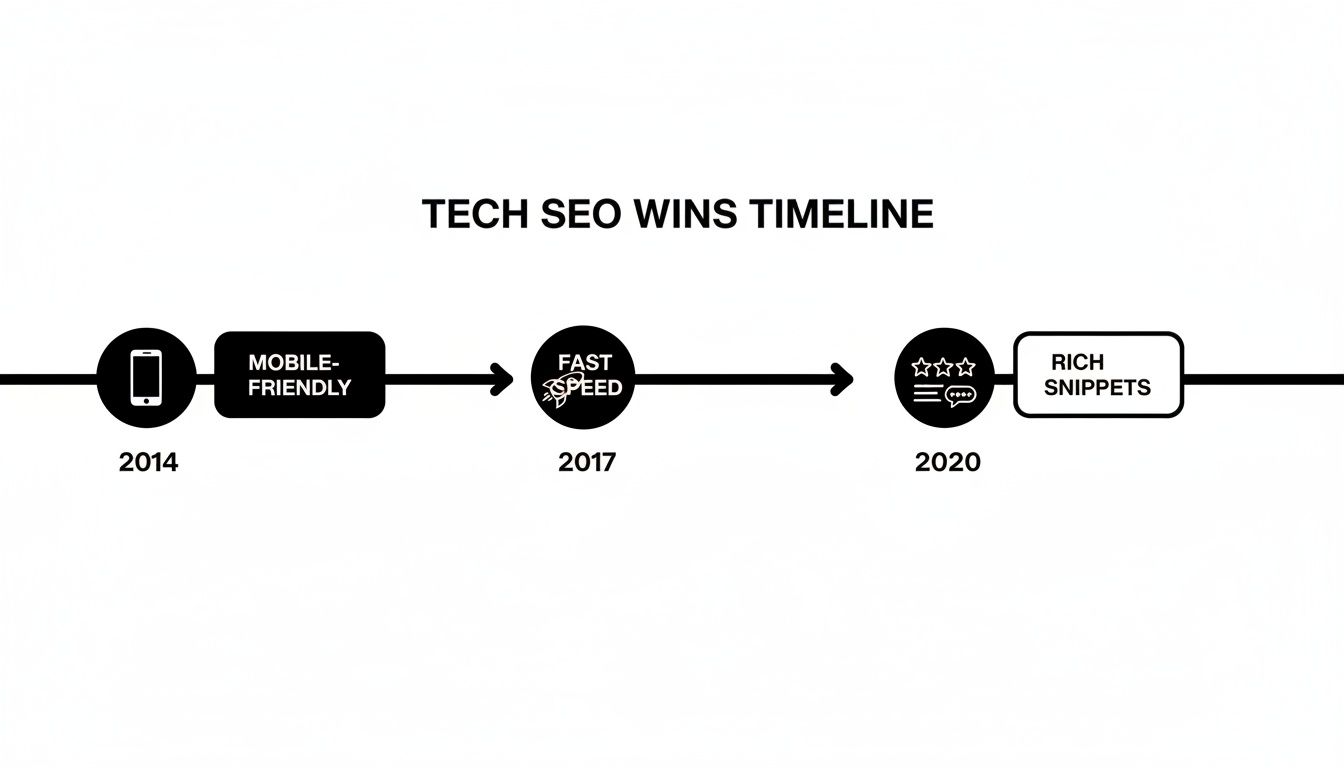
This visual timeline is a great reminder that getting the fundamentals right creates a strong base for more advanced strategies down the track.
Here’s what your first year could look like:
Months 1-3: Focus on the Foundations
Months 4-6: Build Authority and Momentum
Months 7-12: Refine and Scale Up
To keep things simple, here’s a breakdown of the most important metrics to track, what they mean, and which tools to use.
| Metric (KPI) | What It Measures | Primary Tool for Tracking | Why It's Important |
|---|---|---|---|
| Organic Traffic | Visitors arriving from search engines (e.g., Google, Bing). | Google Analytics 4 | Shows the overall health and reach of your SEO efforts. |
| Keyword Rankings | Your website's position in search results for specific keywords. | Google Search Console | Indicates how visible you are for terms your customers are searching for. |
| Click-Through Rate (CTR) | The percentage of people who click your link after seeing it in search results. | Google Search Console | A high CTR suggests your page titles and descriptions are compelling. |
| Conversions (Goals) | The number of visitors who complete a desired action (e.g., form submission, phone call). | Google Analytics 4 | Directly measures the business impact and ROI of your SEO. |
| Bounce Rate | The percentage of visitors who leave after viewing only one page. | Google Analytics 4 | A high bounce rate can indicate poor content or user experience. |
| Backlinks | The number and quality of other websites linking to yours. | Google Search Console, Ahrefs | Backlinks are a major ranking factor; they signal trust and authority to Google. |
Tracking these KPIs will transform your SEO from a guessing game into a predictable, data-driven process. You’ll know what’s working, where to adjust, and how to confidently invest your resources for the best possible return. For a broader look, you can explore other essential https://virtualadagency.com.au/digital-marketing-performance-metrics/ to get a complete picture of your online success.
Diving into the world of SEO can feel a bit like opening Pandora's box. It often seems to create more questions than answers, especially when you're just starting out. Let's cut through the noise and tackle some of the most common queries I hear from small business owners.
This is the big one, isn't it? The honest answer is: SEO is a marathon, not a sprint.
You'll likely start to see the first glimmers of progress in about 3 to 6 months. This usually looks like small but positive movements—maybe you start showing up in Google Maps for a few searches or ranking for some less competitive local phrases.
But for the kind of results that really move the needle, like a consistent stream of leads coming from organic search, you're typically looking at 6 to 12 months of dedicated effort. Keep in mind that your timeline will shift based on things like how fierce your local competition is, where you're starting from, and how consistently you're able to work on it.
There’s really no one-size-fits-all answer here, as SEO budgets can vary wildly. It all boils down to your approach.
The best way to think about it is as an investment, not a cost. Figure out what a new customer is worth to your business over their lifetime, and then set a budget that gives you a clear path to getting a return on that investment.
The most effective SEO strategies are all about sustainable, long-term growth. Don't get distracted by shiny objects or promises of "overnight rankings." Real, lasting results come from consistent, quality work done over time.
You can absolutely get your hands dirty and handle the SEO basics yourself. In fact, this guide is designed to give you the confidence to do just that. Foundational tasks like beefing up your Google Business Profile, doing some initial keyword research, and writing the content for your main service pages are completely manageable for most business owners.
However, if you're stuck in a highly competitive market or you're just keen to speed things up, bringing in an expert can be a total game-changer. A seasoned SEO pro can wrestle with the technical gremlins, dive deep into competitor analysis, and roll out more advanced strategies that simply require more time and specialised expertise.
For the vast majority of small businesses—think your local bakery, dental clinic, or landscaping company—the answer is a resounding yes. Local SEO is far more important. Its entire focus is on making you visible to customers in your immediate area who are actively looking to buy something or visit a storefront right now.
This is where you'll see the quickest and most direct impact on your bottom line. General, or national, SEO is more for businesses that sell products or services online to a country-wide audience. For a deeper look at all the pieces of the puzzle, this actionable guide to getting found online is a fantastic resource. The smart play is always to dominate your own backyard first before you even think about expanding your reach.
Ready to take the guesswork out of your digital marketing and see real growth? The team at Virtual Ad Agency specialises in creating data-driven SEO strategies that deliver measurable results. Let us help you connect with more customers and build a stronger online presence. https://www.virtualadagency.com.au

 previous