
When you hear "search engine marketing", what comes to mind? For a lot of business owners, it’s about getting to the top of Google, fast. That's pretty much it. Agency search engine marketing is simply the decision to bring in a specialist firm to handle that for you.
At its core, it’s all about paid advertising strategies—like Pay-Per-Click (PPC)—designed to put your business front and centre the very moment a potential customer is looking for what you sell. It’s like setting up a pop-up shop in the busiest part of town, right when your ideal buyer is walking past with their wallet out.
Let’s get a bit more practical. Picture your perfect customer. They're online right now, actively searching for a solution you provide. Agency SEM is like having an expert guide who knows every shortcut and back alley to get your business in front of that person. This isn't just about throwing money at ads and hoping for the best; it's a calculated discipline focused on turning clicks into actual business growth.
People often get SEM and SEO mixed up, or use them interchangeably. They’re two sides of the same coin, both aiming to get you noticed on search engines, but they go about it very differently.
Search Engine Optimisation (SEO): This is the long game. It’s about fine-tuning your website's content, structure, and authority to climb the ladder in the organic (unpaid) search results. Think of it as building a great reputation around town, one handshake at a time. It takes time but has lasting power.
Search Engine Marketing (SEM): This is the immediate, paid route. You're running ad campaigns to appear in the sponsored sections of search results. This gets you seen instantly and gives you a tonne of control over who sees you and when.
So, why bother with an agency? Can't you just run the ads yourself? Well, the digital ad world is a tricky beast, and it changes its mind constantly. An agency brings a very specific set of skills to the table—they live and breathe the complex world of ad auctions, deep keyword research, and performance data analysis. They know the little nuances that make the difference between a campaign that brings in money and one that just… spends it.
A great agency isn’t just an ad manager; they’re a strategic partner. Their whole purpose is to turn your ad budget into real-world results like leads, sales, and revenue. They connect every click to a business goal.
Ultimately, teaming up with a skilled agency gives you the strategic oversight you need to actually compete. They sweat the small stuff—the daily bid adjustments, the ad copy that converts, the campaign tracking—so you can get back to what you do best: running your business. It’s a relationship built on a shared goal: using the immense power of search engines to fuel predictable, sustainable growth. Once you grasp that, it’s easy to see why a solid SEM strategy is a non-negotiable part of any modern marketing plan.
An SEM agency doesn't just do one thing; it's a collection of specialised skills all working in concert. Think of it like a high-performance pit crew for a race car. Each person has a specific job—changing tyres, refuelling, tweaking the aerodynamics—but they are all laser-focused on the single goal of winning the race.
In the same way, an SEM agency brings together several core disciplines to turn your advertising budget into real, tangible business growth. These services are the engine room of any successful paid search campaign, the mechanics that transform clicks into actual customers.
This simple map shows how paid ads and organic efforts both fit under the wider SEM umbrella.
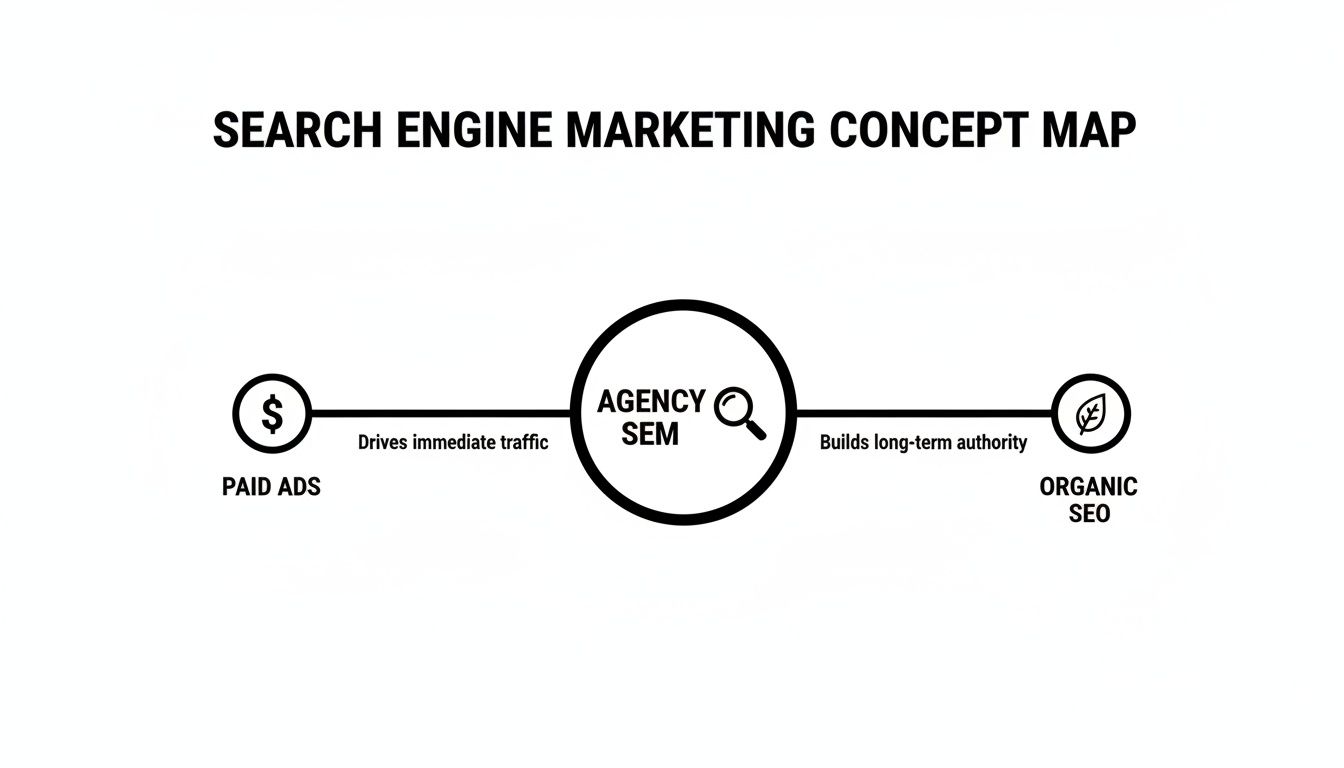
While they're distinct tactics, an agency manages both to help you dominate the search results page.
At the very heart of agency SEM is Pay-Per-Click (PPC) campaign management. This is what most people think of first: the hands-on creation, execution, and constant tweaking of ad campaigns on platforms like Google Ads and Microsoft Advertising.
But it’s far from a "set and forget" job. A good agency meticulously builds out ad groups, crafts compelling ad copy that speaks directly to your audience, and dials in targeting parameters to make sure you're reaching the right people. The whole point is to squeeze the maximum impact out of every single dollar you spend. Find out more about how a specialised pay-per-click agency can fine-tune your campaigns for peak performance.
In the world of search, keywords are the currency. A sophisticated keyword strategy isn't about guessing what people might type into Google; it's a science dedicated to understanding customer intent. An agency’s job is to get inside the head of your potential customer.
They get there by:
This strategic approach means your ads show up at the exact moment a motivated buyer is actively looking for what you sell.
Getting someone to click your ad is only half the battle. If that click sends them to a confusing, slow, or irrelevant webpage, they’ll hit the back button in seconds, and your ad spend is down the drain. This is where landing page optimisation comes in.
A great ad campaign directs traffic, but a great landing page converts it. It’s the critical final step that turns a curious visitor into a qualified lead or a paying customer.
An agency works to create a totally seamless experience, from the ad copy to the landing page itself. They test everything—headlines, calls-to-action (CTAs), page layouts, forms—all to remove friction and make it as easy as possible for a visitor to convert. This process of continuous improvement, known as Conversion Rate Optimisation (CRO), is fundamental to proving a positive Return on Ad Spend (ROAS).
The world of paid search is basically a massive, fast-moving auction. Ad positions and costs are constantly changing based on your competition, the time of day, and who is searching. Bid management is the science of navigating this auction to get the best possible ad placement for the lowest cost.
Agencies use advanced tools and automated strategies to adjust bids in real-time, making sure your budget is being spent in the smartest way possible. This is vital in a competitive space. For example, the Search Advertising market in Australia is forecast to hit around US$6.60 billion in 2025, with quarterly search revenue alone reaching nearly AU$1.9 billion. To get your piece of that pie, expert bid management is non-negotiable.
Of course, none of this means a thing without meticulous performance tracking. Agencies set up sophisticated tracking to monitor every click, conversion, and sale. When looking at what an SEM agency offers, it's worth checking if they use advanced tools, like those provided by LLM Visibility Tracking Agencies, which offer deeper insights into search performance. This data-first approach is how they prove, without a doubt, how their efforts are contributing to your bottom line.
When we talk about search engine marketing in Australia, let's be honest—we're really talking about Google. While other search engines are out there, their footprint is so small that starting anywhere else is like putting up a billboard on a deserted country backroad instead of smack-bang in the middle of a city highway.
For any business serious about getting found online, Google is the whole game. This isn't just a hunch; it's a cold, hard fact. Year after year, data shows Google absolutely dominates the Australian search market, pulling in roughly 93–94% of all search traffic.
This near-total command means even small tweaks and improvements in a Google Ads campaign can deliver huge wins in traffic and leads. The sheer volume of users is staggering. A skilled agency search engine marketing partner gets this and puts all their firepower where it will make the biggest impact.
So, when you're sizing up an agency, deep expertise in Google Ads isn't just another item on a checklist. It's the absolute foundation for success.
Getting a Google Ads campaign up and running is a lot more involved than just picking a few keywords and throwing some money at it. Under the hood, there’s the ad auction—a surprisingly complex system that decides which ads get shown and what they cost. And spoiler alert: it’s not just about who’s willing to pay the most.
An expert agency knows the secret handshake. They know how to tip the auction in your favour by relentlessly improving your Quality Score. Think of this as Google’s report card on the relevance of your ads, keywords, and landing pages.
A high Quality Score is the ultimate advantage. It lets you win better ad positions for a lower cost-per-click (CPC), making your budget work much harder than a competitor who’s just trying to outbid everyone.
Masterful Google Ads management isn't about outspending the competition; it's about outsmarting them. An agency's ability to boost Quality Score and win auctions efficiently is what separates a campaign that bleeds money from one that fuels growth.
Remember when Google was just ten blue links on a page? Those days are long gone. Today, the search results page is a dynamic mix of Shopping ads, map packs, featured snippets, and now, AI Overviews. These features are constantly being tweaked, changing the very way people find what they’re looking for.
A top-tier agency doesn’t just react to these changes; they see them coming. They build campaigns designed to grab visibility in these new formats, making sure your business doesn't get left behind as user habits evolve. For example, with AI summaries becoming more prominent, the game shifts from just chasing clicks to making sure your brand is the one featured in the AI-generated answer.
This kind of forward-thinking is what separates a basic campaign manager from a real strategic partner. Our detailed guide on Google Ads management dives into how we adapt our strategies to keep clients ahead of the curve.
For countless Aussie businesses, the best customers are the ones just around the corner. Searches with phrases like "near me" or that name a specific suburb have exploded, signalling that someone is ready to buy, and they’re ready to buy now. In fact, data shows that around 46% of all Google searches have local intent.
An agency that has mastered Google Ads knows exactly how to tap into this goldmine. They use specific, targeted strategies to own the local search space, including:
This sharp focus on local intent is how online searches turn into real people walking through your door. It’s a powerful reminder of the value of partnering with an agency that doesn't just "do" Google Ads, but has mastered its every nuance to deliver tangible, local results.
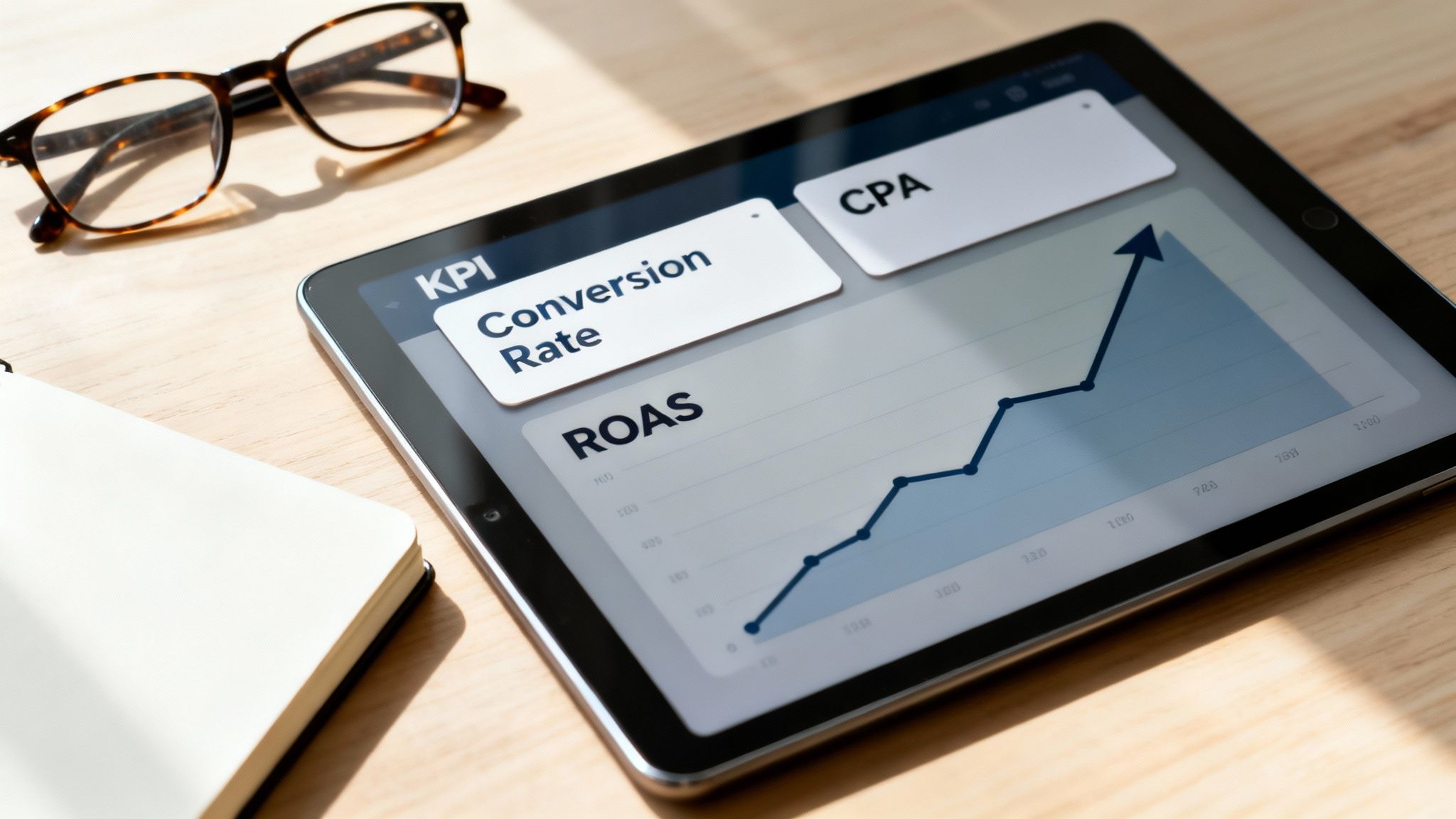
Sure, seeing a report full of clicks and impressions feels good. But those numbers don't pay the bills. When it comes to agency search engine marketing, these surface-level figures are just the start of the story. Real success isn’t about how many eyeballs saw your ad; it’s about what those people did next.
A great agency partner knows how to cut through the jargon and speak the language of business outcomes. They pivot the conversation away from vanity metrics like Click-Through Rate (CTR) and focus squarely on the Key Performance Indicators (KPIs) that actually define growth and profit. It’s all about connecting every dollar of your ad spend to a tangible result.
The aim isn't just to drive traffic. It's to attract the right traffic—the people who are genuinely ready to become your customers.
It's far too easy to get caught up in metrics that look impressive on paper but have very little substance. A mountain of clicks means nothing if none of those visitors actually convert into a lead or a sale. A skilled agency helps you zero in on the data points that directly impact your bottom line.
These are the metrics that truly matter:
These KPIs give you a clear, unfiltered view of your campaign's financial performance. They allow you to make smart, informed decisions about your budget and strategy, ensuring your investment is genuinely fuelling business growth.
The most effective SEM strategies are always built around your specific business goals. A trustworthy agency will work with you from the outset to define what success looks like, then hand-pick the KPIs that best measure progress towards those goals. This alignment ensures every part of the campaign is pulling in the same direction.
A great agency report doesn't just show you data; it tells a story about your business growth. It connects campaign performance directly to outcomes like increased sales, more qualified leads, and higher customer lifetime value.
When you're digging into the financial impact of your campaigns, understanding the nuances of ROAS vs ROI is critical for properly assessing profitability and the overall effectiveness of your agency’s work.
To help you translate any performance report, the table below shows how common SEM metrics line up with business goals.
This table clarifies how common SEM metrics directly reflect business objectives, helping you measure campaign success beyond surface-level clicks.
| SEM Metric (KPI) | What It Measures | Associated Business Goal |
|---|---|---|
| Conversion Rate | The percentage of ad clicks that result in a desired action (e.g., sale, form submission). | Generating more qualified leads or increasing online sales volume. |
| Cost Per Acquisition (CPA) | The average cost to acquire a single new customer from a campaign. | Improving marketing efficiency and maximising the profitability of each sale. |
| Return On Ad Spend (ROAS) | The amount of revenue earned for every dollar spent on advertising. | Proving a direct, positive financial return on the marketing investment. |
Ultimately, a partnership with a results-driven agency gives you something invaluable: clarity and confidence. You’ll know exactly how your investment is performing and see the undeniable link between their work and your company's growth.
Bringing an SEM agency on board isn't just another line item on the marketing budget; it's a major business decision. You're not simply hiring someone to manage your campaigns. You're entrusting a partner with your company's growth.
The right choice can unlock whole new levels of profit, but the wrong one can mean wasted cash and missed opportunities flying out the window.
The trick is to look past the slick sales pitches and big-name client logos. You need a solid way to spot a team that has the right mix of technical chops, strategic thinking, and a genuine interest in your business goals. It's all about asking the hard questions and knowing what a good answer sounds like.
A one-size-fits-all approach to SEM just doesn't cut it. Every industry has its own rhythm—unique customer behaviours, different competitive pressures, and its own language when it comes to keywords. An agency with real, hands-on experience in your sector already has a head start; they get the little details that will make or break your campaigns.
When you're talking to potential agencies, don't be afraid to dig deep into their background. Ask them to show you, not just tell you, about their work with businesses like yours.
Doing this homework early helps you weed out the agencies that talk a good game but don't have the direct experience to get you results in your specific market.
Agency search engine marketing fees aren't set in stone, so it’s critical to find a model that clicks with your budget and what you're trying to achieve. Getting your head around the common pricing structures helps you compare apples with apples when looking at proposals.
You'll generally come across three main models:
There's no single "best" model. The right one for you depends on where your business is at, how much risk you're comfortable with, and the size of your ad spend. The most important thing is transparency—the agency should be able to clearly explain their fees and show you the value you're getting for them.
A top-notch SEM agency does more than just tweak bids and keywords; they act as a strategic advisor. They should be asking you about your wider business goals, your profit margins, and what a customer is worth to you over their lifetime. Their job is to turn those business goals into a smart, data-driven marketing plan.
As you evaluate them, pay close attention to the questions they ask you. A great agency will be just as curious about your business operations as you are about their SEM tactics.
Look for a partner who communicates clearly, sets realistic expectations, and is upfront about both the wins and the losses. Regular, insightful reporting and open, honest conversations are the signs of a healthy agency relationship. For anyone wanting to see what's out there, our list of the top digital marketing agencies is a great place to start your search.
It's also vital to check their skills in specialised areas like local SEM. For so many Australian businesses, winning comes down to capturing customers right in their own neighbourhood. Recent Aussie research shows that local searches can convert at a massive 28%, and businesses with multiple locations pull in around 557% more website traffic than those with just one. An agency that nails geo-targeted campaigns can be a game-changer.
Stepping into a partnership with a search engine marketing agency is a big move. It’s totally normal to have questions swirling around about how it all works, what it costs, and what you should really expect. We get it.
Think of this section as your final checklist before you jump in. We’re tackling the big questions we hear all the time—from timelines and budgets to that classic "should we just do it ourselves?" debate. Let's get you some clarity.
This is usually the first question out of the gate, and the honest-to-goodness answer is: it depends on what you mean by "results." SEM isn’t one single thing; it’s a mix of quick-win tactics and longer-term strategies, and each has its own timeline.
The easiest way to think about it is in two distinct phases.
Phase 1: The Learning and Data-Gathering Sprint (Weeks 1-4)
When a new PPC campaign launches, it’s like a new hire on their first day—it needs a bit of time to learn the ropes. In these first few weeks, the entire focus is on soaking up crucial data.
So yes, you'll see activity straight away, but these aren't optimised results just yet. This phase is an investment in data.
Phase 2: The Optimisation and Growth Climb (Months 2-3 and Beyond)
Once there’s enough data in the bank, the real magic starts. This is where the agency’s work begins to have a meaningful impact on your bottom line.
The key is to separate initial activity from peak performance. While PPC brings immediate traffic, getting to those highly optimised, profitable results is a process. It typically takes a solid 2-3 months of constant testing and tweaking.
There’s no magic number here. A realistic budget isn't just an amount you're comfortable spending; it's a calculated investment designed to hit a specific goal within your unique market.
A few key things will influence what you need to spend:
As a rough guide, a small local business might start with $1,500 – $3,000 per month in ad spend. A business in a more competitive space or with national ambitions should probably plan to invest $5,000 – $10,000+ per month to gather enough data and really make a dent.
The temptation to keep SEM in-house is completely understandable, especially when you're watching costs. And while it’s certainly possible, it's important to weigh what you might save against the very real challenges—and the value an expert agency brings to the table.
Running SEM well is far more than a part-time job for someone. It demands a specialised skill set, continuous learning, and access to professional-grade tools.
Here’s a quick breakdown of what an agency offers that's tough to replicate without a dedicated in-house team:
Ultimately, it comes down to resources. If you have an experienced marketing pro with the time, tools, and singular focus for SEM, an in-house approach can work. For most businesses, though, partnering with an agency search engine marketing specialist delivers a higher level of expertise and a much faster path to a positive return.
A great client-agency relationship is a true partnership. It's built on much more than just performance reports; it's founded on shared goals, transparent communication, and mutual trust.
You'll know you're in a healthy partnership when you see:
When you find the right agency, they become a core driver of your business growth, giving you both clarity and confidence in where your marketing dollars are going.
Ready to see how a strategic SEM partnership can fuel your business growth? At Virtual Ad Agency, we combine expert knowledge with a data-driven approach to deliver results you can measure. Contact us today for a complimentary strategy session and let's build a plan to help you dominate the search landscape.

 previous