
So, what exactly is a cross-channel marketing campaign? Put simply, it’s a strategy where you create a single, unified customer experience across all the different places they interact with you. Instead of just using a bunch of channels, this approach makes sure every touchpoint—from a social media ad to a follow-up email—works together.
It’s about weaving one continuous conversation with your customer, not shouting a bunch of separate, disconnected messages at them.

Let’s be honest, the old-school, siloed way of doing marketing is broken. In today's crowded world, it just doesn’t cut it anymore.
When your email team, social media managers, and paid advertising specialists all operate in their own little bubbles, the customer experience becomes a mess. A customer might get a welcome email after they’ve already bought something, or see an ad for a product they literally just purchased. These disjointed interactions don't just feel clumsy; they actively erode trust.
A unified strategy flips this on its head. It allows you to meet customers with a consistent and genuinely relevant message, no matter where they are. Think of it like this: each channel is just a different chapter in the same story.
A unified strategy transforms marketing from a series of isolated announcements into a helpful, ongoing dialogue. It shows customers you understand their journey and are there to guide them at every step.
To get a handle on the key moving parts, let's break down the essential pillars of a cross-channel strategy.
| Component | Description | Key Objective |
|---|---|---|
| Audience Mapping | Identifying and understanding your customer segments across all platforms. | To create a single customer view and deliver personalised experiences. |
| Channel Mix | Selecting the right combination of channels to reach your audience effectively. | To be present where your customers are most active and engaged. |
| Message Sequencing | Planning the order and timing of messages across different touchpoints. | To guide the customer seamlessly through their journey without repetition. |
| Creative Coordination | Ensuring a consistent brand look, feel, and tone across all creative assets. | To build strong brand recognition and reinforce a single narrative. |
| Integrated Analytics | Using a centralised system to track performance across all channels. | To measure the true ROI and understand how channels work together. |
Each of these components is crucial. When they work in harmony, you create an experience that feels intuitive and valuable to the customer.
The digital advertising space is getting more crowded by the day. Total internet ad revenue recently hit AUD $16.4 billion for the calendar year, which is an 11.1% jump from the previous year. That growth is being fuelled by social, search, and programmatic advertising.
With so much competition for your customers' attention, a disjointed message simply gets lost in the noise.
Before diving deep, it's worth mastering the multi-channel marketing approach to get the fundamentals right. This ensures every channel is orchestrated perfectly from the get-go.
Ultimately, this is about building customer experiences where every piece works together. It creates a journey that feels personal and intuitive, which is what drives real loyalty and growth. For a deeper look into how this all connects, our guide on https://virtualadagency.com.au/what-is-omnichannel-marketing/ is a great place to start. A true cross-channel campaign feels less like marketing and more like a personalised service.
Great cross-channel marketing campaigns don’t kick off with flashy creative or a massive media spend. They start with something much more fundamental: a deep, practical understanding of who you’re talking to and the actual path they take to become a customer.
This isn’t about building abstract personas that just sit in a folder gathering dust. It's about mapping the messy, non-linear reality of how people interact with your brand right now.
The whole point is to move past assumptions and let your data show you those critical moments of influence. These are the touchpoints where you can genuinely make a difference, helping a potential customer move from one stage to the next. The journey is almost always more complex than we first imagine.
It might start with a spark of awareness from a Connected TV ad late at night. That could lead to a brand search the next day, which then fuels some detailed research through your SEO-optimised blog posts. Finally, a retargeting ad on social media might be the very thing that gets them over the line to make a purchase.
Before you can even think about mapping a journey, you need to know your destination. Vague goals like "increase sales" or "boost brand awareness" just won't cut it. They’re too fuzzy to steer a complex campaign. Instead, every single objective needs to be sharp, specific, and measurable.
This is where the SMART framework proves its worth, turning those broad ambitions into concrete targets:
When you set proper SMART goals, you ensure every part of your campaign—from the channels you choose to the ad copy you write—is directly tied to a meaningful business outcome.
With your objectives locked in, it's time to figure out how customers actually behave. This means pulling together different data sources to build a complete picture.
A great place to start is your existing analytics. Look for the most common conversion paths. What sequence of channels do your best customers typically follow on their way to you?
Then, you need to add some qualitative insight to the mix. Go talk to your sales and customer service teams. They’re on the front lines, hearing directly from customers about their pain points and what drives their decisions. Surveys and customer interviews can also uncover the "why" behind the data, revealing motivations and frustrations that analytics alone will never show you.
This whole process is the core of effective customer journey mapping. It helps you visualise every single interaction. You can get a much deeper understanding of this process by exploring our guide on what is customer journey mapping.
The most powerful customer journey maps aren't static diagrams; they're living documents. They should be fed by real-time data and updated as customer behaviours change and your business evolves.
This detective work is what reveals the moments that truly matter. You might discover that while social media is great for initial awareness, it’s your in-depth case studies that are convincing prospects to book a demo. An insight like that is pure gold—it tells you exactly where to put your resources for the biggest impact.
Today's customer path is rarely just digital or just physical; it's a hybrid. Recent Australian research confirms that 75% of shoppers have significantly changed their shopping habits. And while digital discovery is growing, 60% of shoppers still value in-store human connections, with 65% willing to pay more for a standout experience. This data makes a strong case for hybrid strategies that use online channels for discovery and offline experiences to close the deal. You can discover more insights from this Australian omnichannel study here.
By taking the time to map this real-world journey, you’re laying the essential groundwork for a cross-channel campaign that actually resonates, connects, and converts.
This is where your strategy hits the real world. Choosing the right channels is a delicate balance of data-driven science and creative gut-feel, all focused on one thing: mirroring how your audience actually behaves. A powerful channel mix isn't about shouting from every rooftop; it's about being in the right places at the right times, with a message that fits the moment.
Think of it like a well-run relay race. Each channel has to pass the baton to the next one flawlessly, guiding your customer along their journey without a single dropped step. This intelligent sequencing is the absolute heart of an effective cross-channel campaign.
For example, a campaign might kick off with big, bold awareness plays on platforms like YouTube or TikTok, where you can grab attention at scale with engaging video. As people become aware, they naturally start digging for more info. That's the cue for channels like Google Search and in-depth blog posts to step in, capturing their intent as they actively look for answers. Finally, for those who are clearly interested, you can use sharp email automation and precise social media retargeting to close the loop.
Channel sequencing is really just about mapping out a journey that makes perfect sense to the customer. Each touchpoint should build on the last, adding more value and detail as they get closer to making a decision. You wouldn't ask for the sale in the first five seconds, just like you wouldn't throw a dense, technical whitepaper at someone who's never even heard of your brand.
Here’s a practical look at how this flow works:
This simple but powerful three-step journey is a great way to visualise the process.
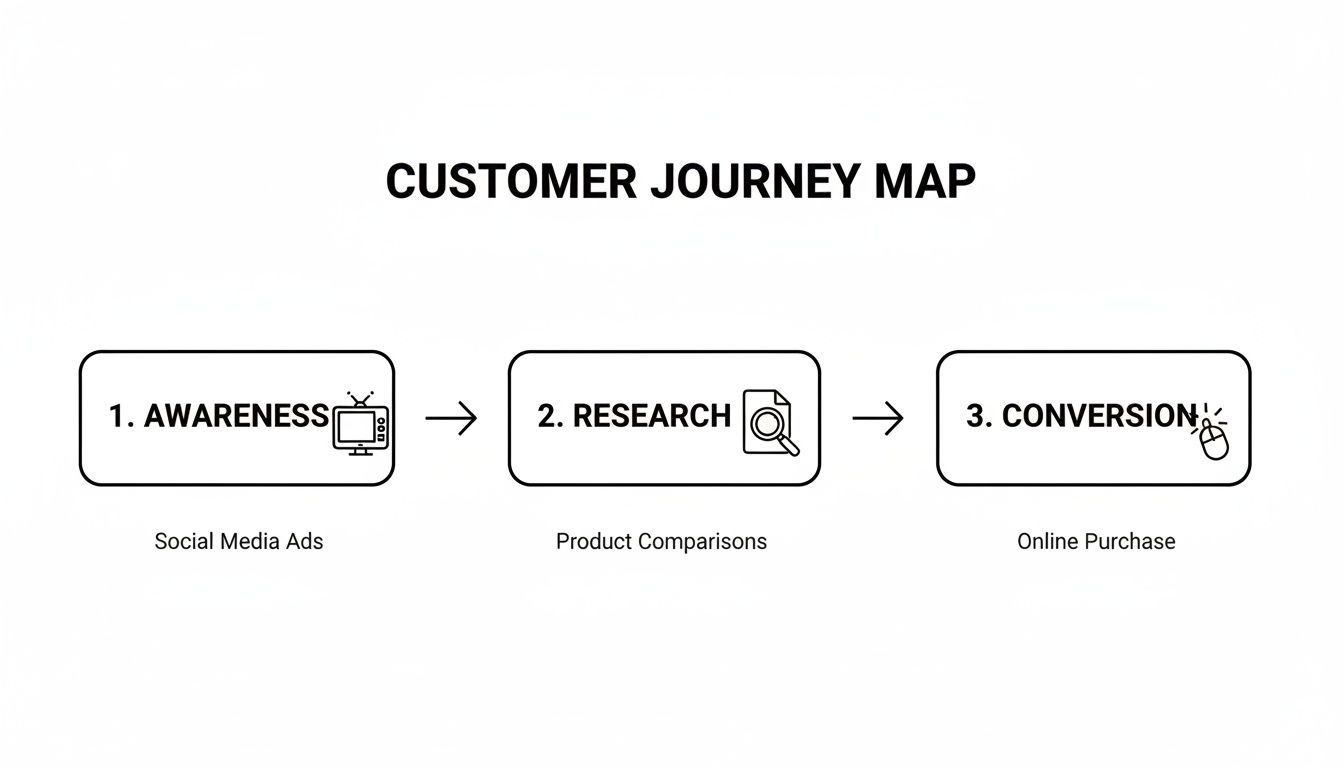
The map clearly shows how different channels are best suited to distinct phases, helping you guide the customer from that first spark of discovery to the final, satisfying click.
To help you map this out, here’s a quick-reference table showing how various channels fit into each stage of the funnel.
| Funnel Stage | Primary Objective | Example Channels | Key Metrics |
|---|---|---|---|
| Awareness (Top) | Generate brand visibility and reach. | Social Media Ads (Video), CTV, Podcasts, Display Ads | Impressions, Reach, Video Views, Brand Recall |
| Consideration (Middle) | Educate and engage interested prospects. | Google Search Ads, SEO/Blog Content, Webinars, Case Studies | Click-Through Rate (CTR), Time on Page, Downloads |
| Conversion (Bottom) | Drive action and secure sales/leads. | Retargeting Ads, Email Marketing, Landing Pages, Shopping Ads | Conversion Rate, Cost Per Acquisition (CPA), ROAS |
This table isn't exhaustive, of course, but it provides a solid framework for thinking about which tools to use for which job, ensuring your message is always relevant to where the customer is in their decision-making process.
Just as crucial as where you show up is how you show up. Creative coordination ensures that while the format might change, your brand's core identity remains solid and instantly recognisable. A customer should know it's you, whether they're watching a 15-second TikTok or reading a 2,000-word blog post.
This means having clear brand guidelines, but it also demands a bit of flexibility.
A classic mistake is just copying and pasting the same ad creative across every channel. True coordination is about tailoring the message to the unique vibe of each platform while keeping your brand voice, visuals, and core promise consistent.
One of the cornerstones of doing this efficiently is embracing some smart top content repurposing strategies. This lets you squeeze every drop of value from your best assets. For instance, a single, detailed customer case study can be spun into gold:
This approach doesn't just save you time and money; it hammers home your core message through repetition in different formats, making it stick.
Getting the operational side of this right is what separates the pros from the amateurs. For a deeper look into the nuts and bolts, our complete guide to media planning and buying lays out a practical framework for getting it done. By carefully picking your channels, sequencing your messages, and coordinating your creative, you build a powerful campaign that feels less like marketing and more like a genuinely helpful, guided conversation.
All the strategic groundwork is done. Now, it’s time to shift gears from planning to doing. This is where the rubber meets the road in cross-channel marketing, turning your big ideas into actual, real-world touchpoints that customers will see and interact with.
Success at this stage is all about tight coordination, smart budget allocation, and a laser focus on the customer experience.
Launching a campaign isn’t like flipping a switch; it’s more like conducting an orchestra. Every team—from creative and media buying to your social crew—needs to be perfectly in sync. A clunky, disjointed launch sends mixed signals, confuses customers, and kills the momentum you’ve worked so hard to build.
Think of your media plan as the financial engine powering your campaign. It's where you decide exactly how much to invest in each channel to actually hit your objectives. Modern media planning isn’t a set-and-forget exercise. It's a living, breathing process that adapts based on performance forecasts and your core strategic priorities.
Start by assigning budget based on the job each channel is meant to do. For instance, top-of-funnel channels designed to build broad awareness, like Connected TV or YouTube, will likely get a hefty initial investment. On the flip side, bottom-of-funnel channels like Google Search or retargeting ads will have budgets tied directly to conversion goals and your expected return on ad spend (ROAS).
Use your own historical data and industry benchmarks to put together some initial forecasts. You should be asking some tough questions:
Answering these questions gives you a data-informed starting line, setting realistic expectations and providing a clear baseline to measure against once you go live.
One of the fastest ways to annoy a potential customer is to hammer them with the same ad over and over again. We call this ad fatigue, or audience burnout, and it's a very real problem in any cross-channel campaign. The fix? Smart frequency capping.
Frequency capping isn’t just a technical setting to limit ad impressions. It’s about respecting your audience’s attention. The goal is to be present and helpful, not persistent to the point of being a pest.
A simple starting point is a universal cap across all platforms—say, no more than three impressions per user in a 24-hour period. But a far better approach is to set different caps depending on where the user is in the funnel.
| Funnel Stage | Audience | Frequency Goal | Rationale |
|---|---|---|---|
| Awareness | Cold Prospects | Low (e.g., 3-5/week) | Introduce the brand gently without being overwhelming. |
| Consideration | Warm Prospects | Medium (e.g., 5-8/week) | Stay top-of-mind while they're actively researching you and your competitors. |
| Conversion | Hot Prospects | High (e.g., 8-12/week) | Give them a timely nudge to get them over the line when they're ready to buy. |
This tiered approach ensures your message hits the right people with the right intensity, making your ad spend work harder while keeping your brand perception positive.
The final piece of this puzzle is orchestrating a flawless launch day. This absolutely demands crystal-clear communication and a single source of truth that all teams can rely on. A pre-launch checklist isn’t just a nice-to-have; it's essential for keeping all the moving parts aligned.
Your checklist should be ruthlessly detailed:
By meticulously planning your media, managing ad frequency, and coordinating a synchronised launch, you give your campaign the best possible chance of success right from the very first click. This kind of operational discipline is what ensures your strategic vision is executed with precision and real impact.

Let's be blunt: a brilliant strategy and flawless execution mean very little if you can't prove they worked. This is where many ambitious cross-channel campaigns start to unravel. It’s not from a lack of effort, but from a lack of clarity in measurement. If you can't measure it, you certainly can't improve it.
The whole thing can feel overwhelming. A single conversion might start with a social media ad, lead to a Google search, get nudged along by an email, and finally happen after a blog visit. So, who gets the credit? Answering this is the key to optimising your spend and proving your campaign’s worth.
Attribution is just the science of giving credit to the touchpoints that lead to a sale. Picking the right model isn’t about finding one “correct” answer. It’s about choosing the one that actually lines up with what your campaign is trying to achieve. There’s no silver bullet here.
Let's break down the usual suspects:
The goal of attribution isn't just to hand out gold stars. It’s to get a much deeper understanding of how your channels actually work together as a team. Moving beyond a simplistic first- or last-touch model is your first real step towards proper optimisation.
While these rule-based models are a good start, the pros are moving towards data-driven attribution. This uses machine learning to analyse all the different conversion paths and assigns credit based on how much each touchpoint actually contributed. It’s more complex, for sure, but it gives you a far more accurate picture of what’s really driving results.
The world of digital tracking is changing, fast. With privacy rules tightening and third-party cookies on their way out, the old ways of tracking just won't cut it anymore. This shift makes collecting and using first-party data—the information you get directly from your audience—absolutely critical.
This is the data you gather from website forms, your CRM, and customer accounts. It’s your direct line to your audience, giving you the clean, reliable signal you need to connect the dots across their journey in a way that respects their privacy. For many Australian businesses, this has become an urgent priority.
Recent marketing stats show that cross‑platform measurement difficulties (64%) and attribution modelling issues (61%) are the biggest hurdles to proving ROI. On top of that, about a third of marketers feel unprepared for the upcoming privacy reforms tied to the Australian Privacy Act. It all points to a massive need for solid, privacy-first measurement solutions. You can explore more Australian marketing trends and statistics to get a better sense of the challenges.
To get ahead of this, businesses are turning to unified analytics platforms and Customer Data Platforms (CDPs). These tools are built to pull all your first-party data from different sources into one place, creating a single, coherent view of each customer. This unified profile is the key to delivering personalised experiences and getting accurate cross-channel measurement in a post-cookie world.
Once you've got your data flowing and a clear attribution model, the real work begins: optimisation. This isn't a "set and forget" task; it's a constant cycle of analysing, testing, and tweaking your campaign on the fly.
Your optimisation playbook should really boil down to three core activities:
By embracing this cycle of measure, analyse, and adapt, you turn your campaign from a static plan into a dynamic, learning system. This constant improvement is what separates the good cross-channel campaigns from the truly great ones, ensuring you’re not just spending your budget, but strategically investing it for the best possible return.
Jumping into the world of cross-channel marketing can feel a bit like learning a new language. There are new terms, complex ideas, and a lot of moving parts. It’s natural to have questions, but getting clear on the fundamentals is the first step to building a strategy that actually delivers.
Let’s clear up some of the most common questions I hear from marketers. Getting this right is crucial for securing the buy-in and budget you need to make things happen.
This is easily the most common point of confusion, and the answer comes down to one simple word: integration.
Multichannel marketing just means you’re active on several different platforms. They exist, but they operate in their own little worlds. You might be running a social media campaign over here and sending out an email blast over there, but the two never speak to each other. It's a siloed approach.
Cross-channel marketing, on the other hand, is all about connecting those platforms to create one fluid, seamless customer journey. The channels are designed to work together, sharing data and context to build a single, unified brand experience.
Think of it like this: Multichannel is like having separate conversations in different rooms. Cross-channel is one continuous conversation that follows the customer from room to room, picking up right where it left off each time.
For example, a customer might see an ad for a pair of runners on their Instagram feed, click through to your website to browse, but then get distracted. A day later, an email lands in their inbox with a gentle reminder about the exact pair of runners they were looking at. That’s one connected experience, not just a bunch of isolated touchpoints.
There’s no magic eight-ball for this one. Your channel mix should always come back to two things: your audience and your goals.
First up, you have to get a real, data-backed understanding of where your target customers actually hang out online. Don’t just assume they’re on TikTok because everyone else is. Dig into your own website analytics, send out a few customer surveys, or look at market research to paint a clear picture of their digital habits.
Once you know where they are, you need to match the channels to your campaign objectives. Every platform has its own strengths, and you need to play to them.
The whole point is to build a strategic mix where every single channel has a specific job to do within the customer's journey.
Even with the best strategy in the world, you'll run into a few hurdles. In my experience, the two biggest headaches that consistently crop up are data integration and accurate attribution.
Stitching together customer data from different, often disconnected, channels is a serious technical challenge. But it's the absolute foundation of a great cross-channel experience. Without that unified view of the customer, you can't create the seamless, personalised journey that makes this strategy so powerful. You're basically just guessing.
The other major challenge is figuring out which touchpoint actually gets the credit for a sale. Was it the first blog post they read six months ago? The YouTube ad they watched last week? Or the final retargeting ad they saw yesterday? Cracking the attribution code requires sophisticated analytics tools, a clear attribution model that makes sense for your business, and a relentless focus on first-party data to connect the dots.
At Virtual Ad Agency, we specialise in untangling these complexities to build powerful, full-funnel strategies. If you're ready to create a truly connected customer experience, explore how our team can help you.

 previous