
In the SEO world, you’ll often hear people toss around the term "DA backlink". It’s industry shorthand, really, for a link that points to your website from another site with a high Domain Authority (DA) score.
The simplest way to think about it is like this: a backlink is a referral, and Domain Authority is the professional reputation of the person giving you that referral. A link from a high-DA site isn't just a link; it's a powerful endorsement from a respected leader in your field.

When an SEO pro talks about a "DA backlink," they're mashing two separate but deeply connected ideas together. It's important to realise this isn't some official term Google uses. It's just a practical way for marketers to quickly gauge a link's potential clout.
Let's pull apart the two components to see how they really work together to shape your site's performance.
First up, you have the backlink itself. A backlink—sometimes called an inbound link—is just a hyperlink pointing from one website to another. For search engines like Google, these links are one of the most crucial signals they use to figure out how credible a site is. Every link acts as a "vote of confidence," telling search engines that another website thinks your content is valuable enough to send their own audience to check it out.
The second piece of the puzzle is Domain Authority (DA). This is a metric created by the SEO software company Moz. It's designed to predict how well a website is likely to rank on search engine results pages (SERPs), scored on a scale from 1 to 100. A higher score suggests a greater ability to rank. DA is calculated by analysing a site’s entire backlink profile—everything from the total number of links to the number of unique websites linking to it.
When you combine these two ideas, a "DA backlink" is simply a link that comes from a domain with a strong, established authority score. This distinction is absolutely vital because not all backlinks are created equal.
A link from a brand-new blog with a DA of 5 carries far less weight than one from a major industry publication with a DA of 75. That stronger link passes more "link equity" (or "link juice," as it's often called) to your site, giving your own perceived authority a significant boost.
This is exactly why any solid SEO strategy isn't just about getting more backlinks. It's about earning high-quality backlinks from authoritative sources. These are the digital handshakes that truly help you climb the search rankings.
Knowing how to earn these powerful links is a massive step on the path to the top page of search results, because it directly shapes how Google sees your website's trustworthiness and relevance within your niche.
Let's cut right to it. Domain Authority (DA) is basically a credit score for your website. It’s a metric cooked up by the team at Moz to predict how well a site is likely to rank on search engine results pages. The score runs on a scale from 1 to 100—the higher the score, the stronger its ranking potential.
Think of it like this: if your website were applying for a loan, its DA score is what the bank would look at to gauge its trustworthiness. A high score doesn't guarantee you get the loan (or the top ranking spot), but it sure makes you look like a much better bet.
This score isn't just pulled out of thin air. It’s calculated by looking at a bunch of signals, mainly related to a site's backlink profile. We're talking about the total number of links, and more importantly, the number of unique, quality domains linking back to you.
At its heart, Domain Authority is all about the company your website keeps online. A site with just a handful of powerful backlinks from highly respected domains will almost always have a stronger DA than a site with thousands of links from brand-new, unknown blogs. Quality, not quantity, is the name of the game here.
This is exactly why focusing only on the number of backlinks is a busted strategy. The internet is littered with broken and worthless links. In fact, research shows that a massive 66.5% of links pointing to websites from the last nine years are now completely dead. It’s a stark reminder of the risk you take chasing low-grade links that just vanish over time. You can discover more about building quality backlink strategies that last right here.
A healthy backlink profile, the kind that actually boosts your DA, is built on three key pillars:
One of the most misunderstood bits about Domain Authority is its logarithmic scale. In simple terms, this just means it gets exponentially harder to improve your score the higher you climb.
The effort needed to grow your DA is not a straight line. Moving from a DA of 20 to 30 is a totally manageable task for a new website. But jumping from a DA of 70 to 80? That requires a monumental effort, demanding links from some of the most authoritative sites on the entire web.
This is a crucial concept to get your head around because it sets realistic expectations. Don't get discouraged if your progress seems to slow down as your score gets better—it's a completely normal part of the process.
This might be the most important thing you need to know about Domain Authority: it is not a Google ranking factor. Google runs on its own incredibly complex algorithms and doesn't use Moz's DA metric to figure out search rankings. Full stop.
So, what's it actually good for? DA is a comparative metric. Its real power is in benchmarking your website's authority against your direct competitors. If your top three rivals have DA scores of 45, 48, and 52, your goal should be to build a link profile that gets you into that same league.
Chasing a specific DA number as a standalone goal is pointless. Instead, think of it as a compass. Use it to guide your link-building efforts, helping you see where you stand in your market and what it’s going to take to start competing for those top spots.
Alright, let's move beyond the theory. We've talked about what Domain Authority and backlinks are, but now it's time to connect the dots to what really matters: getting actual results for your business. We're talking higher rankings, more traffic, and a brand that people recognise and trust. Earning a backlink from a high DA website isn't just a tick-box exercise; it’s a seriously powerful move.
Search engines like Google see these high-authority backlinks as massive votes of confidence. Think of each link from a respected source as a strong recommendation, telling the algorithms that your content is credible, trustworthy, and genuinely useful. This kind of digital endorsement is one of the biggest factors that will determine whether you can rank for those valuable, competitive keywords.
A strong backlink profile doesn't just give you a little nudge; it fundamentally changes how search engines see your entire website. When other authoritative sites in your space consistently point to your content, it builds a powerful case that you're a leader in your field. This perceived authority has a direct, measurable impact on how you perform in search results.
In the cut-throat world of digital marketing, backlinks are the foundation of SEO success. In fact, detailed analysis shows top-ranking pages have, on average, 3.8 times more backlinks than the pages sitting in positions 2 through 10. That paints a pretty clear picture of the link between a solid backlink profile and getting seen at the top. You can dive into more link building stats and insights here.
The ripple effect of landing a high DA backlink goes way beyond just boosting one page. It creates a 'halo effect' that lifts your whole domain.
While climbing the search results is obviously a huge win, the value of high DA backlinks doesn't stop there. These links bring some fantastic secondary benefits that contribute directly to your business's bottom line.
One of the most immediate perks is high-quality referral traffic. A link from a popular, relevant website doesn’t just pass on authority; it sends engaged people directly to your page. These aren't just random clicks; they're warm leads from an audience that already trusts the recommendation of the site they came from.
A high DA backlink is both a reputation booster and a direct referral channel. It strengthens your long-term SEO while delivering immediate, relevant traffic that's ready to convert.
This one-two punch is what makes chasing high DA backlinks one of the smartest strategies for sustainable online growth.
At the end of the day, every high-quality backlink you earn is another brick in the foundation of your brand's digital authority. This isn't about tricking algorithms; it's about building a genuine reputation as a credible voice in your industry. This authority becomes a competitive advantage, making it much harder for newcomers to challenge your spot.
Here’s what that brand authority looks like in practice:
When you see just how far-reaching the impact is, the idea of a 'DA backlink' becomes much clearer. It's not just a number to chase; it's a strategic tool for building a powerful, resilient, and highly visible presence online.
A high Domain Authority score is a fantastic starting point, but it's just that—a start. Relying solely on DA to judge a backlink is like judging a car purely on its top speed; it ignores crucial factors like handling, safety, and fuel efficiency. To build a powerful and resilient backlink profile, you need to become a discerning evaluator.
Thinking beyond this single metric protects you from acquiring links that look good on paper but offer little real-world value—or worse, could harm your SEO. A truly valuable backlink isn't just about the linking site's authority; it's about relevance, context, and trust signals that search engines value deeply.
The first step is to treat DA as a guide, not a rule. While a site with a DA of 70 is generally more authoritative than one with a DA of 20, you must dig deeper. A link from a highly relevant site with a moderate DA can often be far more powerful than a link from a high-DA site that has nothing to do with your industry.
To really gauge a backlink's impact, you need to master the art of checking backlink quality with a more holistic approach. This means looking at a collection of signals that, together, paint a complete picture of a link's worth.
This decision tree shows the simple yet powerful impact of securing high DA backlinks for your website.
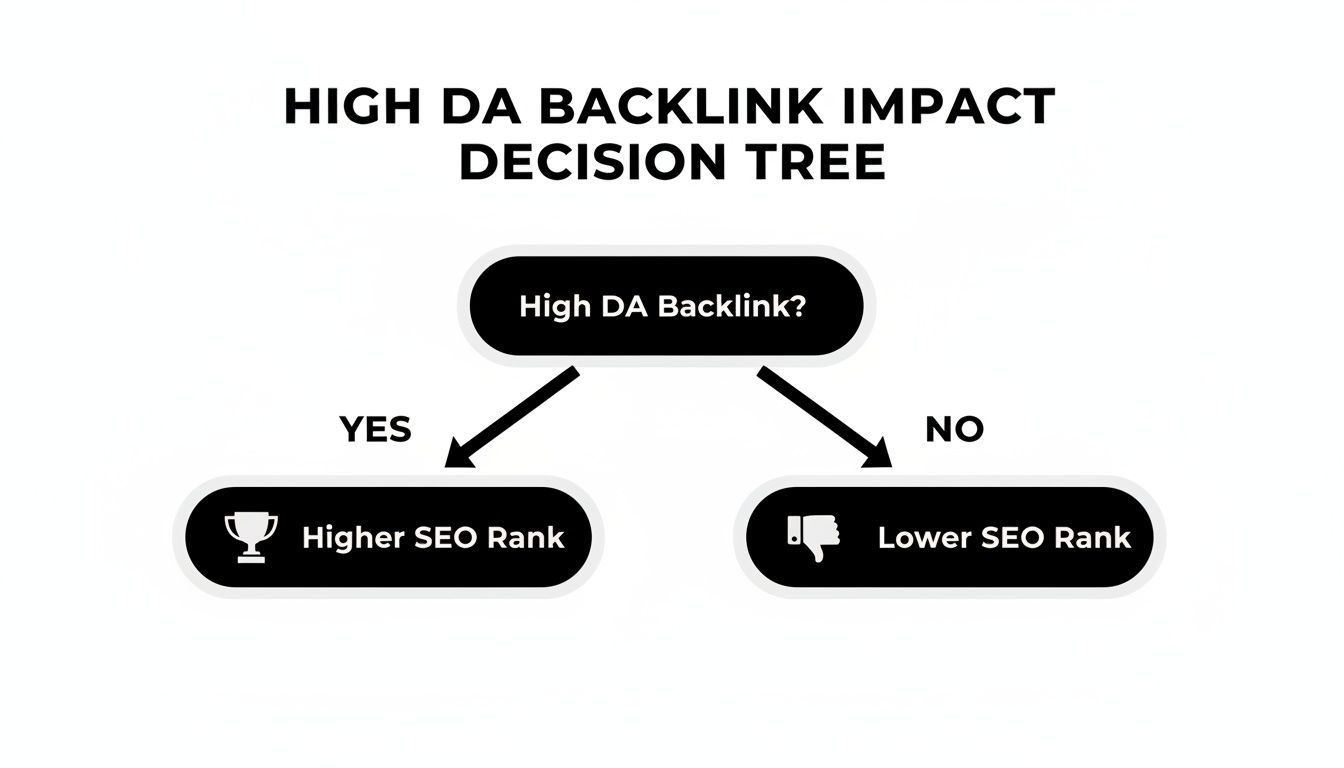
As you can see, the path you take in link building has a direct and binary outcome on your SEO performance.
When a potential backlink opportunity comes your way, don't just glance at the DA. Run it through a proper checklist to assess its true potential and sidestep common traps. This quick table will help you separate the gold from the fool's gold.
| Evaluation Criteria | What to Look For (Good Signal) | What to Avoid (Red Flag) |
|---|---|---|
| Topical Relevance | The linking site is in the same or a closely related niche. Content is a natural fit. | The site's topic is completely unrelated to yours (e.g., a pet blog linking to a finance site). |
| Website Authority & Trust | Healthy traffic metrics, low Spam Score (ideally under 30%), and a good Domain Rating (DR) score from Ahrefs. | High Spam Score, sudden drops in traffic, or a history of penalties. |
| Contextual Link Placement | Link is placed naturally within the main body content, surrounded by relevant text. | Link is buried in a footer, sidebar, or a long, unrelated list of other links. |
| Link Type | "Dofollow" link that passes authority. | "Nofollow," "sponsored," or "UGC" tags that signal to Google not to pass link equity. |
| Website Quality | Professionally designed, updated regularly, easy to navigate, and free of excessive ads or pop-ups. | Outdated design, broken links, thin or low-quality content, and intrusive advertising. |
By using a more detailed checklist like this, you ensure that every link you build adds genuine, lasting value to your website's authority.
Topical Relevance Is King: How closely related is the linking site's content to yours? A link from a respected Adelaide marketing blog to your digital agency is a perfect match. A link from a pet grooming website is not, no matter its DA. Relevance sends a strong signal to Google about your niche.
Website Authority and Trust: Don't stop at Moz's DA. Use other tools to get a second opinion. Ahrefs' Domain Rating (DR) is another industry-standard metric. Also, check the site's Spam Score in Moz—a low score (under 30%) is a good sign.
Contextual Link Placement: Where the link appears on the page is massively important. A link placed naturally within the main body of an article, surrounded by relevant text, carries immense weight. In contrast, links hidden in a website's footer or a long, unrelated list of links are often ignored or devalued by search engines.
A link should feel like a natural, editorial endorsement. If it looks forced or out of place, search engines will likely see it the same way. This is the difference between a genuine recommendation and a paid advertisement.
By performing this level of due diligence, you can start to conduct competitor analysis on a much deeper level. You'll understand not just where your rivals get links, but the quality of those links. This insight allows you to build a smarter, more effective link-building strategy that focuses on earning links that search engines will reward for years to come.
Knowing you need high DA backlinks is the easy part. Actually getting them? That's another story altogether. The good news is you don't need to wade into murky, high-risk tactics to make it happen. Real, lasting authority is built the old-fashioned way: by creating genuine value.
These methods aren't quick fixes. Think of them as foundational pillars for building a backlink profile that search engines genuinely trust and want to reward. The game isn't about chasing numbers; it's about becoming the kind of resource that authoritative sites want to link to.
Digital PR is all about creating content so interesting, unique, or packed with data that journalists and industry publications can't ignore it. You're not just reporting the news; you're making it. This immediately positions you as an original source, which is a powerful magnet for high-authority links.
Think about creating assets like:
The trick is to say something that hasn't been said a thousand times before. One solid digital PR campaign can land you links from major news sites and top-tier industry blogs with DA scores of 70, 80, or even higher.
Another killer approach is to create the absolute best resource on a specific topic within your field. I’m talking about something so thorough and helpful that it becomes the default reference point for everyone else.
When you build a definitive guide, a free calculator, or a super-detailed tutorial, you're creating an asset that earns links passively for years to come. It’s human nature—people link to things that make their own content better or their audience's lives easier.
Consider developing things like:
This strategy takes a serious upfront investment in content, but the long-term payoff in organic, high-authority links is massive.
The most effective link-building strategies are rooted in generosity. By creating immense value for others without asking for anything in return, you naturally attract the kind of authoritative endorsements that money can't buy.
This isn’t just about links. It’s about building real brand equity and a loyal following. You become a pillar of the community, not just another website trying to sell something.
Guest posting is a classic for a reason, but its effectiveness today is all about the approach. The old spray-and-pray method of blasting generic articles to any blog that will take them is long dead. To make it work now, you need to focus on quality, relevance, and adding undeniable value.
Your goal isn't just a link from any site, but from the right sites—respected, relevant publications where your target audience already hangs out. For those looking to get a jump start on improving their site's standing, services like an Authority Builder Package offer a structured way to tackle this.
Your process needs to be laser-focused:
When you focus on making a genuine contribution, the backlink becomes a natural side effect of the value you've provided. It’s these powerful, contextually relevant links that drive both authority and real, interested traffic.
Chasing high-quality backlinks isn’t just another task on the SEO checklist; it’s a serious business investment. To really justify the time and money you pour into it, you have to connect those link-building efforts to results you can actually see on your bottom line.
This means looking past the simple tally of new links. Instead, the focus needs to be on the metrics that prove real growth and a tangible return on investment (ROI). It all starts with tracking the right KPIs. Without them, you’re just flying blind, hoping for the best but unable to actually prove the value of your work.
To get the full story, you need to watch a mix of different indicators. Some will show you early signs of progress, while others will confirm that you're achieving long-term success.
Growth in Referring Domains: This one is a big deal. Tracking the number of unique, quality websites linking to yours is a clear sign that your authority is growing across the web. The goal here is steady, consistent growth from domains that are actually relevant to your business.
Keyword Ranking Improvements: Keep a close eye on the search engine rankings for the specific pages you’re building links to. Seeing these pages climb the ladder for their target keywords is direct proof that what you’re doing is working.
Increase in Organic Traffic: At the end of the day, better rankings are all about driving more of the right people to your website. A sustained lift in visitors coming from search engines is a powerful sign that your link-building campaign is a winner.
Tying these SEO wins to business outcomes is the final step. An increase in organic traffic that also leads to a higher number of conversions, leads, or sales is the clearest possible demonstration of positive ROI.
The true muscle of a solid backlink strategy shows up when you link your SEO metrics back to your core business goals. Think of link building as an investment where 78.1% of SEO experts report being happy with their results, even as the cost for quality links goes up. That satisfaction comes from seeing how the hard work in SEO translates directly into real business growth.
To really nail down your return, think about these connections:
By focusing on these connections, you prove that smart link building isn't just an expense—it's a profit-making engine for your business. To really get this right, you need to understand the full range of digital marketing performance metrics and how they all work together to build a winning full-funnel strategy.
Even after getting your head around how DA backlinks work, a few questions always seem to pop up. Let's tackle them head-on so you can move forward with your link building, minus the guesswork.
This is probably the number one question we get, and the answer is always the same: there's no magic number. Instead of getting fixated on hitting a certain quota, the real goal is to build a backlink profile that's stronger and more relevant than the pages you're trying to outrank.
Think of it less like a sprint to a random number and more like a marathon of steady improvement. A great starting point is to analyse the link profiles of your top competitors. Your mission, should you choose to accept it, is to earn links from similar, or even better, sources over time.
Look, it's technically possible to pay for links, but it's a massive shortcut that goes directly against Google's webmaster guidelines. Taking this route is incredibly risky. These purchased links almost always come from dodgy, irrelevant sites (like Private Blog Networks, or PBNs) and can land you in some serious hot water with Google, potentially wiping out your rankings completely.
Good, sustainable SEO is about earning links because you've created something of value, not buying them off a shelf. An authentic backlink profile, built on genuine merit, will always win out in the long run. Shortcuts rarely lead to lasting success.
Link building isn't an overnight fix; it's a long-term investment in your website's authority. While you might see a few positive flickers within the first one to three months, it generally takes a solid six to twelve months of consistent, high-quality effort before you see a real, lasting impact on your search rankings and organic traffic.
Patience is key here. Every quality link you earn is another brick in the foundation of your site's digital presence. And as with any solid structure, building a strong foundation takes time and care.
At Virtual Ad Agency, we don't just build links; we integrate strategic link-building into comprehensive, full-funnel marketing campaigns that deliver real, measurable results. Our focus is on earning high-quality, relevant backlinks that build lasting authority and drive genuine business growth. Find out how we can elevate your digital strategy at https://www.virtualadagency.com.au.

 previous