
A click-through rate calculator is really just a simple way to get to a crucial marketing number. It shows you the percentage of people who actually clicked your link after seeing it. The formula itself is straightforward: you divide the total clicks by the total impressions, then multiply that by 100. This single metric is the quickest pulse check you can get to see if your ads, emails, or search listings are genuinely connecting with your audience.
Click-Through Rate (CTR) is so much more than a number on a dashboard. Think of it as a direct signal of how well your message is landing. It's the bridge between getting eyeballs on your content (impressions) and actually prompting someone to take action (clicks).
In plain English, it answers the question: "Of all the people who saw my ad, what percentage found it interesting enough to click?"
Before you can really get a handle on your CTR, it’s essential to be solid on the basics of understanding impressions and clicks. Without that foundation, the CTR percentage is just a number without the context you need to make smart moves.
A healthy CTR is a powerful lever for your marketing success. It directly influences key outcomes, like how much you pay for ads on platforms like Google and Facebook. These platforms reward relevance, and a high CTR is one of the strongest indicators that your content is hitting the mark with the people seeing it.
Viewing CTR as a diagnostic tool is where it becomes really powerful. It helps you pinpoint exactly what’s going wrong in your campaigns. If you're seeing a consistently low CTR, that’s a massive red flag that something is off and needs your attention—fast.
Think about these common scenarios:
By mastering this foundational metric, you gain a clearer view of your campaign's health. It provides the insights needed to make smarter, more profitable decisions instead of just guessing what needs to be fixed.
What counts as a "good" CTR is definitely not a one-size-fits-all thing; it varies wildly depending on the industry you're in. Here in Australia, the benchmarks show just how different user engagement can be.
For instance, consumer services might see an average CTR of 2.41%, while the travel and hospitality sector often pulls in a much higher 4.68%. This data really drives home how important context is when you're sizing up your own performance. Comparing your results to relevant industry standards is the only way to know if you're truly on the right track.
Right, let's get down to the brass tacks of calculating your Click-Through Rate. It’s one thing to talk about CTR as a concept, but it's another to roll up your sleeves and work out the numbers. The formula itself is dead simple, but knowing where to find the right data and how to apply it is where a lot of marketers get tripped up.
Getting this right is your first real step to turning a spreadsheet full of numbers into smart, effective campaign decisions.
The one formula you’ll always come back to is:
(Total Clicks ÷ Total Impressions) x 100 = CTR %
This little equation turns two raw data points into a powerful percentage that gives you a quick snapshot of how well your ads are resonating. While most ad platforms do the maths for you, understanding the mechanics means you can double-check the data, calculate CTR for offline campaigns, or even just work it out on the back of a napkin if you need to.
The key is knowing exactly where to look for your clicks and impressions. These are your two essential ingredients, and they live in slightly different places depending on the platform.
It’s also really important to understand what counts as an impression. Clicks are pretty straightforward—someone clicked. But how an impression is defined can get a bit murky and is critical for an accurate CTR. If you want to dig deeper into that side of things, you can learn more about the cost per impression formula and how it all connects to your ad spend.
Let's run through a couple of common scenarios you might encounter here in Australia. Putting the formula into a real-world context helps it all click into place.
To make this crystal clear, here are a few worked examples showing how the formula plays out across different channels.
| Campaign Scenario | Total Impressions | Total Clicks | CTR Calculation | Resulting CTR |
|---|---|---|---|---|
| Google Search Ad (Plumber) | 5,000 | 250 | (250 ÷ 5,000) x 100 | 5% |
| Facebook Video Ad (Fashion) | 40,000 | 320 | (320 ÷ 40,000) x 100 | 0.8% |
| Email Newsletter (Retailer) | 10,000 | 450 | (450 ÷ 10,000) x 100 | 4.5% |
| LinkedIn Sponsored Post (B2B) | 15,000 | 75 | (75 ÷ 15,000) x 100 | 0.5% |
As you can see, the "right" CTR depends entirely on the context of the campaign.
Let's look at those first two examples a bit closer.
Scenario 1: A Brisbane Plumbing Service
Imagine a plumber is running a Google Search Ad campaign, targeting the keyword "emergency plumbers Brisbane". After a week, their Google Ads dashboard shows:
Using the formula: (250 Clicks ÷ 5,000 Impressions) x 100 = 5% CTR
For a search campaign, a 5% CTR is a fantastic result. It’s a strong signal that the ad copy and keywords are perfectly aligned with what people are actively searching for.
Scenario 2: A Melbourne Fashion Brand
Now, picture a fashion label promoting its new winter collection with a video ad on Facebook. Over the first weekend, the ad gets:
The calculation is: (320 Clicks ÷ 40,000 Impressions) x 100 = 0.8% CTR
While this 0.8% looks tiny compared to the plumber's search ad, it might be a perfectly fine result for a broad awareness campaign on social media. People on Facebook aren't actively looking to buy; they're scrolling. Context is everything.
These examples really drive home the point that while the calculation itself never changes, how you interpret the result depends heavily on the channel, your industry, and what you were trying to achieve in the first place.
So, you’ve got your click-through rate. What now? A number on its own is just data, but when you stack it up against the right benchmarks, that’s when it becomes a powerful insight.
The real trick is knowing what "good" looks like for your specific channel. A fantastic CTR in one area can be a flashing red light in another, which is why having some Aussie-specific context is so vital for setting goals that actually make sense.
One of the most common traps marketers fall into is chasing some mythical, universal "good" CTR. It just doesn't exist. A 1% CTR might be a massive win for a B2B display ad targeting a tiny niche of professionals. But if you saw that same 1% from an email campaign sent to your most loyal customers? That'd be a genuine cause for concern.
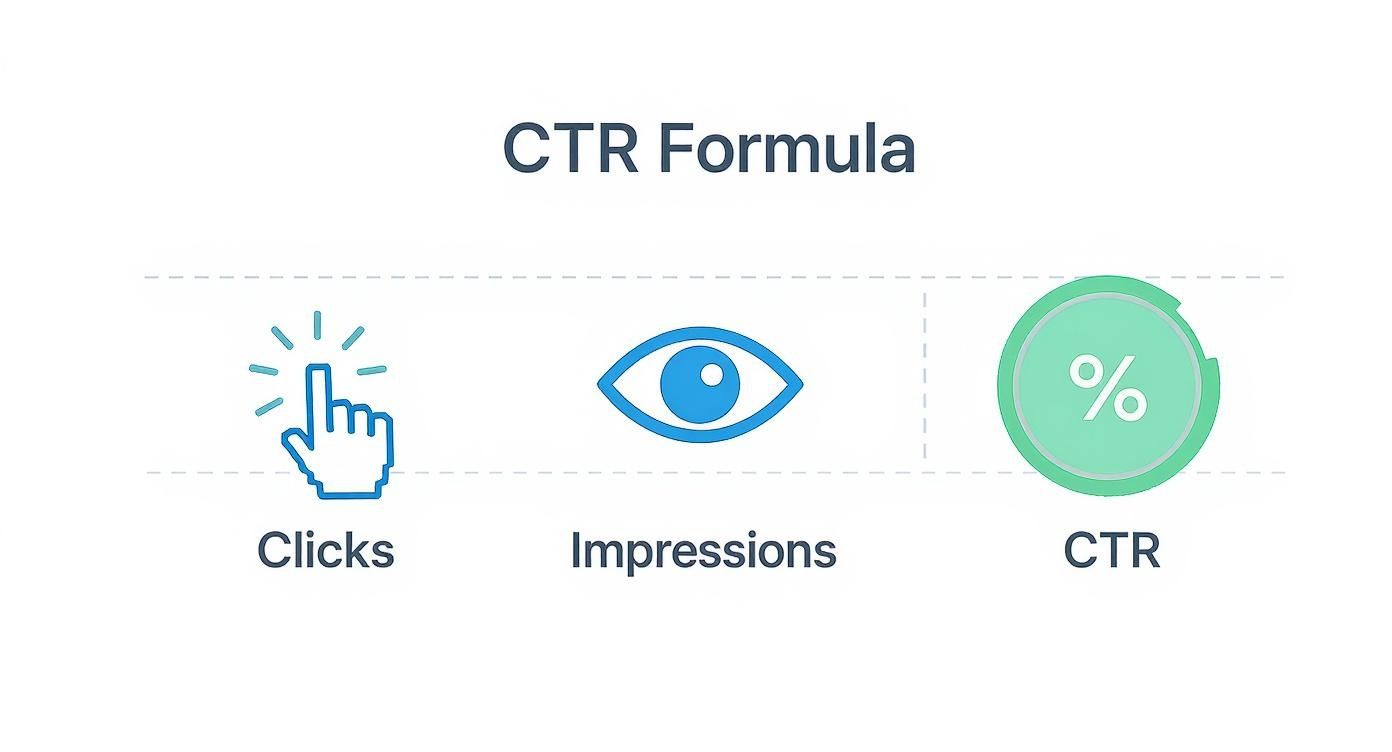
This simple relationship between visibility (impressions) and engagement (clicks) is the foundation of performance, but the story gets much more interesting when we add context.
When it comes to Google Search Ads in Australia, user intent is everything. Someone actively typing "24-hour electrician Sydney" into Google is hunting for a solution, so you’d rightly expect a pretty high CTR from your ad.
For search campaigns, anything above 3% is generally considered solid performance. If you're really dialled in, you'll often see top campaigns pushing past the 5-6% mark.
Display advertising is a completely different ball game. These ads pop up while people are browsing other websites, not when they're actively searching for you. Because of this passive viewing, the average display CTR is way lower, usually hovering around the 0.35% to 0.50% range. In the world of display, hitting anything close to 1% is a seriously strong result.
The takeaway here is simple: context is king. A plumber's search ad will always have a higher CTR than a fashion brand's display banner. Always, always compare your results to the right channel benchmark.
Email marketing continues to be an absolute powerhouse for Aussie businesses. In fact, our local performance often blows global averages out of the water.
Recent data shows the average email click rate in Australia hit 2.82%, which is comfortably ahead of the global average of around 2.00%. This just goes to show the massive opportunity sitting in your subscriber list.
Social media platforms, of course, have their own unique quirks. Your CTR here will swing wildly depending on the ad format, your creative, and just how well you've targeted your audience.
By using these local benchmarks, you can move beyond just plugging numbers into a click-through rate calculator. You can start setting informed targets, spotting underperforming channels, and putting your marketing budget where it will deliver the biggest punch.

Knowing your numbers is one thing; improving them is where the real work begins. Boosting your click-through rate isn't about guesswork. It’s about making specific, targeted changes based on what your audience actually wants.
Instead of vague advice, let's focus on field-tested tactics for the channels you use every day. Small adjustments can lead to significant jumps in engagement, turning passive viewers into active clickers.
For paid search campaigns on platforms like Google Ads, your success lives and dies by your ad copy. The goal is to perfectly match the searcher's intent—the specific problem they are trying to solve right now.
For more specific advice on boosting your ad performance, you can dig into some proven strategies to improve Google Ads CTR. These small tweaks give Google more reasons to show your ad and users more reasons to click it.
In email marketing, the first hurdle is the subject line. If it doesn't grab attention, nothing else matters. Your subject line's only job is to sell the open.
Once they're in, your content must be hyper-relevant. This is where segmentation becomes your secret weapon. Don't send the same generic newsletter to everyone.
By dividing your audience based on past purchases, location, or engagement level, you can send targeted messages that resonate deeply. A customer who bought hiking boots doesn't need an email about high heels; they need one about waterproof jackets.
This level of personalisation directly translates to higher click rates because the content feels like it was made just for them.
On platforms like Facebook and Instagram, you're competing for attention against friends, family, and funny videos. Your creative has to stop the scroll.
The data from social media advertising in Australia shows just how powerful the right format can be. Shopping-related Facebook ads, for instance, saw CTRs jump by a massive 146% year-over-year to hit 4.13%, largely thanks to engaging formats like carousel ads that showcase multiple products.
To find what works for your brand, you must test relentlessly.
The data from these tests provides a clear roadmap. It moves you from making assumptions about what your audience likes to knowing exactly what drives them to click. Each strategy, from search to social, is about closing the gap between your message and your audience's needs.
Getting a high click-through rate feels great. It's a clear sign your ad copy, headlines, and creative are doing their job and grabbing attention. But here’s the thing: getting the click is only the first step in a much longer customer journey.
Chasing a high CTR without looking at what happens after the click is a classic marketing mistake. You end up with a "leaky bucket"—pouring your budget into attracting clicks that never actually turn into paying customers or solid leads.
Believe it or not, a sky-high CTR can sometimes signal a problem. This often happens when ad copy is way too broad, makes an unbelievable promise, or is just plain clickbait. You might get thousands of clicks, but if those users hit your landing page and bounce immediately, you've gained nothing.
This kind of traffic is what we call low-intent. It just drives up your ad spend without helping your bottom line, all while skewing your data and making it harder to see what's truly working.
A high CTR paired with a low conversion rate is a massive warning sign. It almost always points to a disconnect between what your ad promises and what your landing page delivers, meaning you're attracting an audience that isn't qualified to buy.
This is exactly why you have to look beyond that initial click and analyse the entire marketing funnel. A successful campaign isn't just about getting clicks; it's about getting the right clicks from people who are genuinely interested in what you have to offer.
To get the full picture of your campaign’s health, you need to look at your CTR alongside deeper funnel metrics. These are the numbers that reveal the true quality of the traffic your ads are bringing in.
Here are the key metrics to watch alongside your CTR:
By looking at CTR as part of this bigger picture, you can build a much more robust and profitable marketing strategy. To dig deeper, check out our complete guide to the most important digital marketing performance metrics you should be tracking. This holistic view ensures your efforts to grab attention at the top of the funnel translate into real, tangible growth for your business.
We've covered a lot of ground, but it's natural to have a few questions rattling around. When you start digging into the numbers with a click through rate calculator, a few common queries always seem to pop up. Let's tackle them.
This is the million-dollar question, and the honest answer is: it depends. There's no single magic number because a "good" CTR varies massively depending on where you're advertising and who you're trying to reach.
Still, you need a starting point. Here are some solid benchmarks we see for our Australian clients:
The trick is to stop chasing a universal figure and start comparing your performance to relevant industry benchmarks. That’s how you turn raw data into something you can actually act on.
Oh, absolutely. It happens more often than you'd think. A high CTR can easily become a misleading vanity metric if you're not careful.
Imagine your ad copy is a bit too broad, or it makes a bold promise that your landing page can't quite deliver on. You'll get heaps of clicks, sure, but they'll be from the wrong people. This is the classic scenario of a fantastic CTR paired with a terrible conversion rate. It’s a surefire way to burn through your ad spend and fill your analytics with junk traffic.
You have to look at CTR alongside what happens after the click. Check your bounce rate, time on page, and most importantly, your conversion rate. That's what gives you the full picture of your campaign's health, not just its initial appeal.
Your rhythm for checking CTR really depends on the pace of the campaign.
For fast-moving, active campaigns like Google Ads or Facebook Ads, you should be checking your metrics daily or at least every few days. This lets you spot trends or problems early enough to make meaningful changes without wasting your budget.
But for channels with a much slower feedback loop, like SEO or a monthly email newsletter, checking in weekly or monthly is perfectly fine. The goal is to monitor performance regularly enough to take action, but not so often that you get bogged down in daily statistical noise. Using a click through rate calculator or your platform's built-in dashboard can make this a quick, repeatable part of your routine.
Ready to move beyond just calculating metrics and start building a high-performance marketing funnel? The team at Virtual Ad Agency specialises in turning data into real business growth. Find out how we can help optimise your entire customer journey by visiting us at https://www.virtualadagency.com.au.

 previous