
Social media and content creation. They’re the twin engines that power modern marketing, aren’t they? It’s the whole shebang: planning, making, and sharing content—your videos, images, blogs—across your social channels to connect with the right people and hit your business goals. When you get it right, your social media stops being a simple broadcast channel and starts becoming a serious asset for growth.
Welcome. This isn't just another list of generic tips you’ve seen a hundred times before. Think of this as a strategic framework, a repeatable process for building a powerful content engine that delivers genuine business growth. We're going to move past the surface-level tactics and dig into a system that medium-to-large businesses can use to generate real, tangible results.
Forget posting on the fly and just hoping for a few likes. A truly successful social strategy is built on a solid foundation, smart workflows, and decisions backed by actual data. I’ll walk you through the entire journey, from figuring out your goals to proving your value with hard numbers.
My approach here is comprehensive but, more importantly, actionable. You won't just learn what to do; you'll understand how to do it and why each piece of the puzzle matters.
Here's what we'll get into:
By the end of this playbook, you'll have a clear plan to lift your brand’s online presence, connect with your target market on a much deeper level, and tie your social media content directly to what the business really cares about.
In today's crowded digital world, simply "being on social media" isn't a strategy. It's just noise. The businesses that are really winning are the ones that treat content creation and social media as a core marketing function, not just something the intern does on a Tuesday afternoon. The research backs this up, showing that brands with a documented content strategy are far more likely to feel their marketing is actually effective.
This kind of structured approach is what lets you shift from just reacting to trends to proactively building your brand. It makes sure every single piece of content has a purpose, whether that’s building awareness, bringing in leads, or turning customers into loyal fans.
Right, let’s get started. It’s time to build a content engine that consistently delivers value and drives results you can actually measure.
Great social media doesn't just happen. It’s not about a lucky viral post or a clever meme. Behind every high-performing social media presence is a rock-solid plan. Before you even think about creating content, you need to lay the groundwork to ensure every video, image, and story you publish has a clear purpose. This foundational work is what turns random social media activity into a coordinated engine for business growth.
The first move is to get away from vague goals like "more followers" and start thinking about specific, measurable outcomes. Your social media objectives have to link directly back to what the business is trying to achieve. Are you aiming to build brand awareness in a new market? Generate qualified leads for the sales team? Or are you focused on boosting customer loyalty and getting more repeat business?
Each of those goals demands a completely different content playbook.
Your goals are the North Star for your entire strategy. Think of it like this: if your main business objective is to generate 15% more sales-qualified leads this quarter, then your social media mission needs to lock into that. Your content will naturally shift towards value-packed educational material, powerful case studies, and clear calls-to-action that guide people into your sales funnel.
On the other hand, if you're trying to lift customer retention by 10%, your content will look very different. You'd likely focus on community-building activities, responsive customer support, and creating exclusive content that makes your existing clients feel valued.
Getting this clarity from the start saves a massive amount of wasted effort down the track. It's the difference between being busy on social media and being genuinely effective.
Once you know what you want to achieve, you have to get crystal clear on who you're talking to. It’s not enough to rely on basic demographics anymore; you need to build out detailed customer personas. What are their biggest headaches? What challenges keep them up at night that your business is uniquely positioned to solve? And what kind of content do they actually find useful or entertaining, not just another ad cluttering their feed?
Just as important is knowing where they spend their time online. Australia has one of the highest social media penetration rates in the world, with 20.9 million users clocking an average of 1 hour and 51 minutes of scrolling every single day. With so much noise, a deep understanding of which channels your people prefer is absolutely critical. If you want to dive deeper, you can discover more insights about Australian social media usage and see why a tailored strategy is so important.
One of the biggest mistakes we see is businesses trying to be everywhere at once. A much smarter play is to pick the few channels where your ideal customers are most active and engaged, and completely own that space.
A B2B tech company, for instance, is going to live and breathe on LinkedIn and maybe keep a pulse on X (formerly Twitter). But for a fashion brand chasing Gen Z, TikTok and Instagram are the only places to be. When you map your customer journey across the right platforms, you can deliver the right message at the perfect moment.
With your goals and audience sorted, the final piece of the foundation is establishing your content pillars. These are the 3-5 core themes or topics your brand will consistently own. They act as the bedrock of your content strategy, making sure everything you post feels cohesive, relevant, and reinforces who you are.
Take a financial advisory firm, for example. Their pillars might look something like this:
These pillars make brainstorming a breeze and keep your content calendar full of relevant ideas. More importantly, they teach your audience what to expect from you, building trust and positioning your brand as the go-to authority in your field. This is how you build a loyal following over the long haul.
Alright, you've got your strategy nailed down. Now it's time to build the machine that actually brings it all to life. An efficient, scalable content production workflow is what really separates the pros from the amateurs in social media. This is where we stop talking about the 'what' and 'why' and get stuck into the practical 'how' of content creation and social media.
Think of it as setting up a well-oiled assembly line. It stops bottlenecks, keeps your brand voice consistent, and lets your team focus on being creative instead of managing chaos. And it all starts by figuring out who does what.
This simple diagram shows the foundational flow: everything starts with your goals, moves to your audience, and is then guided by your pillars.
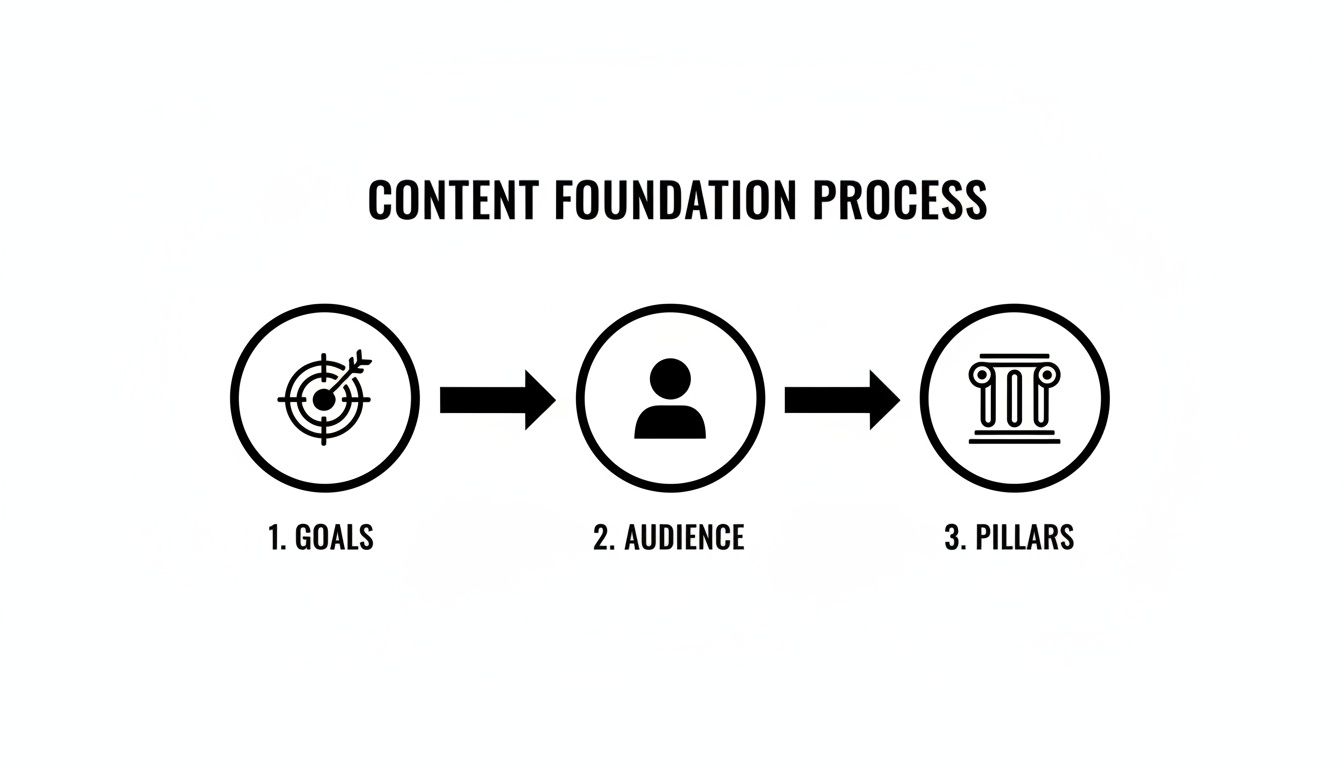
It’s a crucial reminder that production doesn't just happen. Every single post needs to be anchored in a clear strategic purpose before anyone even thinks about writing copy or designing a graphic.
To sidestep confusion and painful delays, everyone needs to know exactly what their job is. In any medium-to-large business, it's rare for one person to wear all the hats. A solid team structure usually looks something like this:
Laying these roles out in a shared document puts an end to the dreaded "I thought you were doing that" problem. It creates clear ownership and accountability.
Your editorial calendar is the absolute heart of your content engine. It’s so much more than a simple schedule of posts; it's the single source of truth that keeps your entire team on the same page.
A good calendar lets you plan out major campaigns weeks or even months ahead, while still leaving space to be agile. You need that flexibility to jump on trending topics and stay part of the real-time conversation. If you haven't got one locked down, learning how to create a content calendar is one of the most valuable things you can do for your workflow.
Your calendar should be a living document, not a rigid plan set in stone. The sweet spot is a balance between your planned, proactive storytelling and the agility to react when opportunities pop up. That mix is what keeps you relevant.
As your content volume picks up, trying to manage this in a spreadsheet becomes a nightmare. This is where technology becomes your best friend. Exploring the best social media management tools can save you countless hours, giving you proper scheduling, collaboration, and approval features all in one place.
A structured workflow is what turns a spark of an idea into a polished, approved piece of content ready to go live. While the exact steps might differ between teams, a solid process generally follows a clear path from start to finish.
1. Ideation and Briefing: It all starts with an idea, usually sparked by your content pillars. This gets fleshed out into a detailed creative brief, covering the post's goal, key messages, audience, format, and the all-important call-to-action.
2. Creation: The brief is handed off to the content creator, who gets to work producing the copy, visuals, or video.
3. Internal Review: The first draft goes out for feedback. Here, the strategist checks it against the plan, and the editor polishes it for quality and accuracy.
4. Revision: The creator takes that feedback on board and refines the content. This might be a quick one-and-done, or it could take a few rounds to get it just right.
5. Final Approval: The polished version is sent up the chain to the final decision-maker—like a Marketing Director or Legal—for the official green light.
6. Scheduling: Once it's approved, the post is loaded into your scheduling platform and plotted on the calendar with its publish date and time locked in.
This systematic approach is your quality control. It makes sure every single post is thoughtfully produced and properly vetted, keeping your standards high and minimising the risk of stuff-ups. It's the assembly line that allows you to scale your content creation and social media without ever sacrificing quality.
Throwing the same message across every social media platform is a surefire way to burn through your budget and creative goodwill. The real wins come when you stop broadcasting and start tailoring your content to the unique culture of each space. A simple truth of effective content creation and social media is that what flies on LinkedIn will absolutely flop on Instagram, and a viral TikTok trend will mean nothing on Facebook.
This means you’ve got to be smart about where you show up and how you act when you’re there. Each platform has its own algorithms, user expectations, and preferred formats. Building a presence that feels natural and genuine requires a deliberate choice of platforms and a real commitment to customising your content for each one.
To make the right calls, you need to know the local lay of the land. Not every platform has the same influence in the Australian market. Understanding the demographics, user behaviour, and content tastes on each is the first step to focusing your energy where it will actually deliver a return.
For instance, Facebook is still the undisputed king here, with 22.8 million users—that's a staggering 82.5% of the population. The biggest user group is the 25-34 cohort, making it prime real estate for businesses targeting young professionals and families. Its massive reach and powerful ad tools make it a workhorse for engagement and lead generation. You can read the full research about these Australian social media statistics to get a sense of just how dominant it remains.
Here’s a snapshot of the major players in the Australian market.
| Platform | Primary Australian Audience | Optimal Content Formats | Strategic Business Use Case |
|---|---|---|---|
| Broad demographic, strong in the 25-54 age range. | Video, link posts, community discussions (Groups), Live streams. | Community building, customer service, targeted advertising for both B2C and B2B, driving website traffic. | |
| Millennials & Gen Z (18-34). Skews slightly female. | High-quality visuals: Reels, Stories, Carousels, professional photography. | Brand storytelling for visual industries (fashion, food, travel), influencer marketing, e-commerce via shopping tags. | |
| Professionals, B2B decision-makers, job seekers (25-49). | Articles, text posts, case studies, professional video, infographics. | B2B lead generation, establishing thought leadership, corporate branding, professional recruitment. | |
| TikTok | Primarily Gen Z & younger Millennials (under 30). | Short-form, vertical video with trending audio, tutorials, behind-the-scenes content. | Building brand personality, reaching a younger audience through authentic and entertaining content, driving trends. |
This table just scratches the surface, but it highlights the distinct role each platform plays. Your job is to match your business goals and audience with the right environment.
The goal isn’t to be on every platform; it’s to be on the right platforms. A focused, high-impact presence on two channels is far more effective than a weak, generic presence on five.
Once you've picked your channels, the real work of customisation begins. This is about so much more than just resizing an image; it’s about adapting your entire communication style.
Think about a software company launching a new feature.
On LinkedIn, they might post a detailed article explaining the business problem it solves, complete with data and a polished case study video. The tone is informative and value-driven, aimed squarely at decision-makers.
Over on Instagram, that same launch becomes a visually punchy Reel. It could be a quick, dynamic screen recording showing the feature in action, set to trending audio, with a caption focused on user benefits in a casual, direct tone.
And for Facebook, they might run a live Q&A session with the product manager, inviting community questions and getting direct feedback. It’s conversational and community-focused.
This multi-faceted approach ensures the message lands the way the audience on each platform wants to receive it. It shows you understand the culture of the space you’re in, which builds trust and sends engagement through the roof. It’s the difference between being a good house guest and someone who just barges in and makes a mess. Your whole content creation process has to account for these nuances from the get-go.
Creating fantastic content is a huge achievement, but it's only half the story. A brilliant video or insightful article that nobody sees is a serious missed opportunity. This is where distribution and amplification come in—the art and science of getting your carefully crafted content in front of the right eyeballs.
Frankly, the success of your entire content effort hinges just as much on your distribution plan as it does on your production quality. It’s about more than just hitting 'publish'. It’s a strategic push to maximise your content's lifespan and impact, mixing smart organic tactics with even smarter paid promotion.
Before you spend a single dollar, the goal is to get every last drop of value from your organic channels. This means optimising your posts for discovery and, just as importantly, actively building your community.
Organic reach isn't about crossing your fingers and hoping the algorithm is in a good mood. It's about being an active, valuable participant in your digital neighbourhood.
The smartest way to look at distribution is to treat content creation as the beginning, not the end. Your post-publish activities—sharing, engaging, and repurposing—are what truly give your content wings.
One of the most efficient ways to amplify your work is through content repurposing. This is simply the practice of taking one big piece of content and slicing it into multiple smaller assets, each tailored for a different platform.
Imagine you've just published a comprehensive 2,000-word guide on your blog. That one piece of work can fuel your content calendar for weeks.
This approach doesn't just save a massive amount of time. It reinforces your core message across your entire digital presence, hitting different audience segments right where they prefer to consume content.
While organic reach is your foundation, paid amplification is the accelerator. It lets you get incredibly precise, targeting specific demographics and interests to guarantee your best content reaches your ideal audience.
This isn't about blindly "boosting" every post you make. It’s about a measured, strategic approach. Start by finding your top-performing organic content—the posts that are already getting traction. Putting a paid budget behind these proven winners is a much safer bet.
For the best results, it often pays to work with specialists. Partnering with a team that lives and breathes social media advertising services can make a world of difference, ensuring your budget is spent efficiently to hit specific business goals, like lead generation or website traffic. This targeted investment turns your content from a brand-building tool into a direct driver of business results.
Look, creating amazing content is a brilliant start, but if you have no way to measure its impact, you're really just guessing. To prove the actual business value of your social media, you have to stop obsessing over vanity metrics like likes and followers and focus on the numbers that matter. This is where analytics, proper reporting, and a commitment to ongoing optimisation turn your content from a cost centre into a real, measurable investment.
The real goal here is to build a powerful feedback loop. You publish content, measure how it performs against your business goals, learn from what the data tells you, and then pour those insights back into making your next piece of content even stronger. This is what separates the high-performing teams from everyone else just posting and hoping for the best.

Before you can measure anything, you have to define what success actually looks like for you. Your Key Performance Indicators (KPIs) need to tie directly back to the business goals you set at the very beginning. Moving beyond surface-level stats is the only way to show how content creation and social media truly contribute to the bottom line.
Picking the right KPIs brings clarity and focus to your whole operation. It makes sure you're working towards outcomes, not just pumping out activity. If you want to get more granular on this, our guide on https://virtualadagency.com.au/digital-marketing-performance-metrics/ can help you nail down the most impactful numbers for your specific business.
You simply can't manage what you don't measure. This is where analytics platforms become your best friend. The native tools built into platforms like Facebook Business Suite or LinkedIn Analytics are a decent place to start for tracking individual post performance and audience demographics.
But for a truly unified view, third-party tools like Sprout Social, Hootsuite, or HubSpot are invaluable. They let you pull data from all your different channels into a single dashboard. This makes it so much easier to spot trends, compare how platforms are performing against each other, and build reports without having to juggle a dozen browser tabs.
Collecting all this data is completely pointless if you don't do anything with it. The final, and most important, step is getting into a regular rhythm of reviewing your performance and turning those insights into actual, concrete actions. This might be a quick weekly check-in with the team or a more formal monthly review.
In these meetings, you need to be asking the tough questions:
The answers to these questions are your roadmap. If you find out that behind-the-scenes videos are driving 200% more engagement than polished product shots, the decision is easy: make more of them. If a certain content pillar is consistently falling flat, maybe it's time to retire it and test something new.
To really nail this part and ensure you're always improving, you need to dig into the details. Diving into a complete guide to Social Media Optimisation can help you refine your approach. This constant cycle of testing, learning, and tweaking is what turns a good social media strategy into a truly great one.
Got a few nagging questions? Most people do. Let's tackle some of the most common ones we hear from businesses trying to get their social media strategy right.
This is the classic "how long is a piece of string?" question. The honest answer is: it depends entirely on the platform and your audience's appetite.
Some channels, like X (what we all still call Twitter), are high-volume newsfeeds where multiple posts a day can work well. But for platforms like LinkedIn or Instagram, you’re often better off focusing on 3-5 genuinely high-quality posts per week.
The golden rule is always consistency over sheer volume. It’s far better to post less often with content that truly adds value than it is to churn out daily filler just for the sake of it.
Right now, video is king. There's no getting around it. Short-form video, in particular—think Instagram Reels and TikTok—is generating the highest engagement rates we've seen in years.
But don't get tunnel vision and only create videos. Interactive content is an absolute goldmine for starting real conversations and building a proper community. Think polls, quizzes, and campaigns that are built around user-generated content (UGC). These are incredibly effective at getting people to do more than just passively scroll.
It’s time to look past the vanity metrics. Likes are nice, but they don’t pay the bills. To get a real sense of your return, you need to track data that connects directly back to your business goals.
Start using UTM parameters on your links so you can see exactly how much traffic is coming from your social channels in Google Analytics. From there, you can track conversion rates on your landing pages and calculate your cost per lead.
Connecting your social media activity to actual sales data is the only way to get a clear, honest picture of your return on investment.
Ready to build a social media strategy that delivers real business results? The team at Virtual Ad Agency specialises in full-funnel marketing solutions that drive growth. Chat with us today.

 previous