
Bringing in a specialist email marketing advertising agency is a smart play. It gives you immediate access to deep expertise in deliverability, automation, and compliance—skills that in-house teams, bless them, often just don't have the bandwidth to develop. This isn't just about handing off tasks; it's a direct investment in a channel proven to drive serious business growth and boost customer lifetime value.
Most medium-to-large businesses hit a wall with their email marketing at some point. It’s a familiar story. The in-house team is brilliant with brand consistency and knows the products inside out, but they’re usually marketing generalists, pulled in a dozen different directions.
A dedicated agency, on the other hand, lives and breathes email. Every single day.
This focus is a massive competitive advantage. These agencies aren't just sending out your weekly newsletter. They're the architects behind complex, automated customer journeys. They get the subtle art of email deliverability, navigating the constantly shifting rules of inbox providers to make sure your messages actually land where they're supposed to.
Picture a growing e-commerce brand. Their campaign engagement has flatlined. The in-house team has the basics down pat, but they’re struggling with advanced segmentation and don't have the right tools for the job. An expert agency can come in and roll out sophisticated strategies straight away, like:
By unlocking these advanced tactics, the e-commerce brand can transform its email program from a simple broadcast tool into a powerful revenue engine, turning dormant subscribers into repeat buyers.
Specialist email agencies are always across the latest B2B email marketing best practices, which is crucial for lifting engagement and getting real results. This focused knowledge is what separates a pretty good email program from a truly great one. To dig deeper into finding the right fit, you can explore our guide on hiring an email marketing agency.
The numbers back this up, too. In Australia, email marketing delivers a staggering average ROI of $42 for every $1 spent. On top of that, 44% of marketing professionals see it as their most effective channel—beating social media and paid search combined. This incredible return makes partnering with email marketing advertising agencies one of the sharpest investments a business can make. Check out more Australian marketing statistics to get the full picture.
Jumping into calls with a handful of agencies without a clear strategy is a surefire way to waste everyone's time, including your own. Before you even start Googling, you need a crystal-clear picture of what success actually looks like for your business. Think of this internal clarity as your compass; it'll guide every single conversation and decision from here on out.
A good starting point is to look past the usual surface-level metrics. Sure, open rates and click-through rates give you a quick temperature check on engagement, but they don't really tell you the story of your business's health. Your goals need to be tied directly to tangible, bottom-line outcomes.
Are you trying to slash the sales cycle for your B2B leads? Or is the main game increasing the average order value for your e-commerce store? Nailing this down is the first, most crucial step.
The goals you set will point you directly to the type of agency you need on your team. It’s that simple.
If your business is focused on improving customer retention, you'll need a partner who lives and breathes lifecycle automation, segmentation, and loyalty programs. On the flip side, a company going all-in on new customer acquisition needs an agency skilled in aggressive lead generation, clever list growth tactics, and powerful welcome sequences that convert.
You have to be able to articulate these specific needs right from the get-go to find the right fit.
Vague goals lead to vague proposals. If you tell an agency you just want "better emails," you're going to get a generic, cookie-cutter plan. But if you tell them you need to increase customer lifetime value by 15% in the next year, you'll get a targeted strategy built to deliver exactly that.
The right agency partner brings a specific set of skills to the table to turn these objectives into reality.
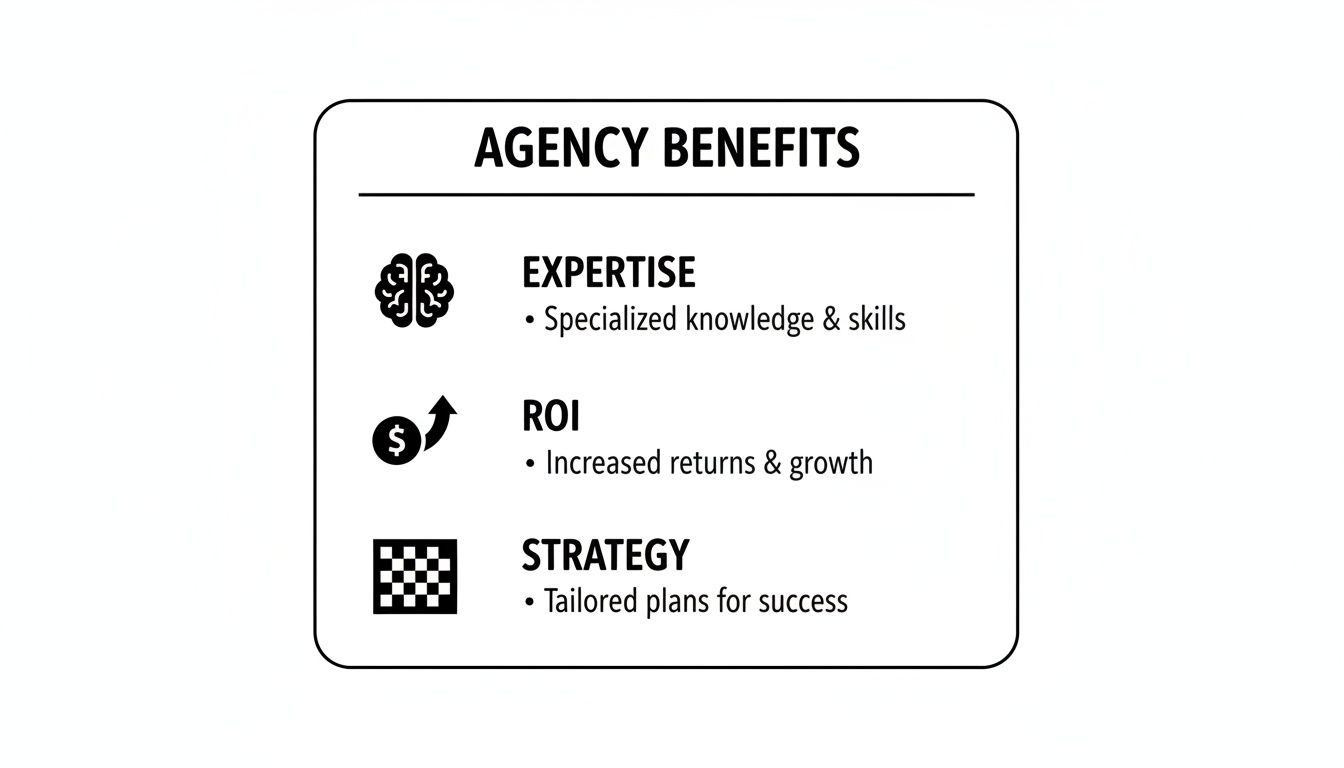
This really highlights how dedicated expertise, a sharp focus on ROI, and solid strategic planning are the building blocks for achieving your goals. Let's look at a simple way to match those goals with the skills you'll need.
To keep your search focused and efficient, it helps to map out exactly what you're looking for. This simple table connects your high-level business objectives to the specific skills, metrics, and tools you should be asking potential agencies about.
| Business Goal | Required Agency Expertise | Key Performance Indicator (KPI) | Example Technology |
|---|---|---|---|
| Increase Customer Lifetime Value (CLV) | Lifecycle automation, loyalty programs, predictive analytics. | Repeat purchase rate, average order value, CLV. | Klaviyo, Rejoiner |
| Generate More Qualified Leads | Lead nurturing sequences, content marketing, lead scoring. | Marketing Qualified Leads (MQLs), conversion rate. | Marketo, HubSpot |
| Improve Sales Attribution | Advanced tracking, CRM integration, multi-touch attribution. | Email-attributed revenue, conversion value. | Salesforce, Ometria |
| Boost Subscriber Engagement | Dynamic content, A/B testing, deliverability optimisation. | Click-to-open rate (CTOR), inbox placement rate. | Litmus, Mailchimp |
By putting in the work to define these elements first, you create a powerful and concise brief. You can walk into those initial agency conversations knowing exactly what you need, which lets you quickly weed out the generalists and pinpoint the partners who are truly equipped to help you win.
Right, you’ve got a shortlist of potential partners. Now it’s time to look past the polished websites and slick sales decks. A proper evaluation means digging into the real substance of an agency's work, their culture, and how they think strategically. This is where you separate the talkers from the doers among email marketing advertising agencies.
The best place to start is with their past work. Don't just accept a glossy PDF of case studies at face value. Ask to see the actual emails and campaign flows they built.

A great agency won't just show you vanity metrics like open rates. They’ll connect their work directly to business outcomes that matter—things like customer lifetime value, lead-to-sale conversion rates, and revenue that can be directly attributed to their email campaigns.
Push them on the details. Ask them to walk you through the thinking behind a successful campaign. Why did they choose that specific segmentation? What was their hypothesis for an A/B test, and what did they learn from the results?
The most insightful question you can ask is: "Walk me through a campaign that underperformed and what your team learned from it." An agency that is honest about its failures and can clearly articulate the lessons learned is one you can trust. It shows humility, a commitment to learning, and a process for improvement.
This kind of honest conversation reveals far more about their capabilities than a perfect success story ever could. It’s a key part of understanding how they apply real-world email marketing best practices.
Modern email marketing is all about data. The agency you choose must be fluent in analytics, segmentation, and personalisation. Don't be afraid to get a bit technical here.
Here are some key areas to probe:
The Australian email advertising market is booming, with ad spending projected to hit AU$421 million by 2029. This growth is fuelled by businesses demanding measurable results, making an agency's data proficiency more critical than ever.
Technical skills are vital, but a successful partnership also hinges on a good cultural fit and clear communication. You'll be working closely with this team, so you need to know who you'll be dealing with day-to-day.
Ask about their team structure. Will you get a dedicated account manager? How often will you actually meet with the strategist driving your campaigns? A common frustration is being wowed by the A-team during the pitch, only to be handed off to a junior account coordinator once the contract is signed.
Finally, get a feel for their communication style. Do they explain complex ideas clearly, or do they hide behind industry jargon? The right agency should feel like an extension of your own team—a true partner who is transparent, collaborative, and genuinely invested in your success.
Figuring out how an email marketing advertising agency structures its fees is a big deal. If you get this wrong, you're looking at misaligned expectations, surprise budget blowouts, and a partnership that just feels… off.
Let's break down the common pricing models so you know exactly what you’re signing up for.
The one you’ll see most often is the monthly retainer. This is a set fee you pay each month for an agreed scope of work. It’s a great fit for businesses that need ongoing strategic advice, campaign management, and consistent optimisation.
Think of a B2B company paying a retainer for an agency to handle its entire lead nurturing funnel. This would cover everything from content creation and automation builds to monthly performance reports. The biggest plus here is predictable budgeting and the chance to build a deep, ongoing partnership. The catch? You pay the same fee whether it's a quiet month or you're in the middle of a massive campaign push.
A popular alternative that's gaining traction is performance-based pricing. With this model, the agency's fee is tied directly to the results they deliver, like a cost-per-lead (CPL) or a percentage of revenue that comes directly from their email campaigns. This approach is brilliant for aligning incentives; the agency only makes more money when you do.
This structure works wonders for a specific, measurable goal, like a holiday sales campaign or a big lead generation drive. A word of caution, though. These agreements demand crystal-clear tracking and attribution to avoid any arguments over what really counts as an "agency-driven" sale.
Finally, there’s project-based pricing. This is a simple one-off fee for a defined project, like redesigning your email templates or building out a new welcome series. It’s perfect for businesses that need some specialised help but aren't quite ready to commit to a long-term relationship.
Once you've landed on a pricing model, the contract is your next hurdle. Don't just skim it. The fine print is where partnerships are either protected or put at risk. A solid contract should lay out every single aspect of the working relationship with total transparency.
A well-structured contract isn’t about mistrust; it’s about clarity. It ensures both you and the agency are perfectly aligned on expectations, deliverables, and what happens if things don't go according to plan.
Keep a sharp eye out for these critical clauses:
By carefully decoding both the pricing and the contract, you're laying the groundwork for a successful and mutually beneficial relationship with your chosen agency.
Choosing the right agency is as much about dodging the wrong ones as it is about finding the perfect fit. Plenty of fantastic agencies are out there, but a bad partnership can do more than just waste your budget—it can actively damage your brand and set you back months.
Knowing what to look for can save you a world of pain.
The biggest, brightest red flag of them all is the promise of outlandish results. If an agency starts throwing around guarantees like a 50% open rate on every email or doubling your revenue in 30 days, it’s time to politely end the call. That’s just not how email marketing works.
Real pros know that performance is tied to countless variables: the quality of your list, your industry's benchmarks, your audience's mood that day. They'll talk about setting realistic, data-backed goals, not selling you a fantasy.
Another major warning sign is a complete lack of transparency. Ask them how they plan to segment your audience. If their answer is a fog of buzzwords like "synergistic frameworks" or "dynamic content leveraging" without a single concrete example, be very suspicious.
Jargon is often just a smokescreen for a lack of real strategy.
A good agency should be able to break it down for you in plain English. You want to hear things like, "First, we'll segment your list by purchase history and website engagement. This lets us build targeted campaigns for your loyal customers and another set to re-engage anyone who looks like they might be slipping away." Simple. Clear. Actionable.
Also, be wary of any agency that tries to shoehorn you into a one-size-fits-all template.
If they pitch you the exact same strategy they used for a fashion retailer when you’re a B2B software company, it’s a clear sign they haven’t done their homework. They're not interested in your unique sales cycle or customer needs. A true expert knows effective email marketing is all about context.
Finally, pay close attention to how they communicate during the sales process itself. Are they listening more than they’re talking? Are they asking smart, probing questions about your business challenges?
Here are a few other little things that should make you pause:
Ultimately, you have to trust your gut. An agency partnership is a relationship, and spotting these red flags early is the key to making a choice you’ll still be happy with a year from now.
The contract is signed. Phew. Now the real partnership begins.
A messy start can poison the well before you even get a drink, creating friction and, worse, delaying results. If you want to hit your email marketing goals, a smooth, structured onboarding process is non-negotiable.

First things first: schedule a comprehensive kick-off meeting. This isn’t just a quick "hello"—it's a proper strategic session to get both teams aligned. Work on the agenda together. The goal is to make sure everyone, from your marketing manager to their lead strategist, is on the exact same page from day one.
Next, you need to empower your new agency. That means giving them the keys to the kingdom—or at least, the relevant parts of it. They need quick access to all the essential assets to get cracking.
A well-prepared onboarding process does more than just save time. It shows you’re serious about the partnership and empowers your new agency to start delivering value almost immediately. It’s how they move from strategy to execution with confidence.
Clearly defined communication channels are just as vital as assets. Decide who the primary points of contact are for both day-to-day tasks and bigger strategic chats. Will you use a shared Slack channel for quick questions? A weekly video call for performance reviews? Nail down this rhythm early to avoid confusion down the track.
This structured approach is particularly crucial in the Australian market. Local consumers have a huge appetite for brand emails, with most subscribing to between 6–10 brands. Engagement here is through the roof—Australia boasts the highest email open rate of any region at a massive 43.46%. A successful onboarding ensures your new agency can tap into this engaged audience right away. You can find more insights on Australian email marketing trends on aamctraining.edu.au.
By taking these steps, you turn the initial handover from a simple transaction into a strategic launchpad. This is how you build a successful, long-term partnership with your new email marketing advertising agency.
Even with the best strategy in place, a few practical questions always pop up when it's time to choose between email marketing advertising agencies. Let's tackle the ones we hear most often.
This is the big one, and the honest answer is: it varies wildly depending on what you need.
A smaller business just getting started might see monthly retainers in the $2,000-$5,000 range. On the other end of the spectrum, a larger enterprise with complex automation, deep segmentation, and a massive list could easily invest $10,000-$20,000+ per month.
But the price tag is only half the story. The real conversation should be about the potential ROI. A top-notch agency won't just quote you a fee; they'll be able to forecast the value and revenue they can bring back to your business, making the cost an investment, not an expense.
Everyone wants to see the needle move yesterday, and that's understandable. While you can expect to see some initial improvements pretty quickly—things like better deliverability or a jump in open rates might show up within the first month—the real business results take a bit longer.
Typically, you're looking at a 3-6 month timeframe for significant growth in revenue or qualified leads. This gives the agency enough breathing room to properly test different approaches, learn from your audience's behaviour, and truly optimise your campaigns for peak performance. It's a marathon, not a sprint.
At Virtual Ad Agency, we build transparent, results-driven partnerships to take your email marketing to the next level. Explore our services today!

 previous