
A Google Ads agency is a team of specialists who manage your paid advertising campaigns on Google's network. Their whole focus is to maximise your return on investment. They'll handle everything from keyword research and ad creation to the nitty-gritty of bid management and performance analysis, saving you a heap of time while getting better results. For a lot of businesses, partnering with a professional agency is the key to turning ad spend into predictable revenue.
Let's be honest—managing Google Ads in-house often feels like you're fighting a losing battle against rising costs and overwhelming complexity. A dedicated Google Ads agency can turn that struggle into a strategic advantage, bringing specialised expertise that most internal teams just can't replicate.

This value goes way beyond just tinkering with bids; it’s about building a comprehensive growth engine for your business. A top-tier agency lives and breathes the platform. They're always ahead of the curve on algorithm changes and new features that can give you a serious competitive edge.
The most significant benefit you'll see is the shift in focus from vanity metrics like clicks and impressions to the business outcomes that actually matter. These specialists know that traffic is only useful if it converts into leads, sales, and loyal customers.
A great Google Ads agency understands that their work extends beyond just ads; they often integrate or partner for comprehensive systems like ecommerce conversion rate optimization services to ensure traffic converts into profit.
This holistic approach is what separates an average campaign manager from a true growth partner. They connect the dots between your ad performance and your bottom line, making strategic tweaks based on real-world data, not guesswork.
The digital advertising space is not just competitive; it's a huge part of the economy. In Australia, the online advertising industry rocketed to a massive $17.1 billion market size, with a robust compound annual growth rate of 8.2% from 2020 to 2025. This growth really highlights the critical role agencies play in helping businesses navigate such a complex environment.
Ultimately, investing in the right agency gives you:
Finding the right Google Ads agency goes far beyond a slick sales pitch or a professional-looking website. To really figure out if an agency has what it takes to deliver, you need to dig deeper into their process, their results, and their actual expertise. It’s time to move past the generic promises and start asking the tough questions that reveal what they can actually do.
A great place to start is by asking for case studies directly related to your industry. But don't just accept a glossy PDF and call it a day; ask them to walk you through it. A truly competent agency will be able to clearly explain the client's initial challenges, the strategy they rolled out, the hurdles they overcame, and the specific numbers that spelled success.
Look for hard proof of their experience. An agency that calls itself an expert should have a solid portfolio of successful campaigns, glowing client testimonials, and, ideally, team members with official Google Ads certifications. While certifications aren't the be-all and end-all, they do show a commitment to staying on top of the platform's constant changes.
Another powerful move is to speak directly with their current clients. Ask the agency for two or three references – preferably from businesses similar in size or industry to yours. This gives you unfiltered insight into their communication style, how transparent their reporting is, and whether they actually deliver on their promises.
A killer question to ask a reference is, "What's been the biggest challenge working with them, and how did they handle it?" Their answer will tell you more about the real partnership dynamic than any sales deck ever could.
This step helps you grasp the day-to-day reality of working with them, which is just as crucial as the campaign results they promise. At the end of the day, a strong partnership is built on clear communication and trust.
When you're talking to a potential Google Ads agency, your questions should force them to show their strategic thinking, not just list off their services. Vague, generic answers are a massive red flag.
Here’s a quick-reference table to guide your conversations. The goal here is to get past the fluff and into the substance of how they operate.
| Area of Inquiry | Key Question Example | What A Good Answer Looks Like |
|---|---|---|
| Strategy & Problem-Solving | "Can you walk me through a campaign you turned around in our industry?" | They describe a specific challenge, the data-driven strategy they used to fix it, and the measurable outcome. They don't just show their best-ever campaign. |
| Process & Methodology | "What is your process for keyword strategy and ad copy testing?" | A detailed, structured approach involving research tools, competitor analysis, rigorous A/B testing frameworks, and continuous optimisation based on performance data. |
| Business Acumen | "How do you determine the initial budget and what is your approach to scaling?" | An answer that connects ad spend directly to business goals like cost-per-acquisition (CPA) or return on ad spend (ROAS). They should talk about profitability, not just clicks. |
| Team & Communication | "Who will be my day-to-day contact, and what's their direct experience with Google Ads?" | You get a clear answer about your dedicated point of contact and their specific, hands-on experience. A good agency is proud of its team's expertise. |
Asking the right questions upfront is the single best way to avoid a bad partnership. It helps you see beyond the pitch and understand if their team truly has the strategic chops to grow your business.
For anyone needing tailored advice on specific campaign challenges, seeking out expert Google Ads consulting can provide a deeper level of strategic insight before you commit to a full management contract. The goal is to find a partner who thinks like a business owner and ties every single action back to your bottom line.
Agency fee structures can feel like a maze, but getting your head around them is the first step toward a transparent partnership. When you choose the right pricing model, the agency's incentives line up perfectly with your business goals. It’s all about preventing nasty surprises and making sure every dollar you invest is working hard for you.
You'll come across a few common models when you start talking to a Google Ads agency.
The most common is the percentage of ad spend model. Here, the agency charges a fee that’s a set percentage of what you spend on ads each month, usually somewhere between 10% and 20%. This can work brilliantly for scaling e-commerce brands with growing budgets, as it motivates the agency to manage bigger spends efficiently. The catch? It can create a conflict if they're pushed to simply spend more rather than optimise for pure profitability.
Another popular route is a flat monthly retainer. This gives both you and the agency predictability, which is a huge plus. It’s a great fit for local service businesses or companies with stable monthly ad budgets who just need consistent, expert management without costs bouncing all over the place. The scope of work is clearly defined, so you know exactly what you’re paying for each month.
Performance-based models are also gaining a lot of ground. In this setup, the agency's fee is tied directly to results, like hitting an agreed-upon cost-per-lead (CPL) or a specific return on ad spend (ROAS). This model really puts the agency in the trenches with you—they only get paid well when you do.
To help you figure out which type of agency might suit your needs, this decision tree lays out a simple vetting process.
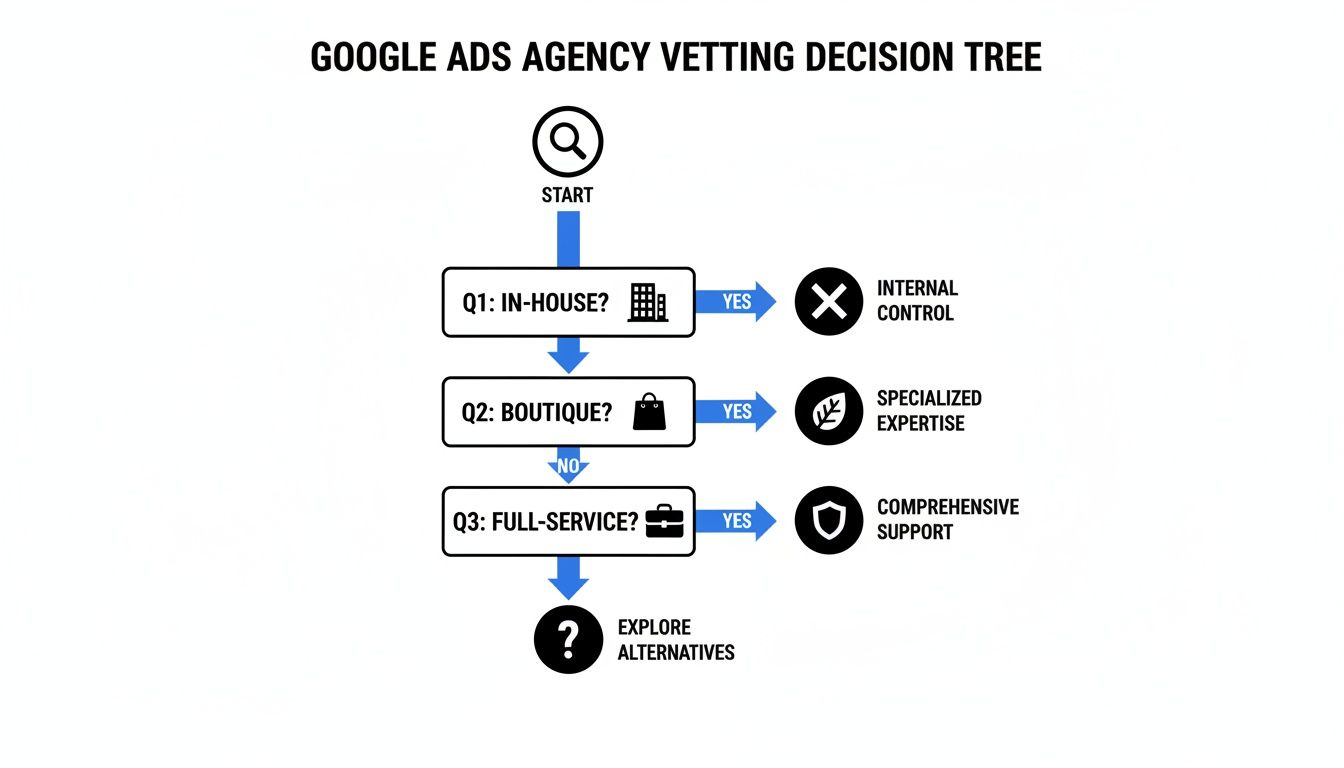
This flowchart can help you decide whether an in-house team, a specialised boutique agency, or a full-service agency is the best path forward based on what your business really needs.
Understanding the local market is crucial for setting realistic expectations. Here in Australia, Google Ads costs have definitely climbed. The average cost-per-click has hit $5.26, which is a 12.88% jump year-over-year.
The good news? Skilled agencies are keeping cost-per-lead growth to a much more manageable 5.13%. For businesses spending in the $1,000-$5,000 AUD monthly range, a good agency can deliver strong national coverage, making it a solid choice for targeting high-volume keywords.
No matter which model you go with, transparency is non-negotiable. Your contract should clearly spell out all fees, the scope of management, and how success will be measured. No hidden costs, no grey areas.
Ultimately, the best pricing model comes down to your business's unique situation. To get a clearer picture of what to expect, have a look at our detailed guide on how much advertising on Google costs to help you prepare your budget and negotiations. A good agency will always work with you to find a structure that feels like a true partnership focused on growth.
Choosing a Google Ads agency is a huge step, but the real work kicks off after the contract is signed. This setup and onboarding phase is where you lay the solid groundwork for a successful, long-term partnership. Getting this right from day one is the best way to prevent future headaches and ensure your campaigns hit the ground running.

This initial stage is all about moving from promising conversations to documented commitments. It's where you establish crystal-clear expectations and agree on what success actually looks like for your business.
A detailed Service-Level Agreement (SLA) is absolutely non-negotiable. Think of this document as your partnership's constitution, outlining everything from how you'll communicate to the exact scope of work. It should leave no room for ambiguity.
Crucially, the SLA must clarify who owns the Google Ads account. You, the client, should always retain ownership and administrative access. An agency insisting on creating the account under its own name is a massive red flag. It’s a classic move that can make it incredibly difficult to leave with your historical data if the relationship sours.
Your SLA should also nail down the specifics on:
Don’t just treat the SLA as a formality to be skimmed and signed. Read it carefully. Push back on any points that seem vague. A good agency will welcome this discussion because it sets everyone up for a much smoother relationship.
It’s vital to move beyond vanity metrics like clicks and impressions. Your Key Performance Indicators (KPIs) should draw a straight line from your ad spend to your business's bottom line. A great Google Ads agency will guide you here, but you should come to the table with a clear idea of what you need to achieve.
Instead of getting bogged down in click-through rates, the focus needs to be on metrics that measure profitability and efficiency. These are the numbers that truly show the value of your investment in expert Google Ads management.
To get the conversation started, here are the core KPIs that link your ad spend directly to business outcomes.
| KPI | What It Measures | Why It Matters |
|---|---|---|
| Cost Per Acquisition (CPA) | The average cost to acquire one new customer or qualified lead from your ad campaigns. | This is your true cost of new business. A lower CPA means your marketing is more efficient and profitable. |
| Return On Ad Spend (ROAS) | The total revenue generated for every dollar spent on advertising. | ROAS is the ultimate measure of campaign profitability, showing a direct link between ad spend and revenue. |
| Conversion Rate (CVR) | The percentage of users who take a desired action (e.g., purchase, form submission) after clicking an ad. | A high conversion rate indicates your ads and landing pages are effectively persuading visitors to act. |
Focusing on these three gives both you and your agency a clear, shared definition of what a "win" looks like, keeping everyone aligned on what truly matters: growing your business.
A smooth onboarding process is a two-way street. To get the best out of your new agency, you need to arm them with the right assets and information from the very beginning. Get a head start by preparing a package that includes:
By providing this information upfront, you’re not just ticking boxes. You're giving your agency the strategic insight it needs to build a powerful, tailored campaign that gets you meaningful results, faster.
A good relationship with your Google Ads agency boils down to two things: transparency and measurable results. To make the partnership work for the long haul, you need to look past the surface-level metrics and understand the story your campaign data is really telling you about its impact on your business.
Great communication is the bedrock of all this. Your agency should be giving you clear, insightful reports that draw a straight line from ad performance to your bottom line. Forget about boring spreadsheets choked with clicks and impressions; you want a performance narrative. One that explains the why behind the numbers and lays out the strategic game plan for the month ahead.
This means you’ve got to move beyond vanity metrics. A huge spike in traffic means absolutely nothing if none of those visitors ever become a customer. A top-tier agency will steer the conversation towards what actually matters: your Cost Per Acquisition (CPA), your Return On Ad Spend (ROAS), and the overall quality of the leads coming through.
Knowing what to look for can save you months of wasted ad spend and a whole lot of frustration. An underperforming agency often leaves a trail of breadcrumbs, and they’re easy to spot if you know where to look. Ignoring them is a costly mistake.
Keep an eye out for these classic warning signs:
One of the biggest red flags is an agency that blames poor results on "the algorithm" or "the market" without taking any ownership. A great partner digs into the data, figures out what’s not working, and comes back to you with a data-backed plan to fix it.
To really gauge performance, you need context. How do your results stack up against others in your industry? This is where benchmarks become incredibly useful. Any competent agency should be able to tell you exactly where your campaigns stand.
Take the Google Ads ecosystem in Australia, for example. The average click-through rate (CTR) is 6.66% and the average conversion rate (CVR) is 7.52%. But these numbers swing wildly between industries. Search CTRs can be as low as 3.27% in the legal sector or as high as a massive 7.83% in the travel industry.
A skilled agency uses this data to set realistic goals and build strategies designed to blow the average out of the water. For a more detailed look, you can discover more insights about the latest Google Ads benchmarks.
Ultimately, a productive partnership is a collaborative one. Stay involved, ask tough questions, and demand reporting that ties every single dollar of ad spend back to tangible business growth. This proactive approach will help you build a successful relationship and give you the confidence to know when it might be time to look elsewhere.
When you're close to partnering with a Google Ads agency, a few practical questions always come up. These aren't just minor details; they often make or break the relationship down the track. Getting clear answers upfront is the key to entering the partnership with your eyes wide open.
This is one of the first things business owners want to know. Many agencies will ask for a minimum commitment, usually somewhere between three and six months. There's a good reason for this. Google Ads isn't a magic wand you can wave for instant results. It takes time to gather data, test what works, and start optimising your campaigns to deliver a solid return.
Think of it as a strategic ramp-up period.
Be wary of any agency that tries to lock you into a 12-month contract right from the start. A far better arrangement is a three-month initial term that then rolls over to a month-to-month agreement. This shows the agency is confident enough to earn your business with performance, not just a piece of paper.
This gives you a way out if things aren't working, but still gives the agency the stability it needs to roll out its longer-term plan for your growth.
This one is a deal-breaker. Let's be crystal clear: You, the client, must always own your Google Ads account. The agency should only ever be granted management access to work within it.
Why is this so important? This setup guarantees that if you ever decide to part ways or bring your advertising in-house, you keep everything. All your historical campaign data, performance history, and the account structure they've built – it's all yours.
An agency insisting on creating the account in their own name is a massive red flag. If you lose access to years of campaign data, you're back at square one. Any new agency or manager would have to start completely from scratch, blind to all the valuable lessons you've already paid for. Insist on ownership from day one. No exceptions.
A professional, confident agency will have a straightforward and painless offboarding process. If you choose to end the partnership, they should make the handover clean and simple. This means revoking their own management permissions and making sure you have full administrative control of your account.
Here’s what a smooth handover should involve:
Asking about their offboarding process early on is a great way to test an agency's professionalism. The best agencies know that great service is what keeps clients, not tricky contracts or barriers to leaving.
At Virtual Ad Agency, we build partnerships on transparency and performance. Our team is ready to answer all your questions and show you how a strategic approach to Google Ads can drive real growth for your business. Discover our full-funnel marketing solutions today.

 previous