
Let’s cut through the jargon. SEO for law firms is simply the art and science of making your website more visible when high-value clients are actively looking online for your exact legal expertise.
It's about optimising your digital presence to rank higher on Google for the search terms that matter. When done right, it directly connects you with people who urgently need your help. This isn't a game of chasing traffic; it's about generating qualified leads that convert into actual cases.
A successful SEO strategy isn’t built on guesswork—it’s built on a solid foundation. Before you can hope to attract your ideal clients, you first have to get inside their heads. What are they searching for? What words are they using? What problems are keeping them up at night? This initial phase is all about laying the groundwork that every other marketing activity will rest on.
This process is what transforms your website from a static digital brochure into a powerful, 24/7 client-acquisition machine. It ensures every single page has a clear purpose, targeting a specific client need and guiding them smoothly toward a consultation.
Good keyword research is so much more than just finding popular search terms. It's about decoding the intent behind the search.
Is someone just looking for information ('what are my rights in a divorce'), or are they ready to pick up the phone and hire a solicitor ('family lawyer Melbourne CBD')? Your job is to find the exact phrases potential clients in your specific geographic area are typing into Google.
Start by brainstorming the core services you offer. Put yourself in your client's shoes and list the problems you solve for them. Next, jump into an SEO tool like SEMrush or Ahrefs to find variations and related questions. You’ll want to pay close attention to "long-tail keywords"—those longer, more specific phrases that almost always signal a user is much closer to making a decision.
Think about it: a broad term like "lawyer" is incredibly competitive and the searcher's intent is a total mystery. But a long-tail keyword like "best commercial litigation lawyer in Sydney for contract disputes" is pure gold. It tells you someone has a specific, urgent problem and is actively looking for representation.
Once you've got your list of valuable keywords, the next crucial step is to assign them to the right pages on your site. We call this keyword mapping, and it’s fundamental to creating a logical, user-friendly site structure that search engines can easily understand.
The golden rule here is simple: one primary keyword topic per page.
This methodical approach stops your own pages from competing against each other for the same search terms. It also sends a crystal-clear signal to Google about which page is the most relevant authority for a specific legal topic. To help organise this, you might find our comprehensive digital marketing strategy template useful.
To give you a clearer picture, here’s a simple framework showing how this looks in practice for a family law firm.
| Client Intent | Primary Keyword | Target URL (Page Type) | Content Focus |
|---|---|---|---|
| Ready to Hire | "divorce lawyer sydney" | /divorce-lawyers/ (Practice Area) | Outlines divorce services, legal process, attorney bios, and a strong call-to-action. |
| Problem Aware | "child custody arrangements nsw" | /child-custody/ (Practice Area) | Details legal options for custody, parental rights, and the firm’s expertise in mediation. |
| Researching | "how much does a prenup cost" | /blog/prenup-costs-australia/ (Blog Post) | An informative article explaining factors that influence cost, benefits, and when to consider one. |
| Location-Specific | "family law firm parramatta" | /contact-us/ (Location/Contact) | Highlights the Parramatta office address, map, contact details, and local legal services. |
Following a logical map like this ensures you're creating the right content for the right person at the right time in their journey.
The infographic below really nails this foundational three-step process: research, map, and structure. It's the blueprint for building an SEO strategy that actually works.
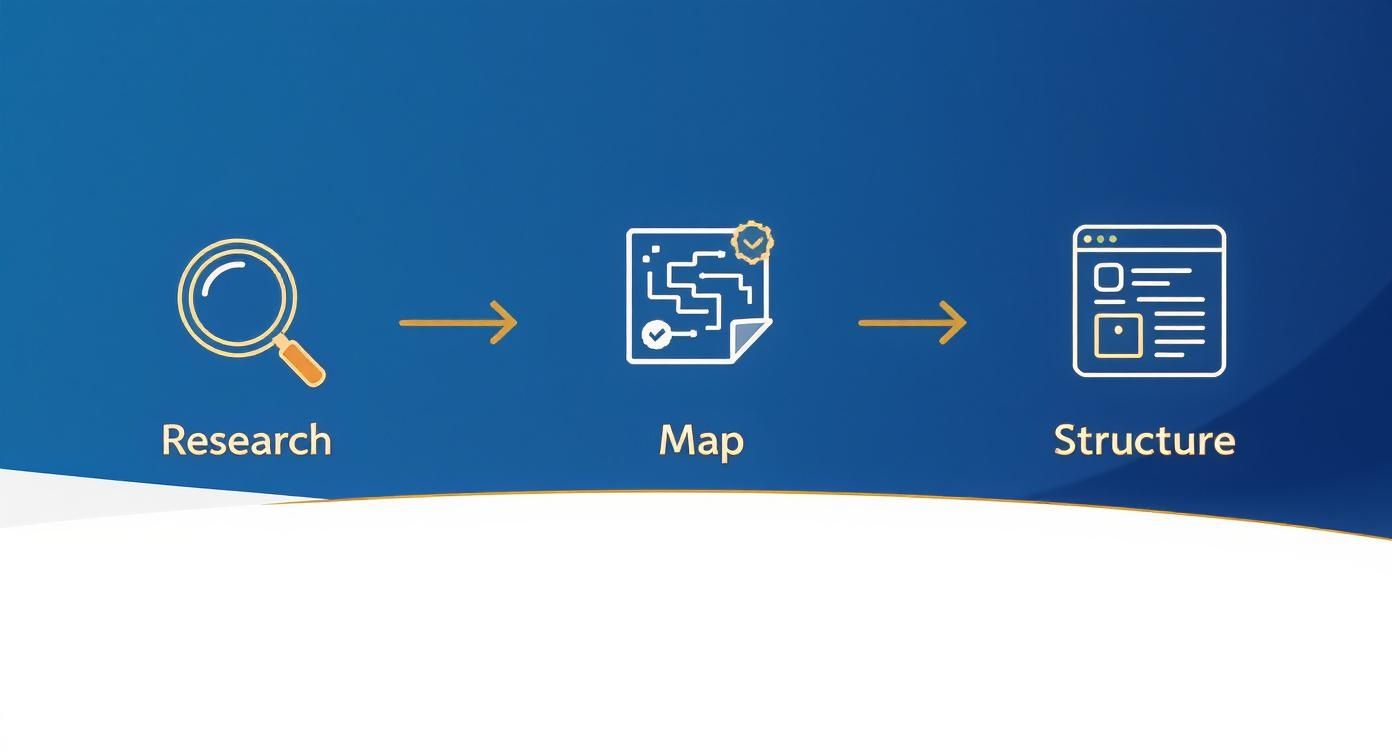
This visual reinforces a simple truth: a successful SEO campaign for any law firm begins with deep research into client needs. This is followed by a strategic plan to map keywords to content, and finally, organising that content into a website structure that both users and Google will love.
For most law practices, your best clients are the ones right around the corner. When someone is hit with an urgent legal problem, what's their first move? They pull out their phone and search for a solicitor "near me." This makes showing up in local search results absolutely critical for any firm that's serious about growth. It’s all about being visible the moment a potential client in your suburb needs you most.
At the very centre of this is your Google Business Profile (GBP). Don't think of it as just another online listing; it's your digital front door and easily your most powerful local SEO tool. It's often the first thing a potential client sees, popping up in Google Maps and the coveted "local pack" search results.
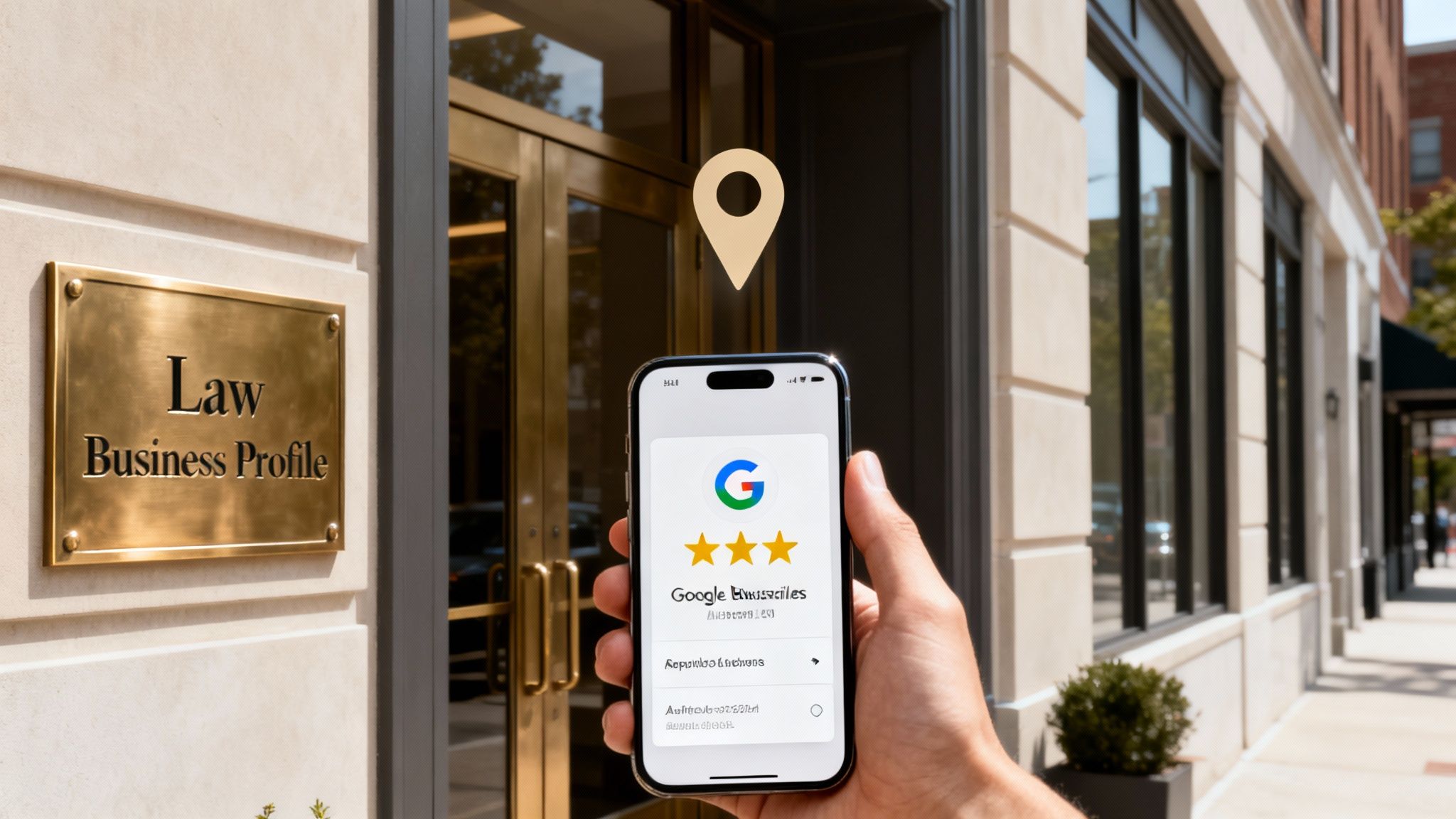
The payoff for getting this right is huge. Australian law firms that dial in their local SEO see incredibly strong results. We're talking a potential 71% increase in local traffic, which makes sense when you realise just about everyone turns to Google to find local services, including legal help. SmartFish has some great insights into these numbers and what they mean for expanding your client base.
Just claiming your profile is the easy part. The real magic happens with careful, continuous optimisation. Every single section of your GBP is a chance to send strong signals to Google about what you do and to build trust with people looking for help.
Start with the absolute basics: your firm's name, address, and phone number (what we call NAP). This information needs to be 100% accurate and consistent everywhere it appears online. Even tiny differences can confuse Google and make potential clients hesitate.
From there, you need to get granular with these key areas:
Pro Tip: Your GBP isn't a "set it and forget it" tool. Use Google Posts regularly to share firm news, articles, or updates. Jump into the Q&A section to answer common questions. This shows you're active and engaged, turning a static listing into a dynamic resource for potential clients.
Beyond your own profile, Google scours the web for other mentions of your firm to confirm you're a legitimate local business. These mentions—your firm's name, address, and phone number on other reputable sites—are known as citations.
Think of each consistent citation as another vote of confidence for your practice. The more high-quality, consistent votes you rack up, the more Google trusts that your firm is a real, established presence in your community. It’s a foundational piece that underpins all your other SEO work.
Make it a priority to get listed in these places:
Consistency here is everything. A simple mistake, like using "St" on one directory and "Street" on another, can weaken the signal. The goal is a perfectly uniform digital footprint that leaves zero doubt about who you are, what you do, and where you're located. These principles are vital, and you can dig into them a bit more in our broader guide on SEO for small business, which covers local signals in greater detail.

Your content is the engine of your SEO strategy, but just publishing a few articles and calling it a day won't cut it. To attract the right kind of clients—the high-value ones—you need to create content that doesn't just rank on Google, but also builds immediate trust and convinces a potential client to pick up the phone.
This is about moving beyond dry, generic legal summaries. It's about developing a content ecosystem that speaks directly to a client's worries and questions, no matter where they are in their journey. Every page on your website should work together to cement your firm as the authority in your practice area and city.
A solid law firm website is built on a few core pages, and each one has a very specific job to do. Think of these as the non-negotiables that form the backbone of your client conversion funnel.
Practice Area Pages: These are your money pages. Each one needs to be a comprehensive deep-dive into a specific service, like "Commercial Litigation" or "Child Custody." Don't just describe the service; aim to answer every conceivable question a potential client has about that legal issue.
Attorney Bio Pages: At the end of the day, clients hire people, not faceless firms. Your attorney bios are a golden opportunity to build a personal connection and showcase genuine expertise. You'll want professional headshots, detailed experience, bar admissions, notable cases, and any awards or publications.
Case Studies or Results Pages: Nothing builds trust faster than proof of your success. Having a dedicated section for anonymised case studies or successful outcomes provides the social proof that hesitant clients need to feel confident in choosing you.
Your core pages are fantastic for targeting clients who are ready to hire. But what about everyone else in the earlier research phase? That’s where a strategic blog comes in. This is your chance to target valuable long-tail, question-based keywords and establish your firm as a genuine thought leader.
For instance, a potential client might not be searching for a "criminal defence lawyer Sydney" just yet. They’re more likely to be Googling something like, "what are my rights if I'm pulled over in NSW?" Your blog is the perfect place to provide a detailed, genuinely helpful answer.
This approach nails two critical goals. First, it brings highly relevant traffic to your site. Second, it shows off your expertise and builds goodwill, making your firm the obvious choice when that person is finally ready to seek proper legal help.
A great way to start planning your blog content is to think like a client. Brainstorm a list of the top 20 questions you hear during initial consultations. Every single one of those questions is a potential high-impact blog post that speaks directly to what your target audience needs to know.
Consistently producing high-quality content demands a structured process. A chaotic approach just leads to burnout and patchy results. Here’s a simple, repeatable workflow you can put into action straight away.
Start with Client Needs: Kick off with keyword research that’s focused on client problems, not just legal jargon. Use tools like Ahrefs or Semrush to find the actual questions your target audience is typing into Google.
Outline Everything First: Before you write a single sentence, create a detailed outline. Map out your H2s and H3s, identify the key points for each section, and note any statistics or internal links you want to include. This saves a huge amount of time later.
Write and Optimise: Draft the content with a focus on clarity, empathy, and making it easy to read. Use short paragraphs, bullet points, and bold text to break things up. To make sure your content actually ranks and brings in clients, it's vital to follow the latest SEO content writing best practices.
Promote and Distribute: Hitting 'publish' is only half the battle. You need to get it out there. Share your new content on your firm’s social media profiles, pop it in an email newsletter, and look for opportunities to repurpose it into other formats, like a short video or infographic.
By sticking to this kind of workflow, content creation stops being a chore and becomes a strategic asset that fuels your firm's growth. Each article and page becomes a long-term tool for attracting and converting your ideal clients.
You could have the sharpest legal content on the internet, but if search engines can't crawl, understand, and serve up your site properly, it might as well not exist. This is where technical SEO comes in—it's the foundational work behind the scenes, ensuring your website is as solid as your legal advice.
While "technical SEO" can sound intimidating, the truth is that a handful of core elements are behind most ranking problems. Nailing these fundamentals gives you a massive advantage. I’ve seen countless law firms invest heavily in beautiful content, only to have it all undermined by a clunky, slow, or broken website. This is a clear opportunity for you to get ahead.
Today’s clients have zero patience for a slow website. A clunky online experience doesn't just frustrate potential clients and send them straight to your competitors; it actively hurts your search visibility. Google measures this user experience through a set of metrics called Core Web Vitals.
Think of them as a quick health check for your site's usability:
Failing these tests tells Google your site offers a poor experience, which can directly drag your rankings down. And this isn't a minor issue. An audit of 54 leading Australian law firm websites found that 15 of them—a staggering 28%—failed Google's Core Web Vitals tests. It's a huge technical gap that penalises firms in search results every single day.
Beyond speed, a few other technical checkpoints are non-negotiable for any law firm that's serious about winning online. You can spot and fix many of these common issues using free tools like Google Search Console.
A technically sound website is built on a few key pillars:
Addressing these basics is fundamental. For a deeper dive, our guide to SEO optimisation best practices covers these topics in much more detail.
Below is a simple checklist you can use to start auditing your own site's technical health.
Use this checklist to perform a quick audit of the most critical technical SEO elements on your law firm's website. It’s a great starting point for identifying high-impact issues that need attention.
| Technical Element | Status (Pass/Fail) | Priority (High/Medium/Low) | Action Required |
|---|---|---|---|
| HTTPS Security | High | Install SSL certificate if missing. | |
| Core Web Vitals | High | Run Google PageSpeed Insights report. | |
| Mobile-Friendliness | High | Use Google's Mobile-Friendly Test. | |
| XML Sitemap | Medium | Check if sitemap exists and is in Search Console. | |
| Broken Links (404s) | Medium | Use a crawler to find and fix broken links. | |
| Robots.txt File | Low | Ensure it isn't blocking important pages. |
Once you’ve run through these items, you'll have a clear, prioritised list of technical fixes that can genuinely move the needle on your search performance.
It's also worth noting that fixing these issues often goes hand-in-hand with improving digital accessibility. When your site is structured logically for screen readers and assistive technologies, it’s also structured well for search engines. Learning how SEO and accessibility work together to boost rankings is a smart move that improves user experience for everyone and strengthens your SEO foundation at the same time.

In the legal world, trust isn’t just a nice-to-have; it’s the bedrock of your entire practice. Google’s ranking system is smart enough to know this, and it mirrors this real-world principle with a concept called E-E-A-T: Experience, Expertise, Authoritativeness, and Trustworthiness.
For law firms, this isn't some fluffy marketing term. Legal advice falls squarely into Google's "Your Money or Your Life" (YMYL) category, meaning topics that can seriously impact someone's life, finances, or well-being. This puts your website under a much bigger microscope. Google has to be certain it's sending people to credible, trustworthy experts.
Think of showing your E-E-A-T as making your firm's real-world credentials and successes crystal clear online. It's not about trying to fool an algorithm. It's about sending consistent, undeniable signals that you are a legitimate and reliable source of legal counsel.
Here are some practical ways to weave these trust signals throughout your website:
Key Takeaway: For Google to trust your firm, it needs proof that real people do. A simple but powerful step is to have a licensed solicitor review every piece of legal content for accuracy. This massively strengthens your E-E-A-T signals.
While what's on your site is critical, a huge part of your authority is actually built off-site. In law firm SEO, backlinks—which are simply links from other websites pointing to yours—act as powerful votes of confidence.
Each quality backlink is like a digital referral. When a respected website links to one of your articles or pages, it's a signal to Google that says, "Hey, this law firm is a legitimate authority on this topic." A healthy portfolio of these "votes" from credible sources is one of the single biggest factors in climbing the search rankings.
But be warned: not all links are created equal. A single link from a well-regarded legal journal is worth infinitely more than hundreds of links from spammy, irrelevant directories. The days of buying links are over—that's a fast track to a Google penalty. The name of the game today is earning links through genuine value.
Earning these high-quality backlinks is an active process. It’s all about creating value and building real relationships. Forget the old, spammy tricks and focus on these proven, ethical strategies that actually work.
Reporters are always on tight deadlines, and they frequently need expert commentary on legal stories hitting the news. By positioning your solicitors as available experts, you can earn incredibly valuable links from major news publications.
One of the most sustainable ways to build links is to create a resource so genuinely useful that other sites can't help but reference it.
Your offline activities can pay direct online dividends. Sponsoring local events, charities, or sports teams often leads to a backlink from the organisation's website, which signals local relevance to Google.
.edu links carry immense authority.By focusing on showcasing your E-E-A-T and pursuing ethical link-building, you create a powerful, long-term competitive advantage. This strategy doesn't just please search engines; it builds the real-world trust that turns a website visitor into a client for life.
Diving into the world of legal SEO can feel a bit overwhelming. It's a unique corner of the digital marketing world, filled with its own set of rules and challenges. But get it right, and the rewards are significant. Let's tackle some of the most common questions we hear from lawyers and marketing managers, giving you the straight answers you need to move forward.
This is the big one, and the honest answer is always the same: it’s a marathon, not a sprint. In a field as competitive as law, you can realistically expect to see the first signs of positive movement—think small ranking jumps and a slight uptick in traffic—within 4 to 6 months of consistent, focused effort.
But we're not just aiming for movement; we're aiming for leads. Achieving those significant, phone-ringing results often takes closer to 6 to 12 months. This timeline can shift based on how fierce the competition is in your city and practice area, the current state of your website's health, and just how aggressively you pursue your SEO campaign. Lasting visibility is built brick by brick, not overnight.
You absolutely can. Many firms successfully handle foundational SEO tasks in-house. Things like keeping your Google Business Profile updated and writing blog posts that answer common client questions are fantastic places to start.
But SEO is a deep and ever-changing field. When you get into the more technical side of things—site audits, schema markup, advanced link building, and deep competitive analysis—it really helps to have a specialist in your corner. A lot of firms find a sweet spot with a hybrid approach: they manage the content creation internally while partnering with a legal SEO agency for the heavy lifting on technical strategy, analytics, and building off-site authority.
Ultimately, the right choice boils down to your firm's time, resources, and comfort level with the technical details. Just don't underestimate the time it takes to keep up with Google's constant algorithm changes.
For almost every law firm serving a specific city or region, local SEO is the key to immediate client acquisition. It’s what gets you in front of people searching "personal injury lawyer near me" or "family lawyer in [Your City]," capturing high-intent leads the moment they need help.
However, it's a mistake to think of local and organic SEO as separate things. They're two sides of the same coin, and they work best together.
Think of it this way: a strong Google Business Profile (local SEO) gets a massive boost from a well-optimised website filled with authoritative content (organic SEO). When you rank well for broader legal topics, it signals to Google that you're an expert, which in turn strengthens your local authority. To truly win, you need to master local SEO for immediate impact while building a powerful organic foundation for long-term market leadership. You need both.
At Virtual Ad Agency, we specialise in creating strategic SEO campaigns that deliver measurable growth for law firms across Australia. We get the nuances of the legal market and build strategies that attract high-value clients. If you're ready to turn your online presence into a powerful client-acquisition engine, we're here to help. Connect with us today.

 previous