
Ecommerce SEO services are a specific set of strategies laser-focused on getting your online store seen in search results. Think of it as a complete plan—from architecture to marketing—that places your digital shop right on the busiest high street, pulling in customers who are actively looking for exactly what you sell. It's not just about getting more traffic; it's about attracting the right kind of traffic that actually turns into sales.
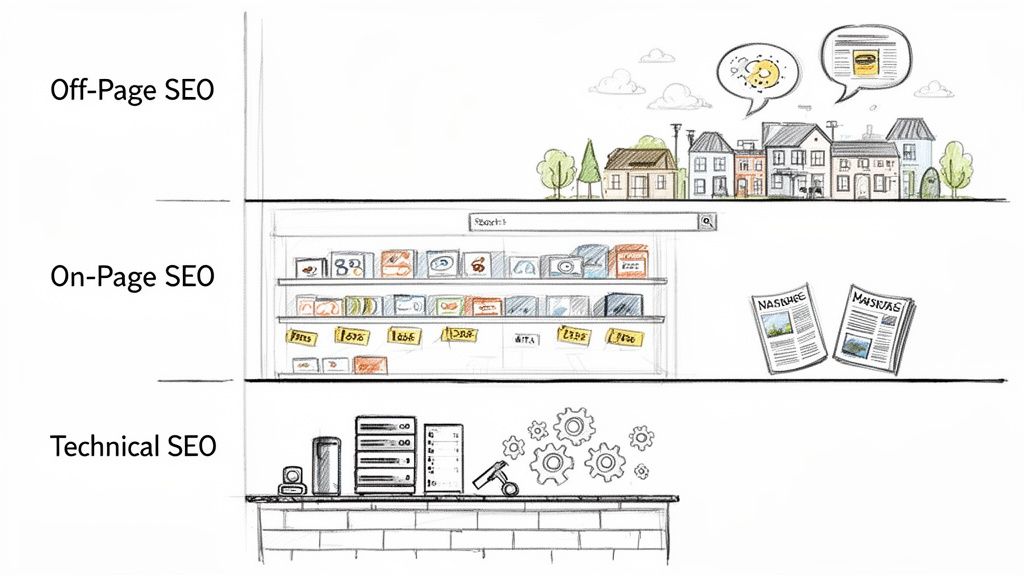
Imagine building a stunning flagship retail store. You wouldn't just plonk it down in the middle of nowhere and hope people find it. You’d pick a prime location, create inviting window displays, and make sure the inside is easy for shoppers to navigate. SEO services for ecommerce do precisely this for your online business.
This isn’t just one thing, but a whole collection of different strategies that all work together. A simple way to picture it is by breaking it down into three core layers, each one building on the last.
First up is Technical SEO. This is the concrete foundation, the wiring, the structural integrity of your store. It’s all about making sure search engines like Google can easily crawl and understand your site. It also covers crucial elements like fast page load times, security, and making sure your site works perfectly on mobile phones. If this base is weak, everything else you try to build on top will struggle.
Next, we have On-Page SEO. This is your perfectly arranged product displays, the clear aisle signage, and the helpful staff on the shop floor. It involves optimising your individual product pages, category pages, and blog posts with the right keywords, compelling descriptions, and high-quality images that attract shoppers and convince them to buy.
Finally, there’s Off-Page SEO. This represents your store’s reputation around town—the word-of-mouth buzz, glowing reviews, and mentions in popular magazines. In the online world, this is mostly built by earning high-quality backlinks from other reputable websites. You can get a deeper understanding of how agencies build your site's authority in our guide to professional link building services.
At its core, ecommerce SEO is about building a sustainable, long-term asset that generates predictable revenue. It's the complete opposite of the short-term sugar rush from paid ads, which vanishes the second you stop paying.
For any serious online retailer, investing in this strategic framework is a no-brainer. Australia’s digital economy is booming, projected to hit $120 billion by 2025, and businesses are catching on. An estimated $1.5 billion is set to be invested in SEO services this year alone, which is a massive 12% jump from 2024. This shows a clear shift away from temporary paid campaigns towards sustainable organic growth—an essential move for any ecommerce business that wants to dominate its market for years to come.
A winning strategy for ecommerce SEO services is never about a single magic bullet. It’s built on several core pillars working in lockstep to create unstoppable momentum for your online store. Let's cut through the jargon and look at what these components actually do and how they combine to drive real growth.
Think of these pillars as different departments within your digital storefront. Each one has a specific job, but they all report to the same manager: increasing revenue. An expert agency knows exactly how to manage each one to get the best results.
Here’s a breakdown of the essential pillars of a comprehensive ecommerce SEO strategy. Each component plays a distinct role, but they are most powerful when they work together, creating a flywheel effect that drives sustainable growth.
| SEO Component | Primary Focus | Business Impact |
|---|---|---|
| Technical SEO | Website health, speed, and crawlability. | Ensures your site is accessible and trusted by search engines, preventing lost sales from technical glitches. |
| On-Page SEO | Optimising product and category pages. | Makes your products easy to find and compelling to customers, directly increasing conversion rates. |
| Off-Page SEO | Building authority and credibility online. | Earns trust from search engines and customers, leading to higher rankings and brand recognition. |
| Content Marketing | Creating valuable, problem-solving content. | Attracts customers early in their buying journey, building brand loyalty and generating qualified leads. |
| Local SEO | Targeting geographically specific customers. | Drives foot traffic and online sales from nearby shoppers, connecting your online presence to the real world. |
Understanding how these elements interact is the key. A technically sound site makes your on-page efforts more effective, while great content provides the fuel for your off-page link-building campaigns. It's all connected.
Technical SEO is the non-negotiable bedrock of your ecommerce website. It’s all the behind-the-scenes work that makes sure your store is a place search engines love to visit—fast, secure, and easy to understand. Without a solid technical foundation, even the best products and marketing campaigns will stumble.
Key elements here include:
On-page SEO is the art and science of making your product and category pages irresistible to both customers and search algorithms. This is where you directly influence how your pages are seen, clearly communicating what you sell and why someone should buy it from you.
This involves meticulously optimising every important page on your site. For stores on platforms like Shopify, a specialised approach is often needed. For a deeper dive, a guide on Mastering SEO for Shopify Stores offers a comprehensive approach.
Effective on-page SEO includes:
Off-page SEO is all about building your store's credibility and authority across the web. Think of it as your digital public relations campaign. The main goal is to earn high-quality backlinks from other reputable websites, which act as powerful "votes of confidence" in the eyes of search engines.
A strong backlink from a trusted industry blog is like a personal recommendation from a respected expert. It tells search engines that your store is a legitimate and valuable resource, boosting your rankings significantly.
This pillar isn't just about links, though. It also includes brand mentions, reviews, and social signals that all contribute to your overall online reputation. A robust off-page strategy signals to Google that you're a leader in your niche.
Content marketing is the engine that attracts your ideal customers long before they’re even ready to buy. By creating helpful guides, blog posts, and articles that solve their problems, you build trust and position your brand as the go-to expert.
For an ecommerce store, this could mean creating:
This content not only pulls in organic traffic but also gives you valuable assets to support your link-building efforts, creating a self-reinforcing cycle of growth.
For ecommerce stores with a physical footprint or those serving specific geographic areas, local SEO is a game-changer. It focuses on optimising your online presence to pull in customers from your local community, connecting your digital storefront with real-world activity.
This is especially potent in Australia, where local search is a powerhouse. It commands 28% of total search traffic and converts at triple the rate of standard organic results. With 85% of Australians searching online for local businesses and a 200% surge in "near me" searches, the opportunity is immense. In fact, a remarkable 76% of these local mobile searches result in a store visit within 24 hours.
Kicking off a partnership for ecommerce SEO services is a bit like planning a cross-country road trip. You wouldn’t just jump in the car and start driving; you’d map out your route, know your major stops, and have a clear destination in mind. SEO is definitely a marathon, not a sprint, and this roadmap will help you understand the journey ahead, setting realistic expectations for what happens and when.
Think of the whole process in distinct phases, with each one building on the last. While every ecommerce business is different, a typical project follows a structured path from foundational work right through to accelerated growth. This ensures every move is strategic and pulls in the same direction: increasing your organic revenue.
The first leg of the journey is all about deep analysis and planning. Before any agency can kick your growth into high gear, they need to get under the hood and understand every detail of your business, your market, and where you currently stand online. This isn't a quick once-over; it's a full diagnostic.
This initial phase involves:
By the end of this phase, you should have a clear, documented strategy that lays out the priorities, goals, and a detailed action plan for the months ahead. It’s the GPS for the entire campaign.
With the strategy locked in, the focus shifts to getting our hands dirty with implementation. This phase is all about fixing the cracks in your foundation and tuning up your most valuable digital assets—your core category and product pages. It's the critical groundwork that makes all future growth possible.
During this period, your SEO partner will be busy:
This phase is about making your website a place both customers and search engines love to visit.
Now that your site is technically sound and well-optimised, it’s time to put the foot down. This is where you’ll start to feel some real momentum as the focus turns to building your store’s authority and expanding its reach through smart content and outreach.
This is often the point where you start seeing tangible results, like a significant lift in organic traffic and revenue. The foundational work from the earlier phases really begins to pay off, creating a compounding effect that builds month after month.
Key activities here are all about strategic content creation and authority-building outreach. This timeline shows how different SEO pillars are prioritised over the life of a campaign.
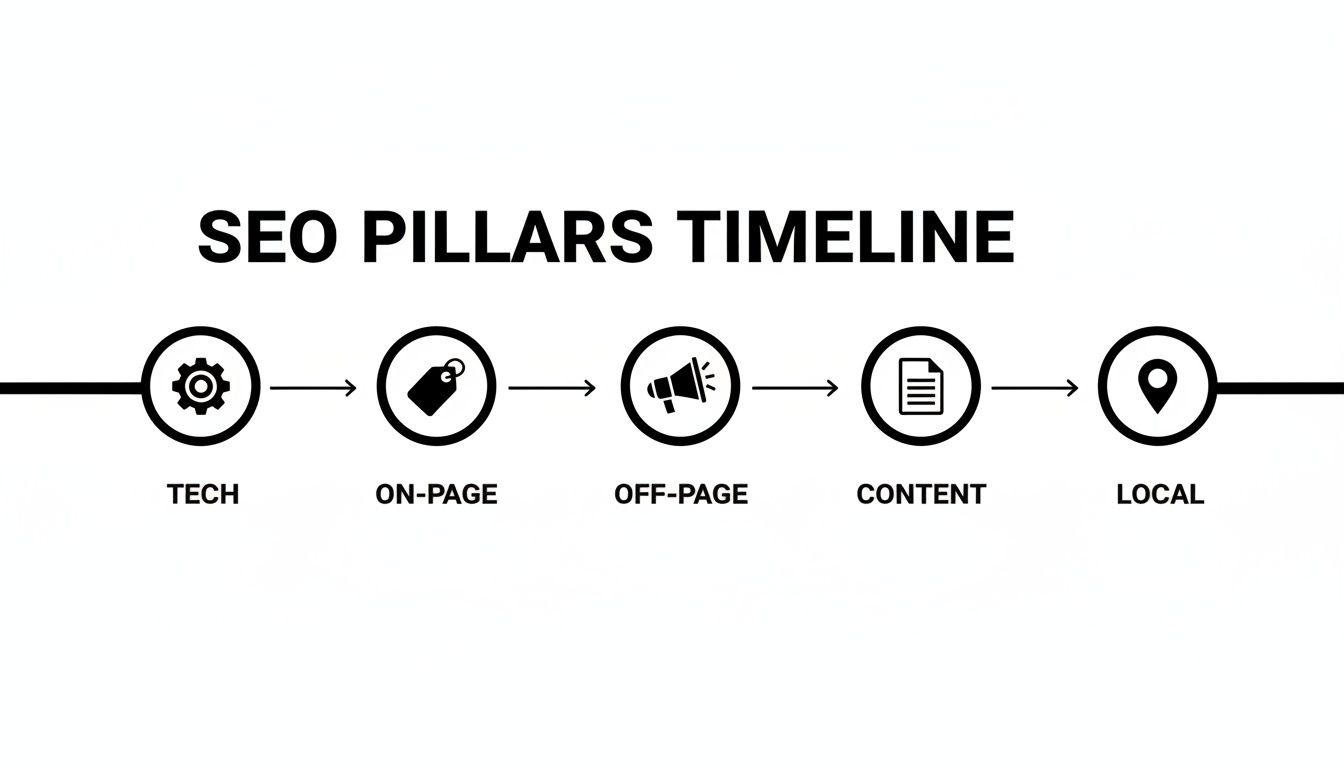
As you can see, while technical and on-page SEO are heavily front-loaded, content and off-page efforts become the long-term engines for growth.
The final phase never really ends. SEO isn't a "set and forget" deal; it demands constant analysis, refinement, and scaling. By this point, your agency will have a mountain of data on what’s working best for your business.
This advanced stage is all about doubling down on what’s winning, exploring new keyword opportunities, and continually tweaking for conversions. And it's not just about search engines. A massive part of fostering long-term growth involves mastering your e-commerce customer service. Taking this holistic approach ensures the traffic you worked so hard to get is far more likely to convert into loyal, repeat customers, maximising the return on your SEO investment.
So, how can you be sure your investment in ecommerce SEO services is actually delivering the goods? Seeing your store climb the search rankings is a nice ego boost, but it’s just a vanity metric if it doesn't translate into real business growth. True success lies in tracking the numbers that directly affect your bottom line.
A top-tier agency gets this. They shift the conversation from, "Are we number one yet?" to "How much revenue did our organic traffic pull in this month?". It’s a simple change in focus, but it makes all the difference. It ensures every SEO activity is held accountable and serves a clear commercial purpose.
Transparent reporting is the bedrock of this entire approach. A decent performance report isn't just a data dump; it’s a strategic game plan. It should clearly show the metrics that matter, explain what they mean for your business, detail what was done to achieve them, and lay out the plan for the next month.
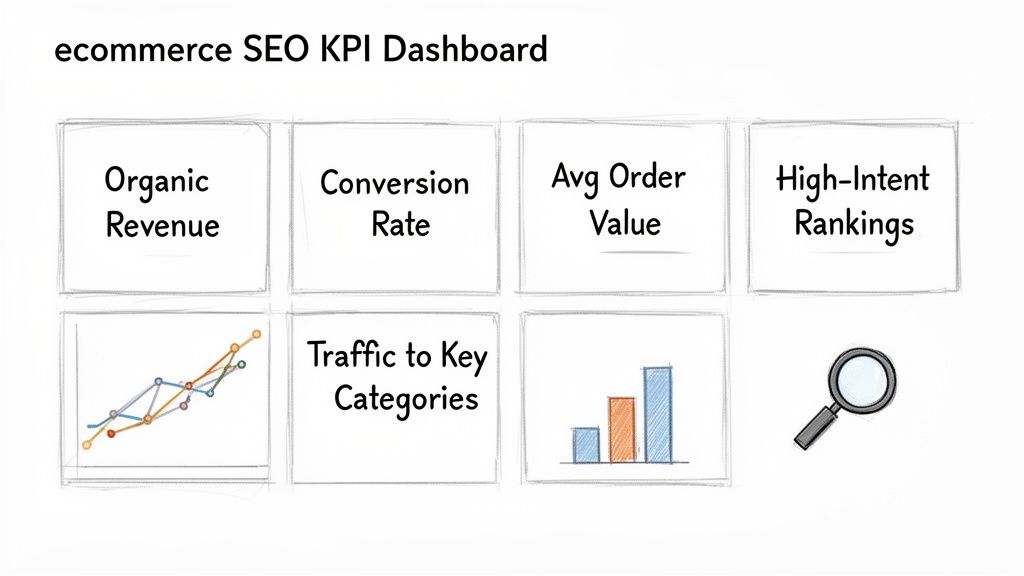
To really get a feel for the health of your ecommerce SEO, you need to look at metrics that speak the language of business: financial performance and customer behaviour. These are the numbers that matter to your leadership team and stakeholders. They're the proof that your SEO efforts aren't just an expense, but a powerful revenue driver.
You’ll want to keep a close eye on these business-critical KPIs:
These numbers give you a complete picture of your store's performance. For a deeper dive, you might find our guide to digital marketing performance metrics useful.
Alongside the bottom-line numbers, it’s vital to monitor the leading indicators that signal future growth and overall SEO health. These metrics often give you the earliest signs that your strategy is working, long before the revenue figures show a massive jump. They show the foundational work is paying off.
A transparent SEO partner connects every single activity to a tangible business outcome. They don't just throw data at you; they provide real insights and a clear plan that shows how today's work will drive tomorrow's revenue.
Key health metrics to keep tabs on include:
The impact of a well-executed strategy can be massive. For instance, AI-enhanced SEO is delivering some incredible results in Australian e-commerce. We're seeing some optimised sites get organic traffic surges of up to 45% and conversion rate jumps of 38%. That’s a huge deal when you consider the average e-commerce conversion rate is a tiny 1.78%. With 68% of businesses reporting a higher ROI from AI-boosted content and SEO, tracking these KPIs is how agencies prove they're delivering tangible wins. You can find more insights on these AI-driven SEO findings on supple.com.au.
Picking the right agency is easily one of the most important business decisions you’ll make for your online store. Get it right, and you unlock serious, long-term growth. Get it wrong, and you’re looking at a wasted budget and a whole lot of missed opportunities.
This isn’t about just hiring another supplier; it's about finding a genuine strategic partner who is as invested in your success as you are.
So, how do you see past a slick sales pitch and find a team that can actually deliver the goods? It all comes down to having a proper evaluation process and asking the kind of sharp questions that separate the real experts from the crowd. An agency's ability to answer these with confidence, transparency, and hard data will tell you everything.
Generalist SEO agencies often trip up on the unique complexities of online retail. Ecommerce SEO is a completely different beast, demanding specialised know-how of specific platforms, common retail challenges, and strategies laser-focused on revenue.
You need a partner who lives and breathes this world every single day.
When you're vetting potential agencies, look for specific, solid proof of their experience:
Once you’ve got a shortlist, it's time to dig in. The goal here is to really get a feel for their strategic thinking, their processes, and how they handle accountability. A good agency will welcome these tough questions and have impressive answers ready to go.
A top-tier ecommerce SEO agency doesn't just promise rankings; they promise revenue. Their entire strategy should be built around a single question: How does this activity contribute to selling more products?
To help you vet potential partners, we've put together a checklist of must-ask questions. Their responses will show you their strategic depth and whether they’re truly on the same page as your business.
Before you sign on the dotted line, running through these questions is a crucial step. This isn't just a formality; it's about making sure you're bringing on a partner who can truly move the needle for your business.
| Question Category | Sample Question | What to Look For in the Answer |
|---|---|---|
| Strategy & Revenue | "How will you connect your SEO strategy directly to our revenue goals?" | Look for answers that focus on high-intent keywords, optimising category pages, and tracking organic revenue, not just traffic. |
| Technical Expertise | "What is your process for auditing and fixing technical issues on a large ecommerce site?" | They should mention specific tools (like Screaming Frog), talk about crawl budget optimisation, and explain how they handle faceted navigation. |
| Authority Building | "How do you earn high-authority backlinks that are relevant to our industry?" | Avoid agencies that talk about buying links. A quality answer will focus on digital PR, content-led outreach, and building genuine relationships. |
| Reporting & KPIs | "What will your monthly performance reports look like, and which KPIs do you prioritise?" | The report should be more than a data dump. They must highlight organic revenue, conversion rates, and provide actionable insights for the next month. |
These questions cut through the fluff and force an agency to show their value. Their answers will tell you whether they are a true strategic partner capable of providing the specialised seo services for ecommerce that you need to grow, or just another vendor selling a generic package. Choosing wisely at this stage sets the foundation for all your future organic success.
Jumping into the world of professional SEO services for ecommerce always brings up a few questions. It’s a big decision and a serious investment, so getting your head around the costs, timelines, and the unique challenges of online retail is the first step to making a smart choice.
To cut through the noise, we've pulled together the questions we hear most often from business owners weighing up a partnership with an SEO agency. The goal here is to give you direct, honest answers so you can move forward with real confidence.
The truth is, the investment in professional ecommerce SEO in Australia varies quite a bit. It all depends on the size of your store, how tough your market is, and what you’re ultimately trying to achieve. It’s a tailored service, not something you can pull off a shelf.
For established, medium-to-large businesses, you can expect monthly retainers to start from around $3,000 and head north of $10,000 AUD. It’s much healthier to think of this as an investment in a core, revenue-driving part of your business, rather than just another marketing expense.
A word of caution on low-cost offers: be wary. Cheaper services almost always have to cut corners somewhere, and it’s usually on high-quality content and authoritative link building—the very things that deliver real, long-term growth. These shortcuts can even put your site at risk down the track.
A credible agency won’t have a generic price list. They'll always want to understand your specific business goals and run a proper audit of your site before putting a custom proposal in front of you.
This is the big one, and the honest answer is that it requires a bit of patience. SEO is a marathon, not a sprint. Building real, lasting authority with search engines is a gradual process that compounds over time.
While you might see some quick wins from technical fixes within the first 1-3 months, the really significant, revenue-driving results typically start to show up between the 6 and 12-month mark.
Here’s a rough idea of what to expect:
While they both stem from the same core principles, ecommerce SEO is a highly specialised game. The main difference? It has an intense, laser-like focus on driving product sales and transactions, not just generating leads or website traffic.
This calls for a unique and far more complex approach. Think of it as the difference between a GP and a heart surgeon—both are doctors, but one has a very specific, high-stakes skill set.
Ecommerce SEO demands deep expertise in a few key areas that regular SEO barely touches on:
At the end of the day, it's a discipline that ties every single activity directly to your bottom line and transaction-level results.
An in-house marketing team can absolutely handle basic on-page SEO tasks like writing product descriptions or creating blog posts. For smaller businesses, this is often a great way to get started.
However, a truly competitive strategy requires a deep, specialised, and often multi-disciplinary skill set. We're talking expert-level knowledge in technical SEO, sophisticated content strategy, high-authority link building, and data analysis.
On top of that, professional agencies have access to a suite of expensive, enterprise-level tools for audits, keyword research, and competitor analysis—tools that are often too costly for a single business to license. For most medium to large ecommerce businesses, partnering with a specialised agency is simply more effective. It frees up your team to focus on what they do best, while you get a dedicated team of experts whose only job is to drive scalable, sustainable organic growth.
Ready to turn your online store into a revenue-generating powerhouse? The expert team at Virtual Ad Agency specialises in crafting bespoke ecommerce SEO strategies that deliver measurable results.
Start your journey to ecommerce growth with a custom strategy from VAA

 previous