
Let's be honest, the term 'pay per click agency' can sound a bit dry. It often conjures up images of someone just pushing buttons on an ad account. But the reality, for a good agency, is far more involved.
Think of them less as ad managers and more as your strategic growth partner. Their entire job is to take your advertising budget and turn it into tangible results—be it targeted traffic, qualified leads, or direct sales. They live and breathe platforms like Google Ads and Meta, all to maximise your return on investment.
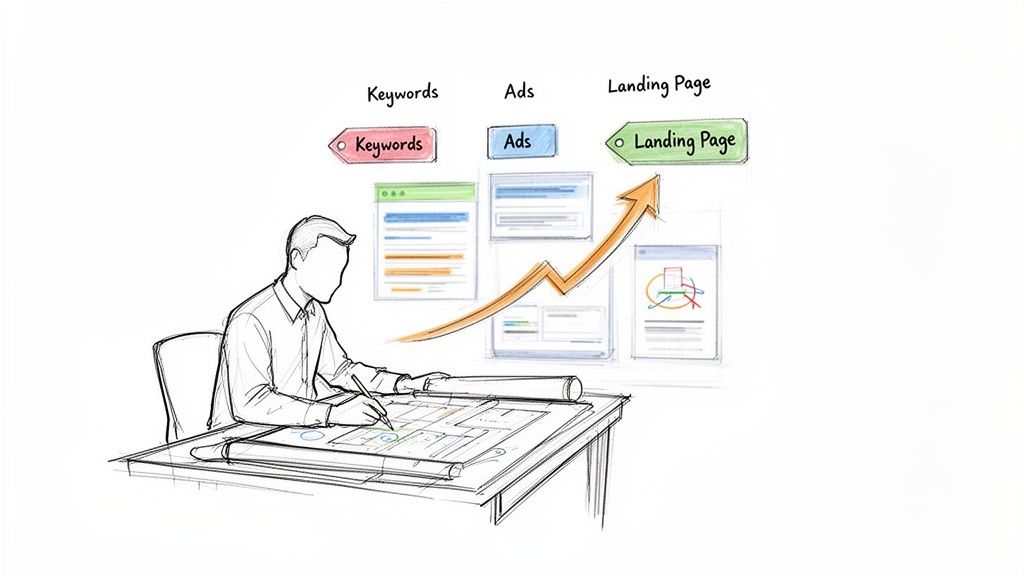
Before you hand over your ad spend, it’s crucial to peek behind the curtain. Top-tier agencies operate on a much deeper, more strategic level than you might expect. They don’t just launch campaigns and hope for the best; they architect them for success from the ground up.
Imagine a skilled architect designing a blueprint for a new building. They don’t just show up and start laying bricks. First, they need to understand the building's purpose, analyse the terrain, and map out every potential challenge. A great PPC agency applies that same meticulous planning to your digital presence.
The whole process kicks off with a deep dive into your business. Seriously, their first job is to understand what you’re actually trying to achieve. Are you chasing more online sales? Do you need a steady stream of qualified leads for your sales team? Or is it all about getting your brand name out there? This discovery phase is everything—it sets the direction for the entire campaign.
From there, they get into some serious market and competitor research. This isn't just a quick Google search. It's about figuring out exactly what your competitors are doing, what keywords they’re bidding on, and where the weak spots are in their strategy. This intelligence forms the bedrock of a data-driven plan, not one based on guesswork.
A PPC agency’s value isn’t just in managing ads, but in translating business goals into a profitable digital strategy. They connect the dots between your budget and your bottom line.
Once that strategic blueprint is locked in, the agency shifts into execution mode. This is where their specialised skills really come into play, covering a whole host of detailed tasks that make or break a campaign.
Here’s a glimpse of what that looks like:
By managing all these interconnected pieces, a specialised agency brings immense value. They transform your ad spend from a line-item expense into a powerful, predictable engine for business growth.
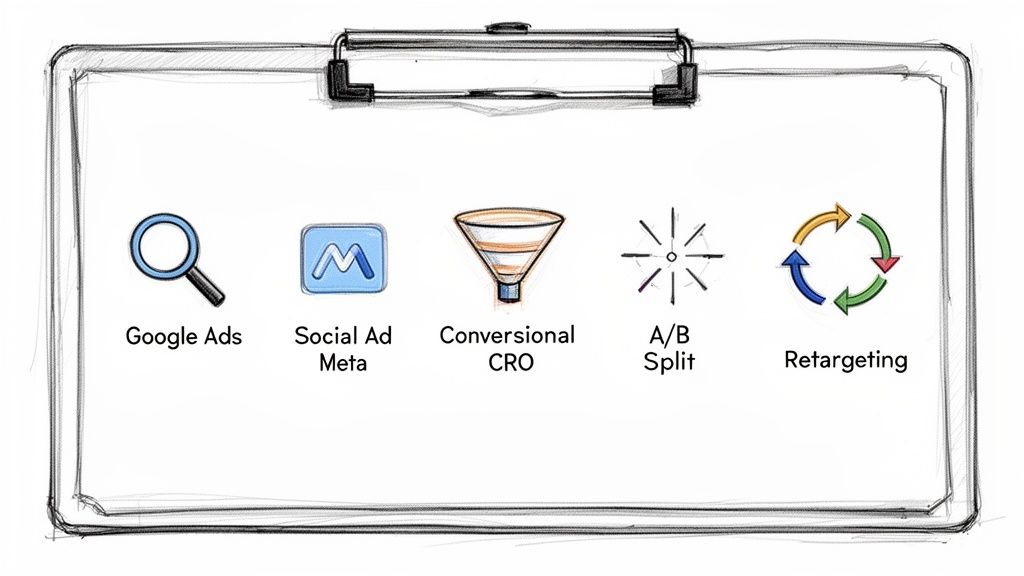
It’s fair to say that not all pay-per-click agencies are created equal. While most can handle the basics of a campaign, the really good ones offer a whole suite of services that cover every single step of the customer journey. They're focused on turning those initial clicks into genuine conversions, and eventually, into loyal customers.
Think of it like a restaurant. Some places just offer the basics, while the premier establishments provide a full multi-course experience. Understanding this "menu" of services is the key to matching your business needs with an agency's real expertise. It ensures you find a team that’s perfectly aligned with your growth goals, whether you’re chasing immediate leads or building your brand for the long haul.
At its heart, a PPC agency's main job is managing your ad campaigns across the platforms that matter. This is the absolute foundation of their service, the bedrock on which every other strategy is built. And trust me, it’s a lot more involved than just setting a budget and letting the ads run on autopilot.
This core service always includes:
The services that really separate the top-tier agencies from the pack are the ones focused on optimisation and growth. This is where they move beyond just managing a campaign to actively making it better and boosting your return on investment. It's what turns a good campaign into a great one.
The Australian digital ad market recently ballooned to a staggering AUD $16.4 billion, growing by 11.1% in just one year. This shows how much businesses are investing and why advanced optimisation isn’t a luxury anymore—it’s a flat-out necessity. With the average cost-per-click (CPC) on Google Ads in Australia ranging from $1.82 AUD for e-commerce to a hefty $13.37 AUD for finance, making every single click count is vital.
Simply driving traffic isn't enough. The real goal is to drive the right traffic and then make sure your website is perfectly tuned to convert those visitors into real business results.
When you're looking at what different agencies offer, it helps to see the full picture. Most will have a mix of standard and more advanced services available.
| Service Category | Description | Best For |
|---|---|---|
| PPC Audits | A deep dive into your existing ad accounts to find wasted spend, missed opportunities, and areas for improvement. | Businesses with existing campaigns that are underperforming or have plateaued. |
| Campaign Management | The day-to-day running of campaigns, including bidding, ad copy creation, and budget management across platforms. | Any business looking to outsource their paid advertising to experts. |
| Keyword Research | Identifying high-intent and long-tail keywords to target customers at different stages of the buying cycle. | Businesses starting new campaigns or wanting to expand their reach. |
| Social Media Ads | Creating and managing campaigns on platforms like Meta (Facebook/Instagram), LinkedIn, TikTok, and Pinterest. | Brands wanting to build awareness, target specific demographics, or engage with a community. |
| Landing Page Design | Designing and building dedicated landing pages that are optimised for conversion from a specific ad campaign. | Lead generation and e-commerce businesses focused on maximising ROI from ad spend. |
| Conversion Rate Optimisation (CRO) | Using A/B testing, heatmaps, and user behaviour analysis to improve website and landing page performance. | Businesses that have steady traffic but want to increase their lead or sale volume without increasing ad spend. |
| Retargeting Campaigns | Creating ads that specifically target users who have previously visited your website or engaged with your brand. | Virtually all businesses, especially e-commerce and those with longer sales cycles. |
| Reporting & Analytics | Providing detailed performance reports and data-driven insights to track KPIs and inform future strategy. | Any business that wants to understand campaign performance and see a clear return on investment. |
This table gives you a good starting point for mapping out what you need versus what an agency can deliver, ensuring you find a partner who can truly move the needle for your business.
One of the most valuable services an agency can provide is Conversion Rate Optimisation (CRO). This is the art and science of tweaking your website and landing pages to get more visitors to take the action you want, whether that's filling out a form or hitting "buy now." An agency that’s good at CRO doesn't just send you traffic; they help you convert it.
This process often involves:
On top of that, a well-rounded service includes crafting a smart strategy for Paid Ads Marketing in really competitive industries. Agencies also set up clever retargeting campaigns to re-engage people who've visited your site before, bringing those warm leads right back into your funnel.
Figuring out how you'll be charged is a massive part of finding the right agency partner. When you start the search for a pay-per-click agency, you'll quickly realise the pricing isn't a simple one-size-fits-all deal. Most agencies use a few common models, and each has its own quirks.
The right structure for you really comes down to your budget, what you want to achieve, and how hands-on you plan to be. Let's pull back the curtain on the most common pricing models so you know exactly what you’re looking at.
This is probably the most common model you’ll come across. The agency takes a management fee that’s a set percentage of what you spend on ads each month. This usually sits somewhere between 15% to 30%.
So, if your monthly ad budget is $10,000 and the agency’s cut is 20%, you’ll pay them $2,000 for their work. If you decide to ramp things up to $20,000, their fee climbs to $4,000. It's a popular choice because it scales directly with your advertising investment.
This model is a solid fit for businesses with growing budgets who want a straightforward, scalable fee.
With a flat-fee model, it's all about predictability. You pay a fixed amount every single month for PPC management, no matter what. This fee is locked in upfront and doesn't change based on your ad spend or how the campaigns are doing. For instance, an agency might charge a flat $3,000 per month to manage any ad spend up to $20,000.
This approach is fantastic for budgeting. Businesses that need to keep a close eye on cash flow love it because there are no nasty surprises, which makes financial planning a whole lot easier.
The biggest win with a flat-rate model is the transparency. You know exactly what’s going out the door each month, letting you focus on the results they're delivering, not on a fluctuating agency bill.
This one gets right to the point: the agency's pay is tied directly to the results they get for you. Instead of billing based on ad spend or a flat fee, they charge based on hitting specific targets, like the number of leads you get or sales you close. It’s a true "pay for what you get" approach.
For example, you might agree to pay the agency $50 for every single qualified sales lead they send your way through the campaigns.
Before you sign on any dotted line, always get clarity on setup fees, contract lengths, and exactly what’s covered in the service-level agreement (SLA). It’s the best way to make sure your investment is protected and everyone is on the same page.
Pay-per-click advertising is a numbers game. But in a world overflowing with charts and dashboards, it’s far too easy to get mesmerised by “vanity metrics”—stats that look good on paper but don’t actually tell you if you’re making money. A good PPC agency knows how to cut through the noise and zero in on the Key Performance Indicators (KPIs) that reveal the true financial health of your campaigns.
Getting your head around these core metrics is vital. It’s what turns you from a passive observer into an informed partner who can read a performance report with confidence and really understand the impact of your ad spend. Think of it like a doctor reading a patient's chart; each metric is a vital sign that tells a specific part of the story.
It all starts with the basic building blocks of PPC performance. These are the top-line figures every agency reports on, but their real value is in how they interact with each other. A great number in one area can be totally meaningless without the context from another.
Here are the essentials:
A high CTR is fantastic, but it’s useless if those clicks never convert. Likewise, a low CPA looks great, but not if the leads are low-quality and never close. The best agencies understand this balancing act and constantly tweak campaigns to get all these factors working together for maximum profit.
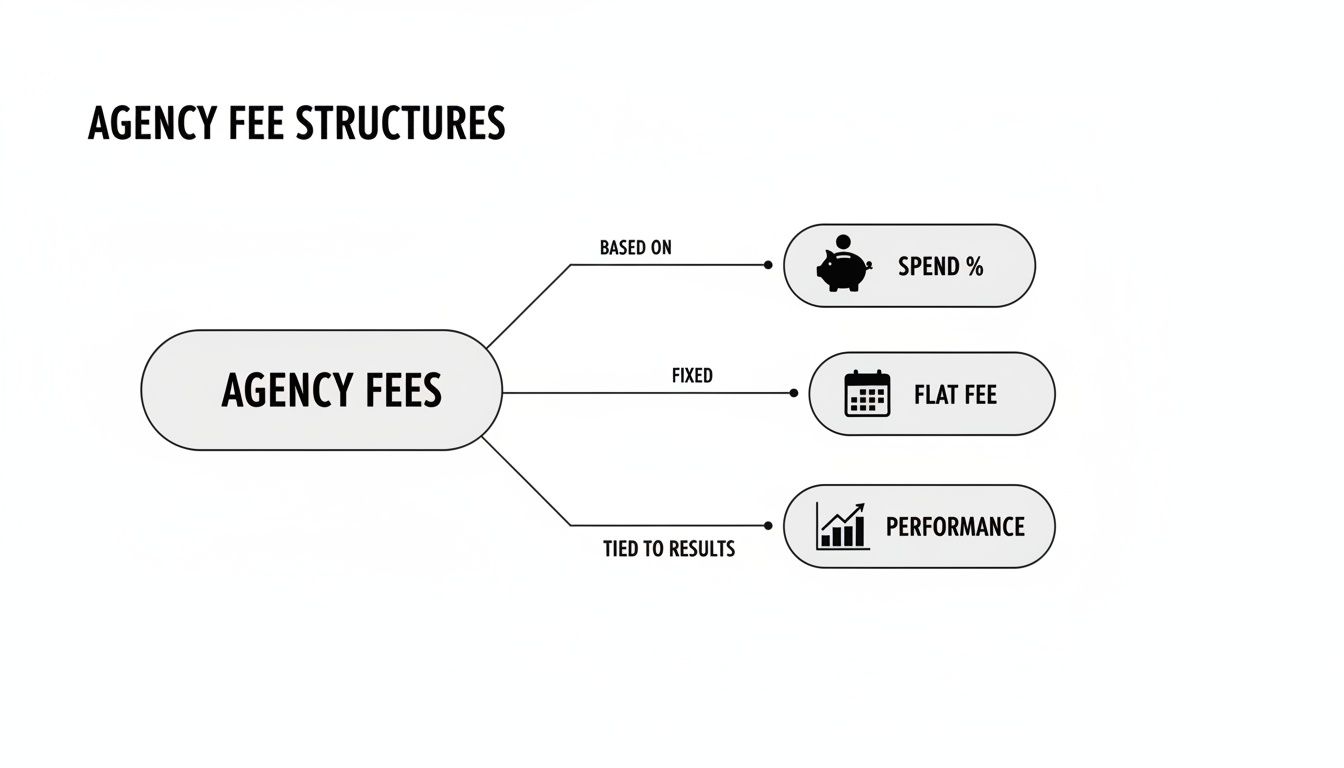
Understanding these fee structures is crucial for evaluating whether the performance justifies the cost, whether your agency charges based on a percentage of ad spend, a flat monthly fee, or performance targets.
While all the above metrics are important pieces of the puzzle, one stands head and shoulders above the rest: Return On Ad Spend (ROAS). This is the KPI that tells you exactly how much revenue you’re generating for every single dollar you spend on ads. It connects your campaigns directly to your business's bottom line.
ROAS cuts through all the noise. It answers the most important question: "Is my advertising investment actually profitable?"
For example, a 4:1 ROAS means that for every $1 you spent, you generated $4 in revenue. For businesses that can track the lifetime value of a customer, this metric becomes even more powerful, giving a clear window into long-term profitability. You can dive deeper into the nuts and bolts by checking out our guide on understanding ROAS in marketing.
To help put it all together, here’s a quick rundown of the essential metrics and what they really mean for your business.
| KPI (Metric) | What It Measures | Why It Matters For Your Business |
|---|---|---|
| Click-Through Rate (CTR) | The percentage of ad impressions that result in a click. | Indicates how well your ad copy and targeting are resonating with your audience. A higher CTR often leads to a better Quality Score and lower costs. |
| Conversion Rate | The percentage of clicks that complete a desired action (e.g., purchase, form fill). | This is the true measure of your campaign's effectiveness. It shows how well your landing page and offer are converting traffic into business value. |
| Cost Per Acquisition (CPA) | The average cost to acquire one new customer or lead. | A critical efficiency metric. Knowing your CPA helps you determine if your campaigns are profitable and scalable. |
| Return On Ad Spend (ROAS) | The total revenue generated for every dollar spent on advertising. | The ultimate profitability metric. It directly ties your ad spend to your revenue, answering the most important question: "Are we making money?" |
| Quality Score | Google's rating of the quality and relevance of your keywords, ads, and landing pages. | A higher Quality Score can lead to lower ad costs and better ad positions. It’s a key indicator of campaign health. |
These metrics don't exist in a vacuum; they tell a collective story about where your money is going and what it’s bringing back.
Knowing what these metrics mean is one thing, but knowing what a "good" number looks like is another. Benchmarks can vary wildly between industries, but having a general idea helps you set realistic goals with your PPC agency.
In Australia, Google Ads is still the dominant player. The platform has an average CTR of 6.42% across all industries, which is a healthy figure despite rising costs. However, the price of a click can be worlds apart depending on your industry. You might see an average Cost Per Click (CPC) of $1.82 AUD in e-commerce, but that can jump to $10.61 AUD for competitive legal services or even $13.37 AUD in the finance sector.
A skilled agency doesn't just report these numbers; they use them to take action. They analyse the data to spot trends, identify opportunities for improvement, and make strategic decisions that constantly refine your campaigns for better performance over time.
Handing over the keys to your ad spend is one of the biggest marketing decisions you’ll ever make. The right agency can become a genuine growth engine for your business, while the wrong one will happily burn through your budget with very little to show for it. Making a smart choice means looking past a slick sales deck and digging into what really matters.
This isn't about finding the cheapest option; it's about finding the most valuable one. You need a partner who gets your industry, aligns with your business goals, and operates with complete transparency. It’s a due diligence process, but one that puts you in the driver's seat.
Before you even start hopping on calls, it’s a good idea to have a clear set of criteria. This checklist will help you systematically evaluate each candidate, so you’re comparing apples with apples.
Once you have a shortlist, the interview process begins. The questions you ask should be designed to peel back the layers and reveal their strategic depth and problem-solving skills. To get a feel for how different agencies operate, you can even check out how platforms cater to them. For example, visiting WinningAds' agencies page can give you some useful context.
Here are a few questions I always recommend asking:
"Walk me through how you would approach our first 90 days together."
This reveals their onboarding process and how they plan. A great answer will involve discovery, research, and a phased rollout—not just jumping straight into launching ads.
"Can you share an example of a campaign that failed and what you learned from it?"
This is a test for honesty and a commitment to learning. Every single agency has campaigns that don't go to plan; the best ones analyse why and apply those lessons moving forward.
"How do you connect PPC performance to our bigger business goals, like revenue?"
This is the question that separates the button-pushers from the true strategists. You want a partner who thinks about your bottom line, not just clicks and impressions.
An agency's true value is revealed not in their sales pitch, but in the quality of the questions they ask you. A great partner will be just as interested in vetting you as a client to ensure a successful fit.
Just as important as knowing what to look for is knowing what to avoid. Certain behaviours are clear warning signs that an agency might not be the right partner for your business.
Keep an eye out for these red flags:
The search for the right partner can feel a bit daunting, but this framework will help you navigate it with confidence. By focusing on evidence, strategic thinking, and transparency, you'll be well-equipped to find one of the top PPC marketing agencies that can truly help your business grow.
Stepping into the world of PPC agencies can feel like learning a new language. There are a lot of moving parts, and getting straight answers is the only way to feel confident you're making the right call for your business. Let's tackle some of the most common questions we hear from companies just like yours.
Think of this as your cheat sheet for the practical side of hiring a PPC specialist.
This is the big one, and the answer has two parts: the agency's management fee and your actual ad spend. For a medium-sized business here in Australia, you can expect a monthly management fee to land somewhere between AUD $1,500 and $5,000+. That fee is purely for the expertise, strategy, and hands-on management—it's completely separate from what you pay the ad platforms.
Your ad spend, the money that actually goes to Google or Facebook, often sits between AUD $5,000 and $20,000 a month. Where you fall in that range really depends on how competitive your industry is and what you’re trying to achieve. It’s less of a cost and more of an investment; you’re paying for experts to make every dollar of that ad budget work harder and deliver a much stronger return.
While you'll see traffic coming through almost the second a campaign goes live, the real, optimised results take a little patience. You're typically looking at about three months to see meaningful momentum. That initial period isn't dead time; it's a critical phase for gathering data and learning what your audience actually responds to.
The first 90 days are all about strategic learning. Month one is for setup and data gathering. Month two is for the first round of tweaks and optimisations. By the end of month three, you should be seeing a clear, positive trend in your key metrics.
By that third month, your agency has a much clearer picture of what's working. They should be able to show you a solid upward trajectory in the numbers that matter most, like your Cost Per Acquisition (CPA) and Return On Ad Spend (ROAS).
Great question. Both Search Engine Optimisation (SEO) and Pay-Per-Click (PPC) are about getting seen on search engines, but they go about it in completely different ways. Getting your head around the distinction is key to understanding where a PPC agency fits into your wider marketing efforts.
Here’s the simple version:
Honestly, the most powerful digital strategies use both. It’s a one-two punch that maximises your visibility, making sure you’re capturing potential customers from every possible angle.
At Virtual Ad Agency, we build data-driven PPC strategies that deliver real, measurable growth for medium-to-large businesses. If you’re ready to see what a strategic partnership can do for your bottom line, let's talk. Find out how we can help by visiting us at https://www.virtualadagency.com.au.

 previous