
Choosing the right lead generation partner can feel like a massive undertaking, but it all boils down to one simple thing: finding an agency whose capabilities match your business goals. A great partner does more than just hand over a list of contacts; they deliver qualified prospects who are actually ready to talk to your sales team.
Let's cut through the noise and get straight to what matters.
Think of vetting potential agencies as a targeted reconnaissance mission. The goal is to quickly figure out their core strategies and understand exactly how they get results for clients like you. A modern lead-gen agency won't put all its eggs in one basket. Instead, they'll blend several high-impact methods to build a steady flow of opportunities.
A balanced approach is what you’re looking for. The best partners mix and match their tactics to engage prospects at different stages of their buying journey.
When you're first sizing up a potential partner, keep an eye out for genuine expertise in these key areas:
Let's take a quick look at how these channels stack up.
| Channel | Primary Benefit | Typical Conversion Rate |
|---|---|---|
| AI Chatbots | Real-time lead capture & qualification from existing website traffic. | 2-5% of site visitors convert to leads |
| LinkedIn Outreach | Highly targeted B2B prospecting & direct relationship building. | 1-3% reply rate on cold campaigns |
| Content Marketing | Builds brand authority & attracts warm, inbound leads over time. | 0.5-2% visitor-to-lead conversion |
Each channel has its strengths. A chatbot delivers immediate results, LinkedIn gets you in front of specific decision-makers, and content builds a sustainable asset for the future. The magic happens when an agency knows how to combine them.
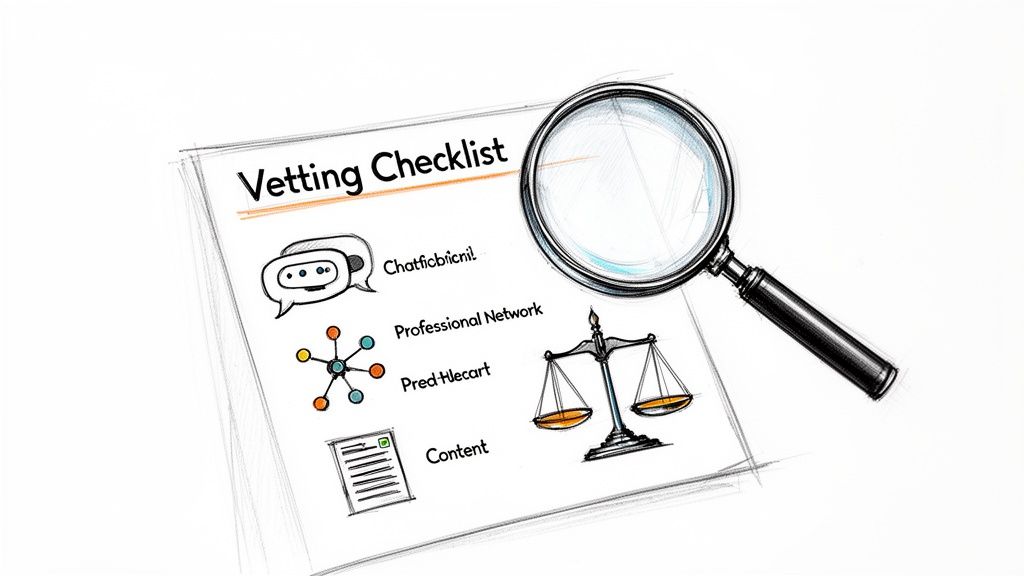
When it comes to something like LinkedIn, a strong agency uses profile data—like job titles, company size, and industry—to craft highly relevant messages that don't feel like spam.
An agency that truly gets how to use a platform like LinkedIn can become a priceless extension of your sales team, sparking the kinds of meaningful conversations that lead directly to new business.
Not all lead generation companies are cut from the same cloth. Getting your head around the services they offer and the thinking behind them is your first real step towards finding a partner who can deliver predictable growth—not just a spreadsheet of random names. It’s all about matching their playbook to your business goals.
At a high level, these firms usually run on two distinct models: inbound and outbound. Think of it as the difference between a magnet and a megaphone. Inbound strategies are designed to pull interested people towards you, while outbound pushes your message out to find them.
A truly switched-on partner rarely relies on just one. They’ll blend both, creating a campaign that connects with potential customers at different points in their journey. For instance, an outbound email might introduce your brand, which then prompts a prospect to download an inbound piece like an eBook. Just like that, they’re qualified for a sales call.
Inbound lead generation is all about creating value before you ask for anything in return. The aim is to produce genuinely helpful, relevant content that your ideal customer stumbles upon through search engines or social media. This builds trust and cements your business as an authority in your space.
Common inbound services you’ll see include:
This approach is powerful because the leads it brings in are already "warm"—they've actively sought you out and shown they’re interested. Our complete guide on B2B lead generation strategies gets right into the nuts and bolts of building a strong inbound engine.
Inbound marketing is a long game. It might take more time to see results compared to outbound, but the leads are often higher quality and convert better because they’ve already qualified themselves.
Outbound lead generation is much more direct. It’s about proactively reaching out to a carefully curated list of potential customers who fit your ideal client profile. Here, precision and relevance are everything if you want to avoid being seen as spam.
Sophisticated lead gen companies are masters at this. They do it by:
Done right, outbound is a fast and scalable way to build your pipeline, especially when you’re trying to crack a new market or go after specific high-value accounts. When you're weighing up different services, look for partners using advanced tools like AI actions for Salesforce leads to handle lead qualification and routing more efficiently.
The Australian lead generation scene in 2025 is being supercharged by AI, with 58% of B2B companies expected to use AI-powered chatbots for lead qualification. This is tipped to boost sales efficiency by a whopping 35%.
Here’s a quick look at how a simple AI chatbot can engage a website visitor and qualify them on the spot.
This kind of automated chat gathers key info without needing a human to step in, freeing up your sales team to focus on the hottest prospects.
To make sense of which model fits you best, it helps to see them side-by-side. Each has a different feel, cost structure, and is suited for different business situations.
| Model | Approach | Cost Structure | Best For |
|---|---|---|---|
| Inbound | "Pull" Marketing: Attracts leads through valuable content, SEO, and social media. | Typically a monthly retainer for ongoing strategy and content creation. | Businesses building a long-term brand, educating the market, and seeking high-quality, self-qualified leads. |
| Outbound | "Push" Marketing: Proactively contacts potential leads via email, calls, and direct outreach. | Can be a monthly retainer, pay-per-lead (PPL), or a hybrid model. | Businesses needing to generate pipeline quickly, targeting specific accounts, or breaking into new markets. |
Ultimately, the best strategy often involves a bit of both. An inbound blog post can be the perfect follow-up for an outbound email sequence, creating a much smoother experience for your potential customer.
Beyond the what, you need to understand the how. How will the agency structure the partnership? The two most common models you’ll come across are monthly retainers and pay-per-lead agreements.
A monthly retainer gives you a dedicated team and a set scope of work for a fixed fee. This is ideal for complex, ongoing campaigns that need a mix of inbound and outbound activities.
In contrast, a pay-per-lead (PPL) model is purely performance-based; you only pay for the qualified leads you get. PPL can be a great way to test the waters with an agency with less upfront risk, but you absolutely must have a crystal-clear definition of what a "qualified lead" is to avoid any dramas down the line.
Picking the right lead generation partner is about a lot more than just being wowed by a slick presentation or a polished website. A proper evaluation means you need to get your hands dirty, digging into their process, double-checking their claims, and making absolutely sure their entire approach fits with how your business actually operates. A bad fit here isn't just a waste of money; it can seriously damage your brand with poorly executed or off-brand outreach.
Your first port of call should be to scrutinise their case studies and testimonials, but with a healthy dose of scepticism. Don't just skim the headline success stories. You're looking for real evidence that they "get" your specific industry and its unique quirks. A company that boasts incredible results for a SaaS client might be completely out of its depth trying to apply the same playbook to a manufacturing business.
When you're digging into case studies, the devil is in the detail. Vague claims like "we increased leads" should set off alarm bells. What you really want to see is concrete, measurable data that tells a story.
This kind of process flow gives you a glimpse into the common strategies lead generation companies use, whether it's pulling in prospects with valuable content or proactively reaching out to them.
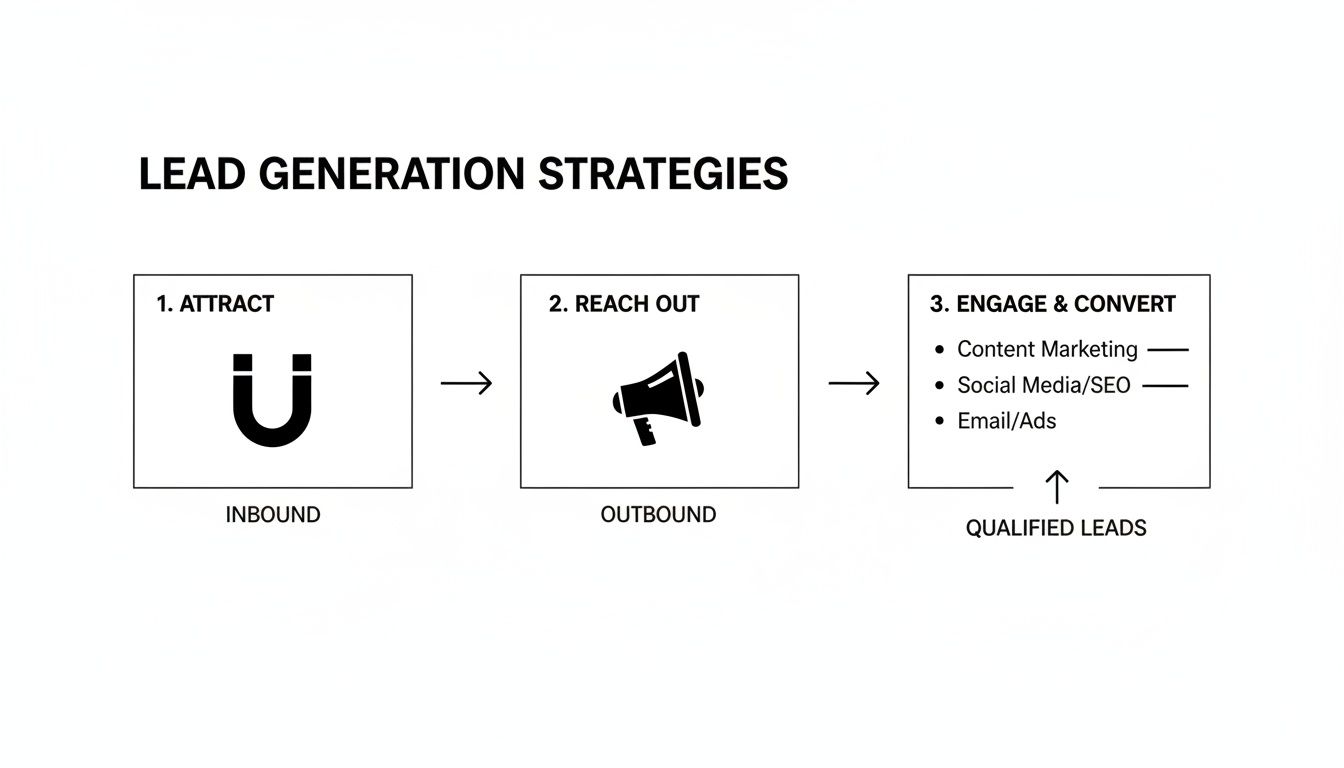
Understanding whether an agency leans more towards inbound (attracting leads) or outbound (finding leads) helps you see if their core strength matches what you need right now.
Testimonials are nice, but nothing beats a direct conversation. Ask any potential partner for references from current or recent clients—and try to get ones that look a lot like your own company. When you get on the phone with these references, you aren't just confirming they were happy; you're gathering real-world intelligence.
A few solid questions to ask their references:
That third question is particularly telling. Every agency has campaigns that don't perform as hoped. The best partners are upfront about it and come to the table with data-backed solutions, not a list of excuses.
A great agency doesn't just report on the numbers; they provide insights and clear next steps. If their reports feel like a data dump with no analysis, it's a sign they're focused on activity, not outcomes.
Australian marketers are increasingly seeing the power of value-first strategies. In fact, content marketing is now generating three times more leads than traditional outbound methods, all while costing 62% less. This really drives home the importance of finding a partner who can execute a modern, inbound-style strategy. You can discover more insights about B2B marketing statistics on leadagency.com.au.
Before you even think about signing a 12-month contract, it's a smart move to propose a short-term pilot project. A three-month trial is usually more than enough to get a real feel for their capabilities, their communication style, and, most importantly, their ability to deliver the qualified leads you need. It's a great way to minimise your risk and get a real-world sample of their performance.
For the pilot, you'll want to define a very specific, measurable goal. Something like, "Generate 15 Sales Qualified Leads from companies in the fintech sector with over 100 employees." This kind of clarity means you can objectively judge their success when the trial period is over. Any agency that's confident in its abilities will jump at the chance to prove its value.
Once you’ve got a shortlist of promising lead generation companies, it’s time to dig a little deeper. This is where you move from just looking at their website to asking the hard questions, and a well-thought-out Request for Proposal (RFP) is your best friend here.
A good RFP isn’t just about getting a price list. It’s designed to make potential partners show you how they think, how they work, and what success actually looks like to them. It helps you quickly sort the genuine strategic partners from the ones who are just selling you a list of names.
Forget those long, complicated documents no one wants to read or fill out. Your goal is to get clear, comparable answers that let you make a confident choice.
To get the ball rolling, your RFP needs to cover a few core sections. Think of it as giving them the briefing documents they need to give you a smart response.
This simple framework forces agencies to provide a relevant, tailored response instead of a copy-and-paste sales pitch.
Now for the most important part: the questions. This is where you probe beyond the slick marketing claims to find out how an agency really operates. Remember, generic questions get generic answers.
Here are the essential questions you should be asking every single potential lead generation partner:
A strong agency will welcome these kinds of detailed questions. A weak one will give you vague, fluffy answers. A bad response to the optimisation question sounds like, "We will work to improve the campaign." A great one sounds like, "We'd analyse open and reply rates, A/B test three new subject lines, and refine the target list based on engagement data."
The quality of their answers tells you everything you need to know about their expertise. A partner who can clearly explain their process is one you can trust. An agency that talks in circles is a major red flag.
To make it even easier to compare apples with apples, organising your questions into a clear structure is key. This table lays out the essential sections for your RFP and the kind of questions that will get you the answers you need.
| RFP Section | Purpose | Key Questions |
|---|---|---|
| Company & Strategy | To understand their business model, expertise, and strategic fit with your goals. | – Tell us about your company’s core strengths. – What makes your approach to lead generation different? – Share two relevant case studies from our industry. |
| Process & Methodology | To learn about their day-to-day operations, from data sourcing to lead qualification. | – How do you source and verify contact data? – Walk us through your lead qualification process (MQL vs. SQL). – How do you handle campaign optimisation for underperforming results? |
| Technology & Integration | To ensure their tech stack is compatible with yours and meets your security needs. | – Which CRM platforms are you most experienced with? – How do you ensure data security and compliance with privacy laws? – What tools do you use for outreach and campaign management? |
| Reporting & KPIs | To align on how success will be measured and communicated. | – What Key Performance Indicators (KPIs) do you track? – Can you provide a sample performance report? – What is your proposed meeting and communication schedule? |
| Pricing & Terms | To get a clear, transparent view of the costs and contract details. | – Please provide a detailed breakdown of your pricing model. – Are there any setup fees or hidden costs? – What are your standard contract lengths and termination clauses? |
Using a structured approach like this ensures every agency is answering the same core questions, making your final decision that much clearer and more confident.
Before you even think about signing a contract, you need to have a serious chat about the numbers. Getting your head around how a lead generation company structures its pricing isn't just a budget exercise; it’s about making sure their financial incentives are locked in with your business goals. Get this wrong, and you'll end up with a partnership that feels more like a transaction than a strategic move.
Most agencies you'll talk to will lean on one of three main pricing models. Each one has its own set of pros, cons, and a different level of risk for you, the client.
Which model works best for you really comes down to your company's appetite for risk and how quickly you need to see a return on your investment.
Monthly Retainer: This is a classic. You pay a fixed fee each month for a specific scope of work. It’s perfect for those bigger, integrated campaigns that mix inbound and outbound tactics, as it gives you a dedicated team that's focused squarely on your account. The upside is budget predictability, but it definitely requires a high degree of trust that the agency knows how to deliver.
Pay-Per-Lead (PPL): With a PPL model, it's simple: you only pay for the qualified leads the agency sends your way. It's an attractive option because it ties your costs directly to a tangible result, which lowers your upfront financial risk. The catch? Your definition of a "qualified lead" has to be absolutely rock-solid. Otherwise, you’ll find yourself paying for prospects who are a terrible fit for your sales team.
Performance-Based or Hybrid: This is where things get interesting. This model usually combines a smaller retainer with performance bonuses tied to very specific outcomes—think appointments set, or even better, deals closed. It’s a genuine partnership model where the agency truly has skin in the game. Their success is directly linked to yours.
When you're in negotiations, always ask the hard question: what happens if performance targets are missed? Will you get a credit for the next month? Does it automatically trigger a strategy review? A great partner will have a clear plan for getting back on track, not a list of excuses.
Let's be blunt: the total number of leads is a vanity metric. It looks good on a report but means very little on its own. What really matters is the impact those leads have on your bottom line.
Setting realistic, meaningful Key Performance Indicators (KPIs) from day one is the only way to measure the true value of what you're paying for. Your chats with potential agencies should focus less on lead quantity and a whole lot more on lead quality.
Here are the KPIs that actually make a difference:
These metrics completely change the conversation from, "How many leads did we get?" to, "How much revenue did this partnership generate?" A confident lead generation company won't shy away from being measured by these bottom-line results. They know their job isn't just to fill the top of your funnel—it's to fuel genuine business growth.
The first 90 days with a new lead generation partner are where the real foundation for success is laid. A messy or rushed onboarding is a massive red flag, and it almost always leads to mismatched expectations and underwhelming results down the track. A great partnership kicks off with a smooth handover, clear communication, and a shared definition of what a ‘win’ actually looks like.
This initial phase is far more than just sharing a few logins; it's a critical alignment period. Your new agency needs to become an extension of your team, getting a deep feel for your brand voice, your ideal customer, and the specific problems you solve. It's here that you set the rhythm for the entire engagement.
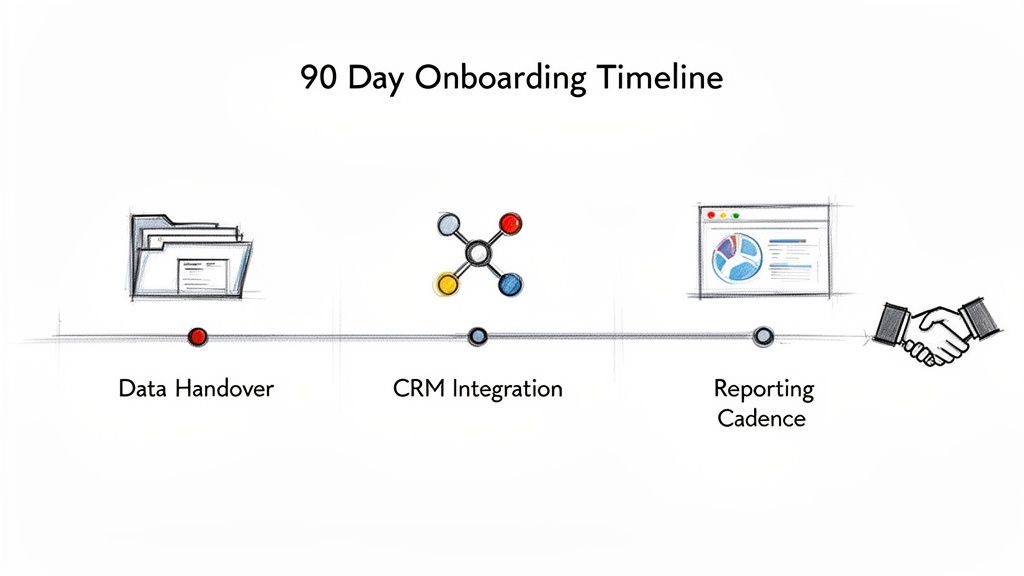
A structured onboarding process makes sure nothing slips through the cracks. It should feel like a true collaboration, not like you're just lobbing information over a wall and hoping for the best.
Your agency should be driving this with a clear checklist, but it generally involves a few key steps:
Getting the technical setup right is non-negotiable. If a lead gen company fumbles a simple CRM integration, it should make you seriously question their ability to handle more complex campaign management later on.
Vague reporting is a classic calling card of an underperforming agency. You need more than a monthly PDF clogged with vanity metrics. The goal is to set up a reporting system that gives you actionable insights, not just a data dump.
The most valuable reports answer the question, "So what?" A good report doesn't just show that you got 100 leads; it shows where they came from, why they are qualified, and what the plan is to get 120 better ones next month.
The best lead generation companies give you access to a live dashboard that you can check whenever you want. This kind of transparency builds trust and keeps everyone on the same page. But a dashboard is only half the story.
You also need a regular meeting—usually weekly or fortnightly—to talk through performance. This catch-up shouldn’t just be a recital of the numbers on the screen. It needs to focus on:
This constant feedback loop is what turns a good campaign into a great one. It all comes down to a strong partnership where both sides are committed to improvement. Integrating these strategies with wider automation can seriously boost efficiency; you can find out more by exploring what marketing automation is and how it can support your campaigns. By putting these processes in place from day one, you build a system for sustained growth and a partnership built on clarity and results.
When you're thinking about bringing on a lead generation partner, a few questions always come up. It's smart to ask them. Getting straight answers before you sign anything is the foundation of a good, transparent partnership.
This is probably the number one question we get asked, and for good reason. You're making an investment and you want to know when you'll see a return.
While every campaign has its own rhythm, you should start seeing the first trickle of leads within the first 30 to 45 days. This initial phase is all about launching, gathering real-world data, and making those first critical tweaks. The real momentum, that steady stream of qualified leads you're after, usually builds up over the first 90 days as the campaign finds its groove.
It’s a fair question. Sometimes, a campaign doesn't hit the ground running. This is a normal part of the process, and a good partner won't start making excuses. They’ll have a clear, data-driven plan to figure out what's going on and how to fix it.
They should be diving into the numbers and asking the right questions:
A proactive agency will come to you with these insights, not just the problems. They'll have a plan ready for A/B testing new messaging, refining the audience, or adjusting the offer to get things back on track.
A partnership is a two-way street. If a campaign is struggling, the best results come from open collaboration. Provide your agency with honest feedback from your sales team on lead quality—it's the most valuable data they can get.
This kind of collaborative problem-solving is what turns an underperforming campaign into a winner. It's the mark of a true strategic partner, not just another service provider.
At Virtual Ad Agency, we build partnerships focused on transparency and measurable outcomes. We combine strategic insights with data-driven execution to deliver qualified leads that fuel real business growth. Learn more about our unique approach to lead generation.

 previous