
At its core, EDM stands for Electronic Direct Mail. It’s the modern-day version of the letters a business used to send you in the post, only now it lands directly in your email inbox. The goal is the same: building a relationship, driving sales, and keeping customers loyal through messages that feel personal.
Think of it this way: old-school email marketing is like dropping a generic flyer into every letterbox on a street. A few people might glance at it, but most will just toss it in the bin. It’s a shot in the dark.
Strategic EDM, on the other hand, is like a handwritten invitation sent directly to someone who’s already shown they’re interested in your party. It goes way beyond just hitting 'send' on a massive, faceless list. It uses data to understand who people are, segmentation to group them, and automation to have relevant, one-on-one conversations at scale.
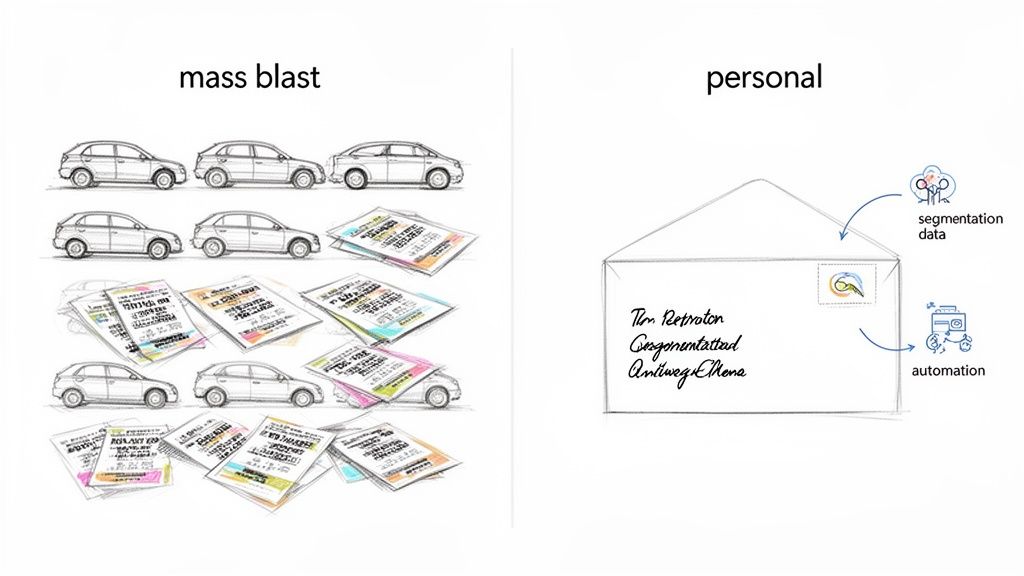
It’s this targeted approach that makes it a true cornerstone of digital strategy for Australian businesses. You’re not just sending an email; you're sending the right email to the right person at exactly the right time.
To really get the difference, let’s quickly break down the two approaches.
| Feature | Traditional Email Blast | Strategic EDM |
|---|---|---|
| Audience | One large, unsegmented list | Segmented lists based on behaviour, demographics, or purchase history |
| Message | Generic, one-size-fits-all content | Personalised and highly relevant to the recipient |
| Timing | Sent at a single, scheduled time to everyone | Automated and triggered by user actions (e.g., cart abandonment) |
| Goal | Mass communication, brand awareness | Nurturing leads, driving conversions, building loyalty |
| Analogy | A billboard on a highway | A personal shopper's recommendation |
The real magic of EDM marketing lies in its direct line to a very personal space: the inbox. It’s a channel people trust. Recent research from Australia shows that consumers are happy to subscribe to between 6–10 brands via email. Compare that to the 1–5 brand relationships they’ll typically maintain through SMS, and you start to see just how much trust and reach email commands. If you're keen to dig deeper, you can find more insights about Australian email and SMS trends to get the full picture.
An effective EDM strategy turns a monologue (shouting at everyone) into a dialogue (speaking with someone). It recognises your audience isn't a faceless crowd, but a collection of individuals with their own needs and interests.
Ultimately, understanding what EDM marketing truly means is about recognising this shift. It’s moving away from mass communication and towards meaningful, personal connection. That’s the real secret to building lasting customer relationships and driving predictable growth in today's market.
Think of a successful EDM campaign like a well-made recipe. It's not just about throwing things together; you need the right ingredients, combined in the right order, to create something that leaves an impression. Moving from simply understanding what EDM is to actually launching a campaign that gets results means mastering four key components.
Get these right, and you turn a simple email into a genuine business tool.
First up, and arguably the most important ingredient, is your audience. You can have the most beautifully designed email and the most compelling offer, but if you're sending it to the wrong people, it's all for nothing. The first real step is to curate a high-quality list of contacts—people who have actively chosen to hear from you. You need to ethically build a powerful email address list full of genuine prospects, not just random addresses scraped from the web.
Once you have your list, it's time to get smart with it. This is where segmentation comes in. And no, we're not just talking about splitting contacts by postcode. Modern, effective segmentation is all about grouping subscribers based on their behaviour.
Think about it:
This is the perfect lead-in to automation, the real engine of your EDM strategy. Automation uses triggers—like a customer ditching their online shopping cart—to send super timely and relevant emails without you having to lift a finger. That abandoned cart, for instance, could automatically trigger a reminder email an hour later, maybe followed by a small discount offer 24 hours after that. It's about turning those near misses into wins.
Of course, all the clever targeting in the world won't save a boring email. The final two pieces of the puzzle are all about the content itself.
By mastering these four building blocks—a quality list, smart segmentation, timely automation, and engaging content—you assemble a complete toolkit for creating EDM campaigns that deliver real results.
A powerful EDM strategy never works in isolation; it’s the central nervous system connecting all your marketing efforts. It’s what transforms scattered touchpoints from channels like SEO, social media, and paid ads into one seamless, cohesive customer journey.
Picture this common scenario: a potential customer finds your business through a Google search for a problem you solve. They click through to your website, read a blog post, and download a helpful guide, giving you their email in return. This is where EDM takes the baton.
From that point on, your EDM system nurtures that new lead. It sends a welcome series, delivers valuable content related to their interests, and gently guides them toward making a purchase. It’s the engine that converts that initial flicker of interest into real action.
This integration is a two-way street. Data from your paid ad campaigns can directly inform your email segmentation. For instance, if you know a lead came from a Facebook ad promoting a specific product, you can add them to an EDM sequence focused entirely on that product’s benefits and features.
This creates a powerful feedback loop where each channel makes the others stronger. Your ads generate leads, EDM nurtures them, and the resulting customer data helps you create even more targeted and efficient ad campaigns.
The journey doesn't end at the first sale, either. Post-purchase EDM campaigns are crucial for turning one-time buyers into lifelong advocates. You can send thank you messages, request reviews, offer loyalty rewards, and introduce complementary products—all of which deepen the customer relationship. This transforms the traditional marketing funnel into a continuous cycle of engagement and growth. You can explore more strategies for building these integrated experiences by learning about cross-channel marketing campaigns.
The chart below shows how these core components drive the process.
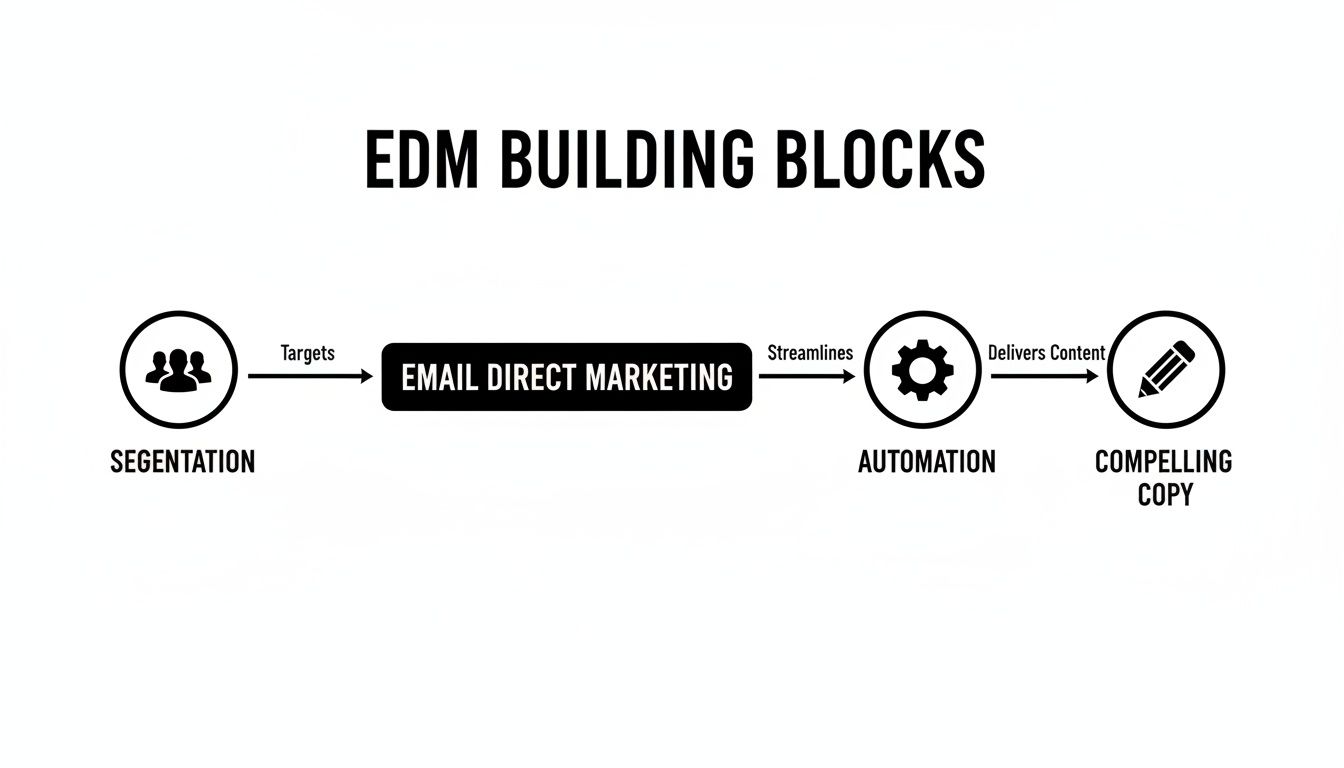
This shows how segmentation, automation, and great copy work together to move customers through the funnel. A powerful EDM campaign doesn't just end with a sent email; it directs recipients to optimised destinations. Learning how to create a landing page that converts fast is a critical skill for squeezing every last drop of ROI from your campaigns.
Anyone can hit 'send' on a campaign. That's the easy part. The real challenge is figuring out if it actually worked—and for that, you need to look well beyond the surface-level numbers.
While a high open rate might give you a warm fuzzy feeling, it doesn’t tell you the whole story. Far from it. True success in EDM is measured by the actions people take that actually move the needle for your business. It’s about impact, not just impressions.
To get a clear picture of what’s really going on, you need to shift your focus from who opened your email to who took meaningful action because of it.
It's easy to drown in a sea of data. Instead of getting bogged down, it pays to zero in on the metrics that give you genuinely actionable insights. These numbers don't just report on what happened; they actively inform your next move and help you understand precisely what’s connecting with your audience.
Here are the essential KPIs you should be tracking:
A high click-through rate but a low conversion rate isn't a failure—it's a clue. It often signals a disconnect between the promise made in your email and the experience delivered on your landing page, giving you a clear problem to solve.
Ultimately, tracking these core metrics lets you calculate your overall Return on Investment (ROI), proving the tangible, dollars-and-cents value of your EDM program.
To help you get started, we've put together a quick reference table for the most important metrics, what they reveal, and some general benchmarks we see for Australian businesses.
| Metric | What It Measures | Good Benchmark (AU) |
|---|---|---|
| Open Rate | The percentage of recipients who opened your email. | 15% – 25% |
| Click-Through Rate (CTR) | The percentage of recipients who clicked a link. | 2.5% – 5% |
| Conversion Rate | The percentage who completed a goal after clicking. | 1% – 3% |
| Bounce Rate | The percentage of emails that couldn't be delivered. | Under 2% |
| Unsubscribe Rate | The percentage who opted out of your list. | Under 0.5% |
| List Growth Rate | The net rate your subscriber list is growing. | 5% – 15% (annually) |
Remember, these are just starting points. Your industry, audience, and the quality of your list will all influence your results. The key is to track your own performance over time and focus on steady improvement.
By consistently monitoring these figures, you can stop guessing and start making smarter, data-driven decisions that deliver real results. To go deeper, check out our comprehensive guide on essential digital marketing performance metrics.
Building a genuine connection with your audience means respecting their inbox. This isn't just about good manners; in Australia, it’s the law. To really get what EDM is about, you have to know the rules, and for any Aussie business, that means getting familiar with the Spam Act 2003.
Ignoring these rules won't just tarnish your brand's reputation—it can land you with some seriously hefty fines. The good news is, staying compliant is pretty straightforward. It all comes down to three core principles of ethical marketing. Think of them as the non-negotiable rules of the road for every single email you send.
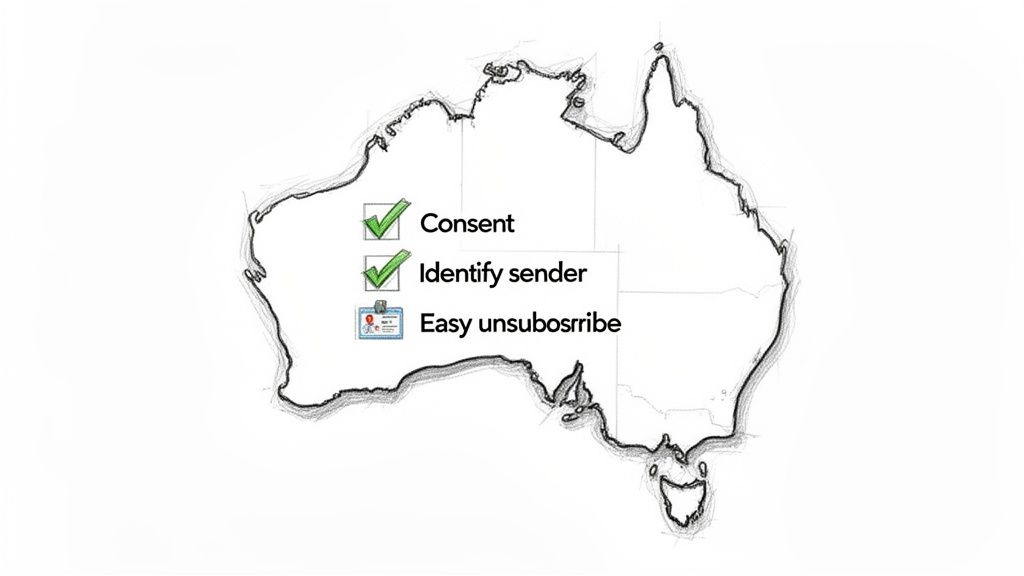
To keep things legal and build trust, every commercial email hitting an inbox must tick these three boxes:
Sticking to these rules is about so much more than just dodging a fine. It’s the very foundation of a sustainable, trust-based relationship with your customers, making sure your messages are actually welcomed, not just junked.
By weaving these practices into the fabric of your EDM strategy, you're not only protecting your business but also showing a fundamental respect for your audience. And that, right there, is the cornerstone of any marketing that truly works.
Right, so you've nailed the basics. But if you want to leave your competitors in the dust, it's time to move beyond the standard newsletter blast. The real magic happens when you turn your EDM program into a powerful, automated engine for growth.
This is where leading brands separate themselves from the pack. It’s all about creating hyper-relevant experiences for every single subscriber, at scale. The goal? To make each person feel like you're speaking directly to them, even when you're communicating with thousands.
At the heart of any advanced strategy is some seriously deep personalisation. I’m talking about going way beyond just dropping in a subscriber's first name. With dynamic content, you can swap out entire blocks of an email in real-time, based on what you know about the person opening it.
Think about how a retailer could use this:
This level of customisation makes your messages feel incredibly relevant, which has a direct knock-on effect on engagement and sales. People notice this stuff. In fact, research shows that 33% of email subscribers really appreciate it when brands remember their preferences. Knowing their history is key.
Another incredibly powerful tactic is setting up behavioural triggers. These are automated emails that fire off in response to something a user does (or doesn't do) on your website or app. Go deeper than the standard abandoned cart email.
Consider setting up triggers for things like:
These triggered messages are timely, relevant, and often achieve engagement rates far higher than standard campaigns because they arrive at the perfect moment of interest.
Finally, you need to commit to some proper A/B testing. Don't just fiddle with subject lines. Start experimenting with send times, call-to-action button colours, completely different email layouts, and various offers to constantly refine your approach. By pulling all these advanced tactics together, you can build a truly high-performance email marketing program that boosts customer loyalty and delivers a serious return on your investment.
Even when you’ve got a handle on the big picture, the day-to-day questions always pop up. Let’s tackle a few of the most common queries we hear about using Electronic Direct Mail.
It’s simple, really. Think of ‘EDM’ as the entire toolbox and a ‘newsletter’ as just one specific tool inside it.
EDM is the overarching strategy for all your targeted electronic messages. A newsletter is typically a general update you send to a wide audience. An EDM campaign, on the other hand, could be a highly specific, personalised offer sent to a tiny group of customers who looked at a certain product yesterday. One is a broadcast; the other can be a precision strike.
There’s no magic number here. The real key isn’t frequency, it’s consistency. What works depends entirely on your industry, who your audience is, and how much value you’re packing into each email.
The best way forward is to test it out. Try sending weekly for a month, then switch to fortnightly and watch your engagement metrics like a hawk. See what your audience responds to. The one thing you don't want is an unpredictable schedule – that’s a surefire way to get forgotten or sent straight to the junk folder.
Forget asking "how often?" and start asking "how valuable?" If every email is genuinely useful, people will be happy to hear from you. If it’s not, even once a month feels like spam.
Absolutely. In fact, EDM is a B2B marketing powerhouse. The content might change from weekend sales to deep-dive industry insights, but the strategy is the same.
For B2B, the sales cycle is often much longer and more considered. Marketers use EDM to nurture those high-value leads over time with things like case studies, white papers, and exclusive webinar invites. It’s all about building credibility and staying top-of-mind, guiding prospects through their decision-making process one valuable email at a time.

 previous