
Picture this: you're feeding money into a giant advertising vending machine, but you're not entirely sure if you're getting more back than what you've put in. That’s pretty much what marketing can feel like if you don't have a solid grasp on ROAS.
Return on Ad Spend (ROAS) is the go-to metric that tells you exactly how much gross revenue you’ve generated for every single dollar spent on advertising. It cuts through the noise to answer one simple, crucial question: "Is this ad campaign actually making us money?"
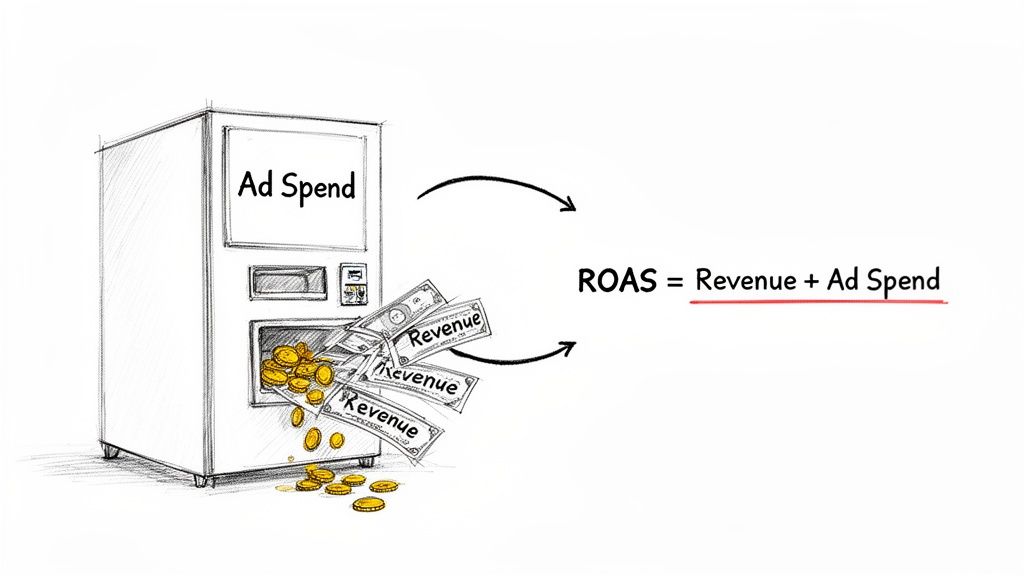
At its heart, ROAS in marketing is a direct measure of how profitable your advertising campaigns are. It gives you a clear, tactical view of which campaigns are knocking it out of the park and which ones are just burning through your budget.
Unlike some of the bigger, broader business metrics, ROAS is laser-focused on one thing: the relationship between what you spend on ads and the revenue that spending brings in.
Think of it as a financial scorecard for each of your ads. Let's say you spend $100 on a Google Ads campaign and it generates $500 in sales. Your ROAS is 5:1. For every dollar you invested, you got five dollars back. Simple, right? This single calculation empowers you to make sharp, data-driven decisions instead of just relying on guesswork.
Calculating ROAS couldn't be more straightforward. Here's the formula:
ROAS = Total Revenue from Ad Campaign ÷ Total Ad Spend
Let's quickly break down those two parts:
The result gives you a clear ratio (or percentage) showing how effective your ad spend really is. A ROAS of 400% is the same as a 4:1 ratio, meaning you've earned $4 for every $1 you've put in.
To help you get your head around these core ideas, here’s a quick summary.
| Concept | What It Measures | Why It Matters |
|---|---|---|
| ROAS Ratio | The gross revenue generated for every dollar of ad spend (e.g., 4:1). | It provides a direct, easy-to-understand measure of an ad campaign's profitability. |
| Ad Spend | The total cost of running an advertising campaign on a specific platform. | This is the "investment" part of the equation needed to calculate efficiency. |
| Revenue | The total income generated directly from the ads, tracked via conversions. | This is the "return" that determines whether your campaign was successful. |
This table neatly sums up why ROAS is such a fundamental metric for any marketer.
While Return on Investment (ROI) looks at the bigger picture of profitability for a whole business initiative, ROAS is all about ad campaign efficiency. It doesn't factor in other costs like making the product, shipping, or team salaries. This tight focus makes it an invaluable tool for optimising your advertising at a really granular level.
For a deeper dive into the different ways to measure success, you might find our guide on key digital marketing performance metrics helpful.
By keeping a close eye on your ROAS, you can:
Ultimately, understanding ROAS is the first step toward building a more profitable and sustainable marketing machine, ensuring every dollar you spend is working as hard as it possibly can for your business.
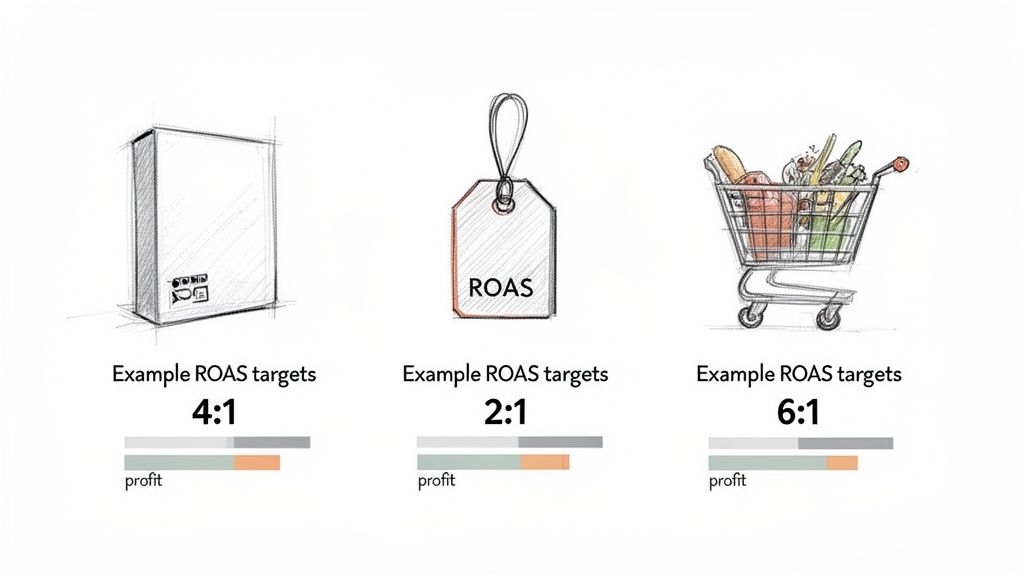
It’s one of the first questions everyone asks: "What's a good ROAS?" The honest answer? It completely depends on your business. The 4:1 ROAS you often hear tossed around as a general benchmark might be a huge win for one company but a disaster for another.
The myth of a universal "good" ROAS is dangerous. It completely ignores the one factor that matters most: your profit margin. A business with fat margins can easily thrive on a lower ROAS, while another with wafer-thin margins needs a massive return just to keep the lights on.
That’s why chasing a generic industry average is a flawed game. Your real goal is to figure out what a good ROAS in marketing means specifically for you, using your own numbers as the only source of truth.
Before you can even think about what a good ROAS looks like, you need to find your break-even ROAS. This is your baseline—the point where your ad spend is paid back in full by the revenue it generated. You’re not making money, but you’re not losing it either. Anything above this number is pure profit.
To find that magic number, you just need to know your profit margin. The formula is refreshingly simple:
Break-Even ROAS = 1 ÷ Profit Margin
Let's say you sell custom T-shirts online, and your profit margin is 25% on every sale. Pop that into the formula, and your break-even ROAS is 1 ÷ 0.25 = 4. This means you need a 4:1 ROAS just to cover your costs. If your campaign brings in anything less, you're officially losing money.
Your profit margins are welded to your industry and business model, which is why a good ROAS can look so different from one business to the next. A SaaS company with an 80% profit margin can be profitable with a ROAS that would sink a retail business.
Let’s look at a few different scenarios to see this in action:
As you can see, context is king. The film industry might pour colossal budgets into a campaign for a return that looks small on paper. Meanwhile, a personal care brand could hit a 6:1 ROAS with a modest investment, all thanks to high demand and lower overheads.
Once you’ve nailed down your break-even point, you can start setting smart, realistic targets that align with where you want to go. A "good" ROAS isn't just about covering costs; it's about generating the cash needed to reinvest, grow, and scale your operations.
A great rule of thumb is to aim for a target that doubles your break-even number. If your break-even ROAS is 4:1, a healthy starting goal could be 8:1. This ensures you’re not just covering ad spend and product costs, but you're also building a serious profit engine to fuel your next marketing push.
When you stop chasing arbitrary benchmarks and start focusing on your own profitability, ROAS transforms from a vanity metric into a true compass for your business's financial health.
Knowing your target ROAS is one thing; actually hitting and exceeding it is where the real growth kicks in. Boosting your Return on Ad Spend isn’t about flipping a single magic switch. Instead, it’s about a series of smart, data-backed tweaks that make every dollar you spend work that much harder for you.
These aren't just theories from a textbook. They're practical, high-impact moves you can make right now to stop wasting budget and start driving more profit. From who you're talking to, to what happens after they click, every piece of the puzzle matters for your ROAS in marketing. Let's get into the nitty-gritty of what actually works.
The quickest way to torch your ad budget? Showing your ads to the wrong people. A killer ROAS is built on a foundation of pinpoint audience targeting. You need to get your message in front of people who are genuinely ready to buy, not just window shopping.
One of the most powerful tools in your arsenal is the humble negative keyword. Think of it as a bouncer for your ad campaign. If you sell premium leather shoes, for example, you’d add words like "cheap," "repair," and "second-hand" to your negative list. This simple step stops your ads from showing up in irrelevant searches, saving you a fortune on clicks that were never going to convert anyway.
Beyond that, really dig into who your best customers are. Are they women aged 35-50 who follow certain foodie accounts on Instagram? Use those insights to build super-specific audience segments. The more granular you get with your targeting, the less money you'll waste and the higher your potential return.
Your ad creative is the very first handshake with a potential customer. It can make or break your campaign in a split second. Never, ever assume you know what will connect with your audience. The secret is to test everything, all the time.
A/B testing, or split testing, is simply running two or more versions of an ad to see which one gets better results. You'd be amazed how tiny changes to a headline, image, or call-to-action (CTA) can lead to a massive lift in performance.
Start with a simple theory. For example: "I bet a 'Shop Now' button will get a better ROAS than 'Learn More' because it feels more urgent." Then, run both versions and let the data prove you right (or wrong!).
Here are a few things you should constantly be testing:
Consistent A/B testing turns your advertising from a guessing game into a science, making sure your creative is always pulling its weight.
Getting the click is only half the job. If that person lands on a page that’s slow, confusing, or totally disconnected from the ad they just saw, you’ve wasted your money. Your ROAS will tank. The journey from the ad to the checkout needs to be smooth as silk.
This is where your landing page comes in. It has to deliver on the promise your ad made. If your ad talks about a specific red dress, it needs to click through directly to the page for that red dress—not your homepage. This continuity keeps the momentum going and guides the user straight to the prize.
On top of that, your page needs to be fast and simple. A slow-loading page is the ultimate conversion killer. Your CTA button should be big, bold, and impossible to miss. For businesses wanting an expert eye on these technical details, professional PPC ad management services can be a game-changer.
And for those looking to hand over the reins to an expert team to guarantee better returns, specialist services offering Done For You Ads are well worth a look. By dialling in these three core areas—targeting, creative, and the post-click experience—you're not just improving your ROAS; you're building a reliable system for profitable growth.
Not all ad platforms are created equal, especially in the competitive Australian market. To get the most out of your advertising, you need to be smart about where you spend your money, focusing on the channels that actually deliver a solid return. What worked last year might not be your best bet today.
For Aussie businesses, understanding these platform differences is the key to unlocking real growth. It’s about moving beyond a scattergun approach and putting your ad dollars where they’re most likely to bring in serious revenue. That means looking at the data and backing the true high-performers.
One of the biggest shifts we're seeing is the massive growth of retail media networks. Platforms like Amazon Advertising are becoming absolute powerhouses because they connect with customers right at the moment they’re ready to buy. This high-intent environment naturally leads to better conversion rates and, you guessed it, a stronger ROAS.
Think about it. On social media or even search, users are often just browsing or researching. But on a retail site, they have one main goal: to purchase something. This fundamental difference is why these networks are consistently delivering brilliant ROAS for e-commerce brands across Australia.
Improving your ROAS isn’t a one-and-done deal; it’s a process of continuous refinement. You need to dial in your targeting, test your creative, and make sure your landing page is doing its job.
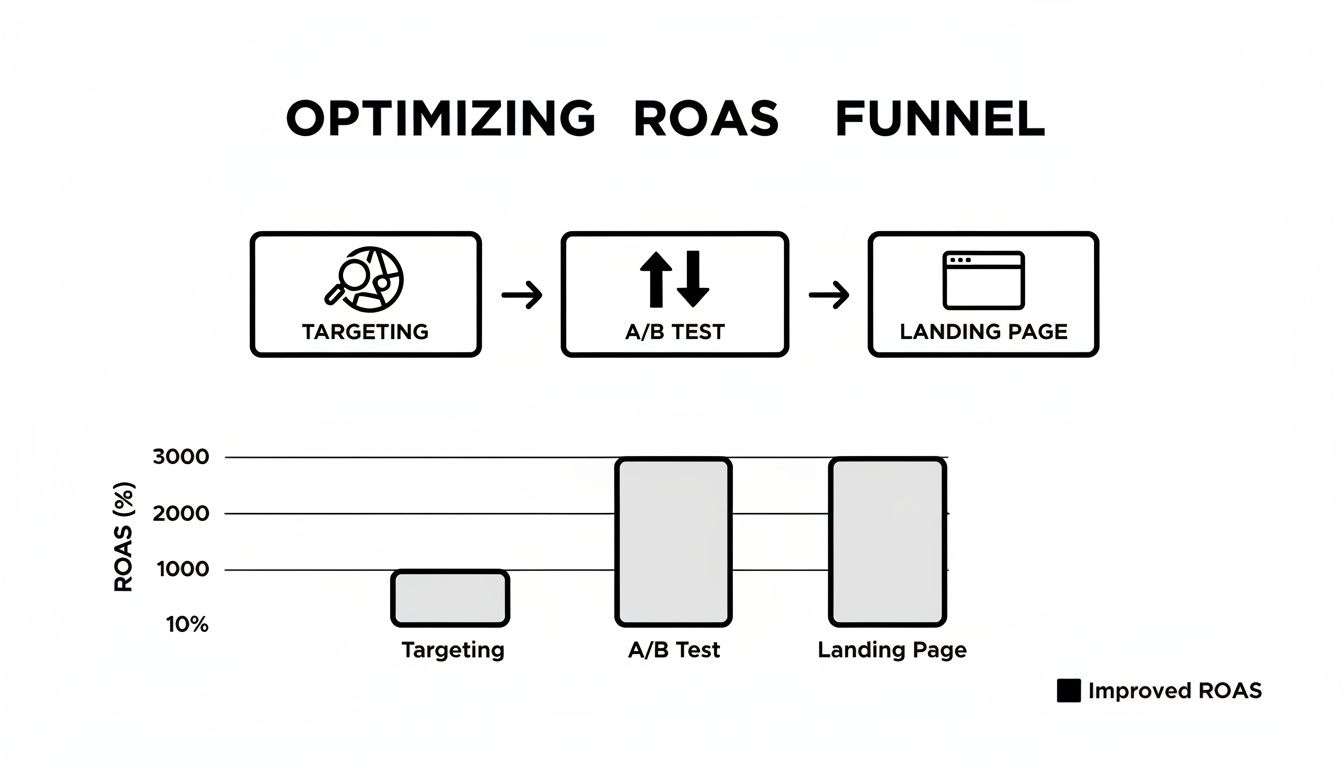
As the diagram shows, every stage of the funnel offers a chance to boost your returns. It’s about optimising the entire journey from the first impression to the final click.
Recent data paints a very clear picture of where the advertising dollars are best spent in Australia. When you look at direct returns, the differences between platforms are stark. Smart marketers are taking note and shifting their strategies to get ahead.
In 2025, Amazon advertising is the standout performer in the Australian market. It delivers an impressive 113% ROAS, which means you get $2.13 back for every dollar spent. This performance blows competitors out of the water, with Google Search at 78% ROAS and Meta Ads trailing at just 29% ROAS.
Drilling down, Amazon's Sponsored Products average a $3.41 ROAS and Sponsored Brands hit $3.06. For businesses like ours here at Virtual Ad Agency in Adelaide, this just highlights the power of platform-specific optimisation in a market projected to hit AUD $18.1 billion in digital ad spend by 2026.
This dramatic performance gap shows that just being present on the major platforms isn't enough. You have to strategically allocate your budget to the channels with proven high returns, like retail media, if you want to stay profitable and scale your business effectively.
To give you a clearer picture, here’s how the major players stack up in the Aussie market.
This table offers a snapshot of the average ROAS you can expect across the main advertising platforms in Australia, giving you a baseline for where to focus your efforts.
| Platform | Average ROAS (%) | Key Strengths |
|---|---|---|
| Amazon Ads | 113% | High purchase intent, direct access to shoppers, strong product focus. |
| Google Search | 78% | Captures active search intent, excellent for lead generation and research phases. |
| Meta Ads (Facebook/Instagram) | 29% | Powerful audience targeting, great for brand awareness and top-of-funnel engagement. |
As you can see, the numbers tell a compelling story. While each platform has its place, the direct return from retail media is currently leading the pack by a significant margin.
Knowing which platforms perform best is the first step. Next, you need a budget strategy that reflects this reality. This doesn’t mean you should ditch Google or Meta completely, but it does mean rethinking their role in your marketing mix.
Here are a few practical steps for Australian businesses:
By taking a channel-specific approach, you build a more balanced and effective advertising machine. Each platform plays to its strengths, contributing to a healthier overall ROAS for your business. The key is to let the data guide your investments, making sure you’re always placing your bets on the channels most likely to win.
While a big, juicy ROAS number can feel like a major win, chasing the highest possible figure isn't always the smartest play for long-term success. Relying on this one metric is like judging a car's quality purely on its top speed – you get a very narrow, and potentially misleading, view of its actual performance.
Think about it. A high-ROAS campaign might look fantastic on a weekly report, but what if it only attracts one-off discount hunters? Is it truly growing your business? Sometimes, a campaign with a more modest ROAS is your quiet hero, bringing in loyal customers who will buy from you again and again.
This is why you have to look beyond the immediate return. Real, sustainable growth comes from understanding the bigger picture and balancing short-term wins with long-term profitability.
Focusing only on ROAS can lead to some seriously flawed decisions. The metric is brilliant for measuring direct revenue from ad spend, but it’s completely blind to other crucial business factors and the nuances of customer behaviour.
For instance, ROAS doesn't account for your profit margins. A campaign hitting a 10:1 ROAS on a low-margin product might actually be less profitable than one achieving a 3:1 ROAS on a high-margin item. To see the full picture, you need to understand the difference between return on ad spend and overall return on investment. This insightful guide on ROAS vs ROI is a great place to start.
On top of that, different attribution models can dramatically inflate or deflate your reported ROAS, making it tricky to compare performance across channels with any real accuracy.
To build a marketing strategy that lasts, you need to analyse ROAS in marketing alongside a few other key performance indicators (KPIs). This approach creates a far more complete and accurate view of your business's health.
Think of these metrics as a panel of expert advisors, each offering a unique perspective:
A campaign that brings in high-LTV customers at an acceptable CPA is a true engine for growth, even if its immediate ROAS isn't the highest in your account. This is the strategic shift from short-term gains to long-term enterprise value.
Let's imagine you're running two separate ad campaigns for your online store.
At first glance, Campaign A looks like the clear winner. But when you dig a little deeper, you find that customers from Campaign A never buy again. In contrast, customers from Campaign B go on to make several more purchases over the next year, resulting in a 300% higher LTV.
This is why context is everything. Campaign B, despite its lower ROAS, is building a loyal customer base and driving far more sustainable profit for the business.
The explosive growth of retail media networks in Australia really highlights this need for a more nuanced view. Projections show retail ad spending hitting around AUD $2.2 billion in 2025, driven by sophisticated targeting that delivers a superior ROAS. Amazon's $3.41 ROAS on Sponsored Products is a prime example within the rapidly expanding $16.4 billion Australian paid ad market. This shows that while a high ROAS is achievable, understanding the customer value it creates is the real key to lasting success.
Even after you get your head around the basics, Return On Ad Spend can still be a slippery concept. The little details in how you calculate it, what it means for your specific industry, and how it plays with other metrics are often where people get stuck.
We're here to clear the fog. In this section, we'll tackle the most common questions we hear about ROAS in marketing, giving you straight, simple answers. Think of it as your go-to guide for those tricky moments.
This is probably the biggest point of confusion, and getting it right is crucial. The easiest way to think about it is this: ROAS tells you how healthy your ads are, while Return on Investment (ROI) tells you how healthy your entire business venture is.
ROAS is a tactical metric. It’s laser-focused on the gross revenue you get back for every dollar you put into advertising. It answers one simple question: "For every dollar I spent on ads, how many dollars in sales did I see?"
ROI, on the other hand, is a strategic metric. It takes a much bigger picture, looking at all your costs – not just ad spend. This includes the cost of your products, shipping, software, salaries, you name it. It answers the ultimate question: "After everything is paid for, are we actually making money?"
Key Takeaway: You can have a brilliant ROAS and still be losing money. A 4:1 ROAS might look fantastic on paper, but if your product margins are only 20%, your ROI is in the negative once all those other business costs are factored in.
This one feels a bit abstract because you aren't dealing with a direct sale. How do you measure a return when there’s no immediate revenue? The trick is to figure out what a lead is actually worth to your business. It takes a little bit of homework with your own data, but it turns a fuzzy goal into a number you can actually work with.
Here’s a simple way to break it down:
With that number in hand, you can now use a modified formula to calculate your ROAS:
ROAS = (Total Number of Leads x Average Lead Value) ÷ Total Ad Spend
This gives you a real, tangible metric to see if your lead generation ads are actually pulling their weight and setting you up for profitable growth.
Ah, the classic scaling problem. It's a situation that trips up a lot of businesses. Seeing sales climb while your ROAS starts to dip is usually a red flag for declining efficiency. It means that as you’re pushing more money into your campaigns to chase those extra sales, your Cost Per Acquisition (CPA) is climbing even faster.
There are a few usual suspects for this:
While seeing that top-line revenue grow is exciting, a falling ROAS is a warning light on your dashboard. It tells you that your profit margin on each sale is getting thinner. It’s a clear sign to hit pause, dive into your campaign data, tighten up your targeting, and get some fresh creative in front of people.
Patience is a tough but necessary virtue in advertising. Jump the gun and you might kill a campaign that was just about to find its groove. The right amount of time to wait really boils down to two things: your typical sales cycle and the ad platform's "learning phase."
For a straightforward e-commerce product that people buy quickly, you can probably get a decent read on performance within 7 to 14 days. But if you’re selling high-ticket items or B2B services where people take weeks or months to make a decision, you’ll need to look at a much longer window—at least 30 to 90 days—to understand the true ROAS.
And most importantly, you have to give platforms like Google and Meta time to get out of their initial "learning phase." This is the period, usually about a week or until a campaign gets 50 conversions, where the algorithm is just gathering data and figuring out who to show your ads to. Performance will be all over the place during this time, so don't make any knee-jerk changes to your budget or strategy until it's done.
Ready to stop guessing and start driving real, profitable growth with your advertising? The team at Virtual Ad Agency specialises in full-funnel marketing strategies that optimise every dollar you spend. Discover how our data-driven approach can maximise your ROAS today.

 previous