
So, what exactly is a PPC marketing agency? Think of them as specialist firms laser-focused on managing a company's paid advertising campaigns, whether that’s on Google Ads, social media, or elsewhere. Their whole reason for being is to maximise your return on investment. They handle the entire process – from the big-picture strategy and nitty-gritty keyword research to creating the ads, managing bids, and constantly analysing performance.

Before you even think about shortlisting potential partners, it’s crucial to get your head around why bringing a top PPC agency on board is a strategic move, not just another line item on your expenses sheet. The real value is so much more than just getting some ads live; it's about engineering real, tangible business growth through expert hands-on management.
This means you need to look past the flashy presentations and vague promises. Instead, focus on the hard metrics that actually hit your bottom line. We’re talking about measurable jumps in Return on Ad Spend (ROAS), a significant drop in your Cost Per Acquisition (CPA), and a clear uptick in the quality of leads getting passed to your sales team.
I’ve seen it time and time again: a business tries to run complex PPC campaigns in-house without a dedicated expert, and it almost always leads to the same costly mistakes. The most obvious sign is wasted ad spend. Budgets get chewed through by irrelevant clicks or ads shown to completely wrong audiences. It’s the classic symptom of not having deep, hands-on knowledge of the ad platforms.
But the other, less obvious cost is missed opportunity. The paid search world doesn't stand still for a second. It demands constant attention and tweaking. If you don't have a team living and breathing this stuff, your campaigns will fall behind competitors who are optimising their bids, ad copy, and landing pages every single day. The result? A campaign that just flatlines and fails to deliver any real growth.
The core difference really comes down to proactive strategy versus reactive management. A great agency sees market shifts and algorithm updates coming. An inexperienced team is usually left scrambling to put out fires after the damage is already done.
On the flip side, a top-tier agency brings a level of sophistication that’s incredibly difficult, if not impossible, to build internally overnight. They’re not just pulling levers; they’re using advanced strategies that connect every single touchpoint of the customer journey, making sure everything works together seamlessly.
Their toolkit is usually packed with things like:
When you’re weighing up the true value of an expert PPC partner, it pays to look at the advanced tools and platforms they use. For example, understanding the benefits an agency can gain from robust data quality and tracking tools shows their commitment to accuracy and your success. This kind of insight helps you justify the investment. You can dive deeper into this in our complete guide to PPC ad management.
In the cut-throat world of Australian digital marketing, PPC agencies have become essential for any business serious about getting the most from their ad spend. We consistently see top agencies deliver a 5x to 8x ROAS for clients. That’s the kind of return that turns PPC from a marketing expense into a powerful engine for growth.
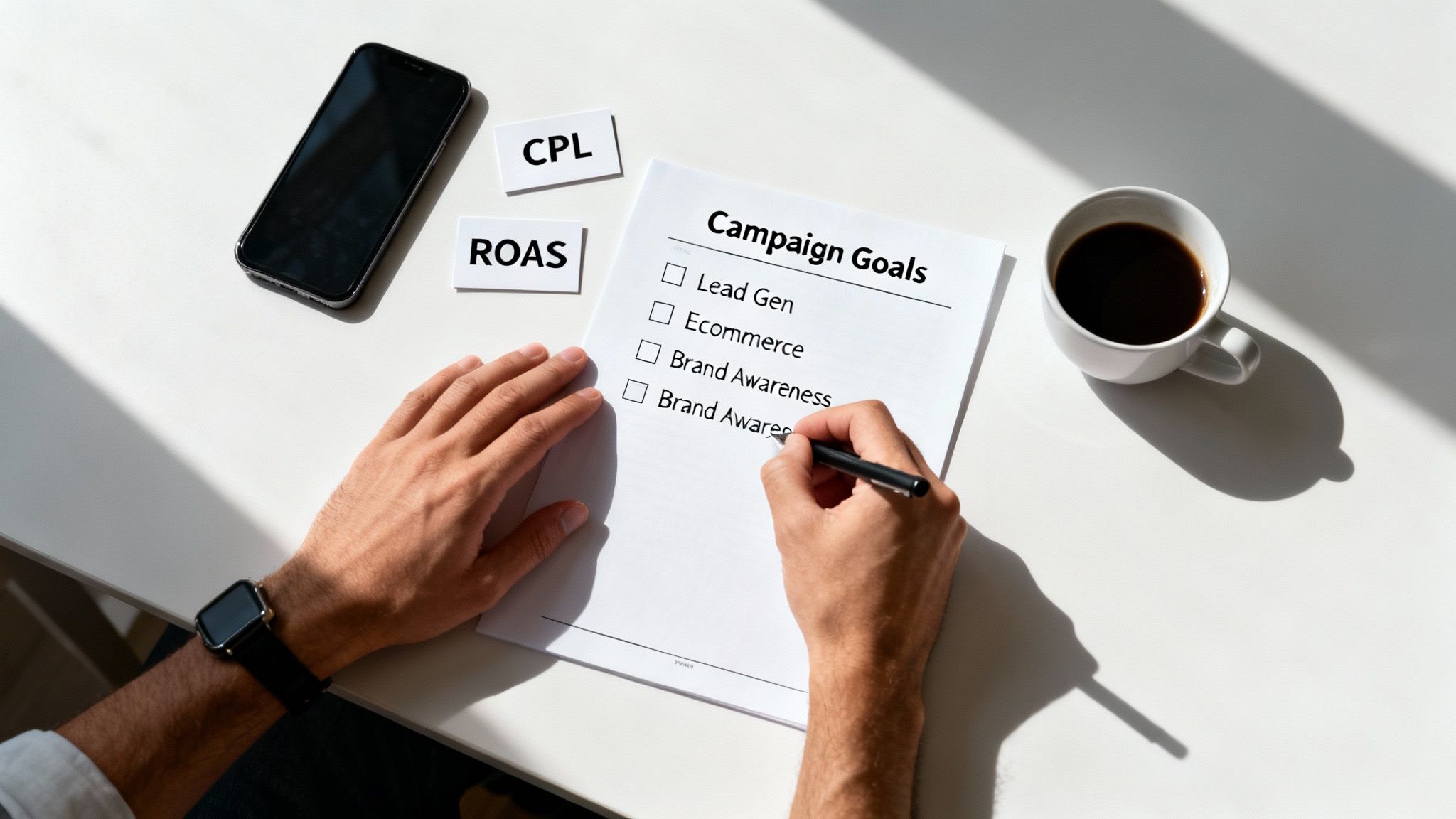
Before you even think about Googling a list of PPC marketing agencies, the most crucial work has to happen in-house. It’s impossible to pick the right partner if you haven’t first defined what a “win” actually looks like for your business. This means taking a good, hard look at your own goals, resources, and what you expect to get out of this relationship.
Without this groundwork, you’re just setting yourself up to be dazzled by an agency’s slick presentation. A flashy case study showing a 200% ROAS for an e-commerce brand is completely meaningless if your main goal is to get qualified leads into the hands of your B2B sales team.
Doing this prep work transforms your search from a vague hunt for "a good agency" into a targeted mission. You're looking for a strategic partner who fits your specific needs, and this process gives you the scorecard to measure them against. It's all about turning those big-picture business objectives into concrete numbers a PPC campaign can actually hit.
First things first, you need to answer a simple question: What, precisely, are you hiring these ads to do? Fuzzy goals like "more traffic" just won't cut it. Your PPC efforts have to be tied to tangible business outcomes, which usually fall into one of three buckets.
Filling the Sales Pipeline (B2B/Service-Based): The mission here is to generate high-quality prospects for your sales team. Success isn't about clicks; it’s about the number and quality of leads. Your North Star metric is Cost Per Lead (CPL) or, even better, Cost Per Qualified Lead (CPQL). For instance, a software company might set a clear goal of keeping their CPL under $150 for leads who book a demo.
Driving E-commerce Sales (Retail/D2C): For online stores, it's all about direct revenue. The only metric that truly matters is Return On Ad Spend (ROAS). Giving an agency a specific target, like achieving a $5 return for every $1 spent on ads, provides a crystal-clear benchmark for success.
Building Brand Awareness and Reach: This one is a bit harder to track, but it's a perfectly valid goal for new brands or businesses launching in a new market. Here, you'd look at KPIs like impression share, click-through rate (CTR) on top-of-funnel keywords, and watching for a steady increase in branded search queries over time.
Here's a classic mistake: trying to chase all of these goals at once on a shoestring budget. You have to prioritise. An agency that's trying to optimise for both brand awareness and direct sales at the same time will probably end up failing at both. Pick one primary objective.
Once you know what you want to achieve, it’s time for a reality check on your resources. You need to define not just your monthly ad spend but also your budget for the agency's management fees. These are two separate line items, and being upfront about both from the get-go saves a lot of headaches and awkward conversations down the track.
Just as critical is having a razor-sharp definition of your ideal customer. An agency can't find your audience if you can't describe them.
Pull together a concise Ideal Customer Profile (ICP) that covers:
This little document is pure gold for a PPC agency. It lets them go way beyond basic keyword targeting and start building hyper-specific audience segments, making sure every dollar of your budget is aimed at people who are actually likely to convert. This is the bedrock of a successful partnership.
You've got your shortlist of potential PPC marketing agencies. Now the real work begins. This is where you have to look past the slick websites and flashy client logos to see what's actually under the hood. It’s all about asking sharp, insightful questions that reveal how they think, how they operate, and ultimately, if they’re the right fit for your business.
A generic question like, "What's your experience?" is only going to get you a pre-packaged, surface-level answer. To really vet an agency, you need to dig into the specifics of their team, the tech they use, and their strategic thinking. The goal is to separate the agencies peddling a one-size-fits-all template from those who will genuinely build a strategy around your unique business goals.
First up, you need to find out who will actually be working on your account day-to-day. It’s a classic agency move for a senior director to woo you through the sales process, only to hand your account over to a junior staffer once the ink is dry. You need to get clarity on this from day one.
Focus your questions on the hands-on team:
Just as important is their technology stack. The tools an agency uses for bidding, analysis, and reporting can make or break a campaign. You don't need to be an expert on every platform, but asking about their core toolkit gives you a sense of their sophistication.
Ask them what they use for competitive analysis, call tracking, and automated bidding. A solid agency won't just list software; they'll explain why they chose those tools and how they'll directly benefit your campaigns.
A great answer isn’t just a list of software names. It’s an explanation of how their tech stack provides deeper insights or efficiency gains that they can then pass on to you in the form of better results.
This is where you can truly tell an average agency from a great one. You want a partner who thinks strategically, not one who just ticks boxes on a checklist. The key is to understand how they would approach your specific challenges and goals.
Here are a few targeted questions to get the conversation rolling:
When you're vetting agencies, it's also smart to see if they're aware of the common mistakes brands and agencies make in Facebook Ads, as knowing the pitfalls often points to a higher level of expertise.
For businesses in the Australian market, there are unique local dynamics. Sydney's PPC scene, for instance, is booming, with over 31 specialised agencies in 2025. These firms are masters at building strategies that tap into local consumer habits, especially since 65% of Australians click on ads when they're ready to buy.
Finally, any strong partnership is built on trust and transparency, especially when it comes to performance reports and billing. You need to be crystal clear on how success will be measured and exactly what you're paying for. Vague answers here are a massive warning sign.
Demand clarity on these points:
This kind of detailed questioning gives you a complete picture of a potential partner. For those looking for a dedicated team, exploring the services of a specialised Google Ads agency can provide the focused expertise needed to navigate the platform effectively.
By asking the right questions upfront, you set the stage for a productive, results-driven relationship built on mutual understanding and clear expectations.
So, you've done the pitches, shaken the hands (or clicked "End Meeting"), and now your inbox is lighting up with proposals. This is where things get serious. It’s incredibly tempting to flick straight to the last page and compare the numbers, but I can tell you from experience, the best PPC marketing agencies show their true value in the details—not just the final price.
Think of a proposal as more than just a quote; it's a peek into how an agency thinks. If you get a generic, copy-paste document that could be for any business, that's a massive red flag. You want to see a plan that specifically mentions your goals, your challenges, and the conversations you've already had. It should feel like a custom strategy, not just a glossy brochure.
To compare apples with apples, you first need to get your head around how agencies charge. Most will fall into one of four buckets, and each has its pros and cons depending on your business and what you're trying to achieve.
If you want to dig deeper into the numbers behind these models, our guide on how much Google Ads can cost is a great place to start.
Every single proposal will come packed with glowing case studies. Your job is to look a bit closer. Are the clients they’re showing off in a similar industry to you? Do they have a comparable budget? A massive win for a national retail brand is great, but it might not mean much if you’re a local service business.
This is also the time to keep an eye out for promises that sound a little too good to be true.
Be extremely wary of any agency that "guarantees" specific results like a #1 ranking or a fixed ROAS. The world of PPC is far too dynamic for such certainties. A confident agency will talk about data-driven projections and their process for optimisation, not unbreakable promises.
Now, that's not to say exceptional results aren't possible. We're seeing Australian PPC agencies do some incredible things, with some delivering 50% year-on-year growth for clients. Others are hitting amazing campaign metrics like a 146% increase in leads coupled with a 63% lower cost-per-conversion. It just shows what expert management can really pull off.
This decision tree gives you a solid framework for vetting agencies, focusing on the three pillars: team, tools, and strategy.
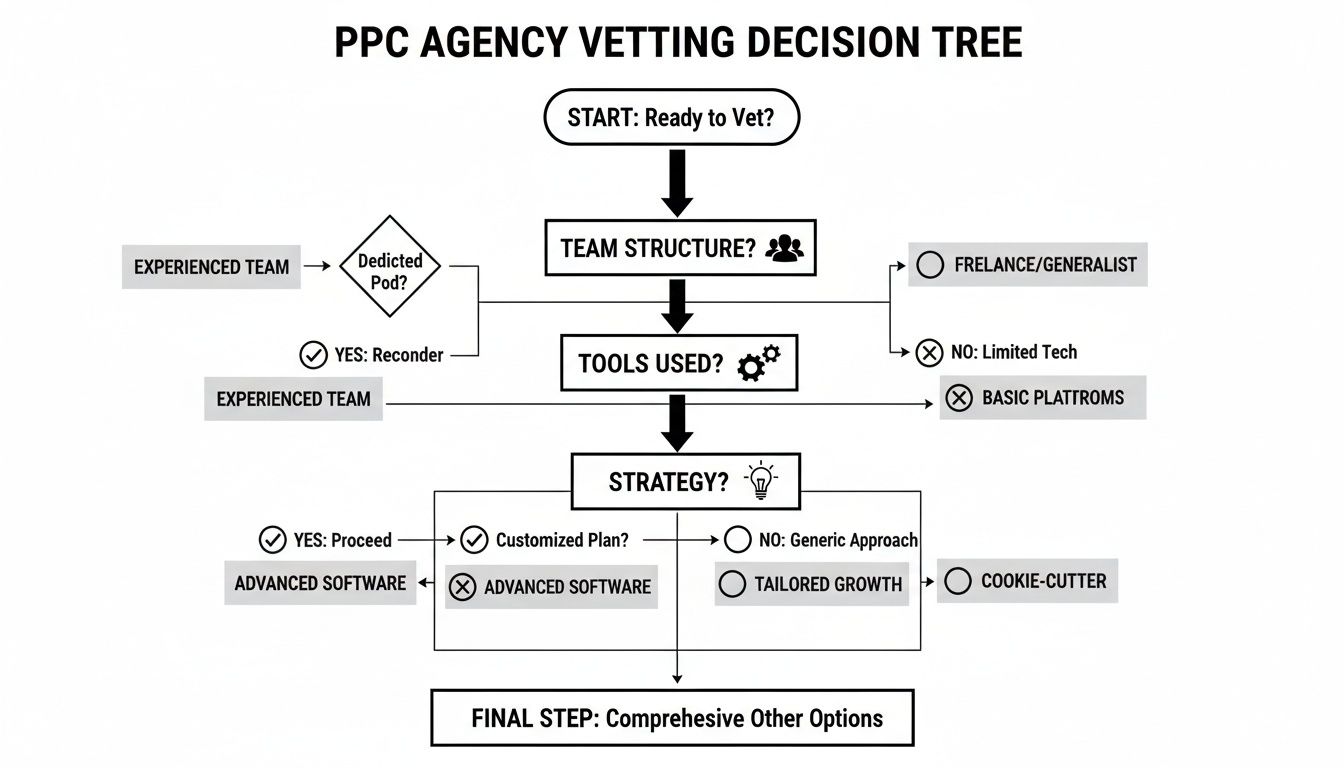
It’s a good reminder that a thorough check goes way beyond the proposal itself. You need to look at the underlying structure and approach of each potential partner.
At the end of the day, you’re looking for a partner based on value, not just the lowest price tag. A cheap agency that gets you poor results is going to cost you a lot more in the long run than a premium-priced partner that delivers a killer return on your investment.
I find it helpful to create a simple comparison table to weigh up what really matters to you.
| Agency Name | Pricing Model | Strategic Depth | Team Expertise | Cultural Fit |
|---|---|---|---|---|
| Agency A | Flat-Rate | Strong | High | Good |
| Agency B | % of Spend | Average | Medium | Excellent |
| Agency C | Hybrid | Excellent | High | Average |
Laying it out like this forces you to look beyond the cost and consider the whole package. Choosing the right agency is a long-term investment in your business’s growth. A thorough, careful evaluation now is what builds the foundation for a profitable partnership down the track.

Choosing your new agency is a massive milestone, but it’s the starting line, not the finish. Seriously. The success of your entire partnership will be decided in the first few weeks, where you either build a solid foundation or watch things crumble before they've even started.
A messy onboarding process leads to missed opportunities and friction right out of the gate. A well-structured one, on the other hand, sets the stage for genuine, long-term growth.
This initial phase is all about alignment. You're shifting from a client-vendor dynamic into a proper partnership. It demands a proactive approach from you to ensure the agency has everything they need to start delivering value, fast. The goal is to move from signing the contract to launching smart, optimised campaigns without any frustrating delays.
Remember, this is a two-way street; it’s not a "set and forget" deal. Your active participation is the secret ingredient that turns a good campaign into a truly great one.
The very first step is a formal kick-off meeting. This isn't just a casual chat; it's a structured session designed to get both teams aligned on goals, roles, and how you'll work together. This meeting needs to include all the key players from both sides of the table, making sure everyone is on the same page from day one.
The agenda should be comprehensive. You need to cover everything from the big-picture strategic objectives to the nitty-gritty details of account access. It’s your chance to hammer home the KPIs you’ve defined and for the agency to walk you through their initial 30-60-90 day plan.
Your role as the client is absolutely critical here. An agency can be technically brilliant, but they don't know your business like you do. Giving them deep insights into your customers, sales cycle, and market positioning is what empowers them to build campaigns that actually resonate and convert.
To make sure nothing falls through the cracks, a detailed onboarding checklist is non-negotiable. This document becomes your shared source of truth, tracking progress and assigning responsibility for every task. It's the framework that ensures a seamless handover.
Here’s what your initial checklist should cover:
By managing the onboarding process with this level of detail, you create transparency and set a professional, collaborative tone for the entire partnership. This early effort pays dividends for years to come and is what helps the best PPC marketing agencies evolve with your business to consistently deliver exceptional growth.
Even after going through a detailed guide, it's pretty normal to have a few questions rattling around your head before you take the plunge and partner with a PPC agency. Let's tackle some of the most common ones we hear, helping you tie up any loose ends so you can move forward with confidence.
This is the million-dollar question, and the honest answer is: it depends. You can get traffic and eyeballs on your ads almost instantly, but real, meaningful results take a bit more patience. As a rule of thumb, give a new agency a solid 90-day window to really get things humming.
Think of it like this:
You should definitely see some positive signs within the first month. But the big jumps in your return on ad spend (ROAS) or a lower cost per lead (CPL) usually start showing up in months two and three, once the agency has enough data to start refining their strategy properly.
Agency pricing isn't a one-size-fits-all deal, but you'll come across a few common models. For medium-to-large businesses here in Australia, PPC marketing agencies usually price their services in a couple of ways.
The most popular model is a percentage of your ad spend, which typically sits somewhere between 10% and 20%. Another common setup is a flat monthly retainer. This can range from a few thousand to tens of thousands of dollars, depending on how complex your account is and the scope of work involved.
The real key isn’t the dollar figure itself, but the value you get in return. A higher fee can be completely justified if it comes with deep industry knowledge, a dedicated senior team, and a track record of delivering brilliant ROI.
Yes. One hundred percent. You should always, always retain ownership of your Google Ads, Microsoft Advertising, and any social media ad accounts. The agency gets management access to do their job, but you remain the ultimate owner.
This is a complete non-negotiable. Keeping ownership means that if you ever decide to switch agencies or bring things in-house, all your valuable campaign history and data stays with you. An agency insisting on creating accounts under their own name is a massive red flag.
A great agency partnership is built on open communication and a clear, fair contract. Before you sign anything, make sure the agreement spells out the terms for ending the relationship. Most agencies operate on a rolling monthly contract after an initial minimum term, which is often three to six months.
This initial period gives them a fair go at implementing their strategy and proving their worth. The contract should also specify a notice period—usually 30 days—if you decide to part ways. This ensures a professional handover of all account info and assets, protecting both you and the agency. Talking through these "what if" scenarios upfront is just good business.
At Virtual Ad Agency, we believe in building transparent partnerships that are all about results. If you’re ready to see what expert PPC management can really do for your business, we're here to help you kick your goals. Get in touch with us today.

 previous