So, how much do you need to budget for SEO? In Australia, a small business can typically expect to invest somewhere between $1,500 and $3,000 per month. For mid-sized companies, that figure usually sits between $3,000 and $7,500. And for the big players running national campaigns, costs will often push past $7,500 every month.

Asking about the price of an SEO package is a bit like walking into a car dealership and asking, "How much for a car?". There's no single answer because effective SEO is never an off-the-shelf product. It’s a service plan, built around your specific business goals, the industry you’re in, and who you’re up against.
Think of it this way: a small hatchback is perfect for zipping around the city on local errands. A family-sized SUV costs more but gives you the space and safety you need for a growing family. Then there's the semi-trailer, a massive investment built for hauling freight across the country. Each vehicle has a distinct job and a price tag to match.
SEO works exactly the same way. The investment you need to make depends entirely on where you want to go and what kind of "vehicle" you'll need to get there.
To give you a clearer picture, here’s a breakdown of what you can generally expect to invest based on your business size and ambitions.
| Business Size / Scope | Typical Monthly Price Range (AUD) | Best For |
|---|---|---|
| Small / Local | $1,500 – $3,000 | Local service businesses, cafes, single-location retailers. |
| Medium / Regional | $3,000 – $7,500 | Multi-location businesses, growing e-commerce stores, B2B services. |
| Large / National | $7,500+ | National brands, large e-commerce platforms, highly competitive industries. |
This table is a starting point. Your final quote will always depend on the specific strategy required to get you the results you're after.
A local Adelaide cafe trying to rank for "best coffee near me" has completely different needs—and a different budget—than a national e-commerce store fighting for a top spot on Google for "buy running shoes online."
The cafe’s strategy will likely be focused and local:
On the other hand, the national shoe store needs a much bigger, more powerful engine. Their campaign is a heavy-duty operation involving complex technical SEO, a huge content marketing plan, and an aggressive link-building strategy to muscle out the big brands. Their "vehicle" is the semi-trailer, and it demands a serious investment for a much bigger potential payoff. For more on getting this right, you can learn about the connection between SEO and small business success.
The price of an SEO package is a direct reflection of the resources, expertise, and strategic intensity required to achieve your specific business goals in your unique market.
Getting your head around this spectrum is the first step toward making a smart investment. It helps you get past the simple "how much does it cost?" question and start asking the right one: "What level of service do I actually need to hit my goals, and what's that outcome worth to my business?"
This guide is here to help you answer that very question. We’ll break down what really drives the final SEO packages price, show you what to expect at different investment levels, and give you the tools to spot genuine value for your business. When you understand the landscape, you can choose a package that fits your budget and actually drives the growth you're looking for.
When you start digging into the SEO packages price, you'll soon realise that agencies don't just pluck numbers from thin air. The cost is almost always built around a specific pricing model, and getting your head around these is the key to understanding exactly what you’re paying for.
Think of it like a mobile phone plan. Some are straightforward monthly subscriptions, others are pay-as-you-go, and a few are one-off purchases for a new handset. Each SEO pricing model is designed for a different business need, timeframe, and level of involvement. Knowing the four most common frameworks will help you have much clearer conversations with potential agencies and pick the structure that actually fits your goals.
By far the most common model you'll encounter is the monthly retainer. It's a simple, fixed fee you pay each month for an ongoing SEO campaign. It’s like a gym membership; you pay a set amount for continuous access to all the expertise and tools needed to build your online strength over the long haul.
This consistency is what allows an agency to plan long-term strategies, roll out content regularly, and stay on top of all the pesky algorithm changes as they happen.
Project-based pricing is exactly what it sounds like: you pay a single flat fee for a specific, one-time project. The deliverables and timeline are all clearly defined upfront. Imagine hiring a tradie to renovate your kitchen—you agree on the scope, the materials, and the final price before a single tile is laid.
This model is perfect for tackling a particular SEO challenge without locking yourself into an ongoing campaign.
Common one-off SEO projects include things like:
A project-based fee is ideal for businesses that need targeted expertise to solve a specific problem or to get their website ready for a future retainer-based campaign. It's a focused investment with a clear start and end point.
Hourly consulting is the most flexible approach, where you're simply paying for an SEO expert's time at a set hourly rate. This is like bringing in a specialist consultant to advise your in-house team. It’s not really for running an entire campaign but for providing high-level strategic guidance, training your staff, or untangling a complex technical knot that has your team stumped.
Hourly rates in Australia can range anywhere from $100 to over $300 per hour, all depending on the consultant's experience and area of expertise. This model works best when you already have an internal team managing the day-to-day stuff but need a seasoned expert to help steer the ship or offer a second opinion.
While it's a different field, looking at various SaaS pricing strategies can offer some interesting parallels for how to value and monetise expert services.
Finally, we have performance-based SEO. On the surface, this model sounds incredibly appealing. You only pay the agency after they achieve specific, pre-agreed results, like hitting page one for a keyword or reaching a certain traffic milestone.
It seems like a no-risk deal, but honestly, it’s often fraught with peril.
To get paid quickly, agencies on this model can be tempted to use aggressive, short-term tactics (what we call "black-hat SEO") that can get your website penalised by Google down the track. It also tends to focus on vanity metrics like rankings instead of what really matters: business outcomes like leads and sales. While it might work in very rare cases with a trusted partner, most reputable agencies steer clear because sustainable SEO is a long game, not a series of quick, risky sprints.
Ever wondered why one SEO agency quotes you $1,500 a month, while another confidently slides a proposal for $10,000 across the table? That massive difference isn't just a number pulled out of thin air; it’s a direct reflection of the work needed to get your business from where it is to where you want it to be. Good SEO isn't an off-the-shelf product, it's a completely customised service.
Think of it like training a professional athlete. The coaching, nutrition plan, and gear all depend on their current fitness level and what championship they're aiming for. An amateur training for their first local marathon has vastly different needs—and a different budget—than an Olympian chasing a gold medal on the world stage.
In the same way, the price of your SEO package is shaped by a few key things that define how big, intense, and complex your campaign needs to be.
One of the biggest factors is how crowded your industry is. Are you a local plumber in a small town, or an online fashion retailer duking it out with national giants? The more businesses fighting for the same eyeballs and keywords, the more effort it takes to stand out.
Trying to rank for a term like "car insurance" requires a much more aggressive and resource-heavy strategy than, say, "artisan sourdough bakery Adelaide." A cut-throat market demands smarter strategies, a higher volume of content, and a much stronger link-building campaign, all of which dials up the monthly investment.
Where your website is at right now is another critical piece of the puzzle. A brand-new site with zero authority is like that athlete starting from scratch—it needs foundational training just to build basic strength and endurance. This means a lot of upfront work on the technical setup, creating initial content, and building a base of backlinks.
On the other hand, a well-established website might already have some authority but could be held back by deep-seated technical gremlins or a penalty from an old Google update. Fixing those kinds of problems can be tricky and time-consuming, requiring specialist skills that affect the initial cost or the first few months of a retainer.
The state of your website directly dictates how much foundational work is needed. A clean, technically solid site lets an agency jump straight into growth tactics, while a site with underlying issues needs a 'rehab' phase first.
The size of the net you're trying to cast is a major price determinant. A wider net simply requires more resources to be effective.
Finally, what’s actually in the package will directly impact the cost. Not all SEO packages are created equal. A basic package might only cover some on-page tweaks and keyword tracking. A comprehensive, mid-to-high-tier package will bundle in a much wider array of services that deliver a far bigger impact over time.
This table gives you a clear idea of how these different factors can lead to wildly different price points for an SEO campaign.
| Influencing Factor | Low Cost Scenario (e.g., $1,500/mo) | High Cost Scenario (e.g., $10,000+/mo) |
|---|---|---|
| Competition | Niche industry, low keyword difficulty | Saturated market like finance or real estate |
| Website Health | Healthy, established site with no penalties | New site or site with major technical debt |
| Campaign Scope | Local service area (e.g., one city) | National e-commerce with 10,000+ products |
| Services | On-page SEO, basic reporting | Content marketing, link building, PR, CRO |
Once you understand these drivers, you can see your SEO packages price not as a random cost, but as a calculated investment based on the unique reality of your business and its ambitions.
Knowing the price of an SEO package is only half the story. The real question is, what do you actually get for your money? SEO isn’t one single task; it’s a whole collection of specialised services working in sync. As your investment goes up, so does the intensity, scope, and sophistication of the work being done.
Let's pull back the curtain on what you can typically find inside entry-level, mid-tier, and premium SEO packages. This should help you line up your budget with realistic outcomes and pick a plan that actually fuels your growth, rather than just ticking a box.
The biggest factors driving the price—your competition, the scope of work, and your website's current health—are what shape the deliverables you'll see in each tier.
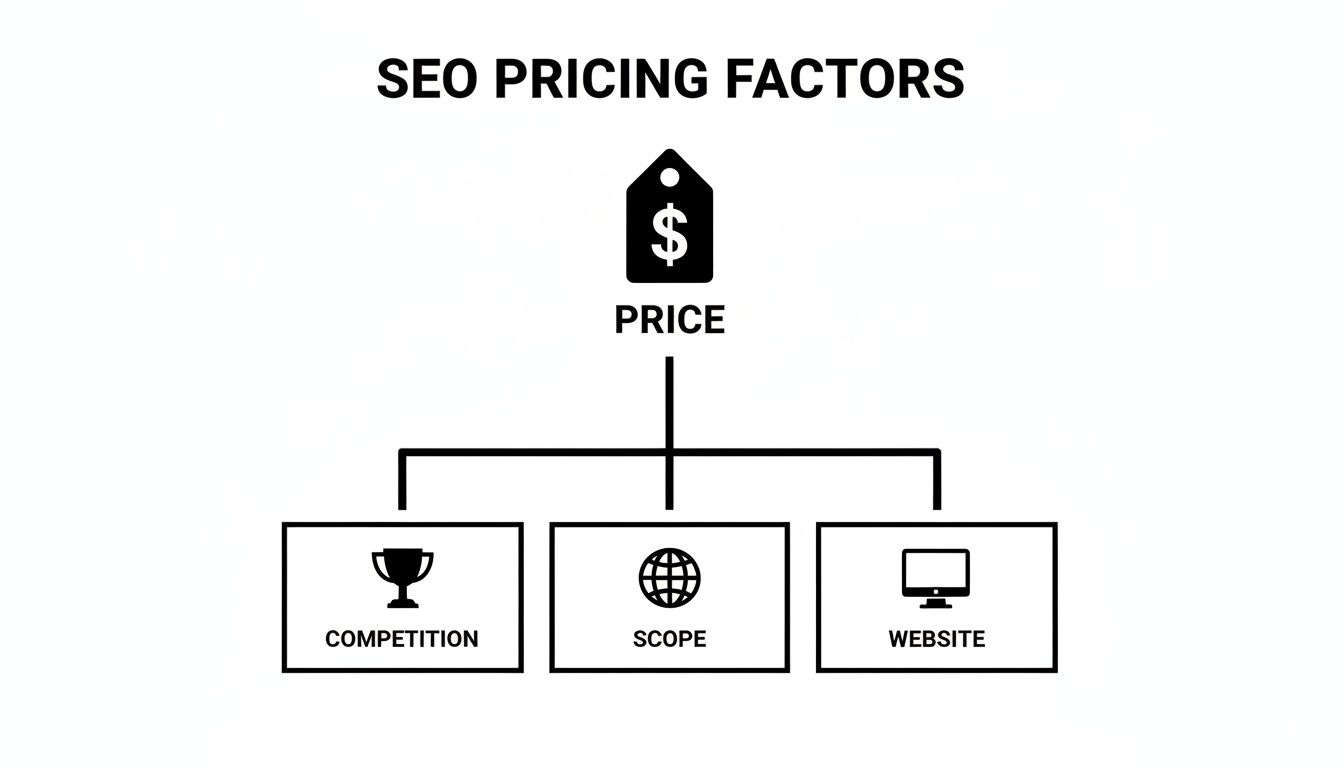
You can see how the final price tag is built on the foundation of your site's current state, the size of your market, and just how tough your industry competition is.
Often called "starter" or "essentials" packages, these are built for small businesses, local shops, or companies just dipping their toes into the world of SEO. The main goal here is simple: build a solid foundation and start showing up in search results for less competitive keywords.
In the bustling Australian market, these foundational SEO package prices usually land between $1,400 and $2,500 per month for small businesses. This investment covers the essentials like technical tune-ups, some initial link building, and content optimisation, especially for local markets—which is critical for the 2.5 million small businesses that are the backbone of our economy. Getting these basics right can pay off, with many businesses seeing up to 30% growth in organic traffic within six months.
So, what’s typically inside?
Think of this tier as getting your business "search engine ready." It’s all about making sure Google can find and understand your site, putting you on the map for your local audience.
This is where things start to get more serious. Mid-tier packages are for growing companies, businesses in moderately competitive industries, or those looking to expand from a local favourite to a regional or national player. The focus shifts from just being visible to actively fighting for valuable traffic and leads.
This tier moves past the basics and brings in proactive growth strategies. It’s not just about having a presence; it’s about using that presence to actively generate business and outflank your competitors.
The deliverables you’ll find here are much more comprehensive:
This level of investment is all about building momentum and creating a sustainable engine for organic growth.
At the top of the ladder, you have premium or enterprise-level packages. These are for established businesses in fiercely competitive national or even international markets. The goal here isn't just to compete—it's to dominate. These campaigns are aggressive, data-obsessed, and woven into every part of a digital marketing strategy.
The price tag reflects the sheer scale of work and expertise needed to win in these crowded spaces.
What really sets this tier apart?
Choosing this tier means you’re treating SEO as a primary channel for business growth. It's a heavy investment aimed at making you the undisputed authority in your field.
Picking an SEO partner is a massive decision for your business. That proposal you're holding is much more than a price list; it's the blueprint for your future growth. To make a smart choice, you have to look beyond the final SEO packages price and really dig into the strategy, the methods, and the honesty being offered.
A great proposal won't just list services—it will explain why those services are the right ones to hit your specific business goals. It should connect every single action to a tangible outcome, giving you a clear picture of how they plan to get you from where you are now to where you want to be.
When a proposal lands in your inbox, it's natural to scroll straight down to the numbers. But the real value is always buried in the details. A truly solid proposal should feel educational, leaving you feeling confident and informed about the agency's game plan.
Here's what you should expect to see in any strong proposal:
If a proposal is wishy-washy on these points, chances are their strategy is just as fuzzy. A good partner wants you to understand the process. For a deeper dive into strategy, bringing in a professional digital marketing consultant for a second opinion before you sign on the dotted line can be a very wise move.
Knowing what to look for is only half the battle; knowing what to run from is just as important. Some promises sound fantastic on paper but hide shady practices that can seriously damage your business down the track.
Be on high alert for any agency that shows these classic warning signs.
Guaranteed #1 Rankings: This is the oldest and biggest red flag in the SEO world. No one can guarantee a specific spot on Google because the algorithm is completely out of their control. Reputable agencies guarantee their effort and their process, never a specific rank.
Other major red flags to watch out for include:
Before signing anything, make sure you're armed with questions that get to the heart of their value and their process. The way they answer will tell you everything you need to know about their competence and transparency.
Making your final decision based on a thorough evaluation, rather than just the SEO packages price, will protect your investment and set your business up for sustainable, long-term growth.
Stepping into the world of search engine optimisation can feel like navigating a maze, especially when it comes to costs and what you get for your money. To cut through the noise, we've tackled the most common questions businesses have about SEO package prices with some straight-up, honest answers.
Think of this as your guide to making a confident, informed decision about your SEO investment.
This is the big one, isn't it? The honest-to-goodness answer is that SEO is a long game, not a quick win. You should start seeing the first signs of life—think small jumps in keyword rankings and a little bump in traffic—within 3 to 6 months.
But the results that really move the needle for your business, like a solid flow of qualified leads and a noticeable increase in sales, generally take 6 to 12 months to come to fruition.
It's a bit like planting a tree. You have to nurture it consistently for a while before it's strong enough to bear fruit. The exact timing always depends on where your website is starting from, how fierce the competition is in your industry, and the horsepower of the SEO package you choose.
We get it. The temptation to go for a cheap SEO package is real, especially when you're just starting out. But here's the hard truth: services advertised for under $500 a month often cause more problems than they solve. They're notorious for cutting corners with outdated or dodgy "black-hat" tactics that can get your website slapped with a Google penalty, digging you into a hole that's tough to climb out of.
Quality SEO is an investment in expert time—time for deep research, creating genuinely useful content, sorting out technical issues, and building real relationships online. A price that seems too good to be true is a dead giveaway that these crucial steps are being skipped or automated in a dangerous way.
You're genuinely better off waiting until you can invest in a quality package from a reputable agency than gambling your online reputation on a cheap service that could set you back years.
In a word: no. This is one of the oldest and biggest red flags in the SEO game. No credible agency will ever, ever guarantee you a #1 spot on Google.
It's simple, really. Google's algorithm is a closely guarded secret that’s constantly changing. Nobody outside of Google's inner circle knows the exact recipe for hitting the top spot. Anyone who claims they do is just not being straight with you.
Here’s what a trustworthy agency can and should promise:
Look for an agency that guarantees their commitment to your growth and a solid process, not an uncontrollable ranking position.
A "good" ROI from SEO can look different depending on your industry and profit margins, but its real power lies in how it grows over time. Unlike paid ads that vanish the second you stop paying, the organic traffic and authority you build with SEO become a permanent asset for your business.
A successful campaign doesn't just bring more traffic; it brings the right kind of traffic, leading to better leads and more valuable customers. Many businesses see an ROI of 5:1 to 10:1 over the lifetime of a customer they've won through organic search. The trick is to partner with an agency that focuses on the business metrics that matter—leads, sales, and revenue—not just chasing vanity rankings.
Ready to invest in an SEO package that delivers real, measurable results? At Virtual Ad Agency, we build custom strategies designed to drive sustainable growth. Let's chat about a plan that fits your business goals and your budget. Explore our services at https://www.virtualadagency.com.au.

 previous