
So, how much does it actually cost to get a web page designed in Australia?
The short answer is that a professional website for a small business will typically set you back somewhere between $3,500 and $10,000 AUD. But that's a pretty wide ballpark, right? The final figure really comes down to what you need your website to do for your business.
Thinking about commissioning a website is a lot like buying a vehicle for your business. A simple ute will get you from A to B, no fuss. But a custom-fitted commercial van, engineered for specific tasks with all the bells and whistles? That’s a different level of investment entirely.
It’s the same with your website. A basic online brochure is your digital ute – effective, but simple. A sophisticated e-commerce platform built to handle thousands of daily transactions is your high-spec custom van. Your investment is directly tied to the business goals you’re chasing.
To really get a handle on what you might spend, it helps to understand the different price brackets and what you get for your money. For a deeper dive into the numbers for the local market, this a comprehensive guide to small business website cost is a great resource.
Before we get into the nitty-gritty of different website types, let's look at the costs at a glance.
This table gives you a quick snapshot of the typical cost ranges you can expect for different kinds of website projects here in Australia. It’s a handy way to quickly gauge where your project might land.
| Website Type | Typical Cost Range (AUD) | Best For |
|---|---|---|
| Landing Page | $1,500 – $4,000 | Startups, single product launches, or focused marketing campaigns. |
| Brochure Site | $3,500 – $10,000 | Small businesses needing a professional online presence. |
| E-commerce Store | $8,000 – $25,000+ | Businesses selling products or services directly online. |
| Custom Web App | $25,000 – $100,000+ | Companies needing unique functionality or complex integrations. |
As you can see, the price climbs with complexity. This quick summary should help you frame your budget before we explore what drives these costs up or down.
In Australia, that $3,500 to $10,000 AUD range is where most standard, professionally designed small business websites land. Many in the industry would say the sweet spot is around $5,000 to $8,000 AUD, which usually gets you a great balance of custom design and essential features.
Step up to a small or mid-sized agency, and you're more likely looking at $8,000 to $25,000 AUD for projects that are more strategic. We're not just talking about a pretty design anymore; this is about building a site that aligns with core business goals, maps out the customer journey, and builds serious brand equity.
Think of this as your starting point for budgeting. The main thing to remember is that a website isn't just another business expense – it's an investment in a powerful asset.
Your website should be your hardest-working employee—a 24/7 sales tool that generates leads, builds your brand, and drives revenue. The cost is a direct investment in that tool's capability and effectiveness.
Now that we have a feel for the general costs, let's break down how different types of websites, from simple landing pages to complex web apps, fit into these price structures. This will give you the clarity you need to match your business ambitions with a realistic budget.
Not all websites are created equal, mainly because no two businesses have the exact same goals. The secret to a smart investment is matching your real-world needs with the right digital solution. This ensures you're not paying a premium for bells and whistles you'll never use, or worse, skimping on features that are critical for growth.
Getting a handle on the main website types is the first step to understanding what your web page design cost might actually look like.
Think about it: a local plumber, a national fashion brand, and a software startup all need a website, but their "digital storefronts" have completely different jobs to do. Each one needs a specific set of tools and a tailored structure to succeed.
Let's break down the main players.
This is the bread and butter for most small to medium businesses. Its main purpose? To plant your flag online, build credibility, and give people the essential info. It’s your digital business card, working for you 24/7.
A brochure site clearly tells visitors who you are, what you do, and how they can get in touch. It's the perfect fit for service-based businesses like consultants, tradies, or local cafés that need to show off their work and get leads through a contact form or a phone call.
You'll typically find these core pages:
For a professionally designed brochure site in Australia, you can expect to invest somewhere between $3,500 and $10,000 AUD. Where you land in that range depends on the level of custom design, how many pages you need, and whether things like professional copywriting or photography are part of the deal.
If you're selling products directly to customers online, you're going to need an e-commerce platform. This is a much more complex beast than a simple brochure site, acting as a full-blown digital retail operation. It’s your virtual shop, complete with aisles, a checkout, and a stockroom.
An e-commerce site has to juggle everything from displaying products beautifully to securely processing payments and managing inventory levels. It’s built from the ground up for transactions. This is the go-to solution for retailers, artists selling prints, or any business with a catalogue of physical or digital products.
A well-built e-commerce site isn't just a place to list products; it's an engine for sales. It needs to be secure, fast, and incredibly easy for customers to use, from browsing to checkout.
The investment for an e-commerce website is naturally higher, usually starting from $8,000 AUD and climbing to $25,000+. What pushes the price up? Things like the number of products, payment gateway integrations (think Stripe or PayPal), shipping complexities, and advanced features like customer accounts or recurring subscriptions.
If your current site just isn't converting visitors into buyers, looking into a professional website redesign in Australia could be the most important move you make this year.
Sometimes, an off-the-shelf solution just doesn't cut it. A custom web application is a purpose-built tool designed to perform specific, often complex, functions that go way beyond just showing information or selling products. Think of it like commissioning a unique piece of machinery, engineered just for your business.
What does this look like in the real world? Online booking systems, customer relationship management (CRM) portals, interactive learning platforms, or real-time data dashboards. These projects are built from scratch to solve a very specific business problem. Because they are entirely custom, the web page design cost is significantly higher, often starting at $25,000 AUD and can easily run into six figures.
The chart below gives you a clearer picture of how these budget tiers stack up for website projects here in Australia.
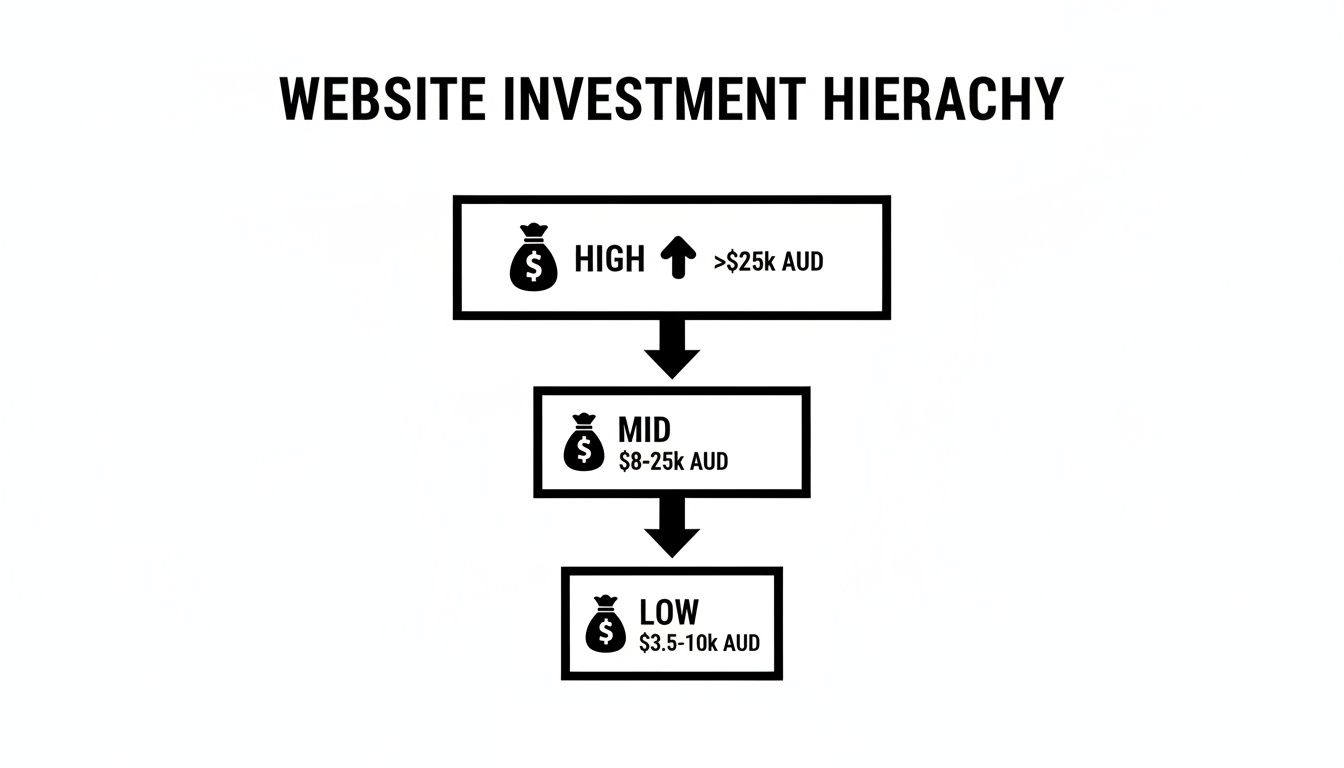
As you can see, the more complex and strategically important your website becomes, the bigger the investment required to get it right. To make this even clearer, let's compare these options side-by-side.
Here’s a comparative look at the different website types, their common features, associated cost ranges, and the kinds of Australian businesses they're best suited for.
| Website Type | Estimated Cost (AUD) | Core Features | Ideal Business Use Case |
|---|---|---|---|
| Brochure Website | $3,500 – $10,000 | 5-10 pages, contact form, blog/gallery, basic SEO setup, mobile responsive design. | Service businesses, tradies, consultants, local shops needing an online presence. |
| E-commerce Platform | $8,000 – $25,000+ | Product listings, shopping cart, secure payment gateways, inventory management, customer accounts. | Retailers, wholesalers, artists, or anyone selling physical or digital products online. |
| Custom Application | $25,000 – $100,000+ | Unique user workflows, database integration, API connections, high-level security, specific functions. | Startups with a unique idea, booking platforms, SaaS products, internal business tools. |
This table helps frame the conversation around what you need versus what might be nice to have, steering you toward the most logical and cost-effective starting point for your business.
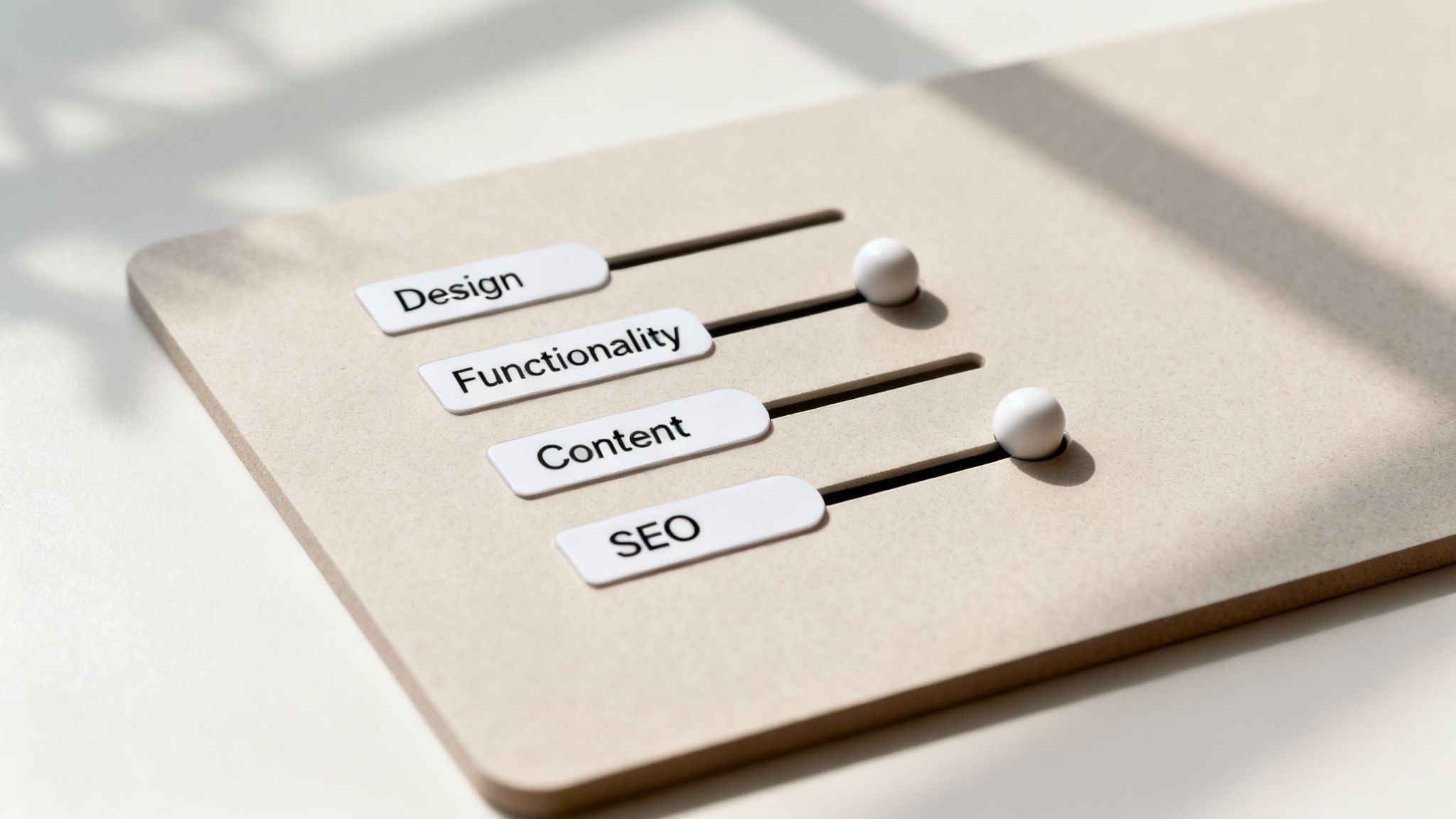
Knowing the different types of websites gives you a decent ballpark for budgeting. But the real story behind your web page design cost is written in the details. Think of it like a set of dials – design, features, content, SEO – each one capable of turning your final price up or down.
It’s a bit like ordering a coffee. A simple long black has a base price. But if you want oat milk, an extra shot, vanilla syrup, and caramel drizzle, the cost naturally goes up. Each addition makes for a better (or at least, more specific) brew, but it all adds to the bill. Your website is no different.
Let's pull back the curtain on the most significant variables that will shape your project. Understanding these moving parts helps you make savvy decisions, ensuring your digital ambitions line up perfectly with your budget.
The first, and often most impactful, cost dial is how custom your design needs to be. This isn't just about looks; it's about the entire user experience, from a clean template to a completely bespoke digital masterpiece. Your choice here sets the tone for the whole project.
A template-based design is your most cost-effective path. We're not talking about cheap, cookie-cutter templates here, but professionally designed layouts that are then customised with your brand’s colours, fonts, and content. It’s a fantastic option for businesses that need a polished, functional site without reinventing the wheel.
At the other end of the spectrum is a fully custom design. This is built from the ground up, tailored specifically to your brand, your audience, and your unique business goals. It's an intensive process involving deep-dive strategy, user experience (UX) research, wireframing, and creating visual elements that are 100% yours. The investment is higher, but the result is a powerful competitive advantage.
A custom design isn’t just about looking unique; it's about creating a strategic tool engineered to solve specific business problems and guide users toward conversion.
Essentially, you’re choosing between a high-quality off-the-rack suit that’s expertly tailored (the template) and a completely bespoke suit crafted just for you (the custom build). Both are great, but they serve different needs and come with different price tags.
Beyond the look and feel, what your website actually does is a huge cost factor. A simple website that just displays information is worlds away from one that needs to perform specific tasks or talk to other software.
Every special function—every button that does something more than "go to another page"—requires development time, rigorous testing, and sometimes, licensing fees for third-party tools. These features are the engines that power your business online, and they represent a significant part of the investment.
Here are some common examples of functionality that bump up the complexity and cost:
Each of these additions requires specialised expertise to build securely and effectively, which will be reflected in the final quote.
A stunning website is just an empty shelf without high-quality content to fill it. A frequently overlooked part of the web page design cost is the actual creation of the text, images, and videos that will bring your site to life.
You’ve got a few options here, each with its own budget implications. You can supply all the content yourself, which is the most budget-friendly choice but requires a serious time commitment from you. Don’t underestimate this part!
Alternatively, you can hire pros. A professional copywriter can craft compelling, SEO-friendly text that speaks directly to your ideal customer. A professional photographer can create high-quality visuals that make your brand pop. While this adds to the upfront cost, professional content can dramatically lift user engagement and conversion rates.
Finally, a website that no one can find is little more than a very expensive digital brochure. Search Engine Optimisation (SEO) is the art and science of building your site in a way that helps it rank highly in search engines like Google for keywords your customers are using.
Basic, foundational SEO should be part of any professional web design package. This usually covers essentials like mobile-friendliness, fast loading speeds, and a logical site structure. However, a comprehensive SEO strategy is a specialised service that adds to the cost. If you’re serious about growing your business online, understanding the role of SEO in web designing is non-negotiable from day one.
More advanced SEO services might include things like:
Here's the bottom line: investing in SEO from the beginning is far more effective and affordable than trying to bolt it on later. It ensures your website is built on a solid foundation, ready for visibility and growth from the moment it launches.
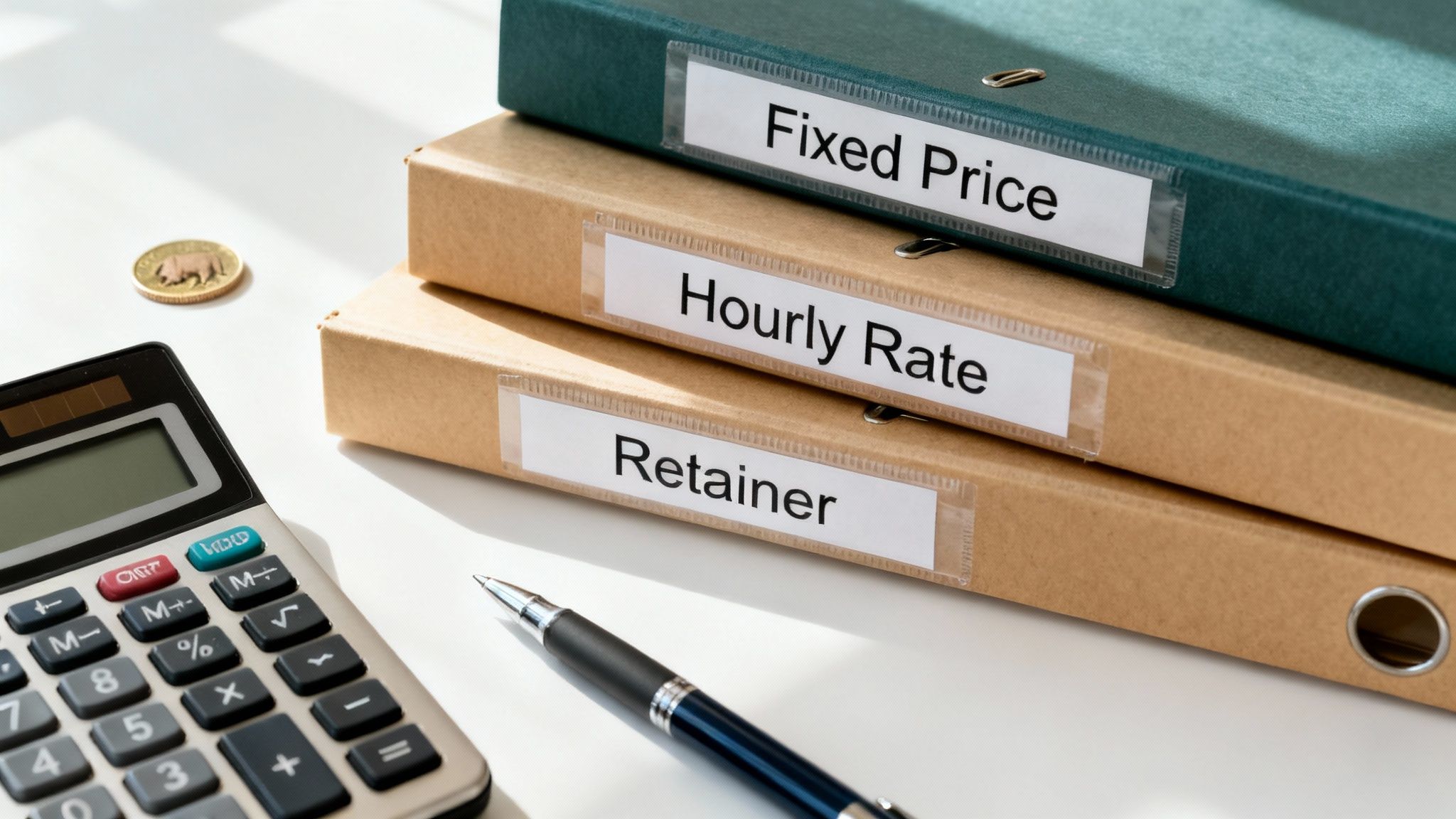
To get a handle on your budget, it really helps to get inside the head of a designer or agency and see how they actually build their quotes. It’s not just about a final number slapped on an invoice; it’s about the philosophy behind that number. Here in Australia, the web page design cost is usually presented in one of three ways.
Each model has its own advantages and pitfalls from your side of the fence. Getting your head around them is the key to comparing quotes properly and picking a partner whose financial approach actually fits your project and your comfort level. Let's break them down.
A fixed project price is exactly what it sounds like: one flat fee for the whole job, from the first meeting to flipping the switch on launch day. This is the go-to model for standard website builds, like brochure sites or smaller e-commerce stores, where what needs to be done is crystal clear from the get-go.
The biggest plus here is budget certainty. You know exactly what you’re up for, which makes managing your cash flow a breeze. No nasty surprises.
But that strength can also be a weakness. A fixed price hinges on a very strict scope of work. If you have a lightbulb moment halfway through and decide you need a major new feature—what we call "scope creep"—it will almost definitely mean a new quote and a change to the contract.
Key Takeaway: A fixed price is perfect for projects with clearly defined deliverables. It protects your budget but doesn't offer much wiggle room for big changes once things are moving.
This approach forces both you and the agency to do some serious planning upfront, which is honestly a great habit to get into. It makes sure everyone is on the same page before a single piece of the site is built.
With an hourly rate, you’re paying for the actual time a designer or agency spends on your project. Rates in Australia can be all over the shop, from about $80/hour for a junior freelancer to $200/hour or more for a senior developer at a top-tier agency.
This model is all about flexibility. It’s ideal for those complex, evolving projects where you don’t know the full scope from day one, or for ongoing little tweaks and updates. You only pay for the work that gets done, which can be a smart way to handle smaller tasks.
The catch? There’s no budget certainty. Without a hard limit, costs can blow out if the project drags on longer than expected. This model demands a huge amount of trust and crystal-clear communication, including regular timesheets from your web partner so you can see where every dollar is going.
At the end of the day, paying by the hour works best when you have a rock-solid, trusting relationship with your web development team.
An ongoing retainer is a set monthly fee you pay an agency for a certain number of their hours or a specific list of ongoing jobs. This isn't really for building a site from scratch, but more for looking after it and helping it grow once it's live.
Think of it like having your own dedicated web team on call. This model is perfect for businesses that need continuous support for things like:
A retainer changes the dynamic from a one-off project to a long-term partnership. It ensures your website doesn't just launch and then gather digital dust, but actually evolves into a powerful business asset. It’s an investment in constant improvement, keeping your online presence sharp, effective, and working for you.
Looking at your website purely as a cost on a spreadsheet is a huge mistake. A great website isn't an expense; it's a powerful business asset and a serious investment in your future growth. It’s time to shift the conversation from what you’re spending to what you’re earning in return.
Think of your website as your hardest-working employee. It’s on the clock 24/7, never calls in sick, and can deal with thousands of customers at once. Its one job is to generate leads, build your brand’s credibility, and drive real, tangible revenue. When you start seeing it this way, the initial web page design cost becomes an investment in a core engine for your business's success.
To really get a feel for the value of your investment, you need to connect every single feature and design choice directly to a business outcome. A slick contact form isn't just a neat design element; it’s a lead generation machine. A well-organised photo gallery isn’t just for show; it’s a powerful tool for building trust and social proof with potential clients.
This mindset forces you to justify every part of the build. So instead of asking, "How much does a booking system cost?" you should be asking, "How much revenue will an integrated booking system generate by streamlining our sales process?" This simple switch turns abstract features into concrete, measurable business tools that feed your bottom line.
A website's success isn't measured by how it looks, but by what it achieves. The goal is to build a high-performance asset that delivers a clear and powerful return on investment (ROI).
For instance, eCommerce website development in Australia demands a significantly higher investment, often in the $10,000 to $25,000 AUD range. With Australia's online retail sales projected to hit $79 billion and grow 10% annually, businesses simply can't afford clunky platforms that contribute to cart abandonment rates as high as 70%. A professionally built, conversion-focused eCommerce site is engineered to capture that revenue, not lose it.
To figure out your website's ROI, you need to look beyond simple traffic numbers. Vanity metrics like page views are nice, but they don’t pay the bills. Instead, you need to focus on Key Performance Indicators (KPIs) that directly reflect the health of your business.
Here are the essential metrics to get on top of:
By keeping a close eye on these KPIs, you can make data-driven decisions to fine-tune your site over time. If your conversion rate is low, it’s a clear signal that something in the user journey needs a second look. For practical strategies on this, our guide on how to improve conversion rate offers actionable steps you can take right now. This cycle of continuous improvement is how you turn a good website into a great one.
Ultimately, maximising your investment means building a website with purpose. Every design choice, every bit of content, and every technical feature should be aimed at hitting a specific, measurable business goal. This strategic approach ensures your website isn't just a line item on a budget but a central pillar of your company's growth strategy.
Navigating the world of web design brings up a lot of questions, especially around the budget. You might find the quotes you receive are worlds apart, and figuring out what’s actually behind the numbers is the key to making a confident decision. This section tackles the most common questions Aussie businesses ask when planning a new website, with direct, jargon-free answers.
Our goal here is to give you the clarity you need to move forward, turning that uncertainty into a clear plan for your digital investment.
It can be confusing when you see a massive range in quotes for what seems like the same job. The huge difference in the web page design cost really comes down to the scope and depth of the service being offered, not just the finished website. It helps to think about it like getting a suit made.
A low quote, often from a freelancer using a pre-made template, is like buying a suit off the rack. It’s fast, affordable, and it gets the job done. It looks professional enough, but it wasn't made with your specific business in mind.
A mid-range quote is more like getting a tailored suit. A designer will take a solid foundation and customise it to fit your brand and goals perfectly. This usually includes a proper strategy session, custom design elements, and foundational SEO to make sure you’re set up for success from day one.
High-end quotes? That’s for a completely bespoke creation. This involves complex custom coding, deep system integrations (like connecting to your internal sales software), and an in-depth marketing strategy. This is the top-tier, custom-made suit, crafted from scratch just for you.
The key is to look past the final price and carefully compare what’s included in each proposal. The cheapest quote is rarely the best value if it doesn't actually help you kick your business goals.
The initial design and build fee is just the beginning. A bit like owning a car, a website has ongoing running costs that are essential for keeping it healthy, secure, and effective. Forgetting to budget for these can lead to some nasty surprises down the road.
Think of it this way: after you buy the car, you still need to pay for rego, insurance, and regular servicing. Your website is no different. The main ongoing costs to plan for are:
For a deeper dive into how costs are calculated and to avoid budget blowouts, this guide on mastering software development cost estimation offers practical models and budgeting strategies. Factoring these ongoing expenses into your initial budget is crucial for the long-term health of your digital asset.
The timeline for building a website is tied directly to how complex it is. There's no single answer, but we can break it down into general timeframes based on the type of project you’re looking at.
A basic 5-10 page brochure website can often be designed and launched in 4-6 weeks. This assumes you have all your content—text, images, and branding—ready to go from the start.
A more customised small business website with a few extra features, like a detailed portfolio or a simple booking system, might take closer to 8-12 weeks. This longer timeframe allows for more detailed strategy, design revisions, and development work.
A full e-commerce build or a website with unique custom functionality is a much bigger undertaking. These projects can easily take 3-6 months or even longer, depending on the number of products, payment integrations, and specific features you need.
It’s important to realise that the biggest factor influencing timelines is often you—the client. The speed at which you can provide feedback, approve designs, and deliver content will have a massive impact on the project's momentum.
Yes, absolutely. The days of needing to call a developer for every tiny text change are long gone. Modern professional websites are built on a Content Management System (CMS), with WordPress being the most popular choice worldwide.
A CMS is designed to be user-friendly, allowing you to log in and manage your own content without needing to know a single line of code. Any reputable agency will provide training as part of the project handover. They’ll walk you through how to:
This empowers you to keep your site fresh and relevant. While you handle the day-to-day content, it's a smart move to leave the technical maintenance—like software updates, security patches, and backups—to your web partner. This ensures your site stays healthy and secure while you focus on what you do best: running your business.
Ready to build a website that delivers real results? The team at Virtual Ad Agency specialises in creating high-performance websites that drive growth and maximise your return on investment. Let's talk about your project today!

 previous