
Getting more traffic to your website isn't about finding one magic bullet. It's about bringing together a few key disciplines: smart search engine optimisation (SEO) to draw in organic visitors, creating killer content that makes them want to stick around, and then promoting it all cleverly across social media and other channels. Think of it as a strategic cocktail—get the mix right, and you’ll see the results.
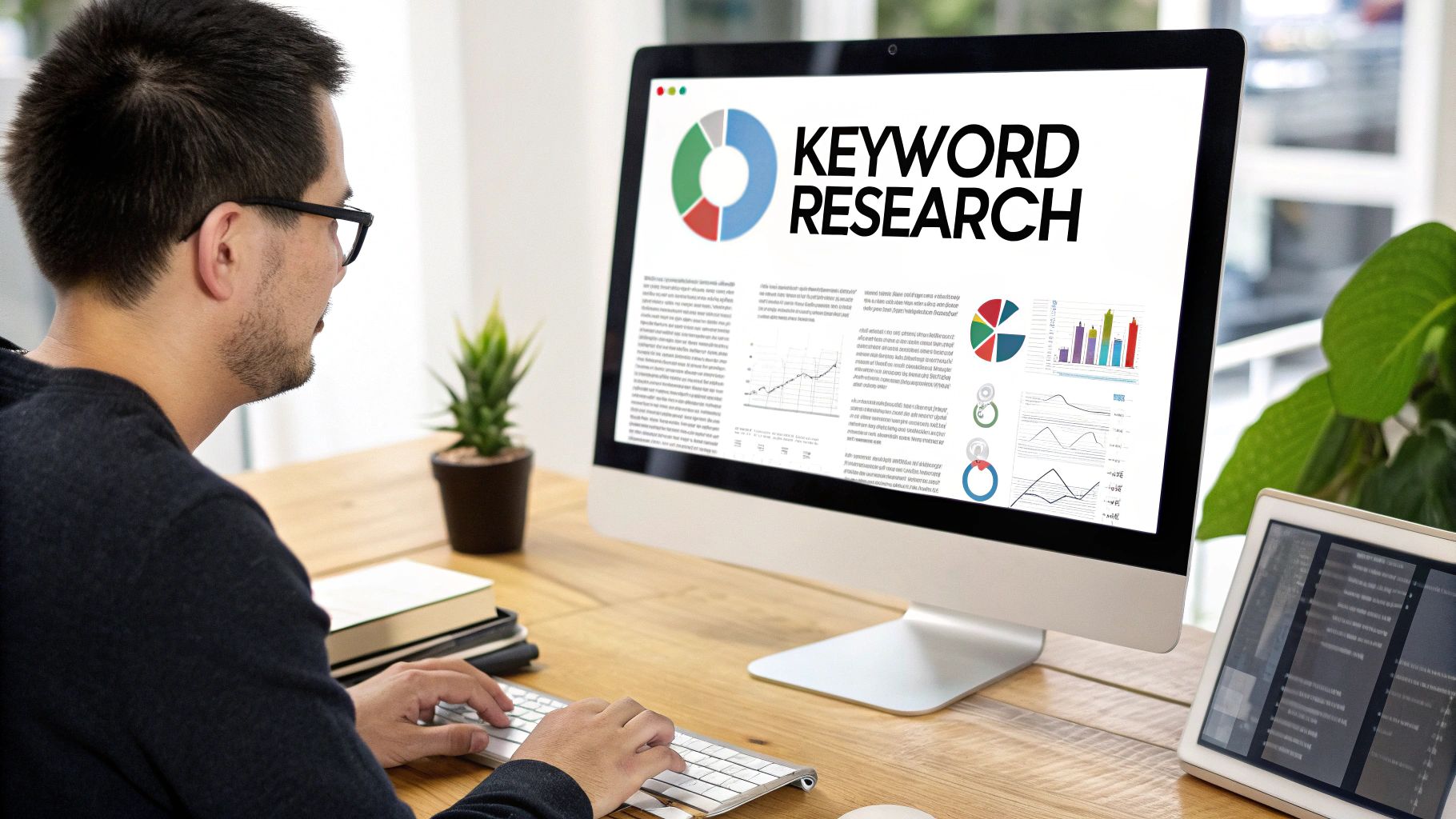
Before you even think about driving new visitors to your site, you’ve got to make sure the place is ready for them. Your website is your digital storefront. If the lights are dim, the aisles are confusing, and it's a pain to get around, people are going to walk right back out. It’s the exact same online.
A strong foundation is what separates a temporary spike in visitors from sustainable, long-term growth. We need to move past generic advice and build a proper blueprint. The real goal here is to turn your website into a powerful asset that consistently attracts the right kind of traffic—people genuinely interested in what you do, not just random clicks that mess with your analytics.
First things first: you need to have a crystal-clear picture of who you're trying to reach. Here in Australia, pretty much everyone is online. As of January 2025, internet penetration hit a massive 97.1%, with the average Aussie spending about 6 hours and 5 minutes online every day.
That time is split almost down the middle between desktop (51.1%) and mobile (48.9%). This tells us your audience is active and ready to be engaged, but you need to understand their specific habits to actually connect.
To do this properly, you need to build out detailed user personas. These are semi-fictional profiles of your ideal customers, built from real data and a bit of educated guesswork. Dig into questions like:
Answering these helps you create content and a website experience that really clicks, making your audience feel like you just get them.
The technical performance of your website isn't just a nice-to-have; it's completely non-negotiable. A slow, clunky website is the fastest way to lose a potential customer before you’ve even had a chance to say hello.
Google’s Core Web Vitals are the metrics they use to measure the real-world user experience of your site—things like loading speed, how quickly someone can interact with the page, and whether things jump around as the page loads. A bad score here can directly hurt your search rankings.
Your website's user experience isn't just a "nice-to-have" feature; it's a core component of your traffic strategy. A site that is fast, intuitive, and mobile-friendly tells both users and search engines that you are a credible and professional authority.
To build that solid technical base, focus your energy on these key areas:
To give you a clearer picture, this table summarises the core strategies we'll be exploring to boost your website traffic. Each pillar plays a unique role in creating a comprehensive and effective growth plan.
Key Pillars of Website Traffic Generation
| Strategy Area | Primary Goal | Key Tactics |
|---|---|---|
| Search Engine Optimisation (SEO) | Increase visibility in search engine results for relevant keywords. | Keyword research, on-page optimisation, link building. |
| Content Marketing | Attract and engage a target audience by creating valuable content. | Blogging, video creation, infographics, case studies. |
| Social Media Marketing | Build a community and drive traffic from social platforms. | Content sharing, community engagement, influencer outreach. |
| Paid Advertising | Generate immediate, targeted traffic through paid channels. | Google Ads, social media ads, native advertising. |
| Analytics & Optimisation | Understand user behaviour and continuously improve performance. | A/B testing, heatmaps, conversion rate optimisation. |
These pillars form the foundation of a robust strategy. By focusing on each area, you create multiple pathways for visitors to discover your website, ensuring more consistent and sustainable growth over time.
Search Engine Optimisation is the engine that drives a steady stream of organic, long-term traffic to your website. It's easy to get lost in the jargon, but at its heart, SEO is just about making it crystal clear to Google what you do and showing that you’re the best answer for what Australians are looking for.
This isn’t about trying to trick the algorithm. It's about building a solid, authoritative online presence that naturally pulls in visitors who are already searching for exactly what you offer. A smart Australian SEO strategy doesn't just get you more clicks—it gets you the right clicks.
The first move is always to get inside the heads of your local customers. What words and phrases are they actually typing into Google? A business in Sydney can't expect to win by targeting generic, global terms; real success comes from understanding the local lingo and search intent.
Think about it. Someone searching for "best coffee Melbourne" has a very different need from someone searching for "how to roast coffee beans." The first is a local customer, ready to buy. The second is a hobbyist looking for information. Your keyword strategy needs to speak to both, but you must know who you're talking to.
You'll need to use keyword research tools to find terms with decent search volume and manageable competition. Keep an eye out for long-tail keywords—those longer, more specific phrases that often signal someone is closer to making a purchase. Instead of just "electrician," a far better target might be "emergency electrician Eastern Suburbs Sydney."
The real secret to a killer SEO strategy isn’t just finding keywords; it’s understanding the person behind the search. When you align your content with their specific problems, you don’t just rank—you connect.
Once you know what people are searching for, it's time to fine-tune your website's pages to match. This is what we call on-page SEO, and it’s the part you have the most direct control over. It's all about sending clear signals to Google about the topic of each page.
Here are the absolute essentials you need to get right for every important page on your site:
yourwebsite.com.au/services/plumbing-repairs is infinitely better than yourwebsite.com.au/p?id=123.For many Aussie businesses, just getting these basics right is a massive step forward. You can dive deeper into these principles with this guide to SEO for small business.
While on-page SEO is about what's on your site, off-page SEO is all about how other websites see you. The single most powerful signal here is backlinks—links from other sites pointing to yours. Think of every backlink as a vote of confidence.
A link from a respected Australian industry blog is worth more than dozens of links from flimsy, irrelevant directories. Google sees high-quality backlinks as proof that your site is a credible, authoritative source, which directly helps you rank higher.
Building a strong backlink profile is a long game, but it's essential. Here are a few ways to get started:
By combining sharp keyword research, solid on-page optimisation, and a steady effort to build authority, you create a powerful SEO foundation that will drive qualified Australian traffic for years.
If SEO is the engine getting people to your website, then great content is the fuel that makes them want to stay. This is where you turn a casual browser into a loyal follower, and eventually, a paying customer. It’s about more than just filling pages with text; it's about building a genuine resource that solves problems, showcases your authority, and actually drives action.
It all kicks off with a clear, deliberate content strategy. Without a plan, you're just creating content for the sake of it, throwing ideas at the wall and hoping something sticks. A solid strategy ensures every article, video, or guide you create has a purpose and a clear path to reaching the right people. It’s the difference between shouting into the void and having a meaningful conversation with your ideal customers.
Before you even think about writing, you need a blueprint. This is your strategic plan, answering a few critical questions about every single piece of content you produce. A brilliant way to get started is by mapping out content clusters. This involves a central “pillar” page on a broad topic, supported by several “cluster” articles that dive deep into more specific, related subtopics.
Let’s say you’re a home builder in Perth. You could create a pillar page titled “The Ultimate Guide to Building a New Home in WA.” This would be your big, comprehensive resource.
From there, you’d support it with cluster content like:
This structure doesn't just organise your content logically for your visitors. It also signals your deep expertise to Google, which can give your rankings a serious boost for those topics.
The most effective content doesn't just answer a question; it anticipates the next question. By creating interconnected content clusters, you guide your audience through their entire journey, establishing your site as the definitive resource.
Not all content is created equal. Different formats serve different purposes, and while long-form blog posts are fantastic for SEO and showing off your expertise, relying on just one format can leave a huge chunk of your audience cold. The key to keeping people interested is diversifying your content mix.
Think about the different ways your audience consumes information. Some people love digging into a detailed article, while others would much rather watch a quick video or scan an infographic. Your job is to match the format to the topic and what your audience is trying to achieve.
Picking the right format can feel like a guessing game, but it doesn't have to be. Each type has its own strengths when it comes to attracting traffic, sparking engagement, or converting leads. This table breaks down where each format really shines.
| Content Format | Best For Attracting Traffic | Best For Engagement | Resource Investment |
|---|---|---|---|
| Blog Posts & Guides | High (Excellent for SEO and long-tail keywords) | Medium (Good for comments and shares) | Low to Medium |
| Video Content | Medium (Great for YouTube and social discovery) | High (Drives longer session times and shares) | Medium to High |
| Infographics | High (Highly shareable and attracts backlinks) | High (Visually appealing and easy to digest) | Medium |
| Case Studies | Low (More for bottom-of-funnel conversion) | Medium (Builds trust and social proof) | Medium |
By mixing and matching these formats, you’ll cater to different preferences and keep your content feeling fresh and exciting. If you want to dive deeper, you can explore our guide on implementing content marketing best practices to find the perfect mix for your business.
Creating amazing content is only half the battle. If no one sees it, it’s not going to deliver results. This is where a smart promotion strategy becomes absolutely essential. Every single piece of content you publish needs a marketing plan designed to get it in front of the right eyeballs.
Your promotion checklist should be a mix of short-term pushes and long-term visibility tactics. Of course, this includes the initial share across your social media channels and in your email newsletter, but you have to go further than that. Consider reaching out to other websites or influencers in your niche for potential shares or backlinks. You can also repurpose your content—that one blog post can be turned into a series of social media graphics, a short video, or a segment in your next email campaign.
This infographic shows just how dramatic the impact can be when you combine great on-page SEO with quality content.
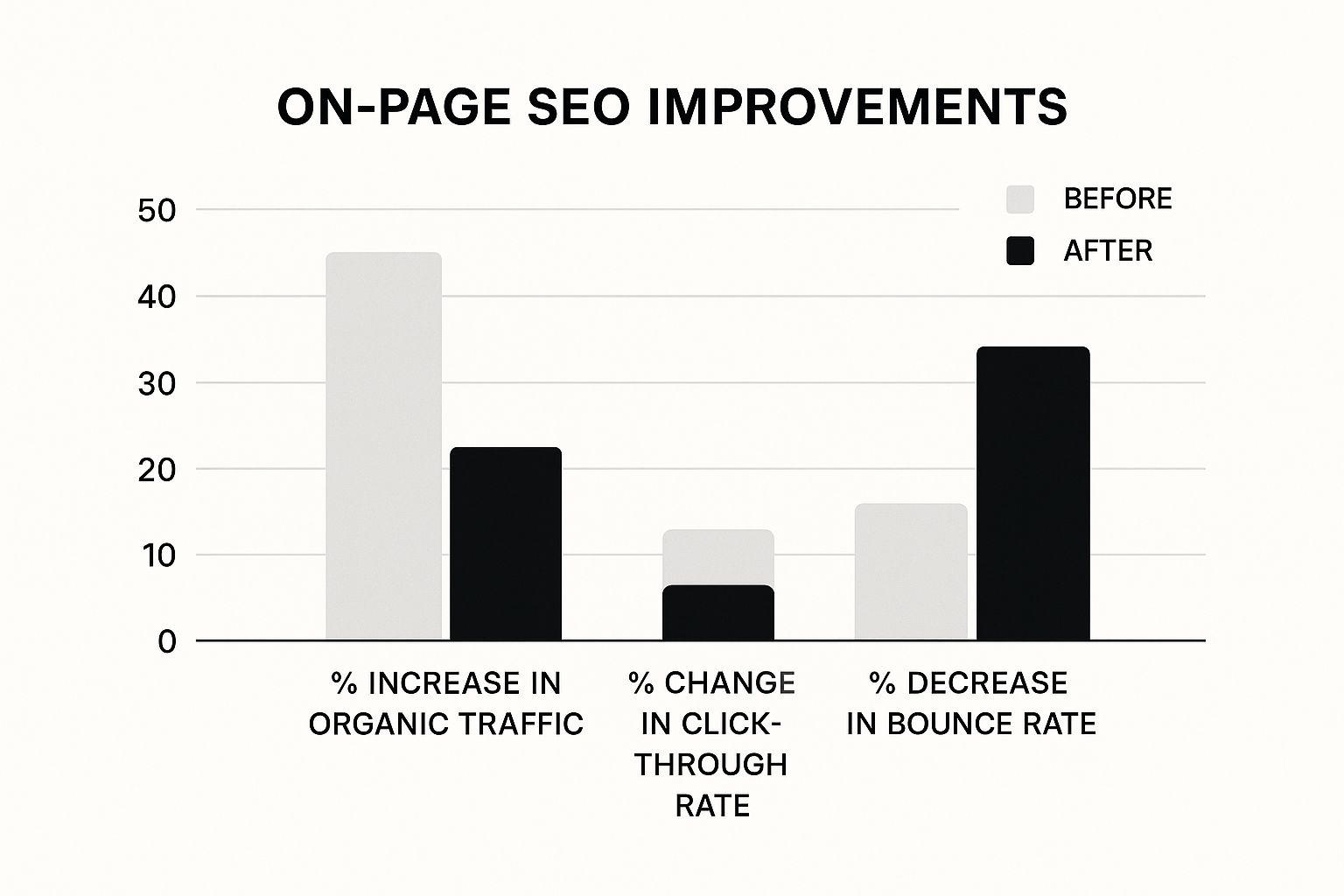
The data makes it clear: well-optimised content doesn't just attract more visitors; it attracts the right visitors who are much more engaged with your site.
You can see the power of combining great content with a strong brand presence by looking at major Australian retailers. In January 2025, for instance, kmart.com.au attracted over 21.3 million visits, while bigw.com.au saw nearly 14.9 million. These massive numbers show how an effective digital strategy, built on recognisable branding and consistent promotion, drives enormous traffic. You can explore more data on Australian retail website traffic on Statista.
By consistently creating and promoting valuable content, you build a powerful flywheel that continuously drives traffic back to your website.

Most businesses see social media as a place for brand updates and pretty pictures. But honestly, that’s selling it short. It’s actually a powerful channel for funnelling highly targeted users straight to your website.
It’s time to stop chasing vanity metrics like likes and followers. The real goal is to create compelling, shareable content that solves a problem, sparks curiosity, and gives people a genuine reason to click through to your site. When you nail this, you’re tapping into a massive, engaged audience ready to connect with your brand on a deeper level.
Just remember, each social platform is its own unique ecosystem. A one-size-fits-all approach just doesn't cut it.
Spreading yourself too thin across every social network is a surefire recipe for burnout and mediocre results. Instead of trying to be everywhere at once, focus your energy on the one or two platforms where your ideal customers are already hanging out.
So, where should you invest your time? Think about these things:
A B2B consultancy, for instance, is far more likely to find qualified leads and start meaningful conversations on LinkedIn. On the other hand, a fashion boutique or a local café would be right at home on Instagram, where visual storytelling is king.
Think of your social media profile as your digital business card. It’s often the very first touchpoint a potential customer has with your brand, and it’s a direct gateway to your website. An incomplete or confusing profile is a massive missed opportunity.
Every single element needs to be geared towards encouraging that all-important click-through. Start with a clear, concise bio that explains exactly what you do and who you help. Most importantly, make sure your website link is front and centre. On platforms like Instagram, that "link in bio" is prime real estate—treat it that way.
Your social media bio isn't just a description; it's a call to action. Use it to tell people not just who you are, but what you want them to do next—which is almost always to visit your website.
To really nail this, keep your branding consistent across all your platforms. Use the same profile picture, colour scheme, and tone of voice. This way, when someone clicks from your social profile to your website, the experience feels seamless and familiar, building trust instantly.
The content you share is the engine of your social media traffic strategy. It has to do more than just entertain; it needs to give someone a solid reason to leave the comfort of their social feed and pay your website a visit.
This is where value-driven content comes in. Social media is a huge driver of website traffic in Australia, where 77.9% of the population actively uses it. TikTok, in particular, has become a massive force with its 8.5 million local users. In 2024, Aussies spent an average of 42 hours and 13 minutes per month on the app—a clear sign of just how engaged they are. If you can create content that grabs their attention, the opportunity is huge. You can find more details about these Australian social media trends on Sprout Social.
This chart from Sprout Social really puts into perspective the dominant role TikTok plays in capturing consumer attention, especially with younger Aussies.
The data doesn’t lie. Platforms with sky-high engagement like TikTok aren't just for brand awareness; they are essential channels for driving actual traffic to your website.
Here are a few content ideas designed to get those clicks:
Building a solid plan is what separates success from wasted effort. For a deeper dive, check out our guide on creating an effective social media marketing strategy that aligns with your business goals. You can also discover some essential social media marketing tips for small businesses to really sharpen your approach.
By consistently delivering value and including a clear call to action, you can turn your social media presence into a reliable source of high-quality website traffic.
Organic growth is the long game, and it’s a brilliant one to play. But let’s be real, sometimes you need to get in front of a new audience right now. That’s where paid ads and sharp analytics come into the picture. When you pair a strategic ad spend with a deep dive into your data, you get the fastest possible feedback loop on what works, letting you put your money where it matters most.
Think of it like this: SEO is like planting an incredible veggie garden that will feed you for years. Paid ads are like ordering a delicious, healthy meal delivered straight to your door. One gives you sustainable, long-term growth; the other delivers immediate results. A truly effective traffic strategy needs both.
Paid advertising can feel like a huge, intimidating world, but the concept is actually pretty simple. You pay to place your website directly in front of a specific group of people. Whether that’s on Google, Facebook, or another platform, you get to choose exactly who sees your message. That precision is what makes it so powerful.
Your first move? Set a realistic budget. You don’t need a fortune to get started. Honestly, even a small, well-managed budget can bring back a treasure trove of insights. Pick one platform to begin with—maybe Google Ads or Facebook Ads—based on where your ideal customers actually hang out online.
Once you’ve picked your battleground, the real work starts: writing ad copy that actually gets people to click. Good ad copy isn't about listing features; it's about solving a problem for someone. Focus on a clear benefit and give them a strong call to action. So instead of "We Sell Custom Furniture," try something like, "Tired of Cookie-Cutter Furniture? Design Your Dream Piece Today." See the difference?
A classic mistake is treating paid ads like a magic button for instant traffic. The real power of ads isn't just the clicks; it's the data they generate. Every impression and every conversion is a piece of feedback telling you what your audience truly wants.
Throwing money at ads without tracking the results is like driving with your eyes closed. This is where your website analytics platform, usually Google Analytics, becomes your most valuable player. Analytics tells the story behind your traffic numbers, showing you who your visitors are, how they found you, and what they do once they land on your site.
Getting your analytics set up is non-negotiable. It’s the only way to measure the real return on your marketing spend and make decisions based on facts, not guesswork. You’ll quickly see which channels are sending you engaged visitors and which ones are just burning through your cash.
The main dashboard in Google Analytics gives you a bird's-eye view of your site’s performance, pulling all the key metrics into one place.
This snapshot shows you crucial data like the number of users, their engagement rate, and where they’re coming from, helping you get a quick health check on your traffic streams.
This data-driven approach is the bedrock of growth. Imagine you notice your Facebook ads are bringing in heaps of clicks, but those visitors are bouncing off your site almost immediately. That’s a massive red flag signalling a disconnect between your ad's promise and what your landing page delivers. Without analytics, you'd never spot that expensive problem.
The real magic happens when you tie your advertising efforts directly to your analytics data. This creates a powerful feedback loop that constantly sharpens your strategy.
Let’s look at a real-world scenario. An Adelaide-based online boutique runs two separate ad campaigns: one on Instagram targeting young fashion enthusiasts and another on Google Ads targeting people searching for "sustainable clothing Australia."
This insight is pure gold. It shows that while the Instagram ad was great at grabbing attention, the Google ad was far better at attracting visitors who were actually ready to buy. Armed with this knowledge, the owner can reallocate their budget, pausing the underperforming Instagram ad and doubling down on the Google Ads campaign.
This is how you stop wasting money and start generating a real return.
Stepping into the world of website traffic can feel a bit like learning a new language. It’s one thing to read about the strategies, but it's another thing entirely to figure out what your own journey will look like. Let's tackle some of the most common questions we hear, with straight-up answers to help you set some realistic goals.
This is the big one, and the only honest answer is: it depends.
If you’re all-in on organic methods like SEO and content marketing, you need to play the long game. You might see some faint glimmers of movement in search rankings within three to six months, but we're usually talking a year or more before you see the kind of substantial, consistent organic traffic that really moves the needle.
For a brand-new website starting with zero authority, the climb is always the steepest. Google needs time to find your site, crawl it, understand it, and ultimately, trust it enough to send its users your way.
Think of it like this: SEO is like planting an orchard. You won't get fruit overnight, but with steady care, you build an asset that pays you back for years. Paid ads, on the other hand, are like turning on a tap—you get water instantly, but it stops the second you turn it off.
Often, the smartest move is a bit of both. Use paid ads to get people to your site right now and collect valuable data, all while your long-term organic efforts are quietly building momentum in the background.
It’s a crucial distinction to make: not all website traffic is created equal. Seeing your visitor numbers spike doesn't automatically mean you're winning. The real goal is attracting qualified traffic—people who are genuinely interested in what you have to offer and could actually become customers.
Here’s a quick way to tell them apart:
Always, always focus on the quality of your visitors, not just the quantity. High engagement is a far healthier sign of a good traffic strategy than a big, flashy number in your analytics.
Starting from scratch feels massive, but it’s also a clean slate—an opportunity to build a rock-solid foundation. Forget trying to do everything at once. Pick a few high-impact activities and nail them first.
This focused approach will help you gain traction so much faster than if you try to chase every single traffic tactic from day one.
Ready to stop guessing and start growing? The team at Virtual Ad Agency specialises in building data-driven marketing funnels that attract high-quality traffic and turn visitors into loyal customers. Let us help you build a strategy that delivers real results. Learn more at https://www.virtualadagency.com.au.

 previous