
Trying to make your mark online when you’re working with a tight budget can feel like an uphill battle. But SEO marketing for small businesses isn't just another techy task to add to your list; it’s genuinely your best shot at long-term, sustainable growth. The best way to think about it is like getting the best shopfront on a busy digital high street, where customers who are already looking for what you sell can find you without any effort.
For a lot of small business owners, marketing feels like shouting into the wind. You can sink money into ads that disappear the second you stop paying, or you can post on social media and just hope for the best. SEO, or Search Engine Optimisation, is a completely different game. At its core, it's simply the art of making your website more appealing to search engines like Google.
When you get it right, SEO puts your business right in front of people at the exact moment they’re searching for what you do. It’s not about interrupting their day with an ad they didn't ask for; it's about being the helpful answer they were actively looking for. This creates a reliable stream of high-quality visitors—people who are already primed to become customers.
Unlike an ad campaign that's here today, gone tomorrow, every bit of effort you invest in SEO builds on itself. It’s a bit like this:
This compounding effect is what makes SEO the ultimate growth engine. The work you put in today can keep bringing in customers months, or even years, down the line. It’s a fantastic return on your initial investment of time and energy. With over 90% of online experiences starting with a search engine, you really can't afford to be invisible there.
One of the most brilliant things about SEO is that it lets small businesses go toe-to-toe with the big guys. Sure, huge corporations can outspend you on advertising, but they can't always beat you on local knowledge and niche expertise. By zeroing in on specific services and local search terms, you can carve out a space where you’re the dominant player.
SEO empowers small businesses to connect with high-intent customers organically. It transforms your website from a simple online brochure into a dynamic lead-generation machine that works for you 24/7, driving consistent and cost-effective growth.
This guide is here to cut through the jargon and give you a clear plan. We’ll focus on practical, down-to-earth strategies that attract real customers and give you a return you can actually measure. And to get you started on the right foot, check out these 8 quick SEO wins that can give your rankings and traffic a nice little boost right away.
Before you can build a house, you need to lay the foundations. It's the same deal with your online presence, and Search Engine Optimisation (SEO) is the concrete, steel, and framework holding everything up. Without a solid base, everything else you do is just decoration on shaky ground.
Let's break SEO down into three core pillars. Get these right, and they'll work together to make your business more visible to the people who need you.
Think of SEO as a simple growth engine. It powers up your visibility, which in turn, brings customers through your door.
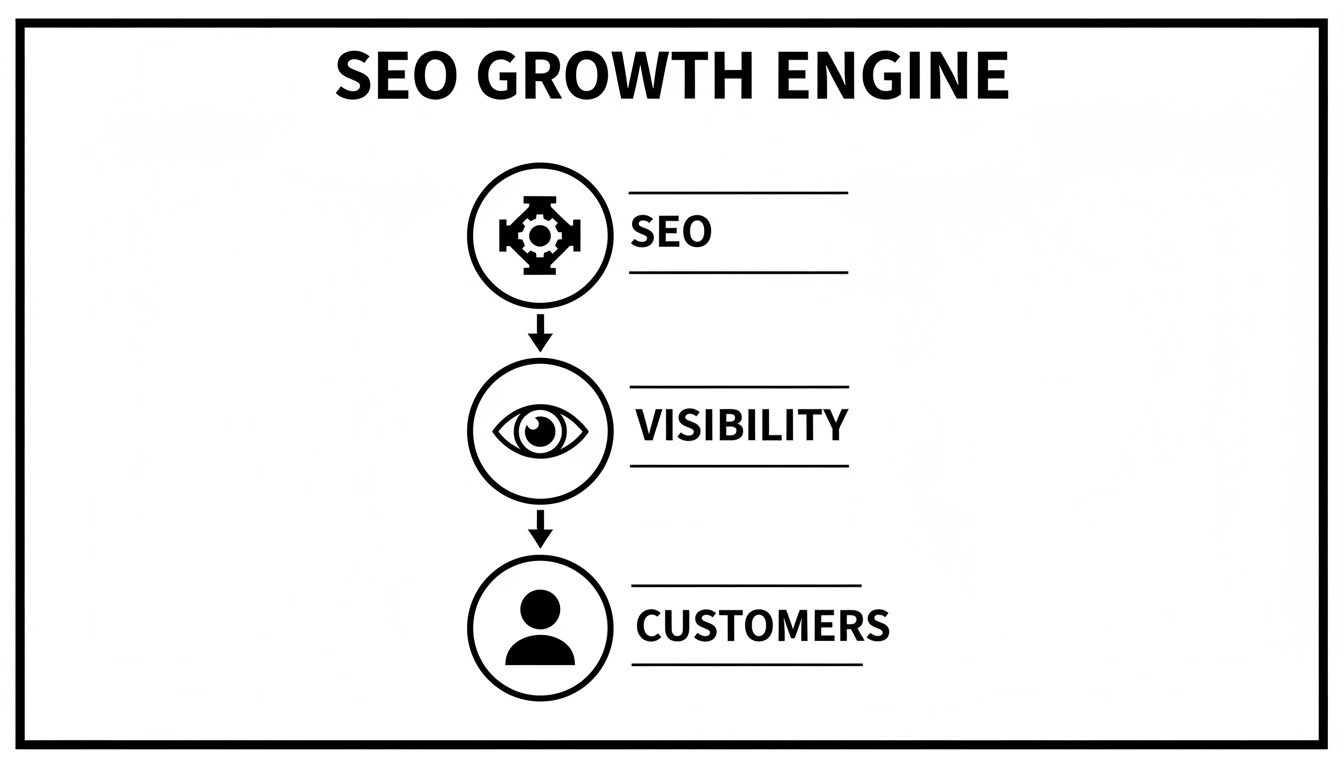
This little diagram shows that every SEO action, no matter how small it seems, is part of a direct path to getting new customers. Now, let's look at the three main parts that make this engine hum.
On-page SEO is everything you do on your actual website pages to help search engines understand your content and see it as valuable. Imagine you own a physical shop. On-page SEO is how you organise your shelves, label the aisles, and make sure customers can easily find exactly what they’re looking for.
This boils down to a few key things:
When you get your on-page SEO right, you’re making your website a welcoming and easy-to-navigate space for your visitors. Simple as that.
Off-page SEO covers all the actions taken outside of your own website to boost your rankings. This is all about building your business's reputation and authority online. It’s the digital version of good old-fashioned word-of-mouth.
When other reputable websites link to yours, it’s like they're giving you a public vote of confidence. Google sees these links (we call them "backlinks") as powerful signals that your site is trustworthy and a useful resource.
Off-page SEO is fundamentally about proving your credibility to search engines. A strong backlink from a respected local business is far more powerful than dozens of low-quality links because it demonstrates genuine authority.
Key off-page activities include getting listed in local business directories, being mentioned in industry blogs, or getting reviews on sites like Google. Every single positive mention builds your reputation and tells search engines you’re a legitimate player.
Finally, there's technical SEO. This is all the behind-the-scenes work that ensures search engines can properly crawl and index your website. If on-page SEO is organising your shelves, technical SEO is making sure the front doors to your shop are unlocked, the lights are on, and there’s nothing blocking the aisles.
This covers some absolutely critical elements:
Without a solid technical foundation, even the most amazing content and strongest reputation won't matter much. Why? Because search engines—and your customers—might not be able to access your site properly in the first place.
These three pillars don't work in isolation. They support each other to create a powerful, sustainable marketing strategy for any small business.
For most small businesses, the online battle isn't won by competing nationally; it's about owning your own neighbourhood. This is where Local SEO becomes your secret weapon. It’s all about making your business impossible to miss when customers are searching for services right in your immediate area.
Think about it. When someone searches for "best coffee near me" or "emergency plumber in Richmond," they aren't just browsing—they have an immediate problem that needs solving. These searches are digital gold because they connect online searching with real-world buying faster than any other kind of marketing. Capturing this local traffic means more feet through the door, more calls to your phone, and ultimately, more sales.
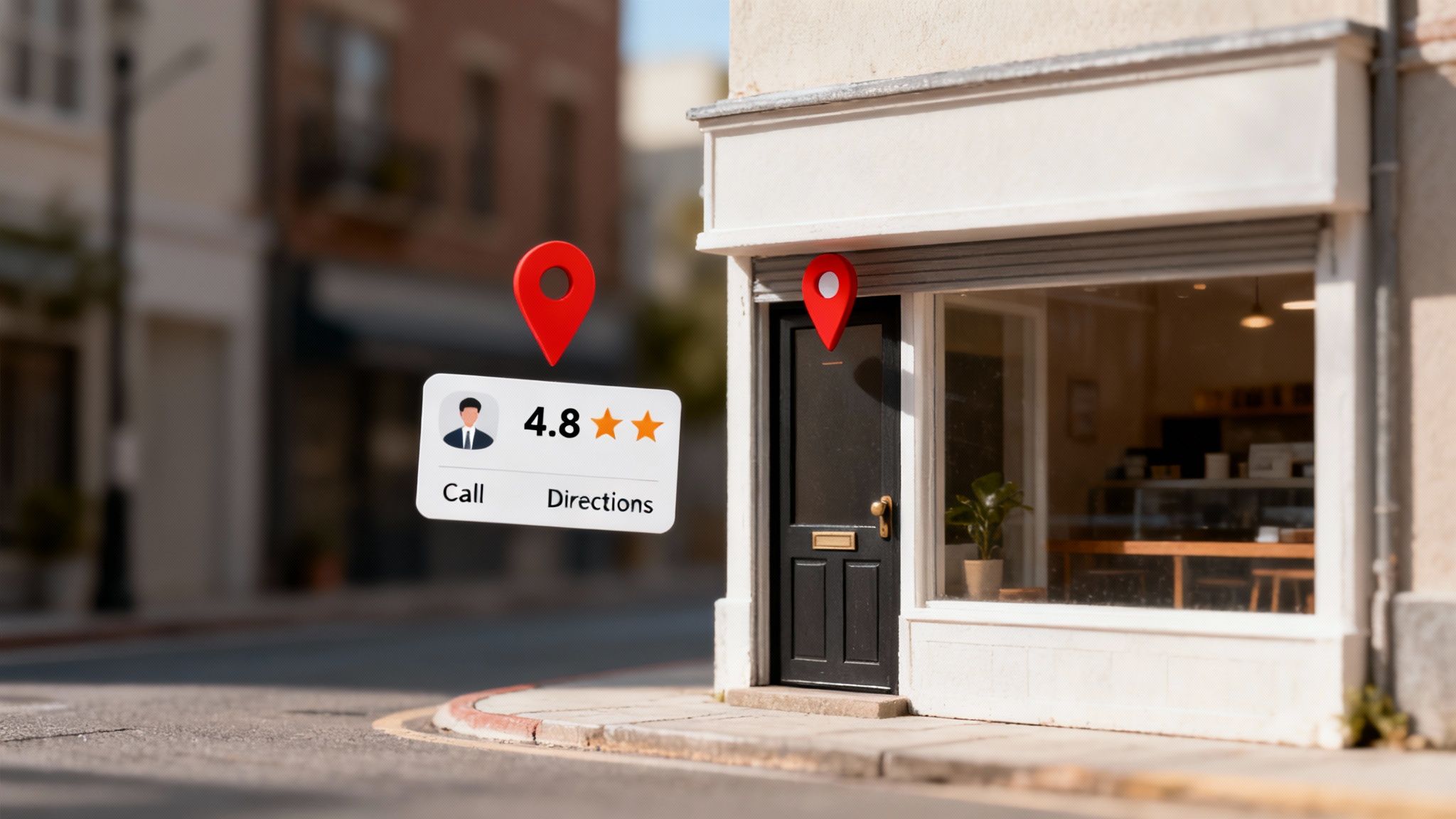
Local SEO has become a genuine game-changer for Aussie small businesses, letting them punch well above their weight against the big players. A massive 46% of all Google searches in Australia have local intent, meaning nearly half the time someone's searching, they're looking for something nearby. Even better, a whopping 78% of mobile local searches result in a visit to a physical store within 24 hours. That's turning a quick search into cash in the till, often on the same day.
Your most powerful tool in the local SEO arsenal is your Google Business Profile (GBP). Don't mistake this for a simple listing; it's a dynamic, interactive storefront that lives right on Google's search results page and on Google Maps. Getting this right is the single most impactful, low-cost action you can take.
A well-oiled GBP is like a mini-website, giving customers all the crucial info they need at a glance. It's often the very first impression a potential customer will have of your business.
Think of your Google Business Profile as the digital front door to your business. If it’s incomplete, out-of-date, or neglected, potential customers will just walk right past and go to your competitor next door.
A complete and active profile doesn't just inform customers; it sends powerful signals to Google. It proves you're a legitimate, active, and reputable local business that deserves a spot in the coveted "Map Pack"—that box showing three local businesses right at the top of the search results. Our comprehensive guide on SEO for small business dives deeper into strategies that complement your GBP optimisation.
Turning your GBP into a machine that attracts customers is pretty straightforward. It just needs a bit of attention to detail and consistency. Let's walk through the must-do steps to make your profile stand out and work for you 24/7.
Claim and Verify Your Profile: First things first, you need to take control. Go to Google and search for your business name. If a profile already exists, you'll see an option like "Own this business?" Follow the prompts to claim and verify it, which usually involves getting a postcard with a code sent to your physical address.
Ensure Absolute NAP Consistency: Your Name, Address, and Phone number (NAP) must be 100% identical across your website and every other online directory. Even tiny variations like "St." versus "Street" can confuse search engines and water down your local authority.
Complete Every Single Section: Don't leave any field blank. The more information you give Google, the more it trusts you.
Getting started with local SEO can feel like a lot, but a few key actions can deliver a big impact, fast. Here's a simple checklist to get you moving in the right direction.
| Action Item | Why It Matters | Difficulty |
|---|---|---|
| Claim & Fully Verify Your GBP | This is your foundation. It proves to Google you're a real, active business at a physical location. | Easy |
| Get Your NAP 100% Consistent | Search engines need consistent signals. Any variation confuses them and hurts your ranking potential. | Easy |
| Upload at Least 10 Photos | Visuals build trust and engagement. Aim for a mix of storefront, team, and product/service shots. | Easy |
| Get Your First 5 Reviews | Reviews are a huge trust signal for both customers and Google. Kickstart the process by asking happy clients. | Medium |
| Respond to Every Review | It shows you're engaged and care about customer feedback, turning browsers into buyers. | Easy |
| Create Your First Google Post | Posts act like free mini-ads on your profile. Share an offer, event, or update to grab attention. | Easy |
Tackling these items is the perfect first step. Once you've got them sorted, you can move on to building even more local authority.
An optimised profile is just the beginning. To stay at the top, you need to keep engaging with your audience. This means actively using the tools Google gives you to show that your business is alive, well, and focused on its customers.
A key part of this is managing your online presence consistently. To effectively manage your local presence and rank higher, it's worth looking into a specialised GMB scheduler for small businesses.
Finally, put your energy into these two critical areas:
Keyword research can sound terribly technical, but it’s really just about listening. Think of it as figuring out the exact words and phrases your customers use when they’re looking for a solution you provide. Getting this right is the very first step in any successful SEO marketing for small businesses strategy.
Instead of guessing what people might be searching for, you need to step into their shoes. What problem are they trying to solve right before they need you? What questions are tumbling around in their head?
This initial brainstorm is your starting point. It's less about finding perfect keywords right away and more about getting inside your customer’s mindset.

Once you’ve got a list of ideas scribbled down, it’s time to see what people are actually searching for. Free tools like Google Keyword Planner are a great place to start. They can show you roughly how many people are searching for a term and, just as importantly, suggest related ideas you might have completely missed.
The goal isn't just to find popular keywords; it's to find the right ones for your business. This means hunting for terms that show someone is ready to make a decision, not just gathering information. This is also where checking out your competitors comes in handy. Our guide on how to conduct competitor analysis is an essential read for refining your keyword list.
As a small business, trying to rank for a massive, broad term like "plumber" is a losing battle. You’d be going head-to-head with national companies that have eye-watering marketing budgets. Your real power lies in long-tail keywords.
These are longer, more specific search phrases, usually three or more words. Sure, they have less search traffic, but the people using them are much, much closer to pulling out their wallets.
A search for "plumber" is a browse. A search for "24-hour emergency plumber in Parramatta" is a cry for help from a customer who needs to hire someone right now. That’s the power of specificity.
Consider the difference in intent here:
Focusing on these hyper-specific phrases is a much smarter use of your time and money. They’re less competitive, which means you have a far better chance of landing on the first page of Google and attracting high-quality leads who are ready to become customers.
The way people search is also changing, especially here in Australia. Voice and mobile searches are exploding, with 33% of Aussies using voice search every day, mostly to find local businesses. People aren't typing stiff keywords; they're asking real questions like, "Hey Google, find a plumber near me that's open now." These queries are often six to ten words long and very conversational, which makes long-tail keywords more important than ever.
This shift means your keyword strategy needs to include natural, conversational phrases and questions that mirror how people actually speak.
Here’s a simple process to find your best long-tail keywords:
By following this process, you move from a vague, ridiculously competitive keyword to a laser-focused phrase that will attract your ideal customer. This targeted approach is the bedrock of successful SEO marketing for any small business.
Good SEO marketing for small businesses isn't about technical wizardry or trying to trick Google. It's actually much simpler than that. It’s built on trust and value. Search engines are designed to find the most helpful, authoritative answers for their users, so your job is to prove your business is exactly that.
This all comes down to two things: creating genuinely useful content that solves your customers' problems, and building relationships that earn links from other reputable websites. Think of it this way: your content is the proof of your expertise, and links are the word-of-mouth referrals that tell Google you’re the real deal.
Your content needs to be designed to help, not just to sell. When you consistently give away useful information, you build a connection with potential customers and position your business as a trusted authority, long before they're even thinking about making a purchase.
And don't overthink it. You don’t need a Hollywood budget to make an impact. Often, the simplest, most practical content is the most powerful.
Here are a few high-value content ideas that work for pretty much any small business:
This approach turns your website from a simple brochure into a valuable resource, attracting the right kind of visitors and building the trust that ultimately leads to sales.
Link building, at its heart, is just old-fashioned relationship building. A link (often called a 'backlink') is just a clickable link from someone else's website to yours. In Google's eyes, these are votes of confidence. When a respected local website links to you, it sends a strong signal that you're a credible and important part of the local community.
For a small business, the best links are almost always local ones. Forget about complex global strategies; your focus should be right here in your own backyard. These are the links that actually move the needle in local search results, and they're well within your reach.
The goal isn't to get thousands of random links. A handful of high-quality, relevant links from local sources is far more powerful for a small business than hundreds of junk links from irrelevant sites.
Focus your energy on simple, community-based opportunities that build real-world connections and boost your SEO at the same time.
Effective link building doesn’t have to be some complicated, expensive mystery. The key is to think locally and focus on genuine partnerships that make sense for your business.
Here are a few practical strategies to earn valuable local links:
Sponsor a Local Event: Supporting a local kids' sports team, a community fete, or a charity fun run almost always gets you a link from the event's website. That’s a powerful local signal right there.
Partner with Neighbouring Businesses: Team up with non-competing businesses that share a similar customer base. You could co-host a workshop or offer a joint promotion, and then link to each other’s websites as "trusted partners."
Join Your Local Chamber of Commerce: Most chambers of commerce and local business associations have an online directory of members. Getting listed is often a quick win for a high-authority local link.
Get Listed in Reputable Directories: Beyond the big general directories, look for ones specific to your industry. A restaurant needs to be on Zomato, while a tradie should be on a site like Hipages. These listings confirm your business details and build local trust.
By creating genuinely helpful content and building real community relationships, you build authority the right way. This is the most sustainable and effective path to signalling to search engines that you are a trusted leader in your local market, and it’s the true foundation of a successful long-term SEO strategy.
So, you’ve put in the hard yards with your SEO. But how do you actually know if it’s working? Measuring the results of your SEO marketing for small businesses can feel like a mammoth task, but it doesn't require a degree in data science. It’s really just about checking a few key signposts to make sure you’re heading in the right direction.
Forget about wrestling with complex spreadsheets and confusing jargon. For a small business, success boils down to tracking a handful of metrics that show a real-world impact. The best part? The tools you need to do this are completely free.
You only really need two tools to get a crystal-clear picture of your performance: Google Search Console and Google Analytics. Think of them as the dashboard and the customer counter for your digital storefront.
These two work hand-in-hand to tell you the whole story, from the moment someone types a query into Google to the final action they take on your site.
To avoid getting lost in a sea of data, just focus on the numbers that directly connect to business growth. A simple monthly check-in on these key performance indicators is all you need to stay on track.
SEO success isn't just about traffic; it's about attracting the right traffic that turns into tangible business outcomes. Tracking a few core metrics ensures your efforts are driving real value, not just vanity numbers.
Start by keeping an eye on these three fundamental areas:
By focusing on these core metrics, you can confidently measure your progress, spot new opportunities, and make smart decisions about where to put your energy next—all without feeling overwhelmed.
Getting your head around SEO marketing can throw up a lot of questions. It's only natural to wonder about the time, money, and effort involved before you dive in. Let's tackle some of the most common worries to give you the clarity you need to get started with confidence.
There’s no magic number here. In Australia, a small business can start seeing a real difference by dedicating consistent time to DIY efforts or by budgeting anywhere from $500 to $2,000 per month for professional help.
The most important thing isn't the dollar amount, but the consistency. A smaller, steady investment over several months will always beat a big, one-off spend. Your best bet is to nail the high-impact, low-cost local SEO tasks first, like perfecting your Google Business Profile. That's where you'll get the fastest return.
SEO is a marathon, not a sprint. While you can often see some quick wins from local SEO improvements—like more calls coming through your Google Business Profile—within a few weeks, climbing the ranks for more competitive search terms usually takes four to six months.
Think of SEO like planting a tree. It needs consistent care and a bit of patience. You have to let the roots grow strong before it can bear fruit. The results are long-lasting, but they definitely don't appear overnight.
This timeline makes sense when you think about it. It takes time for search engines to notice your changes, for your website's authority to build, and for all your different efforts to start working together. Patience and persistence are absolutely essential.
Absolutely! Heaps of foundational SEO tasks are perfect for a DIY approach. As a small business owner, your deep understanding of your customers is a massive advantage you can leverage.
You can make a huge impact by managing your own Google Business Profile, writing helpful blog posts that answer common customer questions, and getting a handle on basic on-page SEO. There are plenty of free tools to guide you.
Consider bringing in an expert or agency when you've run out of time or knowledge, or when you need to tackle more complex technical challenges or a competitive link-building campaign. Many businesses find a hybrid approach works best—handling the basics in-house and outsourcing the more specialised stuff.
Ready to turn searchers into customers but not sure where to start? The team at Virtual Ad Agency specialises in creating practical, results-driven SEO strategies that help Australian small businesses grow. Explore our SEO services to see how we can help you get seen.

 previous