
Trying to generate leads with digital marketing without a solid foundation is like building a house on sand. You can have the flashiest ads and the biggest budget, but if you haven't done the groundwork, it's all going to come crashing down. That foundational work is what makes every ad you launch or blog post you publish actually work. It ensures you're hitting the right people with the right message, every single time.
It's so tempting to jump straight into the exciting stuff—PPC campaigns, social media, content creation. But this is a classic mistake I see all the time, and it leads to wasted resources and a database full of poor-quality leads that go nowhere.
Real success starts with an honest, deep look at where you are right now and getting crystal clear on who you're trying to talk to. It's the difference between casting a huge, empty net and dropping a perfectly baited hook right where the fish are biting.
This really boils down to two key things: a thorough audit of what you're already doing and creating detailed buyer personas. These aren't just fluffy marketing exercises; they are the strategic pillars that will hold up your entire lead generation engine.
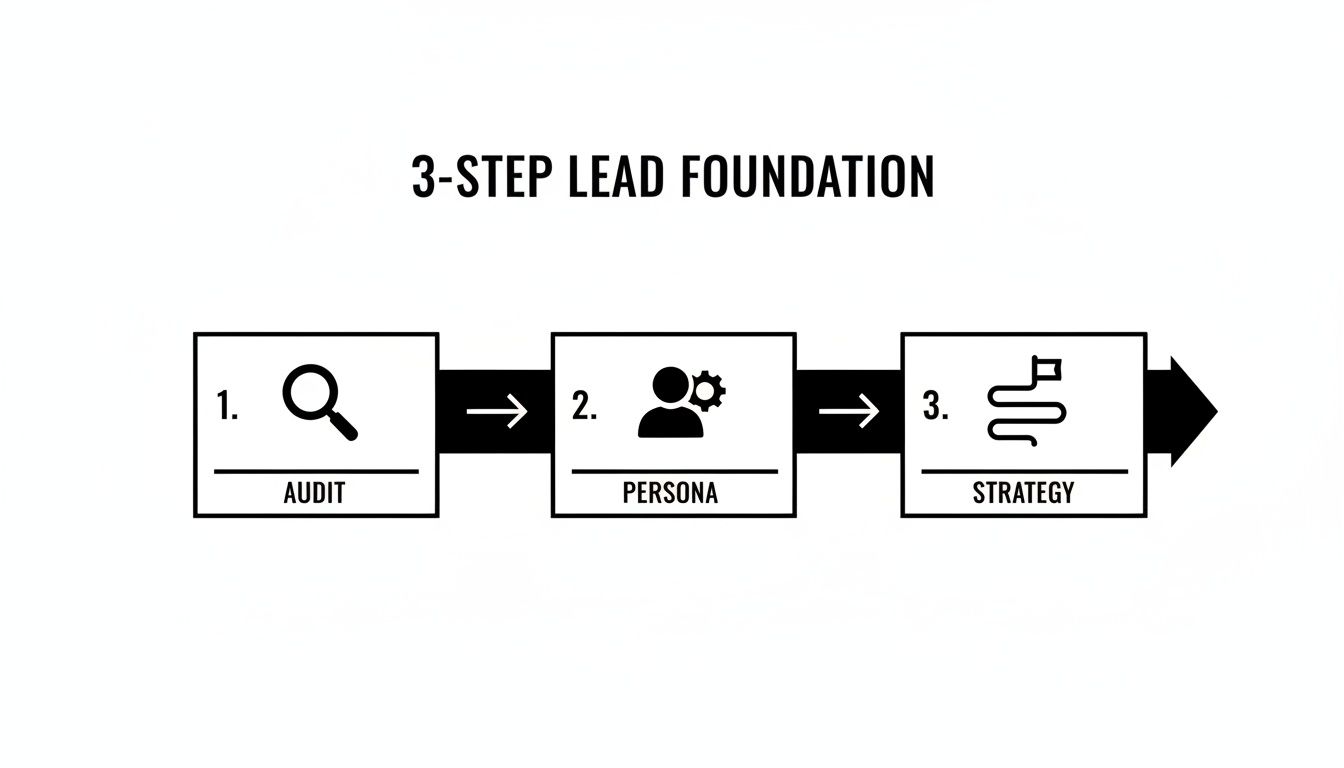
Before you can build anything new, you have to know what you're working with. A proper diagnostic audit is a full review of your current marketing efforts, designed to pinpoint what's working, what's broken, and where the friction is. Think of it as a complete health check-up for your lead generation process.
The goal here is to dig deeper than surface-level numbers like website traffic. We need to find out why things are happening. Why are people bouncing off your key landing pages? Is your killer blog post attracting the right crowd but completely failing to get them to take the next step? An audit gives you the hard data you need to stop guessing and start making smart decisions.
To help you get started, I’ve put together a simple checklist to guide you through auditing the main stages of your funnel.
Before you spend another dollar, run through this checklist. It's a straightforward way to spot the leaks in your funnel and identify the biggest opportunities for improvement.
| Funnel Stage | Key Metric to Audit | Example Tactic to Evaluate | Status (Good/Needs Improvement) |
|---|---|---|---|
| Awareness | Organic Traffic & Keyword Rankings | SEO performance for top-of-funnel, non-branded keywords | |
| Social Media Engagement Rate | Quality of interaction on posts (not just likes) | ||
| Consideration | Landing Page Conversion Rate | Performance of your lead magnet landing pages | |
| Lead Magnet Downloads | Which assets (eBooks, webinars) are most popular? | ||
| Conversion | Lead-to-MQL (Marketing Qualified Lead) Rate | Are the leads you're generating actually a good fit? | |
| Sales Cycle Length | How long does it take for a lead to become a customer? | ||
| Retention | Customer Lifetime Value (CLV) | Are you upselling or cross-selling to existing customers? | |
| Email Open/Click-Through Rates | How engaged is your email list post-conversion? |
This table isn't exhaustive, but it’s a solid starting point. Being honest about where you're at is the first step toward building a funnel that actually produces results.
Okay, so you've got a handle on your current performance. Now, who exactly are you trying to attract? This is where buyer personas come in. These are detailed, semi-fictional profiles of your ideal customers, built from market research and, more importantly, real data from your best existing clients.
A good persona is so much more than basic demographics like age and job title.
A great buyer persona tells you what keeps your ideal customer up at night. It reveals their biggest challenges, where they hang out online to find solutions, and what ultimately triggers them to make a purchase.
This is the kind of insight that turns a document into a powerful, actionable tool. For example, if you know your ideal customer, "IT Manager Ian," is active in specific LinkedIn groups and trusts peer reviews on tech forums above all else, your whole strategy clicks into place. You know exactly where to find him and what content will grab his attention.
To really nail this, it helps to lean on proven frameworks. Diving into some established B2B lead generation best practices can give you a great head start on shaping your strategy.
When you take the time to audit your funnel and build out these personas, you’re setting yourself up for success. Every marketing dollar gets spent more efficiently because you're targeting the right people, in the right places, with a message that truly resonates.
When your ideal customer has a problem, where do they turn first? Not a friend or colleague, but Google. This simple truth is the bedrock of any powerful lead generation strategy. Showing up as the answer they’re looking for isn’t about luck; it’s about a deliberate, two-pronged attack combining long-term organic search (SEO) with surgical paid search (PPC).

This approach lets you intercept leads who are actively searching for a solution, making them some of the highest-quality prospects you’ll ever find. They already have a problem, they're researching their options, and they're ready to act. Your job is to simply meet them there.
First things first, you need to get inside your customer's head. What exact phrases are they typing into that search bar when they need what you do? This isn't just about finding popular terms; it’s about pinpointing keywords that scream commercial intent.
These are the phrases that signal someone is getting close to a decision. They’re often modified with words that show urgency or a desire to take the next step.
Getting this right is crucial. Targeting "what is CRM" is a top-of-funnel content play. Targeting "HubSpot vs Salesforce pricing" is a bottom-of-funnel lead generation play, designed to capture someone deep in the buying cycle. This distinction will shape your entire search strategy.
In Australia, search is king. A massive 62.5% of internet users start their brand research on a search engine, making it the biggest first touchpoint. And with 46% of all searches having local intent, a localised strategy isn’t just an option—it’s essential for capturing leads who are ready to engage.
Too many businesses see SEO and PPC as an either/or choice. Big mistake. They’re a powerful combination that delivers both immediate hits and long-term gains. Think of them as two different tools to achieve the same goal: owning the search results page.
SEO is your long-term asset. It’s the process of optimising your website’s content, technical health, and authority to rank organically for your target keywords. It’s a slow burn, but it builds incredible trust and credibility. Nailing that top spot is worth it; the number one organic result gets an average click-through rate of around 28.5%. To get the foundations right, our guide on SEO optimization best practices is a great place to start.
PPC is your accelerator. It lets you buy your way to the very top of the page, giving you instant visibility for your most valuable commercial keywords. It's perfect for testing offers, targeting competitor terms, and getting leads in the door while your SEO efforts build up steam.
Getting traffic is only half the battle. You need a seamless path from that first click to a conversion.
Here’s how to structure your efforts for real results:
By weaving these organic and paid tactics together, you create a search presence that captures leads no matter where they are in their decision-making process. To give your paid campaigns a real competitive edge, exploring these 10 PPC advertising strategies can help you find new ways to scale your efforts.

Social media has come a long way from being a simple brand awareness tool. These days, when you approach it with a clear strategy, it's a direct and powerful pipeline for generating genuine leads. The secret isn't about being everywhere at once; it's about picking the right channels where your ideal buyers are already active and then delivering value that naturally guides them into your funnel.
Forget chasing vanity metrics like likes and shares. The real goal of digital marketing for lead generation on social platforms is to spark conversations, build trust, and create a clear path for followers to raise their hands and show they’re interested.
Not all social platforms are created equal, especially when leads are the goal. A B2C fashion brand will naturally gravitate towards visual platforms like Instagram, while a B2B SaaS provider will almost certainly find their home on LinkedIn. Your buyer personas should be your north star here.
Think about it: where do your ideal customers spend their time looking for professional advice or real solutions? Getting this distinction right is critical for putting your resources where they’ll actually make a difference.
By 2025, it's estimated that 77.9% of Australians will be active on social media, making it a channel you can't ignore. For B2B businesses, the numbers are even more stark: a staggering 80% of social-generated leads come directly from LinkedIn, which boasts a visitor-to-lead conversion rate significantly higher than Facebook’s. You can explore more Australian marketing statistics to see the full picture.
This data really hammers home the importance of a platform-specific strategy. A generic, one-size-fits-all approach just won't cut it. What works on LinkedIn should look completely different from your strategy on another platform.
Your social media content needs to do more than just entertain; it needs to have a job. Every post, video, or story should serve a purpose in nudging your audience from being passive scrollers to active participants. The key? Offer value first.
The aim is to create a natural, logical transition. For instance, after posting a series of tips on a specific topic, it makes perfect sense to then offer a comprehensive guide on that same subject as a lead magnet.
Influencer marketing has become a serious tactic here in Australia, with ad spend climbing to between AUD $520–929 million. It's a powerful way to generate leads because you're essentially borrowing the trust and credibility an influencer has already built with their audience.
Success here is all about relevance over sheer reach. A micro-influencer with a highly engaged, niche audience is often far more valuable for lead generation than a mega-influencer with millions of generic followers. When you’re vetting potential partners, look for creators who share your brand values and speak authentically to an audience that mirrors your ideal customer.
Structure your collaborations around clear calls-to-action, like signing up for a co-hosted webinar or downloading a unique resource. This ensures the partnership drives measurable leads, not just fuzzy brand exposure.
Getting traffic to your website is a great start, but the real magic happens when you turn those anonymous clicks into actual, tangible leads. This is where high-value content and sharp email marketing come together, creating a powerful engine for conversion.
The exchange is simple and timeless: you offer something genuinely useful, and in return, a potential customer gives you their details and permission to stay in touch.
This process is the heart and soul of effective digital marketing for lead generation. It’s not about pulling a fast one to get an email address. It’s about creating assets so valuable that prospects are more than happy to make the trade. We call these assets lead magnets, and they are the currency of your entire conversion strategy.
A lead magnet isn’t just another blog post. It has to solve a very specific, often urgent, problem for your ideal customer. A generic "10 Tips" eBook just won't cut through the noise anymore. A great lead magnet delivers a quick win or a deep insight they can't easily find with a quick Google search.
And please, think beyond the standard PDF. Your lead magnet should be perfectly matched to where your buyer is on their journey. Someone just starting their research has completely different needs than someone who is comparing options and ready to buy.
The most powerful lead magnets feel less like marketing and more like a genuine solution. They answer a pressing question, simplify a complex process, or provide a tool that makes the prospect's job easier. This focus on utility is what builds initial trust.
To help you map this out, think about which magnet type best aligns with your target audience and where they sit in your funnel.
| Lead Magnet Type | Best For Funnel Stage | Ideal Audience Persona | Example Topic |
|---|---|---|---|
| Checklist/Template | Top of Funnel (Awareness) | The "DIYer" or "Planner" looking for a quick, actionable framework. | "The Ultimate 10-Point SEO Audit Checklist for SaaS Websites" |
| eBook/Whitepaper | Top/Middle of Funnel | The "Researcher" who wants to understand a problem in depth. | "The Future of B2B Lead Nurturing: A Data-Backed Report" |
| Webinar/Workshop | Middle of Funnel (Consideration) | The "Visual Learner" who wants expert guidance and interaction. | "Live Workshop: How to Triple Your Landing Page Conversions in 30 Days" |
| Case Study | Middle/Bottom of Funnel | The "Skeptic" who needs proof that your solution delivers results. | "How [Client Name] Increased MQLs by 200% with Our Strategy" |
| ROI Calculator/Tool | Bottom of Funnel (Decision) | The "Number Cruncher" focused on business impact and justification. | "Calculate Your Potential Cost Savings with Our Automation Platform" |
| Consultation/Demo | Bottom of Funnel (Decision) | The "Ready-to-Buy" prospect who needs their specific questions answered. | "Book a Free, No-Obligation Strategy Session with an Expert" |
Matching the right content to the right person at the right time is what separates a lead magnet that collects dust from one that consistently drives new business.
Once you've got a killer lead magnet, it needs a dedicated home. A landing page is a specialised webpage stripped of all distractions—no navigation menu, no links to other blog posts, nothing. It has one ruthless focus: conversion.
Every single element on the page, from the headline right down to the button text, must work in harmony to persuade the visitor to take that one desired action. A strong landing page will always have:
This laser-focus is precisely why landing pages are so good at turning traffic into leads.
Getting a lead is just the beginning of the conversation, not the end. Now, email marketing steps in to build the relationship, establish trust, and gently guide your new contact through their buyer's journey. This is where automation becomes your secret weapon.
An automated nurture sequence is a pre-written series of emails that gets triggered the moment someone downloads your lead magnet. This isn't about blasting them with sales pitches. It's about continuing the helpful conversation you just started.
A typical nurture sequence might look something like this:
This systematic approach works. The data shows that content marketing can generate three times as many leads as traditional marketing at a 62% lower cost. When you pair that with smart email nurturing, the results get even better. Mature lead-nurturing practices generate about 50% more sales-ready leads at a 33% lower cost, directly connecting your content and email efforts to a healthier bottom line.
Perfecting your nurture sequences is a constant process of tweaking and refining. For a deeper dive into crafting emails that people actually open and click, exploring proven email marketing best practices can give you the actionable tips you need to turn subscribers into sales-ready leads.
Bringing in a steady flow of leads is a massive win, but that's really only half the story. The real challenge—and where most revenue is won or lost—is in efficiently managing and converting those leads as you scale up. Without a solid system, even your best leads can go cold, fall through the cracks, or get stuck, which just means wasted marketing spend and a frustrated sales team.
This is the point where you stop manually chasing contacts and start building an intelligent, automated engine. This machine works 24/7 to nurture prospects, pinpoint the hottest opportunities, and continuously improve your conversion rates. It’s all about getting the absolute maximum value from every single lead your marketing efforts bring in.
Marketing automation is so much more than just sending out a series of emails. It’s a system built to handle repetitive tasks, which frees you up to deliver personalised experiences to leads based on what they actually do. Someone who downloads an eBook needs a very different follow-up conversation compared to someone who requests a demo. Automation makes this possible without needing a huge team.
Think of it as your digital lead-nurturing assistant. It ensures every new contact gets the right message at exactly the right time, building trust and gently guiding them towards a sale. To get started with the basics, understanding what is marketing automation and its core capabilities is a vital first step. It’s the framework that supports a scalable lead management process.
The true power of automation isn't just efficiency; it's relevance. It allows you to have thousands of one-on-one conversations simultaneously, treating each lead as an individual based on their actions, not just as a name on a list.
Let's be honest, not all leads are created equal. Someone who has visited your pricing page five times and downloaded a case study is far more valuable to sales than someone who only grabbed a top-of-funnel checklist. The problem is, how do you tell them apart when you have hundreds of new leads flooding in?
This is where lead scoring comes into play. It’s a system that automatically assigns points to leads based on their attributes and their actions.
When a lead's score crosses a certain threshold (say, 100 points), they're automatically flagged as a Marketing Qualified Lead (MQL) and handed over to the sales team. This simple process ensures your sales reps spend their valuable time on prospects who have shown genuine interest and are much closer to buying.
Getting leads into your system is one thing; getting them to take that next critical step is another game entirely. Conversion Rate Optimisation (CRO) is the systematic process of improving your website and landing pages to increase the percentage of visitors who convert. It's about turning more of your existing traffic into leads and customers.
The heart of CRO is A/B testing, sometimes called split testing. This involves creating two versions of a webpage (an 'A' version and a 'B' version) with one single change, like a different headline or button colour. You then show each version to a different segment of your audience to see which one performs better.
Here are a few high-impact elements to start testing right away:
By constantly testing and refining these elements, you can make some serious improvements to your lead generation results over time—all without needing to increase your traffic. This disciplined approach builds a highly efficient conversion engine that turns clicks into customers with predictable success.
Even the most experienced marketers have questions when it comes to refining a lead generation strategy. It’s a fast-moving game, so staying curious is part of the job. Here are some straightforward answers to the questions we hear all the time.
This is the classic "how long is a piece of string?" question, but we can definitely get you closer to an answer. Your budget shouldn't be a number plucked from thin air; it needs to be a direct reflection of your revenue goals. The best approach is to work backwards from your sales targets.
First, figure out your average Customer Lifetime Value (CLV) and your lead-to-customer conversion rate. Let's say you need 10 new customers this month and your sales team converts 10% of qualified leads. That means you need to generate 100 qualified leads. From there, you can work out a target Cost Per Lead (CPL) that keeps you profitable.
Of course, other factors will influence your budget:
A huge mistake we see is spreading a small budget too thinly across too many channels. You'll get far better results by dominating one or two channels with proper funding than by being a minor player on five or six. Focus your resources where they'll have the most impact.
The "best" channel is always the one where your ideal customers are spending their time. There’s no single right answer for every business, but some channels have clear strengths for certain markets.
For B2B businesses, LinkedIn is often an absolute powerhouse. Its professional context and incredible targeting options make it unmatched for reaching specific job titles, industries, and company sizes. In fact, a staggering 80% of B2B social media leads are said to come from LinkedIn.
For B2C companies, the choice is much broader. Visually-driven brands in fashion, home decor, or food often crush it on Instagram or Pinterest. Businesses targeting a wider demographic might lean on Facebook's massive user base. But when it comes to capturing immediate intent, search engines (SEO and PPC) are king for both B2B and B2C. You’re reaching people who are actively looking for a solution right now.
This really comes down to the channels you choose. The timeline for seeing a return can vary massively between different marketing activities.
The smartest approach is usually a balanced one. Use paid channels to get immediate lead flow and revenue, while you simultaneously build your long-term organic engine with SEO and great content. This creates a powerful, sustainable lead generation machine that isn't reliant on a single source.
At Virtual Ad Agency, we specialise in building full-funnel marketing strategies that deliver real, measurable growth. If you're ready to turn your digital marketing into a predictable source of new business, let's connect and talk about your goals.

 previous