
So, what does a realistic SEO package actually cost in Australia? Brace yourself, because the honest answer is: it depends.
Generally, you can expect to invest anywhere from $1,500 to over $10,000 per month. But for most small to medium businesses looking for genuine, meaningful growth, the sweet spot is usually between $2,000 and $5,000 a month.
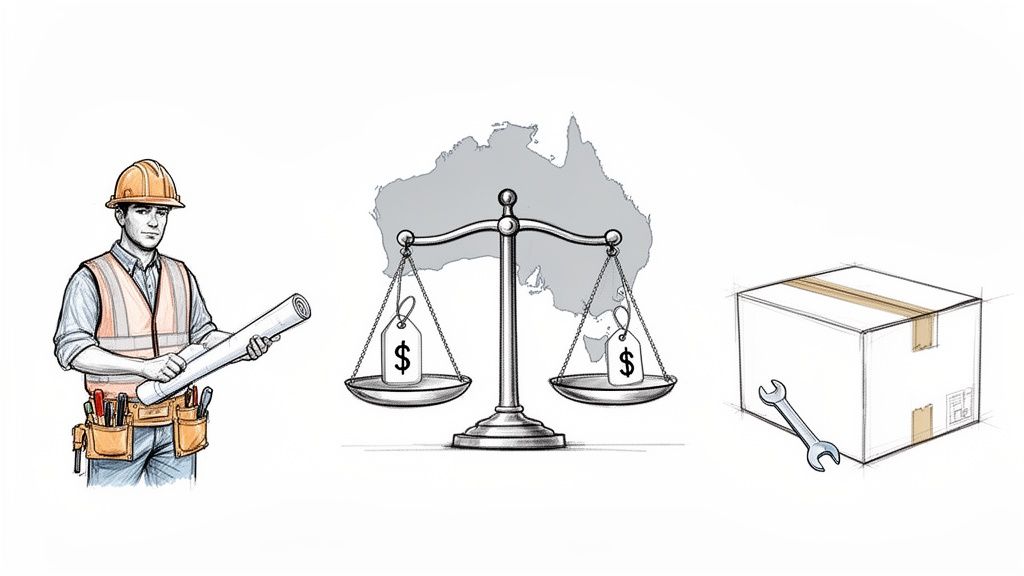
Here's the most important mindset shift you can make: stop thinking of SEO as buying something off a shelf. It's not a product. It’s a service, and a highly customised one at that.
A better analogy is hiring a specialist builder to construct your dream extension. The final price tag is going to come down to the scope of the project, the quality of materials, and the level of expertise needed to get the job done right. You wouldn't expect a simple deck to cost the same as a two-storey addition, would you?
In the same way, an SEO agency needs to properly assess the situation before quoting a price. They’ll look at your current website, suss out the competition, and get to the bottom of your business goals. A campaign for a local Adelaide plumber will have a vastly different scope—and price—than a national strategy for a major e-commerce store.
Figuring out what you should actually be spending is the first hurdle. For small businesses in Australia, a budget between $1,400 and $2,500 per month is a solid starting point to get the ball rolling and start making a real impact.
That sort of investment is especially effective for SMEs in cities like Adelaide, where dominating the local search results can open up a firehose of new leads and customers. To see what this typically covers, you can learn more about how Australian businesses are budgeting for their search engine optimisation services.
This isn't about paying for quick tricks or temporary boosts. It's about laying a solid foundation for sustainable, long-term growth.
Think of your initial SEO investment as pouring the concrete slab for your digital presence. You wouldn't build a house on shaky ground, and the same logic applies here. A proper budget ensures the structural integrity of your online growth for years to come.
To give you a clearer picture, we've put together a simple breakdown of what businesses across Australia are typically investing in SEO each month. This should help set some realistic expectations and show you where your business might fit in.
Here's a quick look at common SEO package prices, broken down by business size and the main focus of the campaign.
| Business Size | Typical Monthly Price Range (AUD) | Primary Focus |
|---|---|---|
| Small Local Business | $1,500 – $3,000 | Local keyword visibility, Google Business Profile optimisation, foundational content. |
| Medium-Sized Business | $3,000 – $7,000 | Competitive keyword targeting, consistent content production, strategic link building. |
| Large Enterprise | $7,000+ | Market dominance, technical SEO at scale, multi-channel content strategy, authority building. |
As you can see, the investment scales directly with the complexity of your campaign and the size of your ambition. A bigger goal simply requires more resources to achieve.
When you start digging into SEO services, you'll find that pinning down a price isn't straightforward. There’s no single price tag because agencies package their work in different ways, each designed to suit different types of businesses and goals. Getting your head around these models is the first step to finding a partner that actually fits your needs and gives you real value for money.
Most agencies you’ll talk to will frame their services around one of three main pricing structures. A good way to think about them is to consider how you’d hire any expert: you could bring them onto the team for the long haul, hire them for a specific, one-off job, or just pay for their time and advice when you hit a roadblock.
Let’s unpack what each of these looks like in the real world.
The most common arrangement in the SEO industry is by far the monthly retainer. This is exactly what it sounds like: an ongoing partnership where you pay a fixed fee every month for a continuous block of services.
Think of it like having a personal trainer. You don’t just pay for a single workout and expect lasting results. Instead, you invest in a long-term program where your trainer is constantly tracking your progress, tweaking your plan, and pushing you forward month after month. An SEO retainer works the same way, providing that consistent, sustained effort needed to build up—and then protect—your website's authority in search results. To see how these are often structured, it's worth checking out different types of SEO packages to understand how retainers are presented.
This model is the best fit for businesses that are serious about long-term, sustainable growth. SEO isn't a "set it and forget it" activity. Google's algorithm is always changing, your competitors are always making moves, and new opportunities are always popping up. A retainer ensures you have a dedicated team keeping their eye on the ball for you, every single month.
Next up is project-based pricing. This is for a specific, one-time job with a very clear start and finish. The scope is defined upfront, and you pay a single, fixed price for the completed work. It’s the perfect option when you have a distinct problem to solve, rather than needing someone to manage your SEO day-in, day-out.
This is like hiring a builder to renovate your bathroom. You both agree on exactly what needs doing—new tiles, new vanity, the lot—and you pay an agreed price once the job is done. When the bathroom is finished, the engagement ends.
A few classic examples of SEO projects are:
This model gives you total cost certainty for a specific outcome, making it a great choice for businesses with a clear, immediate need.
Finally, we have hourly consulting. This is the most flexible, pay-as-you-go option. You’re simply paying an SEO expert for their time, usually at a set hourly rate. This works brilliantly for businesses that already have an in-house marketing team but need some specialised advice or a second opinion on complex challenges.
It’s a bit like having a lawyer on speed dial. You don’t need them for your daily operations, but when a tricky situation comes up, you can pay for an hour of their time to get expert guidance. An SEO consultant can provide high-level strategic direction, train your internal team, or help you navigate a particularly thorny technical issue. It's a targeted way to tap into top-tier expertise without the commitment of a full campaign.
Figuring out the pricing models is a good first step, but it doesn't really answer the big question: why does one business get a quote for $2,000 a month, while another is looking at $8,000? The simple truth is that there's no such thing as a one-size-fits-all SEO package, because every business is its own unique puzzle.
Think of an SEO strategist like a personal trainer. They can't just hand you a generic workout plan. First, they need to assess your current fitness, understand your goals (are you training for a marathon or just trying to touch your toes?), and see what you're working with. The final "prescription"—and what it costs—comes down to a mix of factors that shape your investment.
Let's break them down.
First up, the sheer size and complexity of your website is a massive factor. A clean, five-page website for a local Adelaide dentist is worlds away from a sprawling e-commerce store with thousands of product pages.
More pages simply means more of everything: more keywords to track, more content to get just right, and way more potential technical gremlins to hunt down and fix. It’s the difference between servicing a bicycle and overhauling a freight train. Both have wheels, but the scale of work is on a completely different planet. Any good agency has to factor in that sheer volume of effort.
So, who are you actually up against? The level of competition in your industry is a huge cost driver. If you're a niche consulting firm in a quiet market, grabbing that top spot on Google might be a relatively smooth ride.
But if you’re trying to make a name for yourself in a cut-throat space like real estate or finance, you're not just competing; you're going into battle. You’re up against established players with deep pockets and years of built-up authority. To even stand a chance, your campaign needs to be more aggressive, demanding more resources for top-tier content, powerful link building, and sharp strategic analysis. The price tag reflects the intensity of the fight you need to win.
Your SEO package price is directly proportional to the difficulty of the challenge. You're not just paying for a list of tasks; you're investing in the strategic power needed to outperform established competitors and secure your market share.
What does "success" actually look like for you? Your business objectives dictate the entire strategy, and in turn, the price.
Each of these goals requires a different blend of services and expertise. A campaign designed to drive immediate leads will look very different from one aiming to build a national brand over the next two years.
A lot of websites come with baggage. Technical debt is what we call the buildup of small technical glitches over time—sluggish page speed, broken links, a clunky mobile experience, or messy code. Before you can build anything new, you have to pay down that debt.
Fixing these foundational issues is non-negotiable for SEO success. A deep-dive technical audit is almost always the first step in any serious campaign, and what it uncovers will shape the initial scope of work. If you're curious about what a proper check-up involves, you can explore our guide on what a professional SEO audit service should cover. If your site needs a major cleanup before the real work can begin, that will be factored into the cost.
Finally, we get to the parts of an SEO campaign that are often the most resource-intensive: content and link building. Creating genuinely high-quality, expert-led content isn't a cheap exercise. Neither is earning authoritative backlinks from reputable websites. Both require skilled writers, outreach specialists, and a serious time investment.
These two pillars of a successful campaign often determine the final price. A campaign that requires four in-depth articles per month will naturally cost more than one that only needs one. It's that simple. An SEO package in Australia that includes producing two high-quality blog posts and acquiring 5-10 authoritative backlinks per month for a mid-sized Adelaide company will justify a higher price point because of the sheer expertise and labour involved.
Talking about the factors that influence an SEO package price is one thing, but seeing what that money actually gets you is where it all clicks. What's the real difference between a $2,000 per month investment and a $7,000 one? Knowing the answer helps you set the right expectations and ensures you’re not paying for a V8 engine when you only need a reliable four-cylinder.
Let's break down what you can typically expect at three distinct investment levels in the Australian market. Think of it as moving from getting your foundations right to building a market-dominating skyscraper.
This diagram shows how your website's size, the fierceness of your market competition, and your own business goals are the starting blocks for figuring out which level is right for you.
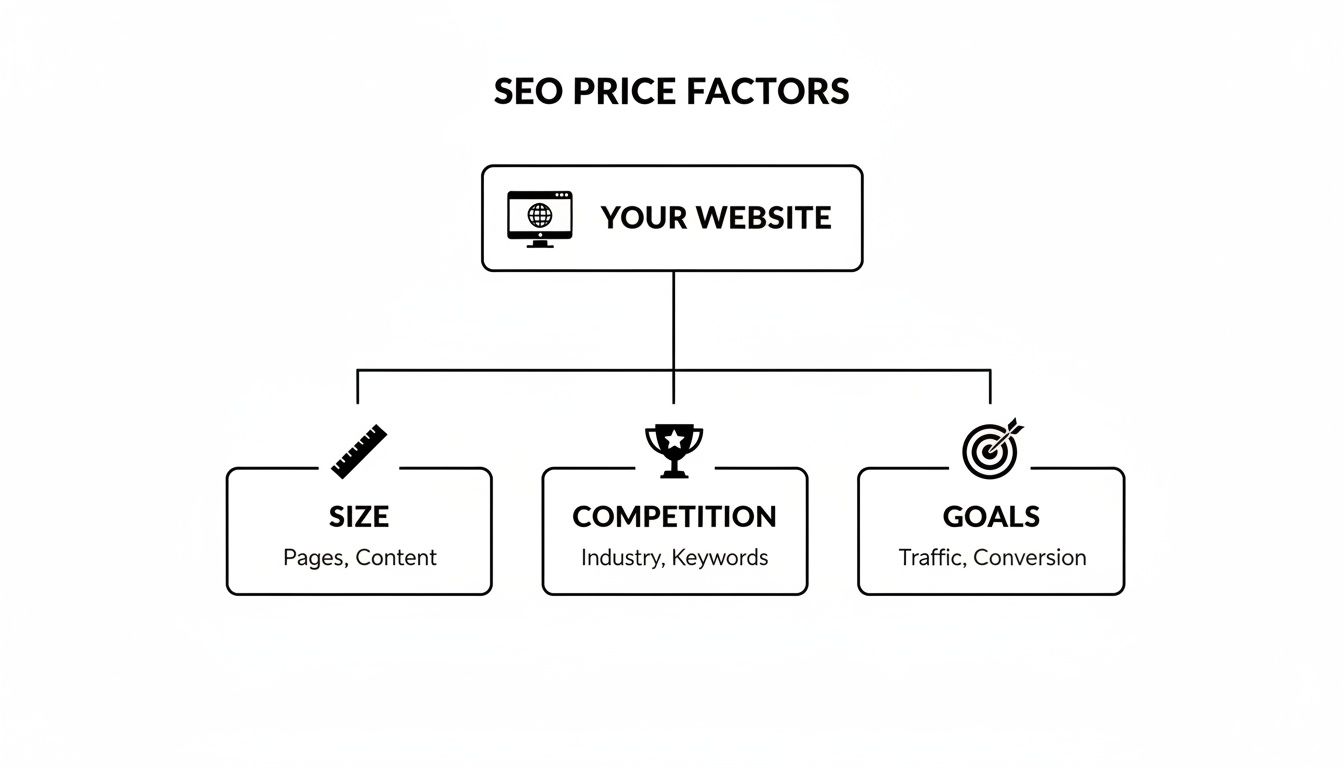
Essentially, your unique situation dictates the strategy, the workload, and ultimately, the cost.
So, what's behind the price tag? This table lays out the common services and outcomes you can expect at different monthly price points here in Australia. It’s a handy guide to see where your business fits and what kind of results are realistic for your budget.
| Investment Level (Monthly AUD) | Typical Included Services | Best For |
|---|---|---|
| Under $3,000 | Technical SEO audit & fixes, on-page optimisation for core pages, Google Business Profile setup, foundational local citations, basic monthly reporting. | Small businesses, local service providers, or companies in low-competition niches just starting their SEO journey. |
| $3,000 – $7,000 | All foundational services plus: ongoing content creation (blogs, articles), strategic link building, competitor analysis, more in-depth reporting, and conversion tracking. | Established businesses aiming for growth in competitive local or regional markets. This is the sweet spot for serious lead generation. |
| Over $7,000 | All of the above plus: advanced technical SEO (site speed, architecture), large-scale content strategy (white papers, case studies), Digital PR campaigns, and conversion rate optimisation (CRO). | Large enterprises, national e-commerce stores, or businesses in hyper-competitive industries aiming for market leadership. |
As you can see, a bigger investment doesn't just mean "more SEO." It means a more sophisticated, proactive, and aggressive strategy designed to tackle bigger challenges and seize larger opportunities.
This entry-level spend is perfect for small businesses or those in less crowded local markets, like many operating in and around Adelaide. The goal here isn't to take over the world overnight. It’s about building a rock-solid base for future growth, fixing technical gremlins, and getting your foot in the door on search results.
At this level, you’re looking at:
Think of it as getting your house in order. You’re not building an extension yet; you’re fixing the leaky roof and making sure the foundations won’t crack. For many smaller operations, this is the perfect starting point. You can find out more about how these crucial first steps come together with SEO services for small businesses.
This is where things get serious. This mid-range budget is for established businesses ready to move beyond the basics and start actively fighting for the more valuable, high-traffic keywords. The strategy becomes proactive, focusing on creating great content and building authority to really challenge the incumbents.
A typical mid-tier package in Australia includes a much wider suite of services. This budget allows for a dedicated strategist to dive deep into keyword research, manage a consistent content schedule, and run a proper link-building campaign. At this level, you can realistically expect to see significant lifts in rankings and organic traffic over a 6-12 month period.
This is the point where SEO shifts from a simple maintenance task into a primary engine for business growth. You're no longer just patching holes; you are actively creating assets—like quality content and powerful links—that will pay dividends for years to come.
This top-tier investment is for the big players—large enterprises or businesses battling it out in fiercely competitive national or even international markets. The goal here isn't just to compete; it's to dominate. Campaigns are aggressive, multi-layered, and deeply woven into the company's broader marketing fabric.
Here's what this budget unlocks:
It’s easy to get fixated on the monthly cost of an SEO package. The invoice lands, and you see it as just another expense. But that's the wrong way to look at it. The real question is how much revenue that investment brings back into your business.
To understand the true value, you need to shift your mindset from cost to profit. This is where calculating the return on investment (ROI) turns SEO from a line item on a spreadsheet into a powerful profit centre for your company.
Forget about vanity metrics for a moment. Seeing your site hit page one feels great, but a high ranking doesn't pay the bills on its own. The metrics that really count are the ones that directly fatten your bottom line.
You need to focus on tangible business outcomes.
By keeping your eyes on these figures, you can draw a straight line from your SEO efforts to genuine business growth.
Working out your return isn't as complicated as you might think. It boils down to a straightforward formula that gives you a crystal-clear picture of how your campaign is performing financially.
(Revenue from SEO – Cost of SEO) / Cost of SEO = ROI
Let’s say you generated $25,000 in new business directly from organic search, and your SEO package cost $5,000. Your ROI would be a very healthy 400%. This simple bit of maths gives you hard data to prove the strategy is working.
Of course, knowing the basics is one thing, but it's crucial to understand how to measure marketing ROI properly to see the full, long-term picture.
Let's make this practical. Imagine an Adelaide-based commercial electrician investing $4,000 per month in a competitive local SEO package.
Now, let's plug that into our formula: ($25,000 Revenue – $4,000 Cost) / $4,000 Cost = 525% ROI.
That's the number to focus on when you're looking at SEO package prices. A well-run campaign isn’t an expense; it’s an investment that delivers a consistent stream of qualified leads, drives down customer acquisition costs, and builds a long-term asset for your business. You can read more about how Australian businesses find their SEO investment pays for itself on seomelbourne.com.

Choosing an SEO partner is a massive decision. Before you lock yourself into a contract and agree on an SEO package price, you need to arm yourself with the right questions. This isn't just about vetting an agency; it's about protecting your investment and making sure you find a team that genuinely gets your business.
Think of it like interviewing a critical new hire. You wouldn't bring someone on board based on a slick resume alone. You'd dig into their experience, challenge their thinking, and see if they're a good fit for your company culture. The same level of care applies here. Asking the right questions can quickly reveal the difference between a real growth partner and a vendor just trying to sell you a list of services.
A slick sales pitch is easy to come by, but a solid strategy takes genuine expertise. Your mission here is to get past the generic promises and really understand how they plan to get results for your specific business. Don't be shy about digging into the nitty-gritty of their process.
Kick things off with these foundational questions about their strategy:
These questions force an agency to move beyond buzzwords and show you their actual strategic thinking. Their answers will tell you if they have a thoughtful plan or just a standard checklist they run through for every client.
A great SEO partner doesn't just tick boxes; they build a customised roadmap for your success. If their strategy sounds like it could apply to any business, it’s probably not the right one for yours.
Clear, honest communication is the foundation of any good agency relationship. You need to know exactly what work is being done and how it’s actually affecting your bottom line. Vague reports are often used to hide a lack of real progress.
When you're picking an SEO agency, transparency in reporting and strategy is non-negotiable. A reputable provider will give you detailed monthly reports that go way beyond simple traffic numbers, showing you metrics like keyword ranking improvements, new backlinks, conversion rates, and a clear summary of the work they completed.
For example, a report for a medium-sized enterprise in Australia should clearly show how the month's activities—like publishing specific blog posts or fixing technical site issues—contributed to the campaign's goals. You can get a better idea of what to expect by learning more about Australian SEO reporting and pricing on searcht.com.au.
Here’s what you should ask to make sure you get the clarity you need:
Finally, some questions are specifically designed to uncover potential warning signs. An agency's response—or lack thereof—can be very revealing.
Be extremely wary of any agency that offers guaranteed rankings. No one can promise a #1 spot on Google. Anyone who does is likely using risky, black-hat tactics that could get your site penalised down the track.
Also, be cautious if they're cagey about their methods or if the SEO package price seems too good to be true. Real expertise costs money, and rock-bottom prices often mean they're cutting corners somewhere dangerous.
Getting your head around SEO pricing can feel like a mission, but it's simpler than it looks once you grasp a few core ideas. Let's tackle the most common questions we hear from businesses, giving you the straight answers you need to move forward.
This is the big one, isn't it? While you might spot some small, encouraging wins within the first 3 months, you really need to be thinking in terms of 6 to 12 months for significant, game-changing results. SEO is a marathon, not a sprint.
Think of the first few months as laying the foundations. It's all about the crucial behind-the-scenes work: fixing technical glitches, deep-diving into keyword research, and sharpening up your existing website content. The real magic, where you see a serious uptick in traffic and quality leads, starts to happen around the six-month mark. This is when all that consistent, high-quality content and smart link building starts to build genuine authority for your site.
If a price looks too good to be true, it almost certainly is. Rock-bottom SEO packages are a massive red flag. To slash costs that much, providers often have to cut corners or, worse, use risky "black-hat" tactics that can do more harm than good. We're talking about buying thousands of spammy links or churning out rubbish, AI-generated content.
A suspiciously low price often signals a high-risk strategy. These shortcuts can lead to severe Google penalties that are not only expensive to fix but can wipe out your online visibility for months or even years.
A realistic SEO package price covers the cost of genuine expertise, quality content creation, and ethical outreach. These are the non-negotiables for sustainable growth that adds real, lasting value to your business.
Not always. A higher price should mean a more comprehensive service—more content, a bigger push on outreach, deeper technical analysis—but the strategy behind the spend is what truly counts.
You can throw a lot of money at an SEO package, but if it's not built on a clear strategy tailored to your specific business goals, it's just not going to deliver. The real aim is to find the right investment level for your business and partner with an agency that can show you how their strategic thinking consistently delivers a positive, measurable return.
Ready to invest in an SEO strategy that delivers real, measurable growth? The team at Virtual Ad Agency builds customised SEO campaigns designed to turn your website into a powerful lead-generation engine. Let's talk about a strategy that fits your business.

 previous