
Trying to pin down a price for a new website can feel a lot like asking, "how long is a piece of string?" The simple answer is, it depends. In Australia, web page design rates can start from around $5,000 for a small business website and climb well past $100,000 for a complex enterprise platform.
The final number on the quote comes down to the project's complexity, the features you need, and just how much customisation is involved.
Figuring out web design rates can feel like pricing a building project without any blueprints. You know you need a house, but is it going to be a straightforward project home or a custom-built architectural masterpiece? The same idea applies to your website. The cost isn’t pulled out of thin air; it’s a direct reflection of the scope, materials, and expertise needed to get the job done.
A simple, template-based site is your project home—it’s cost-effective, quick to get up and running, and perfectly functional for a lot of businesses. But a custom-designed site with unique features, e-commerce smarts, and tricky integrations? That’s the bespoke mansion, built from the ground up to your exact specs. This guide will give you a clear idea of the typical price ranges to help you set a realistic budget.
To put a budget together, you need a starting point. And while every project has its own quirks, the industry generally works with price brackets based on business size and the complexity of the build. These ranges help set expectations before you even start talking to a design agency.
Looking at the current market, there's a pretty clear pricing structure for Aussie businesses. Small to mid-sized companies are typically looking at an investment between $5,000 and $10,000 for a professional website. For most small businesses, that sweet spot is usually in the $5,000 to $8,000 range. You can dive deeper into these figures with some great website cost breakdowns from Strong Digital.
A website isn’t just another line on an expense sheet; it’s an investment in your business’s future. Thinking of it this way helps frame the real value you’re getting, from boosting your brand’s credibility to bringing in more leads.
To make things even clearer, here’s a quick summary of what you can expect to pay based on your needs. Think of this table as a high-level guide to help you figure out which category your project falls into.
| Website Type / Business Size | Typical Price Range (AUD) | Best For |
|---|---|---|
| Startup / Small Business | $5,000 – $15,000 | Businesses needing a professional online presence to build credibility and start generating leads. |
| Medium Business / E-commerce | $15,000 – $40,000 | Companies that need custom features, system integrations, or a solid online store. |
| Large Enterprise / Custom Build | $40,000 – $100,000+ | Organisations requiring a highly customised platform with complex workflows and a scalable setup. |
These figures give you a solid ballpark to start with. As you can see, the investment grows along with the complexity and the potential return for your business.
So, you’re ready to get a website built. One of the first things you'll run into is how the agency actually charges for their work. Getting your head around the different pricing models is super important for keeping your budget in check and avoiding any nasty surprises when the invoice arrives.
Most agencies lean on one of four common structures. Think of it like booking a holiday. Are you after the flexibility of a pay-as-you-go taxi, or the all-in certainty of a fixed-price package tour? Let's break down what each one means for your project and your wallet.
The simplest model to understand is the hourly rate. It's just like a taxi meter – you pay for the exact time your agency spends on the job. This covers everything from the initial design concepts and coding to meetings and any revisions you request. It’s a common approach for smaller tasks, ongoing site tweaks, or projects where the scope is a bit of a moving target.
Here in Australia, you can expect professional web designer rates to sit anywhere from $100 to over $250 per hour, depending on how experienced the agency is and where they're based.
Some agencies offer per-page pricing. With this model, you're charged a flat rate for each individual page of your website – your Home page, About page, Contact page, and so on. It’s a bit like buying tiles by the square metre; you know the unit cost, and the final price just depends on how many you need.
This gives you a bit more predictability than an hourly rate, but it can be a bit too simple. A basic text-only page is a world away from a complex, interactive product gallery, and this model often doesn't account for that difference in effort.
A fixed project fee is your all-inclusive holiday package. You and the agency agree on a very detailed scope of work right at the start, and they give you a single, all-in price to get the entire project done. This is easily the most common way standard websites are priced.
This model is king for budget predictability. You know exactly what you’re paying and what you’re getting for your money, which is why a huge 70% of businesses prefer project-based pricing. It just offers peace of mind.
A fixed fee forces everyone to be crystal clear on the deliverables, timelines, and how many rounds of changes are included. It’s your best protection against cost overruns, as long as you stick to the plan and don't make major changes halfway through.
This decision tree shows how the project's scope, often tied to the size of the business, has a massive impact on these fixed costs.
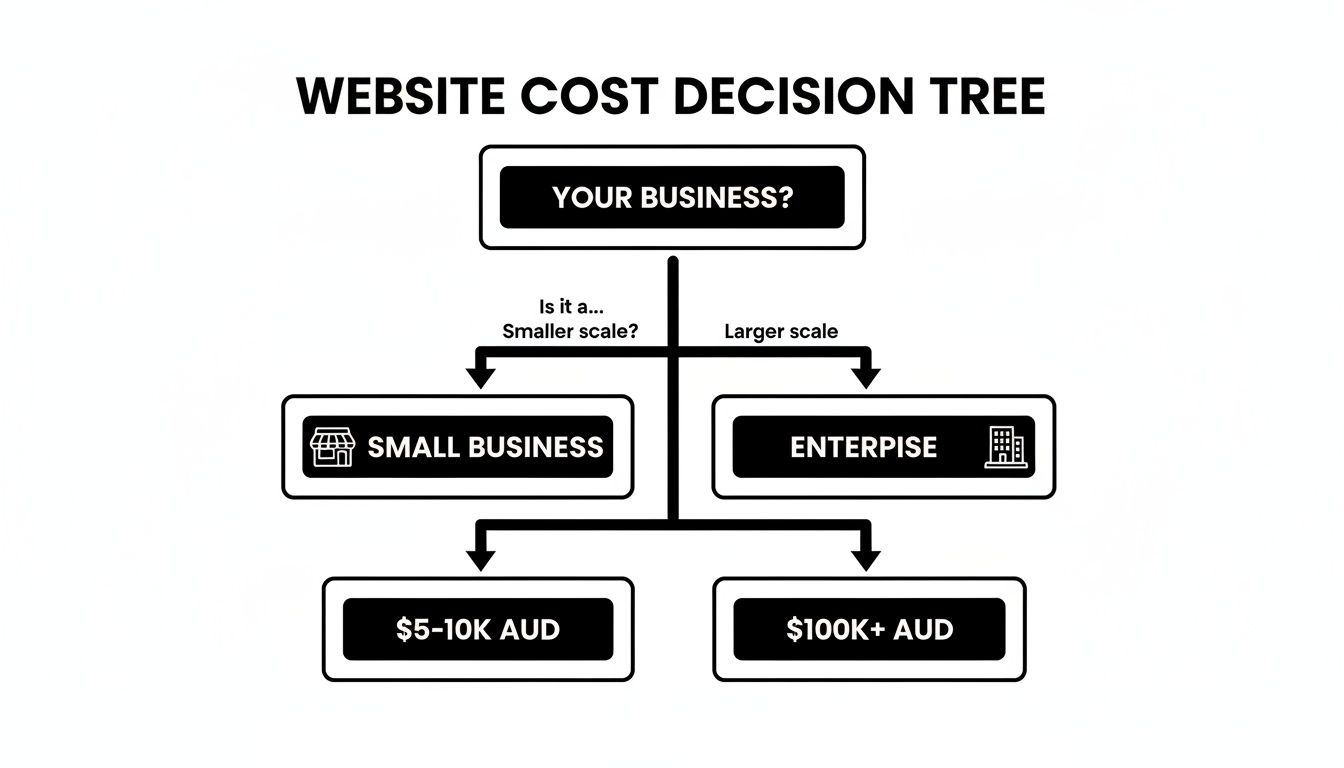
As you can see, the difference between a website for a local small business and a large-scale enterprise platform isn't just a small step—it's a giant leap in cost and complexity.
Last but not least, there’s the retainer model. This is less about a one-off project and more about forming a long-term partnership. You pay a set monthly fee, and in return, you get an agreed amount of work, support, or strategic help. It’s for businesses that see their website not as a static brochure, but as a living, breathing marketing tool that needs constant attention.
Common Retainer Services Include:
This is the perfect setup if you want dedicated expertise on tap without having to hire a full-time in-house team.
Ever wondered why one quote for a new website comes in at $5,000 while another lands at a staggering $50,000? It’s not just random numbers pulled from a hat. The real answer is in the ingredients that make up your project. Getting your head around these core components is the key to decoding any proposal and making sure your web page design rates match the value you’re getting.
Think of it like commissioning a piece of furniture. A simple pine bookshelf built from a standard design will have a very different price tag than an ornate, hand-carved mahogany cabinet designed from scratch. They’re both technically shelves, but the complexity, materials, and craftsmanship are worlds apart. It’s exactly the same with your website.
So, let's break down the five big factors that will shape your final invoice. This will give you a solid framework to figure out what you actually need before you even start talking to an agency.
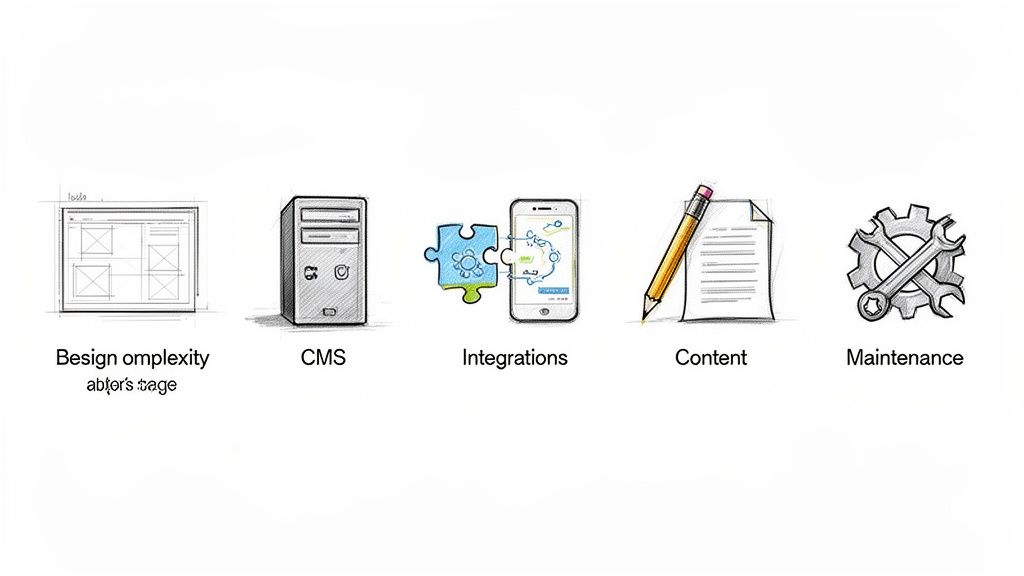
This is probably the biggest cost driver of them all. Are you after a clean, professional site built from a high-quality template, or do you need a completely unique user experience built from the ground up? Neither is right or wrong, but they represent two very different levels of effort and investment.
A template is like buying a great suit off the rack and getting it tailored to fit. A custom design is like visiting a Savile Row tailor for a completely bespoke suit, measured and cut just for you.
The engine that runs your website is its Content Management System (CMS). This is the background software that lets you update text, add blog posts, and manage your site without having to touch a line of code. The CMS you choose has a direct impact on development costs and your long-term flexibility.
Popular choices include WordPress, which powers over 43% of all websites, Shopify for e-commerce, or more complex enterprise-level systems. A simple WordPress build is fairly straightforward, but customising it with advanced features or building on a more specialised platform needs a higher level of developer expertise—and that’s reflected in the price.
These days, websites rarely operate in a bubble. They need to connect with other tools to do their job properly, from taking payments to managing customer relationships. Each of these connections, or integrations, adds another layer of complexity and, you guessed it, cost.
For example, integrating a simple Mailchimp signup form is a quick job. But connecting your site to a complex Customer Relationship Management (CRM) system like Salesforce, an inventory management platform, or a custom booking engine? That requires serious development work to make sure data flows correctly and securely.
The rule of thumb is simple: the more your website needs to "talk" to other software, the higher the development cost will be. Each connection point is a potential source of complexity that requires expert handling.
A beautiful website is just an empty shell without compelling content. A key question is: who is responsible for writing the copy, sourcing the images, and producing the videos? If you provide all the content ready to go, the cost will naturally be lower.
Many agencies, however, offer these services as part of the project, which will add to the total investment.
Well-crafted content has a direct impact on performance, which is why it's so important to consider the relationship between https://virtualadagency.com.au/seo-in-web-design/ from the very start.
Launching your website isn't the finish line; it's the starting grid. Just like a new car, a website needs regular maintenance to perform at its best and stay secure. This includes things like software updates, security scans, regular backups, and performance checks.
Most agencies offer monthly or annual maintenance plans. While this is an ongoing cost, it's a vital investment to protect your initial one. Ignoring maintenance can lead to security breaches or site failures, which are far more expensive to fix down the line. Understanding all the components of your final bill is crucial, and a detailed look at the overall website cost can help you budget effectively for these essential ongoing services.
When you're pulling together a budget for a new website, there's a factor that often flies under the radar: geography. Where your design agency is based can have a surprisingly big impact on the final quote you get. It’s a lot like the cost of living—it varies from city to city, and so do the rates agencies charge.
It really comes down to simple local economics. An agency in the heart of Sydney or Melbourne is juggling much higher overheads. Think office rent, competitive staff salaries, and all the other general costs of doing business in a major hub. An agency in a smaller city like Adelaide or Perth just doesn't have the same financial pressures. Those higher operational costs naturally find their way into their pricing.
This creates a pretty clear pricing map across the country, where you'll often find a premium price tag for the same level of service in the bigger metro areas.
The economic squeeze of big city life directly feeds into what agencies charge. Demand is higher, the talent pool is more competitive, and business costs are simply steeper. Put it all together, and hiring a top-tier agency in a major capital city can be a serious investment.
These geographic differences can lead to cost variations of 30% to 50%. A Sydney-based designer, for instance, often commands premium rates of around $120 per hour, which is a direct reflection of the city's higher costs. Melbourne agencies frequently sit at the top end, with hourly rates hitting anywhere between $150 and $200, making it Australia's priciest market for professional web design. You can dig into more data on how location influences web designer costs from Spark Interact.
But here’s the thing: a higher price doesn't always mean higher quality. An agency in a regional centre can have just as much skill, creativity, and technical know-how as one in a bustling CBD. The key difference is their lower overheads allow them to offer much more competitive rates.
This opens up a massive strategic advantage for any business willing to look beyond its local postcode.
In a world this connected, your design partner doesn't need to be just down the road. The rise of remote collaboration tools has completely flattened the professional landscape. You can now partner with amazing talent from anywhere in the country without ever sacrificing communication or quality.
This is a huge opportunity to make your budget work smarter. By partnering with a skilled agency based outside the major metro hubs, you get access to the same high-calibre expertise without paying that inflated "big city" premium.
Think about the benefits:
Ultimately, picking a design partner should be about finding the right fit—the right skills, the right experience, and the right value. Don't let geography fence you in. By embracing remote work, you can lock in metro-level expertise at a far more reasonable price point, ensuring you get the absolute best outcome for your investment.
Not all websites are created equal. Far from it.
Think of it this way: a standard business website is like a beautifully designed display home. It looks fantastic and shows people what you're all about. But an e-commerce platform? That’s like building a fully operational retail superstore from the ground up. The investment is in a completely different league because the complexity goes way beyond just aesthetics; it's about building a powerful, reliable engine under the hood.
An online store isn't just a handful of pages. It’s a living, breathing system that has to handle secure payments, manage complex product databases, track inventory in real-time, and lock down sensitive customer data. Every one of these moving parts adds layers of development, rigorous testing, and ongoing management, all of which directly shapes the final cost.
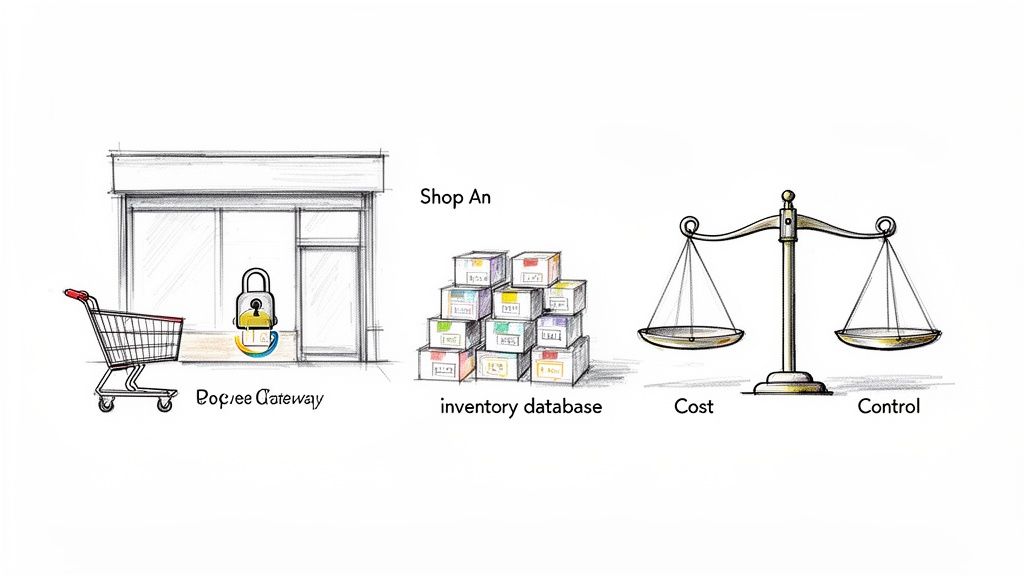
When you're mapping out an online store, one of the first big decisions is the platform itself. This choice often boils down to a classic trade-off: convenience versus control.
The real difference comes down to ownership and scale. With a custom solution like WooCommerce, you own the asset completely and can mould it into anything you need as your business grows. With Shopify, you're effectively renting a premium spot in their digital shopping centre.
Given this added complexity, building an e-commerce site in Australia definitely sits in a premium pricing tier. Small online stores built on platforms like WooCommerce or Shopify typically start in the $8,997 to $14,997 range. For larger, more sophisticated e-commerce projects, you can expect to invest anywhere from $19,997 to $39,997 or more—often double the price of a non-transactional site of a similar size.
Remember, the upfront build is just the beginning of the story. A brilliant online store is useless if nobody can find it. This is where you need to shift your focus to the ongoing, strategic effort required to attract visitors and turn them into customers.
Investing in a high-performance online store without a plan to market it is like building a flagship retail outlet in the middle of the desert. That's why a smart approach to online visibility needs to be baked in from day one. You can get a clearer picture of how to drive traffic and sales with our guide to e-commerce SEO services. By budgeting for both the build and the marketing, you’re not just launching a website; you're setting your business up for real, long-term success.
Getting a few web design quotes in your inbox feels like you're making progress. But honestly, this is often where the real confusion starts. One proposal looks suspiciously cheap, another seems wildly expensive, and the rest are somewhere in the middle. The biggest mistake you can make right now is simply picking the one with the lowest price tag. Web page design rates often hide more than they reveal at first glance.
Choosing the right partner isn't about finding the cheapest quote; it's about identifying the best value. This means you have to look past the final number and really scrutinise what’s included. A true apples-to-apples comparison requires digging into the scope of work, project timelines, the technology being used, and what happens after the site actually goes live.
When you line up your quotes, fight the urge to just compare the final figures. Instead, break down each proposal into its core parts to see where your money is actually going. A detailed proposal is a great sign—it shows the agency is professional and thorough. A vague, one-page quote? That’s an immediate red flag.
Your evaluation should zero in on a few key areas:
The cheapest quote is often the most expensive one in the long run. An unusually low price is a major warning sign that an agency might be cutting corners. This can lead to a poor-quality website that needs a complete do-over much sooner than you think. Our guide to a complete website redesign in Australia often helps businesses that have fallen into this exact trap.
A low quote often signals a lack of strategic thinking. The agency might just be planning to use a cheap, generic template that won't be tailored to your business goals. The result is a site that looks okay but fails to actually generate leads or sales.
Keep an eye out for these common red flags:
To help you get practical, we've put together a simple checklist. Use this table to lay out the key details from each quote side-by-side, making it much easier to spot the differences and identify the true value.
| Evaluation Criteria | Agency A | Agency B | Notes & Red Flags |
|---|---|---|---|
| Total Project Cost | Is the price suspiciously low or excessively high? | ||
| Scope of Work (Clarity) | Are all pages, features, and revisions clearly listed? | ||
| Technology Stack/CMS | Is the proposed platform scalable and right for your needs? | ||
| Project Timeline | Is the timeline realistic? Are key milestones defined? | ||
| Design Process | Is there a clear process for discovery, design, and feedback? | ||
| Post-Launch Support | Is training, maintenance, or support included? For how long? | ||
| Portfolio/Relevant Experience | Do they have proven experience in your industry? | ||
| Team/Communication | Who will you be working with? How will you communicate? | ||
| Hidden Costs/Exclusions | What's not included? (e.g., hosting, content, SEO) |
This simple exercise can reveal a lot. An agency that looks expensive at first glance might actually offer far more long-term value by including crucial services like SEO setup and post-launch support.
Ultimately, choosing a design partner is a serious investment in your business's future. By carefully comparing the details, asking the right questions, and trusting your gut, you can select a partner who will deliver genuine, lasting value.
Investing in a new website is a big step, and it's totally normal to have a lot of questions about costs and what the whole process looks like. To help you move forward with confidence, we’ve put together straight answers to the most common queries we hear from Australian businesses.
This final section is all about clearing up the details, so you know exactly what to expect from your investment.
For a professional small business website in Australia, you should realistically budget between $5,000 and $15,000. That's not just a number plucked from the air; it reflects the real time and expertise needed to build a site that actually does its job and performs well.
At the lower end of that range, you're looking at a polished, high-quality website built using a premium, customised template. This is a brilliant solution for businesses needing to look credible and effectively showcase what they do.
Pushing towards the higher end of the budget gets you into more bespoke design work, deeper strategic thinking, and some foundational search engine optimisation (SEO). Be wary of any quotes that come in well below this range. It’s almost always a red flag that corners are being cut somewhere—be it on quality, strategy, or future support.
The initial design and build fee is just one piece of the puzzle. To budget properly, you absolutely have to account for the ongoing costs that keep your site live, secure, and working hard for you.
Always ask any potential design partner for a complete breakdown of every possible cost. These usually include:
Remember, things like professional copywriting, custom photography, and dedicated ongoing SEO are almost always separate investments. Factoring these in from the start is the best way to avoid nasty budget surprises down the track.
This is a classic question, and the answer really comes down to the scope of your project. Freelancers often have lower hourly rates because they have fewer overheads, which makes them a great choice for smaller, well-defined tasks or specific updates.
An agency, on the other hand, brings a whole team to the table—designers, developers, strategists, and project managers—all working together. For more complex projects that need serious strategic thinking, a wide range of skills, and reliable ongoing support, an agency almost always delivers better long-term value and peace of mind.
The timeline for building a site is tied directly to how complex it is. For a standard 5-10 page "brochure" style website for a service business, you can typically expect it to take 4 to 8 weeks from the first meeting to launch day.
For bigger projects, like a site with custom features or a full-blown e-commerce store, the timeline naturally gets longer. You should realistically plan for 12 to 16 weeks, and sometimes even more. A big part of this schedule also depends on how quickly you, the client, can provide feedback, content, and approvals at each stage of the process.
At Virtual Ad Agency, we believe in transparent pricing and strategic design that delivers real results. If you're ready to build a website that drives growth for your business, we’re here to help. Contact us today to discuss your project and get a clear, detailed proposal.

 previous