
Trying to generate leads for your digital agency without a solid foundation is like building a house on sand. You can jump straight into paid ads or start churning out content, but you’ll be burning through cash and time with very little to show for it.
Real success in digital marketing agency lead generation isn’t about throwing random tactics at the wall and hoping something sticks. It’s about a deliberate, structured approach that begins with absolute clarity. Before you can dream of attracting the right clients, you need to know exactly who they are and what they desperately need from you.
Getting this foundational work right is the difference between a trickle of low-quality, tyre-kicking enquiries and a consistent, predictable flow of prospects who are a perfect fit for your agency.
First things first, you need to move beyond vague descriptions like “small businesses in Australia”. It’s time to create a detailed Ideal Client Profile (ICP). Think of your ICP as a fictional company that gets massive value from what you do and, just as importantly, brings massive value back to your agency.
Have a think about your best-ever clients. What industry were they in? What was their annual revenue? What specific headaches were they dealing with that you were able to solve?
A razor-sharp ICP lets you focus your marketing efforts where they’ll actually make a difference. For agencies wanting to dial this in, exploring comprehensive LinkedIn lead generation strategies is a brilliant way to target these specific profiles with precision.

Once you know who you’re talking to, you have to give them a compelling reason to choose you over the competition. This is your Unique Value Proposition (UVP). It’s a simple, clear statement explaining the benefits you offer, how you solve your client’s problems, and what makes you the obvious choice.
A powerful UVP is all about outcomes, not a laundry list of services. So, instead of saying, “We offer SEO and PPC services,” you might say, “We help B2B tech companies in Sydney double their qualified leads in six months through targeted SEO and PPC campaigns.”
See the difference? This simple shift speaks directly to the results your ideal clients are actually searching for.
Finally, you can’t improve what you don’t measure. Setting your Key Performance Indicators (KPIs) from day one gives you a clear scoreboard for success. You need to focus on the metrics that have a direct line to your agency’s growth and profitability.
Here are the big three to get you started:
Keeping a close eye on these numbers allows you to make smart, data-driven decisions. It helps you tweak your strategies, cut what’s not working, and double down on what is, ultimately building a sustainable growth engine for your agency.
If you want sustainable growth for your agency, you need more than a few flashy ad campaigns. The real foundation is a steady stream of high-value inbound leads, and that comes from building a powerful content engine. This is how you attract the right kind of decision-makers and cement your agency’s authority in the market.
It’s a digital marketing agency lead generation strategy that positions you as the expert, drawing in clients who are already searching for the exact solutions you offer.
And it all starts with figuring out what your ideal clients are actually typing into Google.
Good keyword research isn’t about chasing broad, ego-boosting terms like “digital marketing Australia.” That’s a crowded space. Instead, you want to dig deeper and find the problem-focused, high-intent queries that tell you a prospect is ready to talk to an agency.
Think about the specific pain points that keep your best clients up at night. For instance, a B2B software company in Melbourne probably isn’t searching for “SEO services.” Their search history is more likely to look like this:
Tools like SEMrush or Ahrefs are your best friends here. You’re looking for long-tail keywords packed with commercial intent—phrases that include words like “services,” “agency,” “pricing,” or specific locations. When you build your content around these terms, you attract traffic that’s not just browsing, but is actively looking to buy.
Once you’ve got your keywords, it’s time to create content that genuinely addresses them. I’m not talking about churning out generic, 500-word blog posts. This is about developing practical, authoritative resources that solve your ideal client’s most pressing problems and subtly showcase your expertise.
Your content needs to be actionable. A local home builder doesn’t want a theoretical essay on search algorithms; they need a guide on “local SEO tips for tradies” with steps they can actually implement. For a deeper dive into structuring this kind of work, check out our guide on SEO optimisation best practices.
Your content’s number one job is to prove you understand a potential client’s world better than anyone else. When you give away truly valuable advice for free, you build immense trust. It makes your agency the only logical choice when they’re finally ready to hire an expert.
This strategy is only getting more critical. It’s projected that in 2025, Australian businesses will pour $1.5 billion into SEO services. Small businesses alone are setting aside an average of $1,200 a month just for lead generation.
And with 55% of all website traffic now coming from smartphones, your content and landing pages absolutely must be flawless on mobile. If you want to see just how crucial this investment is becoming, you can discover more 2025 digital marketing statistics.
Creating brilliant content is only half the job. To climb the search rankings and establish real authority, your agency’s website needs high-quality backlinks. Think of a backlink as a vote of confidence from another website, signalling to Google that your content is credible and worth paying attention to.
The best approach is to earn these links from relevant Australian industry publications, business journals, and even complementary businesses (like web developers or business coaches). A few ways to do this include:
Every quality backlink you earn strengthens your website’s authority. This helps all your content rank higher, driving a consistent flow of organic traffic that turns into the high-quality agency leads you’re looking for.
While you’re playing the long game with SEO and content marketing, paid advertising is how you get qualified leads through the door right now. It’s the most direct path for digital marketing agency lead generation, letting you put your message right in front of the decision-makers actively looking for your services.
But running campaigns that actually turn a profit means more than just hitting ‘boost’ on a post. You need a solid strategy for picking your channels, writing your ads, and designing your landing pages. Otherwise, you’re just spending money, not investing in real growth.
First things first: you need to pick the right platform. Not all paid channels are built the same, especially when you’re chasing B2B clients here in Australia. Each one has its own unique audience and vibe.
The power of social media for lead generation is impossible to ignore. In Australia alone, ad spending on these platforms is tipped to hit US$4.73 billion (that’s AU$7.5 billion) by 2025. With 33.6% of consumers using social media to discover new brands, it’s a space you simply have to be in.
Deciding where to allocate your budget can be tricky. To help, here’s a quick comparison of the top channels for agency lead generation.
| Channel | Best For | Audience Targeting | Typical B2B CPL (AU) |
|---|---|---|---|
| Google Search Ads | Capturing high-intent, immediate-need leads | Keyword, location, and demographic-based | $70 – $200+ |
| LinkedIn Ads | Hyper-targeting professionals by job title, industry, and company size | Professional data (job title, seniority, company size, skills) | $90 – $250+ |
| Facebook Ads | Reaching a broad audience and building brand awareness cost-effectively | Interest, behaviour, and lookalike audiences from existing data | $50 – $150 |
| Microsoft Ads (Bing) | Reaching an older, often higher-income B2B demographic with less competition than Google | Similar to Google but with access to LinkedIn profile data | $60 – $180 |
Ultimately, the best approach is often a mix of channels. Start with where you think your ideal client spends their time, test aggressively, and let the data guide your next move.
Your ad campaign is only as strong as its weakest link. A brilliant ad that leads to a slow, confusing, or poorly designed landing page will waste every dollar you spend. The user experience must be frictionless from click to conversion.
Getting someone to click your ad is only half the battle. The landing page is where the real magic happens—or doesn’t. It needs to be flawless. This visual breaks down the key elements you need to nail.
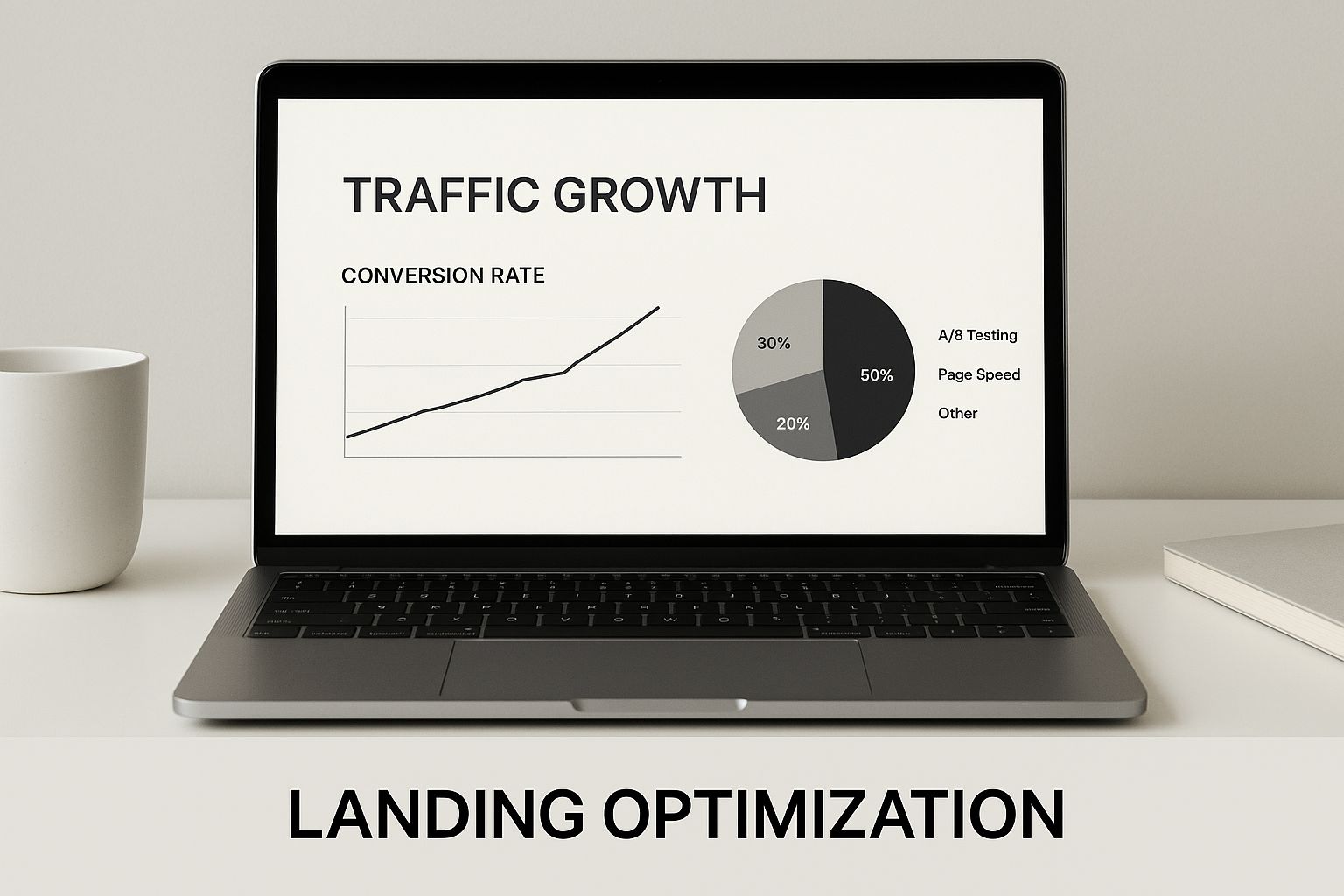
The big takeaway here is that every single element, from your headline to your form fields, must work together to build trust and nudge the visitor towards one clear action.
To build a landing page that actually converts clicks into clients, make sure it has:
By obsessing over these details, you turn ad clicks into genuine business opportunities, creating a reliable and scalable engine for bringing new clients into your agency.
In the fierce world of digital marketing agency lead generation, real personalisation is what separates the agencies that thrive from those just getting by. Artificial Intelligence (AI) isn’t some far-off concept anymore; it’s a practical toolkit that gives your team the power to work smarter and build stronger client relationships right from the first handshake.
This isn’t about replacing your team with robots. It’s about giving them the tools to focus on what humans do best: strategy, creative thinking, and building genuine rapport. Even simple AI applications can take over the repetitive, data-heavy tasks that so often slow down the lead generation process.
One of the most immediate wins with AI is in lead scoring. Instead of your team manually guessing which prospects are ready to talk, AI tools can crunch thousands of data points in a flash. We’re talking about website behaviour, email engagement, social media interactions—all analysed to give each lead a clear score.
This means your sales team can stop wasting time on lukewarm prospects. They get a prioritised list of who to call first, letting them focus their energy on leads showing the strongest buying signals, which dramatically improves their efficiency and conversion rates. For a deeper dive into how this works in practice, you might want to explore more on AI-Powered Lead Generation.
AI lets you move way beyond those generic “Hi [First Name]” emails. By looking at real customer data—their interests, online behaviour, even the blog posts they’ve read on your site—AI-driven agencies can deliver content and recommendations that feel truly personal. This approach has been shown to cut customer acquisition costs by as much as 50%.
This is where you can start building smarter email nurture sequences. Imagine a system that automatically sends a case study relevant to a prospect’s industry right after they download an ebook. Or a personalised follow-up after they’ve visited your pricing page. This is the heart of modern marketing automation.
AI-powered tools don’t just automate tasks; they unlock a level of hyper-personalisation at scale that was impossible before. This builds trust and gently guides prospects toward a sales conversation, making your agency feel like the only logical choice.
This systematic approach is the engine room of a successful inbound strategy. By using technology to deliver the right message at the right time, you nurture leads effectively without anyone having to lift a finger. To really get a grip on the systems behind this, it helps to know what marketing automation is and how you can weave it into your own workflows. It’s all about freeing up your team to have more meaningful, high-value conversations.
It’s one thing to get a trickle of leads coming in. It’s another thing entirely to build a system that delivers a reliable, predictable flow of new business. That’s what separates the agencies that are just ticking along from the ones that are genuinely growing.
Scaling your digital marketing agency lead generation isn’t about throwing more hours at the problem; it’s about building a smart, automated engine. You need something that can nurture and convert leads without you having to manually push every single one over the line.
This is how you turn your marketing from a series of one-off campaigns into a growth machine. It all starts by getting your leads organised so your sales team can jump straight to the warmest prospects—the ones who are actually ready for a chat.
Think of your Customer Relationship Management (CRM) system as the heart of your entire scaling operation. Far too many agencies treat their CRM like a fancy address book, but its real power is in automating the sales process and giving you crystal-clear insights.
When you set it up properly, a CRM stops being a chore and becomes a massive strategic asset. With a single glance, you should be able to see your entire sales pipeline and know exactly where every lead is on their journey. That kind of clarity is gold for forecasting revenue and spotting bottlenecks before they turn into full-blown disasters.
A well-implemented CRM should empower your sales team, not bog them down with data entry. It automates lead assignment, tracks every interaction, and flags high-priority prospects, freeing up your team to do what they do best—sell.
Let’s be honest, not every lead who downloads your latest ebook is ready to sign on the dotted line. That’s where smart lead nurturing comes into play. You can use email automation to stay top-of-mind, building trust and showcasing your expertise over time.
The trick is to deliver value, not just sales pitches. A solid nurture sequence might look something like this:
This approach guides people along their buyer journey without being pushy. It ensures that when they are ready to talk, your agency is the first one they think of.
If you really want to scale, you need to create a tight feedback loop between your marketing and sales teams. This means looking past the vanity metrics like website traffic and focusing on the data that actually hits your bottom line.
There are a few crucial KPIs you need to be tracking relentlessly:
By constantly keeping an eye on these numbers, you can spot trends, tweak your strategies, and make decisions based on real data. This is how you stop guessing and start building a genuinely scalable system for your agency’s growth.
Getting your head around digital marketing agency lead generation can feel like trying to hit a moving target. I’ve seen so many agency owners, especially those just starting out, asking the same crucial questions about where to begin and how to invest their time and money for the best results.
So, let’s jump into some of the most common queries we hear.
When you’re a new agency, the fastest way to get some runs on the board isn’t always the most complicated one. Of course, building out a solid SEO and content strategy is vital for long-term, sustainable growth, but let’s be honest—it just takes too long to deliver the immediate cash flow you need to survive.
Your first move should be a laser-focused paid advertising campaign.
Setting a budget can feel like pure guesswork, but it shouldn’t be. The best way is to root it in your actual growth goals by working backwards from your revenue target.
Let’s walk through an example. Say your goal is to sign two new clients a month at $3,000 each. That’s $6,000 in new monthly recurring revenue you’re aiming for.
If your average lead-to-client conversion rate is sitting around 10% (which is pretty typical), you’ll need 20 qualified leads to hit that $6,000 target.
Your budget should then be based on your target Client Acquisition Cost (CAC). If you’re willing to spend up to one month’s retainer to acquire a client—$3,000 in this case—you could allocate up to $150 per qualified lead ($3,000 / 20 leads). This kind of data-driven approach removes emotion from the equation and gives you a clear financial framework to work within.
There’s a lot of noise around new technologies, and it’s easy to get distracted by shiny objects. Right now, the most impactful development for agencies is the practical application of AI in personalisation.
AI-powered tools can analyse a prospect’s behaviour on your website and dynamically alter the content they see, making your messaging far more relevant and compelling. This leads directly to higher engagement and better-quality leads, all without piling more manual work onto your team’s plate.
At Virtual Ad Agency, we build data-driven strategies that turn marketing spend into predictable growth. If you’re ready to create a reliable lead generation engine for your business, explore how we can help.

 previous