
So, how much do Facebook ads actually cost in Australia? Straight up, you can expect to pay somewhere between $1.15 to $3.20 for a single click (CPC). To get your ad in front of 1,000 people (CPM), you're looking at around $11.00.
But here's the thing: there's no fixed price tag on Facebook ads. The final cost is a moving target, shifting based on your industry, who you're trying to reach, and what you want to achieve.
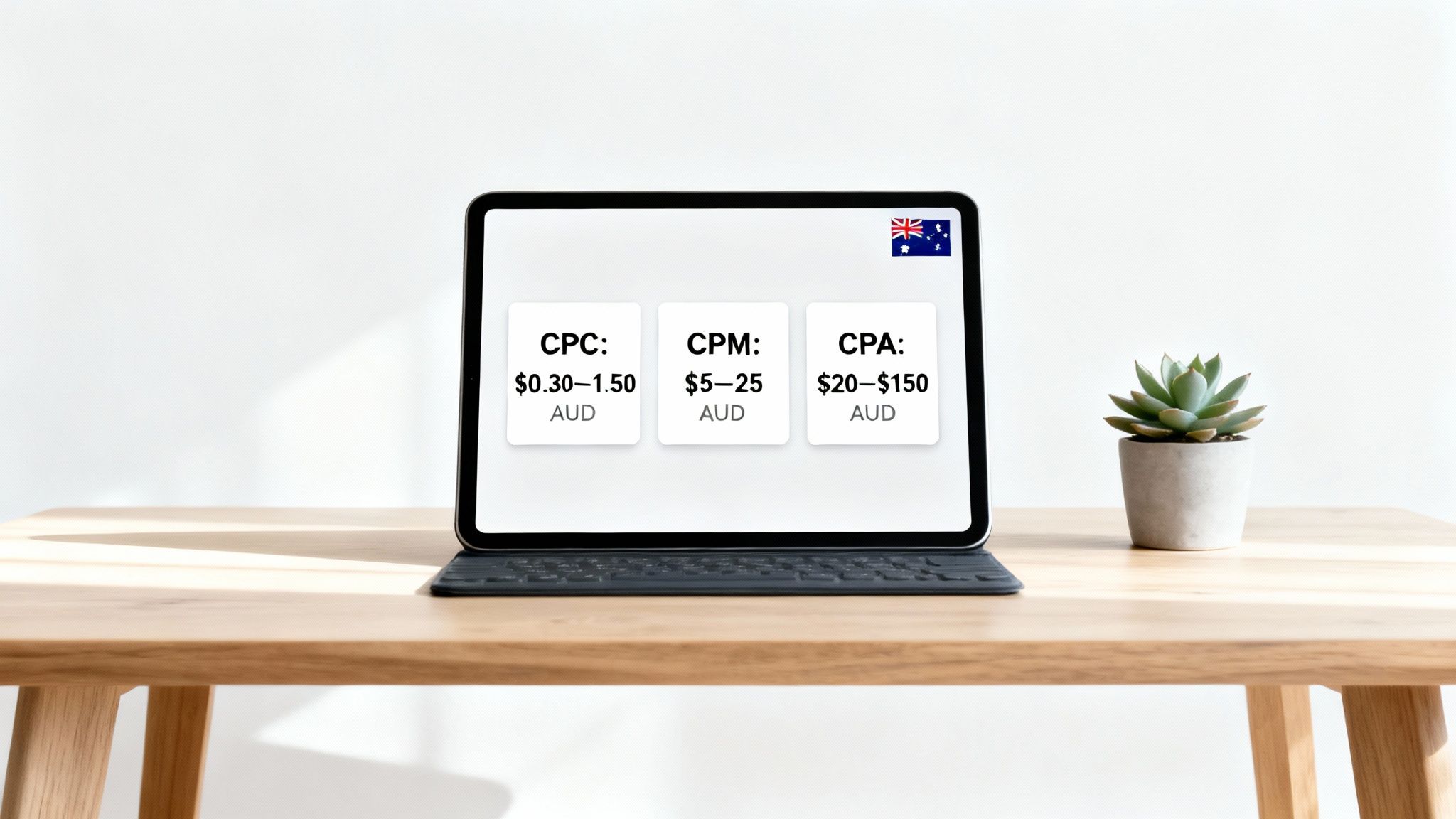
Forget thinking about Facebook ad pricing like a restaurant menu with set prices. It's much more like a real-time auction. Every ad space is sold on the fly, and what you pay is all about supply and demand. The cost is influenced by who you're targeting and how many other businesses are vying for that same audience's attention.
What this means in practice is that a big brand awareness campaign targeting a broad, national audience will have a completely different cost structure to a campaign aiming for niche, high-value sales leads in a specific suburb. Your budget is just one piece of a much larger puzzle.
To get a real grip on your spending, you need to understand the language of Facebook ads. Meta bills advertisers using a few core metrics, and each one lines up with a different business goal, from just getting seen to making direct sales.
Here are the big three:
To give you a clearer picture, we've put together a quick summary of what Australian businesses can generally expect to pay for these outcomes.
This table provides a snapshot of the average costs for key Facebook advertising metrics in Australia. Think of these figures as a starting point for your budget planning, but always remember that your actual costs can—and likely will—vary.
| Metric | Average Cost Range (AUD) | What It Measures |
|---|---|---|
| Cost Per Click (CPC) | $1.15 – $3.20 | The price for a single user clicking your ad. |
| Cost Per Mille (CPM) | $11.00 – $17.00 | The cost to show your ad to 1,000 people. |
| Cost Per Acquisition (CPA) | $10.00 – $50.00+ | The cost for a desired action (e.g., lead, sale). |
Use these benchmarks to guide your initial strategy, but the real magic happens when you start running campaigns and gathering your own data. That's when you can truly begin to understand what works for your specific business and audience.
A lot of businesses think paying for Facebook ads is like ordering from a menu—you pick what you want, and there's a set price. If only it were that simple. The reality is much more like a fast-paced, high-stakes auction happening behind the scenes.
Every single time there's an open ad spot in someone's feed, a lightning-fast auction kicks off to decide which ad gets to fill it. Think of it less like buying a product and more like bidding for a split second of your ideal customer's attention. You're not just buying ads; you're competing for them. Answering "how much do Facebook ads cost?" is impossible without grasping this.
This whole process happens millions of times a second. But here’s the kicker: the winner isn't always the person with the deepest pockets. Facebook’s main goal is to keep users happy and scrolling, so it has to balance your bid against how good your ad actually is.
To pick a winner, Facebook uses a score called Total Value. This isn't just about the cash you're willing to throw down. It’s a clever formula that combines three key elements to give your ad a final score.
It looks a little something like this:
[Your Bid] x [Estimated Action Rate] + [Ad Quality] = Total Value
Whoever gets the highest Total Value score wins the ad spot. This is fantastic news for small businesses, because it means a brilliant, relevant ad can absolutely beat a lazy, big-budget competitor. Let's pull back the curtain on what each part of that formula really means.
Getting your head around these three pillars is the first real step to running ads that don't burn through your cash. These are the levers you can actually pull to control your costs.
What this all boils down to is that a really engaging ad with a high action rate can win an auction even with a lower bid. This is why a thoughtfully crafted campaign always outperforms a sloppy one with a massive budget. This auction system is a fundamental concept in professional advertising, a process you can learn more about by exploring what is media buying. It's all about getting the perfect message to the right person at the best possible price.
Asking "how much do Facebook ads cost?" is a bit like asking how much a car costs. A simple hatchback and a luxury SUV both get you from A to B, but the final price tag is worlds apart. It all depends on what’s under the bonnet and the features you choose.
Facebook ads are exactly the same. Several key factors act as levers, directly influencing the final price you pay for your audience's attention. Understanding these six levers is the difference between burning through your budget and investing it wisely. They’re the control panel for your ad spend, and getting a handle on them is crucial for running campaigns that actually make you money.
Let's break them down, one by one.
The very first thing Facebook asks when you create a campaign is, “What’s your goal?” This isn’t just a tick-box exercise; your answer completely changes how the algorithm works and prices your ads. Each objective has a different perceived value to your business.
Think of it like this: getting someone to simply notice your brand (Awareness) is a relatively easy, low-cost action. Getting them to click a link (Traffic) requires more intent. But persuading them to pull out their credit card and make a purchase (Conversions) is the most valuable action of all.
Because of this, you can expect to pay more for goals further down the marketing funnel.
Who you want to reach has a massive impact on your costs. It really is a simple case of supply and demand. The more businesses competing to get their ads in front of the same group of people, the higher the price.
Imagine you're targeting a broad audience, like "women in Australia aged 25-54." That’s a huge pool of people. Competition is spread thin, so costs are generally lower.
Now, let's say you narrow that down to "women in Sydney, aged 30-35, who are interested in organic skincare and have recently gotten engaged." This is a much smaller, highly specific, and commercially valuable audience. Dozens of skincare, beauty, and wedding-related businesses are all bidding for their attention, which drives the auction price right up.
While a highly targeted audience might increase your Cost Per Click, it often leads to a much better Return on Investment (ROI). Paying a bit more to reach the perfect customer is almost always more profitable than paying less to reach thousands of people who couldn’t care less.
Your bidding strategy is essentially you telling Facebook how to spend your money in the ad auction. You can let the algorithm fly on autopilot or you can take more manual control. Your choice here has a direct effect on both performance and cost.
The main options are:
Choosing the right strategy really depends on your campaign goals and how much control you want over the purse strings.
This screenshot from Meta shows the different campaign objectives available. Each one corresponds to a different stage of the customer journey and, as a result, a different cost structure.
The objectives are grouped under headings like Awareness, Traffic, Engagement, and Sales, guiding you to align your budget with a specific business outcome.
Facebook doesn't just want your money; it wants to protect its user experience. A feed cluttered with irrelevant, low-quality ads would quickly send people running. To stop this from happening, the platform actively rewards advertisers who create high-quality, engaging ads with lower costs.
Facebook measures this using what it calls "ad relevance diagnostics," which break down into three parts:
If your ad gets lots of positive feedback (likes, shares, comments) and has a great click-through rate, Facebook sees it as a quality ad. To learn more about this vital metric, check out our detailed guide on what is click-through rate. High-quality ads get preferential treatment in the auction, often winning prime ad spots even if their bid wasn't the highest.
Advertising demand isn't a flat line; it has peaks and valleys throughout the year. During the big shopping seasons, competition skyrockets, and so do costs.
The most famous example is the fourth quarter (October-December), which is packed with massive events like Black Friday, Cyber Monday, and Christmas. During this period, countless retailers flood the platform with ad spend to capture holiday shoppers, making the ad auction far more competitive and expensive for everyone. On the flip side, costs often dip in quieter months like January and February.
Finally, the industry you're in plays a huge role. Some sectors are just naturally more competitive (and profitable) on Facebook, which leads to higher ad costs.
For example, industries like finance, insurance, and e-commerce often have a high customer lifetime value, which means they can afford to bid much more aggressively to win a new customer. Data shows that Facebook ad Cost Per Click (CPC) in Australia averaged between AUD 1.15 and AUD 3.20 in 2025, with a midpoint of AUD 2.10 for well-run campaigns. This big range often comes down to the industry, with more competitive niches pushing costs toward the higher end. A local cafe, on the other hand, will likely face far less competition and enjoy lower costs.
Knowing what influences your ad spend is one thing, but what's the actual cost of Facebook ads in cold, hard Australian dollars? Without some tangible benchmarks, you're flying blind.
Think of these numbers as your starting line. They help you set a realistic budget, gauge whether your campaigns are on track, and make smarter decisions about where your marketing dollars are going. Let's break down the three most critical metrics you'll be looking at.
This image shows the core elements—Audience, Objective, and Quality—that pull the levers on your final ad cost.
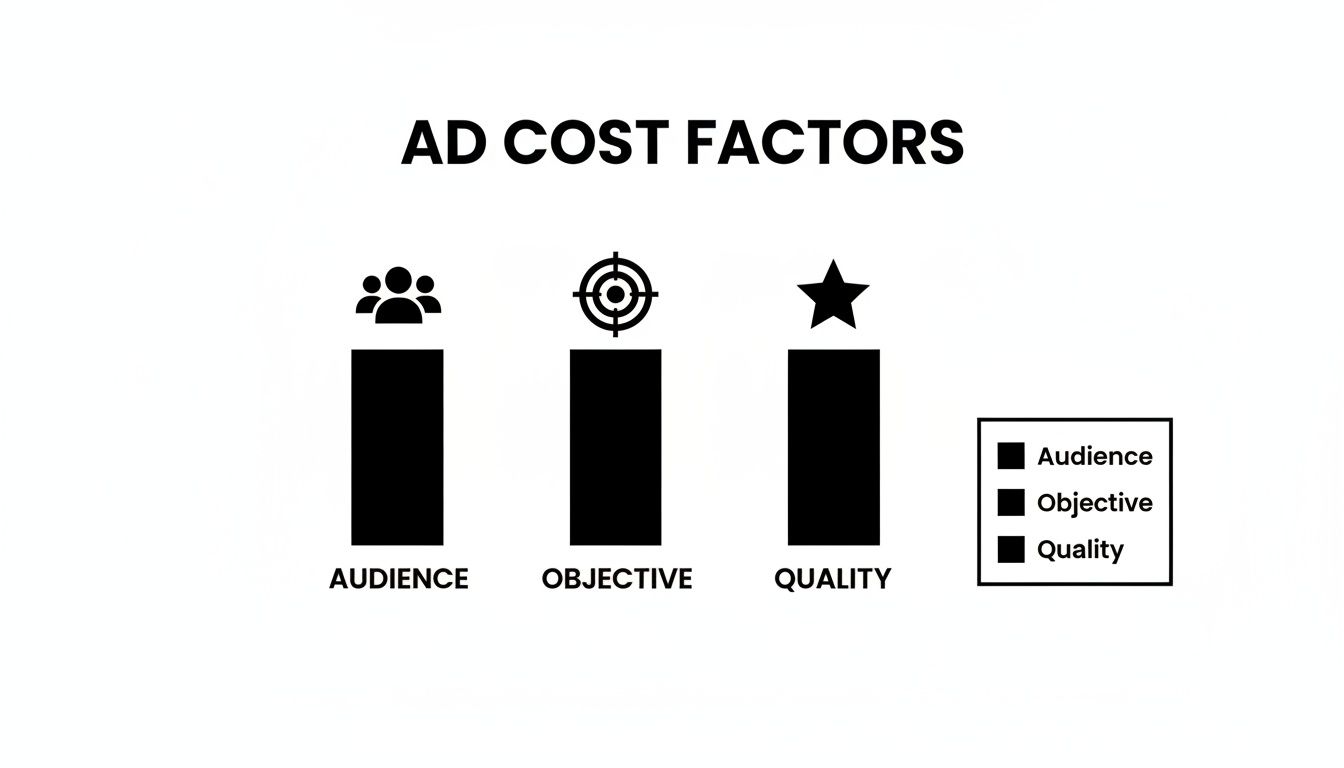
As you can see, each of these factors can push your spend up or down, proving that cost is a dynamic outcome of your strategy, not just a fixed price tag.
CPM, or Cost Per Mille, is what you pay for every 1,000 times your ad gets shown to someone. This metric is the absolute bedrock of brand awareness campaigns. The main goal here isn't clicks or sales; it's just about getting your name and message in front of as many relevant eyeballs as possible.
You're paying for visibility. It's the digital version of renting a billboard on a busy highway. The more people you want to see it, the more you'll invest.
In 2025, the average Cost Per Mille (CPM) for Facebook ads in Australia sits at AUD $11.04. It’s a competitive price, positioning Australia as the world's third most expensive market behind the US ($20.48) and Canada ($14.03). But here's the kicker: Aussies still pay 46% less CPM than Americans, giving local companies working with partners like Virtual Ad Agency a real edge to scale their campaigns without breaking the bank. For a deeper dive, check out more on Facebook advertising costs in Australia.
Cost Per Click is exactly what it sounds like: the price you pay each time someone actually clicks on your ad. This is the go-to metric for any campaign where the main goal is to drive traffic to your website, a landing page, or your online store.
If you want people to explore what you offer or read your latest blog post, CPC is the number you'll be obsessing over. It's a direct measure of how efficiently you're turning casual viewers into active visitors.
Benchmark Range: Australian advertisers can generally expect their CPC to fall somewhere between AUD $1.15 and AUD $3.20. This can swing wildly, though, depending on how competitive your industry is and the quality of your ad creative.
A brilliant, attention-grabbing ad will almost always land you a lower CPC than a generic one. Why? Because it gets more people to click from the same number of impressions.
Cost Per Acquisition, sometimes called Cost Per Action, is arguably the most important number for any business focused on the bottom line. It measures how much it costs you to get a specific, valuable action—a lead form submitted, a product purchased, or an app downloaded.
This is where the rubber meets the road. CPA tells you exactly how much you're spending to get each new lead or customer, making it absolutely essential for calculating your return on investment (ROI). It answers the million-dollar question: "Is this campaign actually making me money?"
For Aussie businesses, CPA varies a lot depending on what you're trying to achieve.
Keep in mind, your CPA is massively influenced by how "warm" your audience is. Targeting people who have already visited your website (retargeting) will almost always deliver a lower CPA than going after a completely cold audience that has never even heard of your brand.
Understanding the mechanics of Facebook ad costs is one thing, but the real question is always the same: what does that mean for my business budget? Moving from the theory of "how much do ads cost" to the practical decision of "how much should I spend" can feel like a big leap.
Let's get one thing straight: there's no magic number. A budget for a local Adelaide cafe trying to get more people through the door will look completely different to a national online store launching a new line. Your goals are the anchor for your entire ad spend.
To make this real, let's walk through three common business scenarios. We’ll look at a starting budget for each and break down what that investment can actually achieve, turning abstract metrics into tangible results.
Picture a brand-new dental clinic in Adelaide. Their goal is simple: get locals to book their first check-up. They don't need to reach people in Sydney or Perth, just those within a reasonable drive.
With this budget, the game is all about a tight, high-intent audience in a specific geographic area. The campaign objective would be 'Leads' or 'Conversions,' aimed squarely at getting people to fill out the appointment form on their website.
Let's do the maths. In Australia, the Cost Per Acquisition (CPA) for a local action like booking an appointment often sits between $5 to $20. With a $750 monthly budget, our dental clinic could realistically generate anywhere from 37 to 150 new patient enquiries each month. For local growth, that's an incredibly efficient use of marketing dollars.
Now, imagine an online store based in Melbourne selling sustainable activewear. They’ve got a small, loyal following but are ready to scale up and drive sales across Australia. The goal here is direct revenue.
This larger budget is needed to cut through the noise of the national e-commerce market. The campaign would be optimised for 'Sales,' with success measured by actual purchases.
The Cost Per Acquisition (CPA) for Facebook ads in Australia hovered between AUD $20-50 in 2025 for e-commerce sales. This benchmark is a critical piece of the puzzle, telling you what it costs to get a customer over the line. A savvy campaign would also use retargeting to re-engage people who've already visited the site, which almost always brings that CPA down. You can learn more about how these benchmarks compare to other platforms.
At $3,500 a month, our activewear brand could aim for between 70 and 175 sales, all depending on how sharp their ads and targeting are.
Finally, let’s consider a Sydney-based software company selling project management tools. Their goal is to generate high-quality leads for their sales team, which means reaching specific decision-makers.
B2B advertising is often more expensive because the target audience is smaller, more specific, and holds a much higher lifetime value. Reaching a handful of key decision-makers is more valuable than reaching thousands of casual consumers.
This substantial budget is required to effectively find and persuade these niche professional audiences. A qualified B2B lead can cost anywhere from $30 to $70, so with a $7,500 monthly budget, the company could generate roughly 100 to 250 high-quality leads to fill their sales pipeline.
As you can see, the "right" budget is simply a reflection of your unique goals and the specific audience you need to reach.
Knowing what drives your Facebook ad costs is one thing. Actually taking the wheel and steering them in the right direction is another. Just paying whatever the auction spits out isn't a strategy; the real win comes from actively pushing those costs down while simultaneously driving your results up.
Getting a handle on "how much do FB ads cost" is less about the total budget you're spending and more about making every single dollar work as hard as it possibly can. By dialling in a few key areas, you can turn a campaign that’s doing okay into one that’s seriously profitable.
These are the levers you can pull to drive down costs and get a much better return on your investment (ROI).
At its heart, Facebook’s algorithm wants to show people ads they actually find useful. It actively rewards advertisers who create a positive user experience. The bottom line? Ads that are relevant, engaging, and high-quality get shown to more people, for less money. It’s that simple.
Put your energy into creating knockout visuals and writing copy that speaks directly to what your audience wants and needs. An ad that clicks with people will naturally earn more clicks and engagement, sending a strong signal to Facebook that you’re adding value to their platform.
This creates a positive feedback loop that directly boosts your Ad Quality ranking, a massive factor in the ad auction. Better quality equals a higher "Total Value" score, which means you win more auctions at a lower price.
One of the quickest ways to slash your acquisition costs is to stop trying to sell to complete strangers. Retargeting lets you serve ads to people who have already shown interest in your business—people who’ve visited your website, liked your page, or are on your email list.
This "warm" audience is worlds away from a "cold" one and is far more likely to convert. Because the chance of a conversion is so much higher, Facebook’s algorithm can deliver results more efficiently, leading to a dramatically lower Cost Per Acquisition (CPA). For a deeper dive into making this work, check out our guide on remarketing with Facebook.
Retargeting campaigns consistently deliver a higher return on ad spend because you're focusing your budget on an audience that already knows, likes, and trusts your brand. It's the lowest-hanging fruit for cost-effective conversions.
Never, ever assume you know what will work best. A/B testing (or split testing) is your best friend here. It's the simple process of running two slightly different versions of an ad against each other to see which one comes out on top. This data-first approach takes all the guesswork out of your optimisations.
You can test almost any part of your campaign to find the winning formula:
By systematically testing, learning, and applying what you find, you’re constantly sharpening your campaigns. This ensures every element is pulling its weight to lower your costs and boost your results.
Your bidding strategy is basically your instruction manual for Facebook, telling it how to spend your money to hit your goals. Letting the algorithm take the lead on "Highest Volume" is a fine place to start, but more advanced strategies can give you much tighter control over your costs.
If you really know your numbers, setting a Cost Per Result Goal can be incredibly effective. This tells Facebook the average price you’re willing to pay for a specific action (like a sale or lead), helping to keep your CPA stable and predictable. For those looking to get even more advanced with optimising spend, it's worth exploring AI-powered tools specifically designed for Facebook Ads that can help automate and refine these complex decisions.
Even the most seasoned campaigners have questions when it's time to lock in the final budget. Let's tackle some of the most common queries we hear from businesses, clearing up any confusion so you can move forward with confidence.
For a small business just dipping its toes in the water, $15-$25 per day (which works out to about $450-$750 per month) is a solid place to start.
This gives you enough firepower to run a couple of ad sets and, crucially, gives Facebook's algorithm enough daily spend to gather meaningful data and push past its initial 'learning phase'. It's the perfect amount to test different audiences and creative ideas to see what clicks before you start dialling up the investment.
This really comes down to the kind of campaign you're running. Think of it this way:
A daily budget is your go-to for consistent, ongoing campaigns. It provides stable, day-to-day spending, which is perfect for evergreen advertising that's always on. A lifetime budget, on the other hand, is brilliant for campaigns with a hard stop date, like a sale or an event promotion. It gives the algorithm more freedom to spend a bit more on days when it sees better opportunities, which can often boost your overall results within that fixed timeframe.
Seeing your costs jump can be alarming, but it's usually down to a few key culprits. The most common one we see is ‘ad fatigue’. This is simply when your audience has seen your ad too many times, their eyes glaze over, engagement drops, and your costs creep up.
Other triggers can be a sudden surge in competition (think Christmas, Black Friday, or other big retail events), a tweak you made to your audience targeting, or a dip in your ad's relevance score. Keeping a close eye on your frequency metrics and regularly refreshing your ad creative is the best way to keep this in check.
Ready to take the guesswork out of your Facebook advertising and get predictable, scalable results? The team at Virtual Ad Agency specialises in building and managing high-performance ad campaigns that drive genuine growth. Contact us today to find out how we can help your business thrive.

 previous