
Real estate ads are all about getting the right eyes on a property. Think of them as everything from the humble newspaper classified to a full-blown digital campaign, all designed to grab the attention of potential buyers, renters, or investors. The end game is always the same: generate solid leads and close the deal.
Let's be honest for a second: a huge chunk of real estate advertising just doesn't work. We've all seen them. The same generic photos, the same flat description listing "3 bed, 2 bath," all getting completely lost in a sea of identical-looking properties. That old-school approach is dead in the water.
Why? Because it doesn't create any kind of emotional connection. In today's crowded market, just listing the facts isn't nearly enough to make someone stop scrolling.
Buyers today aren't just looking for a house; they're searching for a home. They're looking for a place to build a life. The ads that really hit the mark tap into this deep-seated desire. It’s about shifting your mindset from just listing a property to launching a compelling marketing campaign that makes a potential buyer pause and start picturing themselves living in that space.
This is the most common trip-up: agents focus on a property’s features instead of the lifestyle and benefits it offers. A feature is a fact, but a benefit is what that fact feels like. For example, "a large backyard" is just a feature. But "a backyard perfect for weekend barbies with the family" – that’s a benefit. It tells a story.
This is where you start using psychological triggers to your advantage. By painting a vivid picture of what life is like in the home, you get the buyer’s imagination fired up. You’re not just selling square metres; you’re selling the feeling of a cosy Sunday morning, of security, of belonging.
"Effective real estate advertising isn't about selling a property. It's about selling a lifestyle. The moment a potential buyer can mentally place their furniture in the living room, you’ve created a powerful connection."
To create ads that truly resonate, you have to know who you’re talking to and what they need to hear at each step of their decision-making process. Mapping out their path, from that first flicker of interest to signing on the dotted line, is crucial. It lets you craft targeted messages that answer their questions and soothe their worries at just the right moment.
To really get this down, you can learn more about the principles of customer journey mapping and see how to apply them to your own real estate strategy.
This guide will walk you through the entire process, taking you from creating basic listings to developing campaigns that spark genuine excitement. We'll dive into how to:
Get these skills down, and your real estate ads will do more than just list a property—they'll stand out, connect with people, and ultimately bring in more genuine enquiries.
Putting together a successful real estate ad is a lot like building a custom home. You can’t just throw up some walls and hope it all holds together. You need a solid blueprint and a strong foundation long before you even think about the paint colours and fancy light fittings.
It all starts with that blueprint: figuring out who your ideal buyer is. Are you talking to a young family who needs a big backyard for the kids to run around in? Or is it a professional couple after a slick, low-maintenance apartment in the city? Nailing this down first shapes every other decision you'll make, from the photos you lead with to the words you use in the headline.
Once you know exactly who you’re talking to, it's time to pour the foundation. This means finding your property’s Unique Selling Proposition (USP). This is the one thing—the only thing—that truly makes your listing stand out from the crowd. It’s more than just a list of features; it's about the unique feeling or lifestyle the property delivers.
Your USP is the heart and soul of your ad. It’s the compelling hook that makes someone choose this property over the ten others they just scrolled past. To find it, you need to ask what makes this home genuinely special.
Your Unique Selling Proposition is the story only your property can tell. It’s the emotional hook that transforms a simple listing into an irresistible opportunity for the right buyer.
Once you’ve locked in your USP, the next step is to start framing up the ad with brilliant copy and professional photos. This is where it all starts to come to life.
The words and images you choose must work together to tell one cohesive story. Your ad copy shouldn't just be a dry list of facts and figures; it needs to paint a picture and spark an emotion, helping potential buyers imagine themselves living there. Likewise, your photos and videos aren’t just for documentation—they're your most powerful storytelling tools.
This infographic shows just how much the game has changed, moving from outdated, feature-heavy ads to modern, story-driven campaigns that actually connect with today’s buyers.
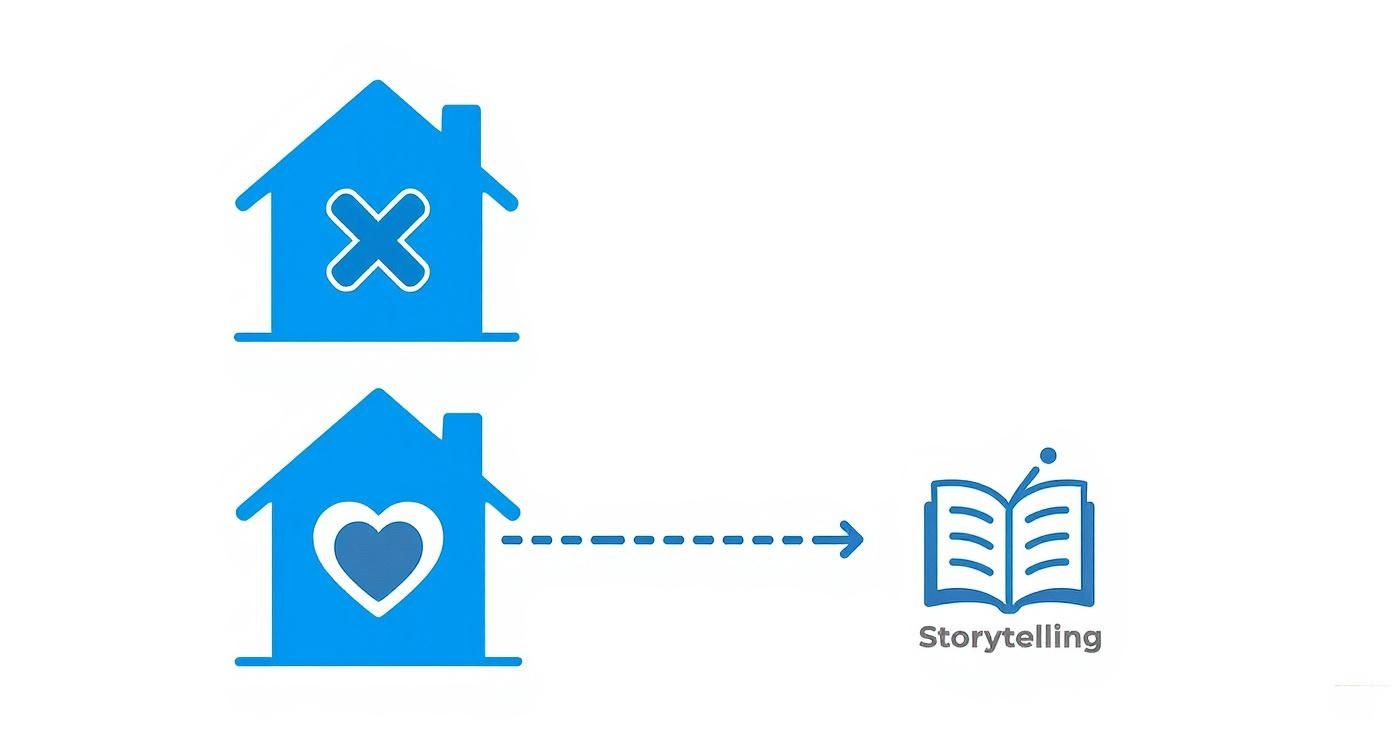
As you can see, the most effective ads have moved beyond just listing bedrooms and bathrooms. They build an emotional connection through storytelling.
Knowing what’s happening in the market is also a huge piece of the puzzle. For example, the Australian residential property market is seeing massive differences from city to city. Perth has seen median house prices rocket up by 17.6%, while Melbourne has seen a small dip. This kind of data helps you frame your ad’s value proposition in a way that resonates with local buyer expectations and current price trends. For a closer look, you can always check out the latest Australian real estate market updates.
Finally, every great real estate ad needs to be topped off with a clear and powerful Call-to-Action (CTA). This is the roof on your structure, telling potential buyers exactly what to do next. Don't leave them hanging.
Your CTA should be direct and create a little bit of urgency, but without sounding too pushy. A few effective CTAs might include:
By building your ad with these core elements—from the buyer blueprint all the way to the final CTA—you create a campaign where every piece supports the others. The end result is an ad that doesn’t just grab attention, but actually gets people to pick up the phone.
Crafting a brilliant real estate ad is only half the battle. Figuring out where it’s going to live online is just as crucial to your success.
Putting your ad on the wrong platform is like setting up a beautiful open home in a suburb nobody can find. To see a real return on your investment, you need a smart approach that matches your property, target buyer, and budget to the right channels.
The Australian real estate advertising scene has long been dominated by a few key players, but social media has completely shaken up how agents connect with buyers. Your decision on where to spend your marketing dollars will directly impact the number and quality of enquiries you get.
For most Aussies, the property search journey kicks off on one of two major platforms. These are the established giants where buyers are actively hunting for their next home, making them a non-negotiable part of almost every campaign.
Realestate.com.au (REA Group): As the biggest portal in the country, REA attracts a massive and diverse audience of serious buyers. Its premium listing options can give your property top-tier visibility, making it an essential spend for most sales campaigns.
Domain: Domain is the other major player, but it often appeals to a slightly different crowd, sometimes skewing towards metro areas and a more affluent audience. Using both platforms is the best way to maximise your reach across the entire buyer pool.
Think of these portals as the bustling main streets of real estate—you simply have to have a presence there. They’re where high-intent buyers go to search, compare, and shortlist properties.
While portals are fantastic for capturing active searchers, social media lets you find passive buyers. These are the people who weren't necessarily looking to move until your stunning property ad popped up in their feed. This is where you can create demand and build a connection before they even start their formal search.
Social media has become an incredibly powerful channel for real estate ads, fundamentally changing how agents generate leads. In fact, agents who get stuck into social platforms report closing 30–40% more leads than those who don’t.
Social media platforms turn real estate advertising from a passive listing into an active conversation. They allow you to target buyers with incredible precision based on their interests, behaviours, and life events.
It’s not just about posting pretty pictures; it’s about strategy. Following a proven social media formula for increasing listings can give you a structured way to turn that online engagement into genuine business opportunities.
Different platforms are built for different types of content and audiences. Picking the right one means understanding its unique strengths and how they align with your property's story.
To help you choose the right channels for your campaign, here’s a quick comparison of the most popular platforms.
| Platform | Primary Audience | Best For | Common Ad Formats |
|---|---|---|---|
| Broad demographics (Gen X, Millennials) | Community-focused properties, family homes, generating direct leads. | High-quality photo carousels, detailed video tours, lead generation forms. | |
| Visually-driven users (Millennials, Gen Z) | Architecturally stunning homes, luxury properties, lifestyle-focused listings. | Polished images, short video Reels, visually engaging Stories. | |
| TikTok | Younger audiences (Gen Z, younger Millennials) | Unique or trendy properties, quick "before-and-after" reveals. | Fast-paced video tours, behind-the-scenes content, engaging clips set to music. |
| YouTube | All demographics | In-depth property storytelling, agent branding. | Longer, high-production walk-through videos, neighbourhood guides. |
So, a luxury waterfront apartment would perform exceptionally well on Instagram, where high-end visuals and aspirational lifestyle content thrive. On the other hand, a practical family home in a great school district is a perfect fit for a targeted Facebook campaign aimed at local parents. It’s all about playing to each platform’s strengths.
Beyond the main portals and social media giants, other digital avenues can get your ad in front of highly specific audiences. One of the most powerful methods is programmatic advertising, which uses automation to place your ads across a massive network of websites, apps, and digital platforms.
This technology allows you to target potential buyers based on their online behaviour—think people who have recently been searching for mortgages or browsing furniture websites. It's a seriously sophisticated way to ensure your real estate ads follow interested users across the web. You can get a deeper understanding by reading our complete guide on what programmatic advertising is and how it can be applied to property marketing.
By combining the broad reach of the major portals with the precision targeting of social media and other digital tools, you create a powerful, multi-channel strategy. This ensures your property is seen by the right people, in the right place, at exactly the right time.
Thinking about your marketing spend as just another expense is one of the most common mistakes in real estate. Let's flip that script. Your advertising budget is a direct investment in your property's success. A well-funded campaign doesn't just get your listing seen; it creates a buzz, drives up competition, and ultimately helps you nail the best possible sale price.
But how much is enough? Getting a handle on the costs is the first step towards building a marketing plan that actually works. Without a clear budget, you’re basically flying blind, guessing where your money will have the biggest impact.
Before you even think about which platforms to use, you need to budget for the creative assets. These are the absolute non-negotiables that form the foundation of all your real estate ads and bring a property to life for potential buyers.
Your budget needs to cover these key items:
These foundational assets are the fuel for your entire campaign. Skimp here, and you'll weaken the performance of every single ad you run, no matter how much you spend elsewhere.
A widely accepted rule of thumb in the Australian real estate game is to allocate between 0.5% and 1% of the property's expected sale price to marketing. This percentage-based approach is great because it scales your investment to match the home's value. A higher-value property naturally needs a more substantial campaign to reach the right calibre of buyer.
So, for a home valued at $500,000, a marketing budget of $2,500 to $5,000 is pretty typical. For a $1 million property, you'd be looking at an investment closer to $5,000 to $10,000. These figures might seem chunky, but they directly correlate to the visibility and buyer competition you can generate. For more examples of how this plays out in different markets, you can explore some real-world advertising cost breakdowns.
Think of your marketing budget as a strategic lever. A 1% investment isn't a cost; it's a tool you use to potentially generate a 5-10% higher sale price through intense competition and market exposure.
This framework gives you a solid starting point, but the real magic happens when you decide how to slice up that pie for the best results.
Once you’ve got your total budget number, the real strategy comes into play. You need to spread it across different channels to create a balanced campaign that catches buyers at various stages of their journey. A smart allocation means you're not putting all your eggs in one basket.
Here’s a sample framework for a $7,000 budget on a $700,000 property:
This balanced approach ensures you have a strong presence where buyers are looking, while also creating new demand through targeted outreach. When you treat your budget as a strategic investment and allocate it wisely, you transform your advertising from a simple listing into a powerful sales machine.
With a solid strategy and budget sorted, it’s time to get creative. This is where you swap the spreadsheets for storytelling and turn a property’s features into something a buyer simply can’t scroll past. We're moving from planning to doing, creating real estate ads that stop thumbs and stir up some serious desire.
A great ad is more than just a list of facts; it’s a narrative built with care. It’s the difference between saying a house has three bedrooms and painting a picture of a home where a family can put down roots and grow. Your words and your pictures are the tools you’ll use to build that all-important emotional bridge.
Your ad copy is your sales pitch, just in text form. And trust me, bland, feature-led descriptions are the quickest way to get lost in today’s crowded market. Don't just list what the property has—focus on what those features mean for the buyer's life.
Think about this little makeover:
The first one is just a list of specs. The second is an invitation to a whole new lifestyle. It taps directly into what buyers are dreaming of, turning simple features into genuine benefits. To get the ideas flowing, check out these viral ad copy examples and see how powerful storytelling can really be.
"The goal of great ad copy is to make the reader feel something. Sell the feeling of coming home after a long day, the joy of hosting friends in a beautiful space, or the peace of a quiet morning. Emotion is what drives action."
Words paint the picture, but your visuals prove it’s real. In real estate, photos and videos aren't just there to support the text—they're often the main event. Whether a potential buyer clicks on your ad or keeps scrolling often boils down to the quality of that first image.
Let’s be clear: high-quality visuals are a non-negotiable, not a nice-to-have. They communicate value, professionalism, and attention to detail before anyone reads a single word.
When you invest in top-tier visuals, you build trust and forge an emotional connection. Buyers can genuinely see themselves in a home when it’s presented beautifully, which is a huge step toward getting them through the door for an inspection. Your visuals don’t just show the property; they sell the dream.

Getting your real estate ads live is just the starting line. The real race begins now, and it's all about tracking, analysing, and refining your campaign. Without keeping an eye on performance, you're essentially flying blind—spending money without knowing what’s actually pulling in buyers.
The goal here is to stop guessing and start making data-driven decisions. This is how you stretch your budget further and attract the highest quality enquiries. It all starts with focusing on the right numbers, not just the ones that look good on paper.
To get a true picture of how your ads are performing, you need to track a few core metrics. Think of these numbers as the storytellers of your campaign; they reveal how potential buyers are interacting with your ads and pinpoint exactly where you might need to make a few tweaks.
Here are the essentials:
For a deeper dive into the numbers that matter, you can explore a full list of essential digital marketing performance metrics that are the lifeblood of any successful campaign.
Data is just a collection of numbers until you do something with it. If your metrics aren't hitting the mark, it’s time to roll up your sleeves and start testing and optimising. This continuous cycle of improvement is what separates a decent campaign from a truly great one.
Think of optimisation as a series of small, informed experiments. You’re not guessing what will work; you're using data to guide your adjustments, one variable at a time, to find the winning combination.
Let's say you have a fantastic CTR, but your enquiry numbers are disappointingly low. This tells you the ad itself is compelling, but something on your property landing page is likely letting you down. The fix? Start A/B testing. This involves running two slightly different versions of an ad or page to see which one performs better.
You could test things like:
By systematically testing, measuring, and learning, you can continuously improve your real estate ads. It ensures every single dollar of your budget is working as hard as possible to find that perfect buyer.
Jumping into the world of real estate advertising can feel like it throws up a hundred questions at once. How long should an ad run for? What are the legal must-dos? Getting clear answers to these practical questions is the key to building a campaign that’s not just effective, but also above board. Let’s tackle some of the most common queries agents and sellers have.
One of the first things people ask is how long a property should be advertised. While there isn't a single magic number, the real goal is to get enough eyeballs on the listing to spark competitive offers, without letting it sit so long that it starts to look stale. Generally, a well-priced property in a balanced market should drum up serious interest within the first 2-4 weeks.
If a place is still sitting on the market after that, it's usually a clear signal that something needs a rethink—whether that’s the price, the presentation, or the marketing strategy itself.
A big one that trips people up is legal compliance. The golden rule is simple: all real estate ads must be truthful and not misleading. This means every claim you make about a property, from its condition to its location perks, has to be accurate and something you can actually prove.
For example, you can't advertise a property as backing onto a permanent "green belt" if you're aware the land is actually zoned for a future housing estate. By the same token, calling yourself a "Luxury Property Expert" should be backed up with genuine experience or training in that niche, otherwise you're misleading potential clients.
"Transparency is non-negotiable in real estate advertising. Every ad must clearly and unambiguously display the licensed name of the real estate firm. This ensures consumers know exactly who they are dealing with, which is a cornerstone of industry integrity."
With so much marketing happening online, another frequent question is about the rules for digital ads, especially on social media. The core principles of transparency don't change just because you're on a different platform. Every single post, email, or digital banner promoting a property needs to include both the agent's and the firm's licensed names.
This simple step helps people instantly identify who is behind the ad. While some of these rules might relax a little once you've officially entered into an agency relationship with a client, the key is to always keep your online presence professional and upfront from the get-go.
By getting a handle on these common issues, you can create compelling and compliant real estate ads that build trust with buyers and, ultimately, get the results you're after.
Ready to create a real estate ad campaign that delivers measurable outcomes? The team at Virtual Ad Agency specialises in building strategic, data-driven advertising solutions that connect with the right buyers. Visit us at https://www.virtualadagency.com.au to learn how we can help you achieve your property sales goals.

 previous