
For a small business, SEO is all about showing up when your local customers are actively looking for what you sell. It’s not about some mystical, complex code; it's about making a genuine connection with your community online. Think of it as the ultimate equaliser, turning your website's visibility into real-world customers and revenue.
This guide is your playbook. We're going to make SEO a powerful, achievable engine for your growth.
Let’s be honest, running a small business in Australia is a tough gig. You're not just up against the shop next door; you're often competing with big players who have marketing budgets you can only dream of.
This is where Search Engine Optimisation (SEO) changes the game. It’s not just another marketing buzzword. It’s a direct line to people who are already searching for exactly what you offer.
When someone types "best coffee in Fitzroy" or "emergency plumber in Adelaide" into Google, they have an immediate need. Good SEO is what puts your business front and centre at that critical moment. It cuts through the jargon to deliver tangible results: clicks become customers, and visibility becomes profit.
The numbers don't lie. Organic search is a massive, untapped goldmine for businesses like yours, driving a huge 53% of all website traffic for small and medium-sized businesses (SMEs). That’s more than social media and email combined.
Yet, a 2023 study of 700 Australian SMEs revealed something shocking: only 36% are actually using SEO effectively. That means a staggering 64% of business owners are leaving a massive amount of potential revenue on the table.
For those who do invest, the returns are brilliant. Local SEO alone is responsible for 28% of total search traffic and converts at three times the rate of standard organic results. It’s clear that learning how to increase organic traffic isn't just a good idea—it's essential for survival and growth.
To get you started, here's a quick look at the core areas we'll focus on. This table breaks down the key pillars of small business SEO, outlining what they are and why they matter.
| SEO Pillar | Primary Goal | Key Action |
|---|---|---|
| Local SEO | Dominate your local service area and show up in "near me" searches. | Fully optimise your Google Business Profile (GBP) and build local citations. |
| On-Page SEO | Make it crystal clear to Google what your pages are about. | Target the right keywords on your service pages and homepage. |
| Content Strategy | Become the go-to expert and answer your customers' questions. | Create helpful blog posts and guides that solve your audience's problems. |
| Link Building | Build trust and authority with search engines. | Get mentions and links from other reputable local websites. |
This isn't about getting lost in theory. We're focused on a clear, actionable plan that delivers the most impact for small businesses.
SEO isn’t about trying to trick Google. It's about providing the best, most relevant answer to a potential customer's question. When you do that consistently, search engines reward you with visibility, and customers reward you with their business.
For most small businesses, the battle for customers isn't fought on a national stage—it's won on your own street, in your own suburb. This is where local SEO becomes your secret weapon. It’s all about making your business impossible to miss for the people actively searching for your services right around the corner.
Think about it. When someone searches for "best pies near me" or "emergency electrician Carlton," they aren't just browsing. They have an immediate need and they're ready to buy. Popping up in those crucial moments is the difference between a quiet afternoon and a new customer walking through your door.
This isn’t about competing with billion-dollar corporations. It's about making sure your neighbours find you first.
If you only take one thing away from this guide, let it be this: your Google Business Profile (GBP) is the single most important tool in your local SEO kit. It's that interactive business card that appears in Google Search and on Google Maps, and it’s completely free.
The numbers are staggering. A huge 46% of all Google searches have local intent. With 3.5 billion searches a day, that's a massive pool of potential customers. Yet, an unbelievable 56% of local businesses haven't even claimed their free GBP listing.
Hitting the top of the local map results—often called the "local pack"—can snag over 24% of all clicks from those searches. It’s a game-changer.
This profile instantly gives searchers what they need: your location, hours, reviews, and photos, making it ridiculously easy for them to choose your business.
Just claiming your profile is the starting line. The real magic happens when you meticulously fill it out. This signals to Google that you're an active, reputable business and helps you leapfrog the lazy competition.
Start by making sure every single section is complete and accurate.
A complete and active Google Business Profile isn't just a listing; it's a dynamic, interactive storefront. Treat it like your second homepage, keeping it fresh with posts, photos, and customer interactions to signal to Google that your business is thriving.
Once the basics are nailed down, start using GBP's features to hook potential customers right from the search results.
Beyond your GBP, Google is like a detective, looking for consistent clues about your business across the web. The most critical piece of evidence is your NAP: Name, Address, and Phone number.
This information must be identical everywhere. Your website, your social media profiles, online directories like Yelp or TrueLocal—every single mention has to match perfectly. Inconsistent details confuse search engines and will absolutely hurt your local rankings.
Think of each consistent mention—known as a citation—as another vote of confidence for Google. It builds a web of trust, confirming that your business is real, it's located where you say it is, and it's a legitimate operation. A consistent online presence is foundational, and for those in South Australia looking for guidance, working with a skilled Adelaide SEO consultant can ensure every detail is perfectly aligned for local success.
Getting clicks from your local SEO work is a great start, but it's only half the story. A click that doesn't turn into a phone call, a filled-out form, or a sale is just a number on a spreadsheet. This is where on-page SEO—the art of optimising your actual website pages—needs to step up and act like your best salesperson.
The mission is simple: build pages that answer the exact questions your customers are asking, earn their trust, and gently nudge them to take the next step. It’s about transforming your website from a passive digital brochure into an active conversion machine. For small businesses, your content needs to work just as hard as you do.
Before you even think about writing, you have to put yourself in your customer's shoes. What problem are they desperately trying to solve when they find your page? They’re not just searching for "plumbing services"; they’re searching for someone who can fix a catastrophically leaking tap right now without it costing an arm and a leg.
This is what we call search intent—the ‘why’ behind every single Google search. Getting this right is the absolute foundation of content that resonates and actually converts.
Your main service pages need to be lasered in on that transactional and commercial intent. Answer the questions that lead straight to a job.
Your service pages are your digital shopfront. They need to be crystal clear, compelling, and built to show Google exactly what you do and where you do it. Think of each page as a dedicated, expert pitch for one specific service.
A local builder in Adelaide shouldn't just have one generic "Services" page. That’s a missed opportunity. Instead, they should have specific, detailed pages for:
Each page should be its own self-contained resource. Walk them through your process, show off photos of past projects, and sprinkle in testimonials from happy clients who had that exact service done. This level of detail builds massive trust and signals to Google that you're a true authority.
Your website content should anticipate and answer every single question a potential customer might have. If they have to click away to find an answer, you’ve probably lost them for good.
Optimising your pages doesn't have to feel like rocket science. By nailing a few key elements, you can dramatically improve your chances of ranking for the keywords that matter.
Here are the absolute non-negotiables:
Custom Deck Builders in Adelaide | Quality Timber Decks.yourwebsite.com.au/services/deck-builders-adelaide, not a messy one like yourwebsite.com.au/page-id=123.Keywords are crucial, but truly brilliant content does more. It shows off your expertise and builds a real connection. At the end of the day, people hire people they trust.
Think about how you can flex your industry knowledge. A local florist could write a guide to seasonal wedding flowers in their region. An accountant could create a simple checklist for sole traders to prep for the end of the financial year.
This kind of content does more than just hit keywords; it positions you as a helpful, trustworthy expert. And trust is the secret ingredient that turns a casual browser into a loyal customer. To dig deeper into this, you can explore detailed strategies on how to improve your conversion rate by fine-tuning every part of the user's journey.
Ultimately, great on-page SEO is about clarity and value. Make it blindingly obvious what you do, where you do it, and why you’re the best choice. When you nail that, your website stops being an expense and starts becoming your most reliable source of new business.
The whole idea of "link building" can sound a bit intimidating, like something reserved for SEO agencies with hefty budgets. But for a small business, it's simpler and far more powerful than you might think.
Let's reframe it. Think of it less as "building links" and more as "building your reputation online." These links, technically called backlinks, are just digital word-of-mouth. When another website links to yours, it's like a vote of confidence, telling Google you’re a trustworthy voice in your field. This is a massive factor in how you rank. So, forget the complicated, expensive tactics for now. We’re focusing on genuine strategies grounded in your local community.
Here's the thing: not all links are created equal. A single, high-quality backlink from a relevant local source is worth a hundred spammy, irrelevant ones. A good link comes from a site that is trusted, relevant to what you do or where you are, and has its own audience.
For example, if you run a cafe in Ballarat, a link from the official Ballarat tourism website is pure gold. A mention from a local food blogger who reviewed your new menu? Fantastic. But a random link from an overseas forum about car parts? That's a red flag to search engines.
The best links for a small business almost always come from real-world relationships. Sponsoring the local footy club, partnering with a neighbouring business, or getting a mention in the local paper are the kinds of activities that build your reputation both online and offline.
Google is incredibly smart at understanding context. It rewards links that make sense and represent real connections.
The most effective link-building strategies for a small business don't require technical wizardry. They just need you to be an active part of your community. These opportunities are often right under your nose.
Another powerful way to build authority is by creating something that other websites genuinely want to link to. You're the expert in what you do—it's time to share that knowledge.
A local landscaping business, for example, could create the definitive guide on "Drought-Resistant Gardening for the Victorian Climate." This is an incredibly useful resource that local gardening clubs, community groups, and even council websites might link to because it provides real value to their audience.
Similarly, a financial advisor could create a simple calculator or checklist for first-home buyers in their area. These practical tools, often called "linkable assets," are magnets for backlinks because they're so helpful. The key is to solve a specific problem for your local audience in a way no one else has. When you do that, you create a resource that naturally attracts the kind of authoritative links that significantly boost your SEO for small businesses.
The phrase "technical SEO" often makes business owners nervous, but you really don't need to be a web developer to make a huge difference. Think of it as checking that your shop’s front door is unlocked and the lights are on for customers. A few simple checks can transform how search engines and people experience your site.
These aren't complicated coding jobs. They're straightforward fixes that have a real, noticeable impact. By zeroing in on a handful of high-impact areas, you can give your website a serious performance boost without ever needing to look at a line of code.
This one is completely non-negotiable. More than 60% of all searches now happen on a phone, and for local businesses, that number is often much higher. Google has shifted to "mobile-first" indexing, which is just a fancy way of saying it looks at the mobile version of your site first to decide how to rank you.
If your site is a pain to use on a phone—forcing people to pinch and zoom to read text or try to tap tiny, fiddly buttons—you're not just frustrating potential customers. You're practically screaming at Google that your site offers a poor experience. Most modern website builders are responsive by default, but you should always, always test it yourself.
Expert Tip: Jump over to Google's free Mobile-Friendly Test tool. Just pop in your website's URL, and it’ll tell you in seconds if you pass the test. More importantly, it will flag any specific issues it finds.
Let's be honest, patience is in short supply online. Research consistently shows that 47% of people expect a website to load in two seconds or less. A slow website is one of the top reasons people will click the back button and never return.
Luckily, one of the biggest culprits behind slow speeds is also one of the easiest to fix: massive image files.
Before you upload a single photo to your website, you need to compress it.
Use free online tools like TinyPNG or Squoosh to shrink your images before they ever get uploaded to your site. This one simple habit can make a massive difference to your page load times.
Broken links, or 404 errors, are dead ends for both your visitors and the search engine bots trying to understand your site. They usually happen when you delete a page or change a URL without telling anyone where it's gone. This creates a frustrating experience and wastes your site's "link equity"—the authority passed between pages.
You can use a free tool like Screaming Frog (the free version crawls up to 500 URLs, which is plenty for most small businesses) to scan your site for broken links. Once you’ve found them, you have two simple choices:
Think of Google Search Console (GSC) as a direct hotline from Google about your website's health. It’s completely free, and frankly, it's an essential tool for any site owner. Setting it up gives you a dashboard where you can spot basic technical problems that might be holding you back.
GSC will send you alerts about indexing problems, mobile usability errors, and even security issues. Just spending 15 minutes a month checking the "Coverage" and "Experience" reports can help you catch and fix problems long before they start hurting your rankings.
All the theory in the world doesn't mean much if you don't actually do anything. So, let's turn advice into action. This is a tangible 90-day plan designed to break down SEO for small businesses into simple, weekly tasks. The name of the game is consistency, not intensity.
Trust me, small but steady efforts have a powerful compounding effect over time. Let’s get stuck into it.
The first month is all about laying a solid groundwork. These are the high-impact jobs that set you up for long-term success and can often deliver some surprisingly quick wins, especially in local search results.
This timeline helps visualise what to focus on first for the biggest immediate impact.
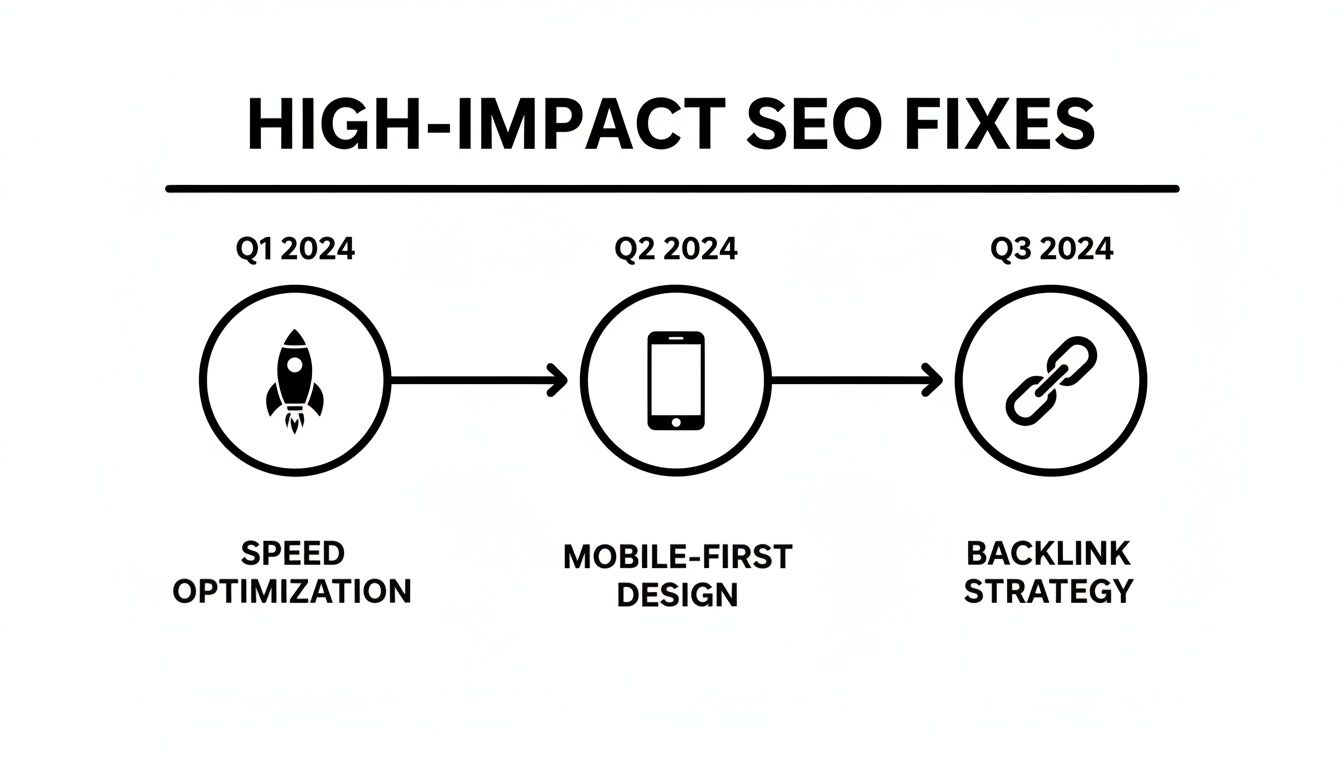
As you can see, getting your site's speed and mobile experience sorted are foundational steps. You need to nail these before you can really start tackling more complex authority-building activities like getting backlinks.
With a solid foundation in place, the next two months are all about showing Google (and your customers) that you're an expert in your field. This is where you start creating genuine assets that attract both potential clients and valuable backlinks from other sites.
Consistency is the engine of SEO. One helpful blog post and one new local citation each month is far more powerful than a flurry of activity followed by months of silence.
This plan gives you a clear path to get started. If you want to map out your goals in more detail, you might find a comprehensive digital marketing strategy template useful for planning further ahead.
If you're a small business owner diving into SEO, you've probably got questions. It's a common feeling. Let's tackle some of the most frequent ones I hear from clients, so you can move forward with a bit more clarity.
This is the big one, isn't it? The honest, no-fluff answer is: it depends. SEO is much more like planting a tree than flipping a switch – it's a long-term investment, not an overnight fix.
You can often see some positive movement in your local rankings within three to six months of consistent, focused effort. But seeing a real, significant impact on your bottom line—more phone calls, more bookings, more sales—that usually takes a bit longer. Things like how competitive your industry is, what your local rivals are doing, and the current state of your website all play a massive part. The key is to chase steady progress, not an instant jump to number one.
Absolutely. For a small business owner, getting your hands dirty with the fundamentals of SEO is not only possible but also incredibly valuable. This playbook is designed to give you the confidence to do just that, especially when it comes to local and on-page optimisations.
But it’s also smart to recognise your limits.
For the vast majority of Australian small businesses, the single most impactful place to start is your Google Business Profile (GBP). Think of it as your digital shopfront on Google Search and Maps. Getting this right is completely non-negotiable for local visibility.
Your GBP is priority number one. Before you get lost in complex strategies, make sure that profile is 100% complete, active with regular posts and photos, and consistently gathering new customer reviews. It's the foundation for all your other local SEO efforts.
Once your GBP is humming along, you can turn your attention to creating relevant local content and building genuine connections within your community.
Ready to stop guessing and start growing your business with a proven SEO strategy? The team at Virtual Ad Agency specialises in creating customised marketing plans that deliver real, measurable results. Let's build a plan that works for you.

 previous