
Trying to pin down a single price for advertising on Facebook is a bit like trying to catch smoke. It just doesn't work that way. While a good ballpark figure for the average cost-per-click is somewhere between AUD 1.15 and AUD 3.20, that’s really just the beginning of the story.
The final figure you’ll pay is a moving target, shifting based on your industry, who you’re trying to reach, and what you want them to do.
Think of it like a real-time auction. There’s no fixed price list because you’re not just buying a billboard; you’re bidding for the attention of specific groups of people against other advertisers who want their attention too. This constant competition is why the cost is always in flux.
This might sound complicated, but it's actually Facebook's biggest strength. It levels the playing field, allowing a local café to compete for eyeballs right alongside a major national brand. The trick is to understand the rules of the game so you can play it smart.
To make sense of your ad spend, you first need to get your head around the two main ways you pay for ads:
Knowing which one to use is half the battle. If you're chasing sales or sign-ups, CPC makes the most sense. If you just want to make a splash and be seen, CPM is a more cost-effective way to reach a huge audience.
Of course, these costs don't exist in a vacuum. It's always a good idea to see how they compare to other platforms. If you're curious, you can check out our deep dive into how much advertising on Google costs for a broader perspective.
The most important thing to remember is this: you are always in control of your budget. Facebook lets you set daily or lifetime spending caps, so you never accidentally blow your budget. Your mission is to make every single dollar work as hard as possible.
To give you a clearer picture of what to expect on home soil, we've put together a quick summary of the key cost metrics for Australian advertisers. Think of this table as your cheat sheet for budgeting.
| Metric | Average Cost Range (AUD) | What It Measures |
|---|---|---|
| Cost Per Click (CPC) | AUD 1.15 – AUD 3.20 | The price you pay for each individual click on your ad. |
| Cost Per 1,000 Impressions (CPM) | Around AUD 11.04 | The price you pay for every 1,000 times your ad is shown. |
| Cost Per Like (CPL) | Around AUD 0.70 | The cost to acquire a new 'Like' on your Facebook Page. |
| Cost Per App Install (CPA) | Around AUD 4.05 | The price you pay when a user installs your mobile app. |
These numbers, based on recent 2025 data, show that while the market is competitive, it's still very accessible. They provide a solid benchmark to help you plan your initial budgets and measure the performance of your campaigns as you get started.
To really get a grip on your Facebook ad costs, you need to peek behind the curtain and understand the engine that powers every single ad placement. A lot of people assume it's a simple case of the highest bidder winning the ad spot, but that’s not the whole story. The reality is far more interesting and, believe it or not, it actually works in your favour.
Think of it less like a traditional auction and more like a popularity contest judged by Facebook's algorithm. The goal isn't just to find the deepest pockets; it's to find the best possible ad for the user. This means a creative, high-quality ad can actually lock in a top spot for less money than a boring, irrelevant ad with a massive budget behind it.
To decide who wins each auction, Facebook's algorithm calculates the "total value" of your ad. This value isn't just about how much you're willing to pay. Instead, it’s a combo of three critical factors that all need to work together.
Your success really hinges on balancing these three elements:
This infographic breaks down the core pricing models that are directly influenced by how this ad auction plays out.
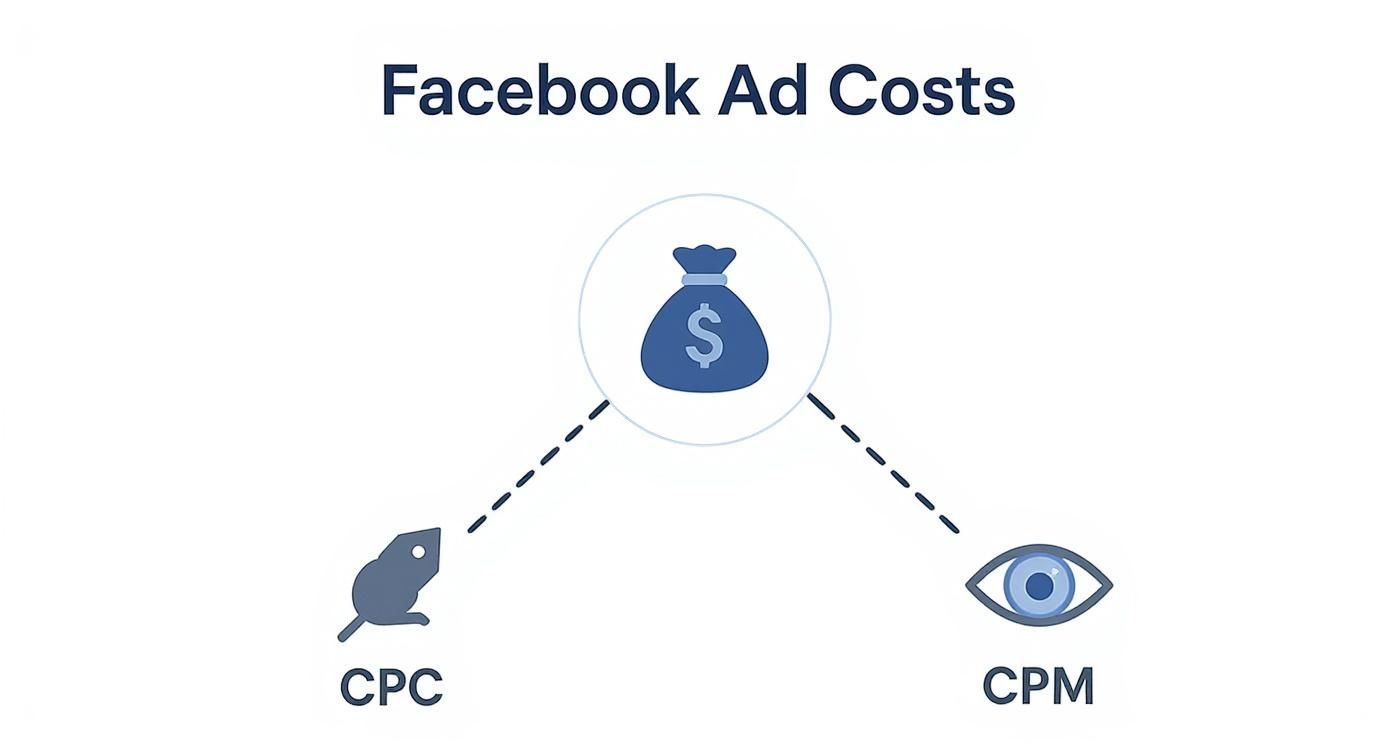
As you can see, your total cost comes down to performance metrics like clicks (CPC) and views (CPM), both of which are outcomes of the ad auction.
This is the single most important concept to wrap your head around. An advertiser with a high ad quality score and a strong estimated action rate can actually win an auction with a lower bid than a competitor with a dud ad.
Facebook's priority is the user experience. They would much rather show a relevant, well-received ad for less money than a spammy, expensive one that users will hate. A good user experience keeps people on the platform, which is good for everyone.
Let’s run a quick scenario. Imagine Advertiser A bids $2.00 for a click, but their ad is generic and uninspiring. Facebook’s algorithm predicts very few people will bother to interact with it.
Now, along comes Advertiser B, who only bids $1.50. But their ad is creative, super relevant to the audience, and has a great offer. The algorithm predicts a high engagement rate. In this case, Advertiser B's ad has a higher "total value" and will win the auction, all while paying less for better placement.
The whole system is designed to reward advertisers who create real value for users. When you focus on making genuinely good ads, you don't just improve your results—you also naturally lower your advertising on Facebook cost.
So, the Facebook ad auction explains how you win a spot, but that doesn't tell the whole story. It doesn't quite explain why your costs can swing so wildly from one campaign to the next. The final price you pay is really a complex cocktail of different variables. Each one is like a dial that can crank your ad spend up or down.
Getting your head around these factors is the key to forecasting your budget and, more importantly, optimising for better returns.
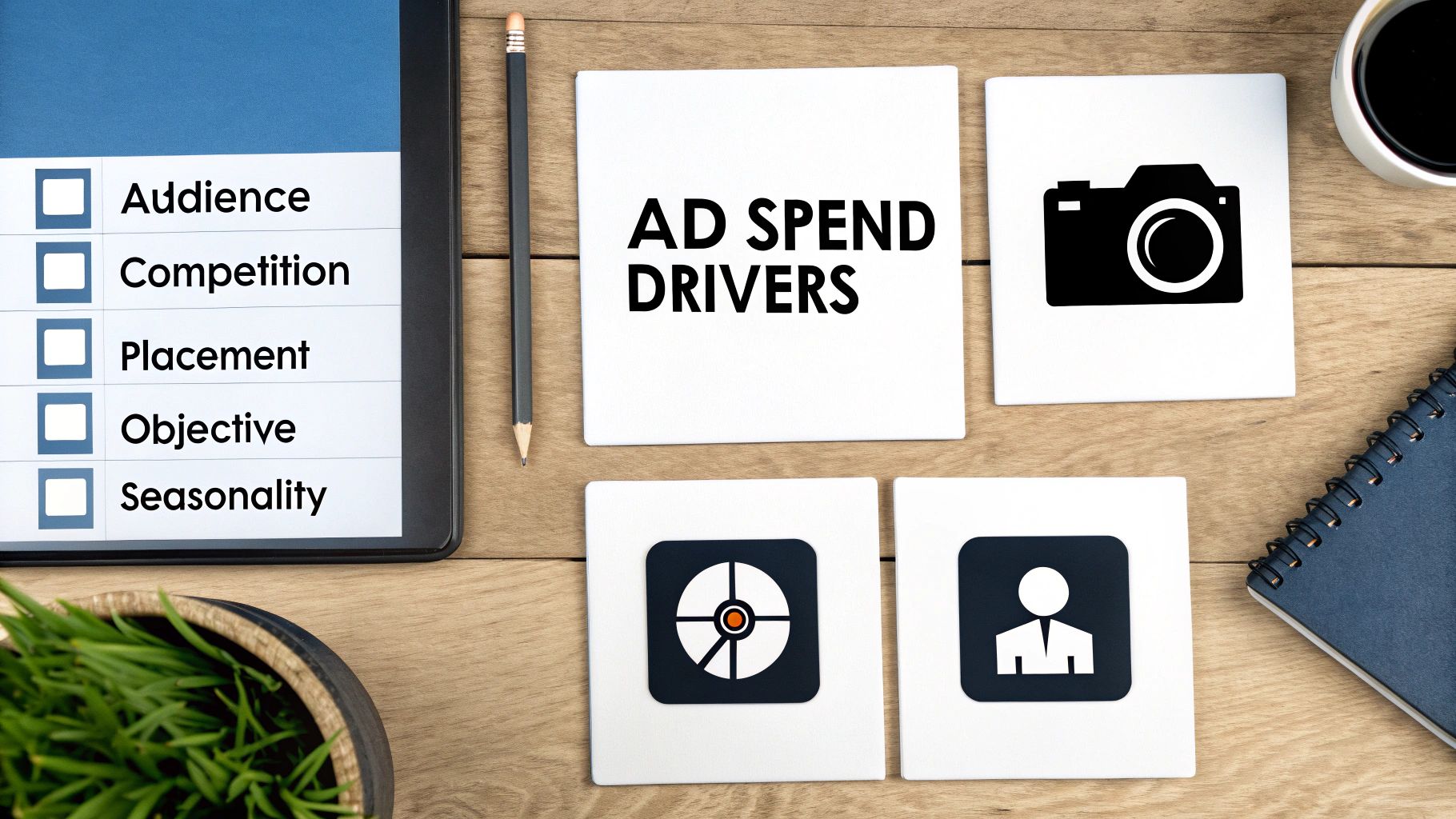
Think of it like booking a flight. The price for the exact same seat can vary massively depending on when you book, the time of year, and how many seats are left. Facebook advertising is much the same; certain choices and conditions will always cost you more than others. Let’s break down the six most influential dials that directly impact your advertising on Facebook cost.
Who you're trying to reach is probably the single biggest driver of your costs. It's a simple case of supply and demand. The more specific and valuable your audience, the more competition you’ll face from other advertisers all trying to get in front of the same people.
A really broad audience, like "women in Australia aged 25-45," is massive and therefore relatively cheap to reach on a per-person basis. But what if you dial that in to "women in Sydney aged 35-40 who are high-income earners and interested in luxury travel"? Now you're targeting a much smaller, highly sought-after group. You'll pay a premium for that kind of precision.
Real-World Example: A local bakery promoting a weekend special to everyone within a 5km radius will pay a lot less per click than a specialised law firm targeting high-net-worth individuals in a major city. The law firm’s audience is just more valuable and competitive, pushing the cost right up.
Let's be honest, some industries are just more cut-throat—and therefore more expensive—on Facebook. Sectors like finance, insurance, and legal services often have an incredibly high customer lifetime value. This means businesses in those fields are willing to pay a lot more to get a single lead through the door.
This inevitably creates a bidding war for the right audiences. Research consistently shows that industries like finance and insurance have some of the highest average Cost Per Click (CPC) rates, sometimes climbing over $3.70 per click. On the flip side, less competitive sectors like apparel or retail can enjoy much lower CPCs, sometimes as low as $0.45 per click, simply because the competition isn't as fierce.
Facebook isn't just Facebook anymore. It’s a whole ecosystem that includes Instagram, Messenger, and the Audience Network. Where your ad shows up within this network has a direct impact on its cost and how it performs.
Naturally, some spots are more desirable and effective than others.
Here’s a quick rundown of your main options:
For most advertisers just starting out, choosing automatic placements is a great move. It lets Facebook's algorithm do the heavy lifting and find the most cost-effective spots for you.
What do you actually want people to do when they see your ad? This is a huge one. The action you optimise for has a massive influence on your costs, because Facebook charges more for actions that are further down the sales funnel.
For instance, an "Awareness" campaign, where the goal is simply to get eyes on your ad (CPM), will be far cheaper than a "Conversions" campaign. With a conversion campaign, you're asking Facebook to find people who are not just likely to click, but also likely to buy something or fill out a form on your website. The algorithm has to work a lot harder to find those high-intent users, so you pay more for that valuable result.
Ad costs aren't set in stone throughout the year. They ebb and flow with supply and demand, which is heavily swayed by seasonal trends and big events. During peak shopping periods, competition goes through the roof.
You can pretty much always expect costs to rise during these key periods:
Planning your campaigns around these periods is vital. If your budget is tight, it might be smart to pull back during the most expensive weeks of the year and go hard when your competitors are quiet.
Finally, the quality and relevance of your ad itself plays a massive role. As we touched on with the ad auction, Facebook actively rewards advertisers who create a good user experience. This is measured through what used to be called a "relevance score," now broken down into quality diagnostics.
Ads with high engagement (likes, comments, shares) and low negative feedback (people hiding your ad) are seen as high-quality. Facebook's algorithm will prioritise these ads, often giving them better placement for a lower cost. In this system, compelling creative and sharp copywriting aren't just nice-to-haves—they are powerful cost-saving tools.
Ultimately, the cost per acquisition (CPA) for Facebook ads in Australia can land anywhere from AUD 20 to AUD 50, largely depending on these factors. Targeting "warm" audiences like website retargeting lists often leads to a lower CPA, while reaching "cold" audiences for the first time is typically more expensive. You can explore more benchmarks for Australian lead generation campaigns to see how these factors play out in practice.
Once you've got your head around the factors that influence your ad spend, the next piece of the puzzle is deciding how you’ll actually pay for your ads. This isn't just about the numbers; it's a strategic choice that will make or break your campaign's performance.
Think of it like picking the right tool for a job. You wouldn't use a hammer to turn a screw, and in the same way, picking the wrong bidding strategy will get you nowhere fast.
Facebook gives you a few ways to bid, but they all boil down to what you value most: eyeballs, clicks, or concrete actions. Get this wrong, and you could easily blow your budget on results you don't actually want. The secret is to line up your bidding strategy with what you're trying to achieve, making sure every dollar is pushing you closer to your goal.
Let's cut through the jargon. All those acronyms—CPC, CPM, CPA—are really just simple, strategic choices. Understanding the difference is the first step to managing your Facebook ad costs effectively.
CPC (Cost Per Click): Imagine you're paying a toll, but only when a car actually crosses the bridge to your destination. With CPC, you only pay when someone is interested enough to click your ad and land on your website. It’s a direct payment for genuine interest.
CPM (Cost Per 1,000 Impressions): This is like buying a billboard on a busy highway. You pay a flat rate every time 1,000 people have driven past and seen your ad, whether they visit your store or not. You're paying for visibility and getting your brand out there.
CPA (Cost Per Acquisition/Action): This is the ultimate performance-based model. It's like paying a salesperson a commission, but only after they've closed the deal. You only pay when someone completes a specific action you care about, like making a purchase or signing up for your newsletter.
Each of these models ties your spending to a different kind of result. Your job is to pick the one that most closely tracks what success looks like for your specific campaign.
The best bidding strategy is always the one that matches what you're trying to do. If you're launching a new product and just want everyone to know its name, paying for clicks (CPC) would be a waste of money. On the flip side, if you need to drive sales to keep the lights on, paying only for impressions (CPM) is a huge gamble.
Your campaign objective should be your North Star. Before you spend a single cent, be crystal clear on what a "win" looks like for your campaign. Is it brand recognition, website traffic, lead generation, or direct sales? Answering this question makes your bidding choice simple.
For example, a local café advertising a new coffee blend would get the most bang for its buck with a CPM strategy, targeting people in the neighbourhood to build awareness. But an e-commerce store running a flash sale needs sales, plain and simple. That makes a CPA strategy focused on purchases the obvious and most effective choice.
To make this even clearer, let's break down which pricing model works best for the most common advertising goals. This table will help you pick the most cost-effective option for whatever campaign you're running, which is key to controlling your advertising on Facebook cost.
| Pricing Model | Best For | When to Use It |
|---|---|---|
| CPM (Cost Per 1,000 Impressions) | Brand Awareness & Reach | Use this when your main goal is to get your brand, message, or product in front of as many relevant people as possible for the lowest cost. It’s perfect for new product launches or building general brand recognition. |
| CPC (Cost Per Click) | Driving Website Traffic & Engagement | Choose CPC when your objective is to get people to leave Facebook and visit your website, blog, or a specific landing page. It's ideal for content promotion and generating initial interest in your offers. |
| CPA (Cost Per Acquisition) | Generating Leads & Sales | This is the go-to model for performance-focused campaigns where a specific action, like a purchase or a form submission, is the end goal. You pay for results, making it highly efficient for maximising your return on investment. |
Choosing the right bidding strategy from the get-go ensures your budget is working as hard as possible to deliver the outcomes that actually matter to your business.
Alright, let's move from theory to action. Deciding on your first budget can feel like a massive step, but the good news is you don't need a huge war chest to get started. The real key is to be strategic, making sure every dollar you put in is a dollar spent learning.
There are really two proven ways to figure out a budget that makes sense for your business. One starts with the finish line in sight, while the other is all about dipping your toes in the water to gather data first.
This approach is perfect if you already have clear business goals and you know your numbers inside and out. It’s all about working backwards from what you want to achieve to figure out what you need to spend. Think of it like planning a road trip: you don't just start driving, you pick a destination first.
The logic is beautifully simple: you calculate the ad spend required to hit a specific sales or lead target.
For example, let's say your goal is to generate 20 new sales this month. You've crunched the numbers and know that your average Cost Per Acquisition (CPA) needs to hover around $25 to stay profitable.
The maths is pretty straightforward from there:
20 Sales (Your Goal) x $25 (Your Target CPA) = $500 (Total Ad Budget)
This method gives you a clear, justifiable budget that's directly tied to your revenue goals. It turns your ad spend from a vague expense into a predictable investment. To nail this, you absolutely need a solid grasp of your metrics. Understanding the customer acquisition cost formula is the perfect place to start.
So, what happens if you don't have past data or a target CPA to work with? That's where the data-gathering method comes into play. It’s tailor-made for anyone who's new to the game and needs to figure out their own cost benchmarks before committing a bigger chunk of cash.
The idea is to start small, learn fast, and then pour fuel on what's working.
With this approach, you set a modest daily budget just to test the waters with different ads, audiences, and offers. A starting point of $10-$20 per day is usually more than enough to get meaningful data without taking a big financial risk. The goal here isn’t to strike gold immediately; it’s to collect performance data.
After a week or two, you’ll have real-world numbers to look at. You'll see your actual CPC, CPM, and most importantly, your initial CPA. This information then becomes the bedrock for setting a larger, more confident budget using the goal-oriented method we just talked about.
Ready to put the data-gathering method into practice? Here’s a quick checklist to guide your first test run:
Getting your head around the mechanics of Facebook advertising is one thing, but actively driving your costs down is where you start to see a real return on your investment. The good news is, you have a surprising amount of control over what you spend.
With a few strategic adjustments, you can make your budget stretch a whole lot further and get better results for less. Think of it like tuning a high-performance engine. It might run okay on its own, but with the right tweaks and the right fuel, you can boost its efficiency and power in a big way.
These strategies are your tuning kit. Use them to systematically lower your advertising on Facebook cost while cranking up your campaign's overall performance.
Your ad's quality is probably the most powerful lever you can pull to lower costs. As we’ve seen, Facebook's ad auction literally rewards engaging content with better placement for less money. A killer image or video paired with persuasive copy isn't just a nice-to-have; it's a direct cost-saving tool.
High-quality creative stops the scroll. It grabs attention and gets people to interact. This tells Facebook your ad is providing a good experience, which can lead to a lower Cost Per Click (CPC) and a much healthier ad spend.
Never, ever assume you know what will work best. A/B testing (or split testing) is just running two slightly different versions of an ad to see which one performs better. It takes the guesswork out of the equation and lets your audience vote with their clicks.
You can test just about any element to find the winning combination.
By isolating and testing one thing at a time, you can make small, steady improvements that add up to massive cost savings over the life of a campaign.
Targeting the right people is absolutely fundamental to cost-effective advertising. Instead of just aiming at broad interests, you can use your own data to build incredibly effective audiences that are far more likely to convert, cutting out wasted ad spend.
The most valuable audiences are often the ones you already own. By leveraging your existing customer data, you can speak directly to people who have already shown interest in your brand, dramatically increasing your conversion rates and lowering your acquisition costs.
Here are the two heavy-hitters you should be using:
It’s a classic marketing truth: it's way cheaper to convert a warm lead than a cold one. Retargeting lets you show specific ads to people who've already interacted with your business, like someone who visited your website or ditched their shopping cart.
For a deeper dive, you can explore the power of remarketing with Facebook to reconnect with these high-intent users.
Because these people are already familiar with your brand, they are so much more likely to take action, which means a much lower Cost Per Acquisition (CPA) for you. Using smart social media marketing tactics for events to build buzz early on can also help by creating a more engaged initial audience to retarget later, bringing your costs down even further.
When you're getting to grips with Facebook ad spend, a few questions always seem to pop up. Getting straight-up answers helps you put a sensible budget together and know what to expect from your campaigns. Let's tackle some of the most common queries we hear from advertisers.
Technically, you can throw a few dollars a day at an ad and call it a campaign. But there’s a massive difference between the technical minimum and what you actually need to spend to get anywhere.
An ultra-low budget just starves the Facebook algorithm of the data and wiggle room it needs to find the right people for you. If you want to gather any meaningful information and start seeing results, most of us in the industry would say you need to start with at least $10-$20 per day for each campaign.
This is where a bit of patience comes in handy. Every single campaign you launch goes into what's called a "learning phase." This is just Facebook's algorithm figuring out who's responding to your ads and how to best deliver them. To get out of this phase, it generally needs about 50 conversions within a week.
While it’s learning, your results can be all over the place. You really need to give it at least 7-14 days before you start making any big calls on whether a campaign is a winner or a dud. Pulling the plug too early is like making a decision with only half the story.
It happens to everyone. A sudden jump in your costs is a classic sign that something needs a tweak. If you notice your cost per result starting to creep up, it's usually down to one of these usual suspects:
The fix? Keep an eye on your ad frequency and make sure you're regularly refreshing your creative to keep things interesting.
Ready to stop guessing and start getting real results from your advertising budget? The team at Virtual Ad Agency specialises in creating and managing high-performance campaigns that maximise your return on investment. Let's talk about growing your business.

 previous